Articles | Volume 11, issue 7
https://doi.org/10.5194/wes-11-2621-2026
© Author(s) 2026. This work is distributed under
the Creative Commons Attribution 4.0 License.
https://doi.org/10.5194/wes-11-2621-2026
© Author(s) 2026. This work is distributed under
the Creative Commons Attribution 4.0 License.
Wake-resolving acoustic tomography: advances through numerical covariance methods

Nicholas Hamilton
CORRESPONDING AUTHOR
National Renewable Energy Laboratory, Golden, CO 80401, USA
Shreyas Bidadi
National Renewable Energy Laboratory, Golden, CO 80401, USA
Related authors
Aliza Abraham, Nicola Bodini, Nicholas Hamilton, Brian Hirth, John Schroeder, and Patrick Moriarty
Wind Energ. Sci. Discuss., https://doi.org/10.5194/wes-2026-82, https://doi.org/10.5194/wes-2026-82, 2026
Preprint under review for WES
Short summary
Short summary
Thunderstorms can cause sudden changes in wind speed and direction called "wind ramps". While wind turbines are designed to withstand simplified versions of such wind ramps, this paper shows that real wind ramps are much more variable and complex than those prescribed in the design standard. This variability makes it difficult for wind farm operators to predict the conditions that each wind turbine will experience, adding uncertainty to the prediction of wind farm power.
Gopal R. Yalla, Kenneth Brown, Lawrence Cheung, Dan Houck, Nathaniel deVelder, and Nicholas Hamilton
Wind Energ. Sci., 10, 2449–2474, https://doi.org/10.5194/wes-10-2449-2025, https://doi.org/10.5194/wes-10-2449-2025, 2025
Short summary
Short summary
When wind reaches the first set of turbines in a wind farm, energy is extracted, reducing the energy available for downstream turbines. This study examines emerging technologies aimed at re-energizing the wind between turbines in a wind farm to improve overall power production. Optimizing these technologies depends on understanding the complex flow features of the atmosphere and the wakes behind turbines, which is accomplished using high-fidelity computer simulations and data analysis techniques.
William C. Radünz, Bruno Carmo, Julie K. Lundquist, Stefano Letizia, Aliza Abraham, Adam S. Wise, Miguel Sanchez Gomez, Nicholas Hamilton, Raj K. Rai, and Pedro S. Peixoto
Wind Energ. Sci., 10, 2365–2393, https://doi.org/10.5194/wes-10-2365-2025, https://doi.org/10.5194/wes-10-2365-2025, 2025
Short summary
Short summary
We explore how simple terrain influences spatial variations in wind speed and wind farm performance during a low-level jet. Using simulations, field observations, and turbine production data, we find that downstream turbines produce more power than upstream ones, despite being subjected to wake effects. This counterintuitive result arises because the low-level jet and winds near turbine rotors are highly sensitive to topographic features, leading to stronger winds at the downstream turbines.
Pietro Bortolotti, Lee Jay Fingersh, Nicholas Hamilton, Arlinda Huskey, Chris Ivanov, Mark Iverson, Jonathan Keller, Scott Lambert, Jason Roadman, Derek Slaughter, Syhoune Thao, and Consuelo Wells
Wind Energ. Sci., 10, 2025–2050, https://doi.org/10.5194/wes-10-2025-2025, https://doi.org/10.5194/wes-10-2025-2025, 2025
Short summary
Short summary
This study compares a wind turbine with blades behind the tower (downwind) to the traditional upwind design. Testing a 1.5 MW turbine at the National Renewable Energy Laboratory's Flatirons Campus, we measured performance, loads, and noise. Numerical models matched well with observations. The downwind setup showed higher fatigue loads and sound variations but also an unexpected power improvement. Downwind rotors might be a valid alternative for future floating offshore wind applications.
Aliza Abraham, Matteo Puccioni, Arianna Jordan, Emina Maric, Nicola Bodini, Nicholas Hamilton, Stefano Letizia, Petra M. Klein, Elizabeth N. Smith, Sonia Wharton, Jonathan Gero, Jamey D. Jacob, Raghavendra Krishnamurthy, Rob K. Newsom, Mikhail Pekour, William Radünz, and Patrick Moriarty
Wind Energ. Sci., 10, 1681–1705, https://doi.org/10.5194/wes-10-1681-2025, https://doi.org/10.5194/wes-10-1681-2025, 2025
Short summary
Short summary
This study is the first to use real-world atmospheric measurements to show that large wind plants can increase the height of the planetary boundary layer, the part of the atmosphere near the surface where life takes place. The planetary boundary layer height governs processes like pollutant transport and cloud formation and is a key parameter for modeling the atmosphere. The results of this study provide important insights into interactions between wind plants and their local environment.
Raghavendra Krishnamurthy, Rob K. Newsom, Colleen M. Kaul, Stefano Letizia, Mikhail Pekour, Nicholas Hamilton, Duli Chand, Donna Flynn, Nicola Bodini, and Patrick Moriarty
Wind Energ. Sci., 10, 361–380, https://doi.org/10.5194/wes-10-361-2025, https://doi.org/10.5194/wes-10-361-2025, 2025
Short summary
Short summary
This study examines how atmospheric phenomena affect the recovery of wind farm wake – the disturbed air behind turbines. In regions like Oklahoma, where wind farms are often clustered, understanding wake recovery is crucial. We found that wind farms can alter phenomena like low-level jets, which are common in Oklahoma, by deflecting them above the wind farm. As a result, the impact of wakes can be observed up to 1–2 km above ground level.
Kenneth Brown, Pietro Bortolotti, Emmanuel Branlard, Mayank Chetan, Scott Dana, Nathaniel deVelder, Paula Doubrawa, Nicholas Hamilton, Hristo Ivanov, Jason Jonkman, Christopher Kelley, and Daniel Zalkind
Wind Energ. Sci., 9, 1791–1810, https://doi.org/10.5194/wes-9-1791-2024, https://doi.org/10.5194/wes-9-1791-2024, 2024
Short summary
Short summary
This paper presents a study of the popular wind turbine design tool OpenFAST. We compare simulation results to measurements obtained from a 2.8 MW land-based wind turbine. Measured wind conditions were used to generate turbulent flow fields through several techniques. We show that successful validation of the tool is not strongly dependent on the inflow generation technique used for mean quantities of interest. The type of inflow assimilation method has a larger effect on fatigue quantities.
Paul Hulsman, Luis A. Martínez-Tossas, Nicholas Hamilton, and Martin Kühn
Wind Energ. Sci. Discuss., https://doi.org/10.5194/wes-2023-112, https://doi.org/10.5194/wes-2023-112, 2023
Manuscript not accepted for further review
Short summary
Short summary
This paper presents an approach to analytically estimate the wake deficit within the near-wake region by modifying the curled wake model. This is done by incorporating a new initial condition at the rotor using an azimuth-dependent Gaussian profile, an adjusted turbulence model in the near-wake region and the far-wake region and an iterative process to determine the velocity field, while considering the relation of the pressure gradient and accounting the conservation of mass.
Ryan Scott, Luis Martínez-Tossas, Juliaan Bossuyt, Nicholas Hamilton, and Raúl B. Cal
Wind Energ. Sci., 8, 449–463, https://doi.org/10.5194/wes-8-449-2023, https://doi.org/10.5194/wes-8-449-2023, 2023
Short summary
Short summary
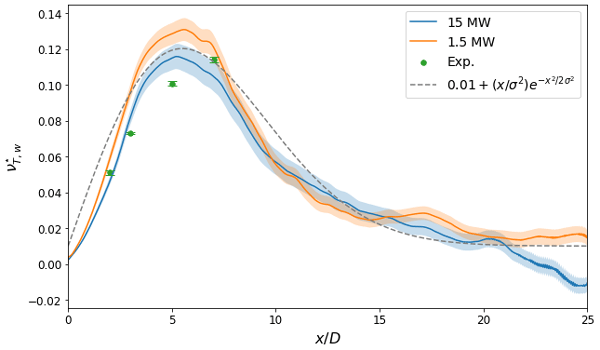
In this work we examine the relationship between wind speed and turbulent stresses within a wind turbine wake. This relationship changes further from the turbine as the driving physical phenomena vary throughout the wake. We propose a model for this process and test the effectiveness of our model against existing formulations. Our approach increases the accuracy of wind speed predictions, which will lead to better estimates of wind plant performance and promote more efficient wind plant design.
Aliza Abraham, Nicola Bodini, Nicholas Hamilton, Brian Hirth, John Schroeder, and Patrick Moriarty
Wind Energ. Sci. Discuss., https://doi.org/10.5194/wes-2026-82, https://doi.org/10.5194/wes-2026-82, 2026
Preprint under review for WES
Short summary
Short summary
Thunderstorms can cause sudden changes in wind speed and direction called "wind ramps". While wind turbines are designed to withstand simplified versions of such wind ramps, this paper shows that real wind ramps are much more variable and complex than those prescribed in the design standard. This variability makes it difficult for wind farm operators to predict the conditions that each wind turbine will experience, adding uncertainty to the prediction of wind farm power.
Gopal R. Yalla, Kenneth Brown, Lawrence Cheung, Dan Houck, Nathaniel deVelder, and Nicholas Hamilton
Wind Energ. Sci., 10, 2449–2474, https://doi.org/10.5194/wes-10-2449-2025, https://doi.org/10.5194/wes-10-2449-2025, 2025
Short summary
Short summary
When wind reaches the first set of turbines in a wind farm, energy is extracted, reducing the energy available for downstream turbines. This study examines emerging technologies aimed at re-energizing the wind between turbines in a wind farm to improve overall power production. Optimizing these technologies depends on understanding the complex flow features of the atmosphere and the wakes behind turbines, which is accomplished using high-fidelity computer simulations and data analysis techniques.
William C. Radünz, Bruno Carmo, Julie K. Lundquist, Stefano Letizia, Aliza Abraham, Adam S. Wise, Miguel Sanchez Gomez, Nicholas Hamilton, Raj K. Rai, and Pedro S. Peixoto
Wind Energ. Sci., 10, 2365–2393, https://doi.org/10.5194/wes-10-2365-2025, https://doi.org/10.5194/wes-10-2365-2025, 2025
Short summary
Short summary
We explore how simple terrain influences spatial variations in wind speed and wind farm performance during a low-level jet. Using simulations, field observations, and turbine production data, we find that downstream turbines produce more power than upstream ones, despite being subjected to wake effects. This counterintuitive result arises because the low-level jet and winds near turbine rotors are highly sensitive to topographic features, leading to stronger winds at the downstream turbines.
Pietro Bortolotti, Lee Jay Fingersh, Nicholas Hamilton, Arlinda Huskey, Chris Ivanov, Mark Iverson, Jonathan Keller, Scott Lambert, Jason Roadman, Derek Slaughter, Syhoune Thao, and Consuelo Wells
Wind Energ. Sci., 10, 2025–2050, https://doi.org/10.5194/wes-10-2025-2025, https://doi.org/10.5194/wes-10-2025-2025, 2025
Short summary
Short summary
This study compares a wind turbine with blades behind the tower (downwind) to the traditional upwind design. Testing a 1.5 MW turbine at the National Renewable Energy Laboratory's Flatirons Campus, we measured performance, loads, and noise. Numerical models matched well with observations. The downwind setup showed higher fatigue loads and sound variations but also an unexpected power improvement. Downwind rotors might be a valid alternative for future floating offshore wind applications.
Aliza Abraham, Matteo Puccioni, Arianna Jordan, Emina Maric, Nicola Bodini, Nicholas Hamilton, Stefano Letizia, Petra M. Klein, Elizabeth N. Smith, Sonia Wharton, Jonathan Gero, Jamey D. Jacob, Raghavendra Krishnamurthy, Rob K. Newsom, Mikhail Pekour, William Radünz, and Patrick Moriarty
Wind Energ. Sci., 10, 1681–1705, https://doi.org/10.5194/wes-10-1681-2025, https://doi.org/10.5194/wes-10-1681-2025, 2025
Short summary
Short summary
This study is the first to use real-world atmospheric measurements to show that large wind plants can increase the height of the planetary boundary layer, the part of the atmosphere near the surface where life takes place. The planetary boundary layer height governs processes like pollutant transport and cloud formation and is a key parameter for modeling the atmosphere. The results of this study provide important insights into interactions between wind plants and their local environment.
Raghavendra Krishnamurthy, Rob K. Newsom, Colleen M. Kaul, Stefano Letizia, Mikhail Pekour, Nicholas Hamilton, Duli Chand, Donna Flynn, Nicola Bodini, and Patrick Moriarty
Wind Energ. Sci., 10, 361–380, https://doi.org/10.5194/wes-10-361-2025, https://doi.org/10.5194/wes-10-361-2025, 2025
Short summary
Short summary
This study examines how atmospheric phenomena affect the recovery of wind farm wake – the disturbed air behind turbines. In regions like Oklahoma, where wind farms are often clustered, understanding wake recovery is crucial. We found that wind farms can alter phenomena like low-level jets, which are common in Oklahoma, by deflecting them above the wind farm. As a result, the impact of wakes can be observed up to 1–2 km above ground level.
Kenneth Brown, Pietro Bortolotti, Emmanuel Branlard, Mayank Chetan, Scott Dana, Nathaniel deVelder, Paula Doubrawa, Nicholas Hamilton, Hristo Ivanov, Jason Jonkman, Christopher Kelley, and Daniel Zalkind
Wind Energ. Sci., 9, 1791–1810, https://doi.org/10.5194/wes-9-1791-2024, https://doi.org/10.5194/wes-9-1791-2024, 2024
Short summary
Short summary
This paper presents a study of the popular wind turbine design tool OpenFAST. We compare simulation results to measurements obtained from a 2.8 MW land-based wind turbine. Measured wind conditions were used to generate turbulent flow fields through several techniques. We show that successful validation of the tool is not strongly dependent on the inflow generation technique used for mean quantities of interest. The type of inflow assimilation method has a larger effect on fatigue quantities.
Paul Hulsman, Luis A. Martínez-Tossas, Nicholas Hamilton, and Martin Kühn
Wind Energ. Sci. Discuss., https://doi.org/10.5194/wes-2023-112, https://doi.org/10.5194/wes-2023-112, 2023
Manuscript not accepted for further review
Short summary
Short summary
This paper presents an approach to analytically estimate the wake deficit within the near-wake region by modifying the curled wake model. This is done by incorporating a new initial condition at the rotor using an azimuth-dependent Gaussian profile, an adjusted turbulence model in the near-wake region and the far-wake region and an iterative process to determine the velocity field, while considering the relation of the pressure gradient and accounting the conservation of mass.
Ryan Scott, Luis Martínez-Tossas, Juliaan Bossuyt, Nicholas Hamilton, and Raúl B. Cal
Wind Energ. Sci., 8, 449–463, https://doi.org/10.5194/wes-8-449-2023, https://doi.org/10.5194/wes-8-449-2023, 2023
Short summary
Short summary
In this work we examine the relationship between wind speed and turbulent stresses within a wind turbine wake. This relationship changes further from the turbine as the driving physical phenomena vary throughout the wake. We propose a model for this process and test the effectiveness of our model against existing formulations. Our approach increases the accuracy of wind speed predictions, which will lead to better estimates of wind plant performance and promote more efficient wind plant design.
Cited articles
Ali, N., Hamilton, N., Cortina, G., Calaf, M., and Cal, R. B.: Anisotropy stress invariants of thermally stratified wind turbine array boundary layers using large eddy simulations, J. Renew. Sustain. Energ., 10, https://doi.org/10.1063/1.5016977, 2018. a
Bodini, N., Zardi, D., and Lundquist, J. K.: Three-dimensional structure of wind turbine wakes as measured by scanning lidar, Atmos. Meas. Tech., 10, 2881–2896, https://doi.org/10.5194/amt-10-2881-2017, 2017. a
Brugger, P., Markfort, C., and Porté-Agel, F.: Field measurements of wake meandering at a utility-scale wind turbine with nacelle-mounted Doppler lidars, Wind Energ. Sci., 7, 185–199, https://doi.org/10.5194/wes-7-185-2022, 2022. a
Chamorro, L. P. and Porté-Agel, F.: Effects of thermal stability and incoming boundary-layer flow characteristics on wind-turbine wakes: a wind-tunnel study, Bound.-Lay. Meteorol., 136, 515–533, https://doi.org/10.1007/s10546-010-9512-1, 2010. a, b
Churchfield, M. J., Lee, S., Michalakes, J., and Moriarty, P. J.: A numerical study of the effects of atmospheric and wake turbulence on wind turbine dynamics, J. Turbul., 13, 1–32, https://doi.org/10.1080/14685248.2012.668191, 2012. a
ExaWind Development Team: AMR-Wind: AMReX-based structured grid fluid solver, GitHub [code], https://github.com/Exawind/amr-wind, last access: 23 April 2025. a
Hamilton, N.: NatLabRockies/ATom: Pinned Release as of 2026-07-20 (Version 20260720), Zenodo [code], https://doi.org/10.5281/zenodo.21460804, 2026. a
Hamilton, N. and Cal, R. B.: Anisotropy of the Reynolds stress tensor in the wakes of wind turbine arrays in Cartesian arrangements with counter-rotating rotors, Phys. Fluid., 27, https://doi.org/10.1063/1.4903968, 2015. a
Hamilton, N., Doubrawa, P., Letizia, S., Thedin, R., and Moriarty, P.: Modal Dynamics of Wind Turbine Wake Meandering from Lidar Observations, Renew. Energ., 254, https://doi.org/10.1016/j.renene.2025.123555, 2025. a
Kolouri, S., Azimi-Sadjadi, M. R., and Ziemann, A.: Acoustic tomography of the atmosphere using unscented Kalman filter, IEEE Trans. Geosci. Remote Sens., 52, 2159–2171, https://doi.org/10.1109/TGRS.2013.2258401, 2013. a
Kuhn, M. B., Henry de Frahan, M. T., Mohan, P., Deskos, G., Churchfield, M., Cheung, L., Sharma, A., Almgren, A., Ananthan, S., Brazell, M. J., Martínez-Tossas, L. A., Thedin, R., Rood, J., Sakievich, P., Vijayakumar, G., Zhang, W., and Sprague, M.: AMR-Wind: A Performance-Portable, High-Fidelity Flow Solver for Wind Farm Simulations, Wind Energ., 28, e70010, https://doi.org/10.1002/we.70010, 2025. a, b
Lignarolo, L. E., Ragni, D., Ferreira, C. S., and Van Bussel, G. J.: Experimental analysis of the wake of a horizontal-axis wind-turbine model, Renew. Energ., 70, 31–46, https://doi.org/10.1016/j.renene.2014.01.020, 2015. a, b
Mudafort, R. M., paulf81, Bay, C., misi9170, Hammond, R., et al.: NREL/floris: v4.6, Zenodo [code], https://doi.org/10.5281/zenodo.18039100, 2025. a
Moeng, C.-H.: A Large-Eddy-Simulation Model for the Study of Planetary Boundary-Layer Turbulence, J. Atmos. Sci., 41, 2052–2062, https://doi.org/10.1175/1520-0469(1984)041<2052:ALESMF>2.0.CO;2, 1984. a, b
National Renewable Energy Laboratory: ATom:Acoustic travel-time tomography, https://github.com/nrel/atom (last access: 24 April 2025), 2025. a
Ostashev, V., Vecherin, S., Wilson, D., Ziemann, A., and Goedecke, G.: Recent progress in acoustic tomography of the atmosphere, in: IOP Conference Series: Earth and Environmental Science, 1, 012008, https://doi.org/10.1088/1755-1307/1/1/012008, 2008. a
Petersen, S. M.: Wind turbine test—Vestas V27-225 kW, Tech. Rep. Risø-M-2861, Risø National Laboratory, 1990. a
Placidi, M., Hancock, P. E., and Hayden, P.: Wind turbine wakes: experimental investigation of two-point correlations and the effect of stable thermal stability, J. Fluid Mech., 970, 1–28, https://doi.org/10.1017/jfm.2023.631, 2023. a, b
Rogers, K. J. and Finn, A.: Methodology Improvements for Three-Dimensional UAV-Based Travel-Time Acoustic Atmospheric Tomography, J. Atmos. Ocean. Technol., 38, 2147–2163, https://doi.org/10.1175/JTECH-D-21-0057.1, 2021. a
Sadek, Z., Scott, R., Hamilton, N., and Cal, R. B.: A Three-Dimensional, Analytical Wind Turbine Wake Model: Flow Acceleration, Empirical Correlations, and Continuity, Renew. Energ., 209, 298–309, https://doi.org/10.1016/j.renene.2023.03.129, 2023. a
Scott, R., Martínez-Tossas, L., Bossuyt, J., Hamilton, N., and Cal, R. B.: Evolution of Eddy Viscosity in the Wake of a Wind Turbine, Wind Energ. Sci., 8, 449–463, https://doi.org/10.5194/wes-8-449-2023, 2023. a
Sharma, A., Brazell, M. J., Vijayakumar, G., Ananthan, S., Cheung, L., deVelder, N., Frahan, M. T. H., Matula, N., Mullowney, P., Rood, J., Sakievich, P., and Sprague, M. A.: ExaWind: Open-source CFD for hybrid-RANS/LES geometry-resolved wind turbine simulations in atmospheric flows, Wind Energ., 27, 225–2257, https://doi.org/10.1002/we.2886, 2024. a
Sprague, M. A., Ananthan, S., Vijayakumar, G., and Robinson, M.: ExaWind: A multifidelity modeling and simulation environment for wind energy, J. Phys. Conf. Ser., 1452, 012071, https://doi.org/10.1088/1742-6596/1452/1/012071, 2020. a
Sørensen, J. N., Nilsson, K., Ivanell, S., Asmuth, H., and Mikkelsen, R. F.: Analytical body forces in numerical actuator disc model of wind turbines, Renew. Energ., 147, 2259–2271, https://doi.org/10.1016/j.renene.2019.09.134, 2020. a
Taylor, G. I.: The spectrum of turbulence, Proc. Roy. Soc. Lond. Ser. A, 164, 476–490, https://doi.org/10.1098/rspa.1938.0032, 1938. a
Thedin, R., Quon, E., Churchfield, M., and Veers, P.: Investigations of correlation and coherence in turbulence from a large-eddy simulation, Wind Energ. Sci., 8, 487–502, https://doi.org/10.5194/wes-8-487-2023, 2023. a
Wilson, D. K., Ostashev, V. E., Voronovich, A. G., Collier, S. L., Symons, N. P., and Aldridge, D. F.: The role of statistical models in the statistical inversion method of tomographic retrieval of atmospheric variables, J. Acoust. Soc. Am., 123, 3720–3720, 2008. a
Wilson, D. K., Pettit, C. L., and Ostashev, V. E.: Sound propagation in the atmospheric boundary layer, Acoust. Soc. Am., 11, 44–53, 2015. a
Wyngaard, J. C., Coté, O. R., and Izumi, Y.: Local free convection, similarity, and the budgets of shear stress and heat flux, J. Atmos. Sci., 28, 1171–1182, https://doi.org/10.1175/1520-0469(1971)028<1171:LFCSAT>2.0.CO;2, 1971. a
Zhang, W., Myers, A., Gott, K., Almgren, A., and Bell, J.: AMReX: Block-structured adaptive mesh refinement for multiphysics applications, Int. J. High Perf. C., 35, 508–526, https://doi.org/10.1177/10943420211022811, 2021. a
Short summary
This study explores improvements to an atmospheric measurement method called acoustic tomography, which uses sound travel times to estimate wind and temperature. We compare several ways of estimating how air conditions vary and show that models based on realistic wind turbine simulations yield more accurate results than traditional simplified methods. These findings support better observations of complex air flows around wind turbines, helping advance renewable energy research.
This study explores improvements to an atmospheric measurement method called acoustic...
Altmetrics
Final-revised paper
Preprint