
Articles | Volume 11, issue 9
https://doi.org/10.5194/wes-11-3337-2026
© Author(s) 2026. This work is distributed under
the Creative Commons Attribution 4.0 License.
the Creative Commons Attribution 4.0 License.
https://doi.org/10.5194/wes-11-3337-2026
© Author(s) 2026. This work is distributed under
the Creative Commons Attribution 4.0 License.
the Creative Commons Attribution 4.0 License.
Research article
| 
07 Sep 2026
Research article |
| 07 Sep 2026
| 07 Sep 2026
Detailed experimental investigation of the aerodynamics and blade/tower interaction of a 1.5 MW wind turbine in a downwind configuration

Technical University of Denmark, Department of Wind and Energy Systems, 4000 Roskilde, Denmark
Pietro Bortolotti
National Laboratory of the Rockies, 15013 Denver West Parkway, Golden, CO 80401, USA
Thanasis Barlas
Technical University of Denmark, Department of Wind and Energy Systems, 4000 Roskilde, Denmark
Pourya Nikoueeyan
Resono Pressure Systems, 1938 Harney St, Laramie, WY 82072, USA
Christopher Kelley
Sandia National Laboratories, P.O. Box 5800, Albuquerque, NM, 87185, USA
Claus Brian Munk Pedersen
Technical University of Denmark, Department of Wind and Energy Systems, 4000 Roskilde, Denmark
Per Hansen
Technical University of Denmark, Department of Wind and Energy Systems, 4000 Roskilde, Denmark
Andreas Fischer
Technical University of Denmark, Department of Wind and Energy Systems, 4000 Roskilde, Denmark
Chris Ivanov
National Laboratory of the Rockies, 15013 Denver West Parkway, Golden, CO 80401, USA
Jason Roadman
National Laboratory of the Rockies, 15013 Denver West Parkway, Golden, CO 80401, USA
Jonathan Naughton
Resono Pressure Systems, 1938 Harney St, Laramie, WY 82072, USA
University of Wyoming, 1000 E. University Ave., Laramie, WY 82071, USA
Kenneth Brown
Sandia National Laboratories, P.O. Box 5800, Albuquerque, NM, 87185, USA
Mark Iverson
National Laboratory of the Rockies, 15013 Denver West Parkway, Golden, CO 80401, USA
Simon Thao
National Laboratory of the Rockies, 15013 Denver West Parkway, Golden, CO 80401, USA
Related authors
Øyvind Waage Hanssen-Bauer, Paula Doubrawa, Helge A. Madsen, Henrik Asmuth, Jason Jonkman, Gunner C. Larsen, Stefan Ivanell, and Roy Stenbro
Wind Energ. Sci., 11, 1913–1948, https://doi.org/10.5194/wes-11-1913-2026, https://doi.org/10.5194/wes-11-1913-2026, 2026
Short summary
Short summary
We studied how different industry-oriented computer models predict the behavior of winds behind turbines in a wind farm. These
wakesreduce energy output and can affect turbines further down the row. By comparing these three models with more detailed simulations, we found they agree well on overall power but differ in how they capture turbulence and wear on machines. Our results show where the models need improvement to make wind farm computer models more accurate and reliable in the future.
Helge Aagaard Madsen, Alejandro Gomez Gonzalez, Thanasis Barlas, Anders Smærup Olsen, Sigurd Brabæk Ildvedsen, and Andreas Fischer
Wind Energ. Sci., 10, 2499–2513, https://doi.org/10.5194/wes-10-2499-2025, https://doi.org/10.5194/wes-10-2499-2025, 2025
Short summary
Short summary
In this article, we present the measurements of local aerodynamic sectional characteristics on a full-scale rotor blade with a novel add-on instrumentation comprising a wake rake, a pressure belt, and a five-hole Pitot tube. In general, the demonstration of this instrumentation opens a range of promising new options for optimizing airfoil sectional performance in its real operating environment, e.g., the size and position of vortex generators.
Andrea Gamberini, Thanasis Barlas, Alejandro Gomez Gonzalez, and Helge Aagaard Madsen
Wind Energ. Sci., 9, 1229–1249, https://doi.org/10.5194/wes-9-1229-2024, https://doi.org/10.5194/wes-9-1229-2024, 2024
Short summary
Short summary
Movable surfaces on wind turbine (WT) blades, called active flaps, can reduce the cost of wind energy. However, they still need extensive testing. This study shows that the computer model used to design a WT with flaps aligns well with measurements obtained from a 3month test on a commercial WT featuring a prototype flap. Particularly during flap actuation, there were minimal differences between simulated and measured data. These findings assure the reliability of WT designs incorporating flaps.
Helge Aagaard Madsen
Wind Energ. Sci., 8, 1853–1872, https://doi.org/10.5194/wes-8-1853-2023, https://doi.org/10.5194/wes-8-1853-2023, 2023
Short summary
Short summary
We present a linear analytical solution for a two-dimensional (2-D) actuator disc (AD) for a plane disc, a yawed disc and a coned disc. Comparisons of the 2-D model with three-dimensional computational fluid dynamics (CFD) AD simulations for a circular yawed disc and with an axis-symmetric CFD simulation of a coned disc show good correlation for the normal velocity component of the disc. This indicates that the 2-D AD model could form the basis for a consistent, simple new rotor induction model.
Paul Veers, Carlo L. Bottasso, Lance Manuel, Jonathan Naughton, Lucy Pao, Joshua Paquette, Amy Robertson, Michael Robinson, Shreyas Ananthan, Thanasis Barlas, Alessandro Bianchini, Henrik Bredmose, Sergio González Horcas, Jonathan Keller, Helge Aagaard Madsen, James Manwell, Patrick Moriarty, Stephen Nolet, and Jennifer Rinker
Wind Energ. Sci., 8, 1071–1131, https://doi.org/10.5194/wes-8-1071-2023, https://doi.org/10.5194/wes-8-1071-2023, 2023
Short summary
Short summary
Critical unknowns in the design, manufacturing, and operation of future wind turbine and wind plant systems are articulated, and key research activities are recommended.
Brandon Arthur Lobo, Özge Sinem Özçakmak, Helge Aagaard Madsen, Alois Peter Schaffarczyk, Michael Breuer, and Niels N. Sørensen
Wind Energ. Sci., 8, 303–326, https://doi.org/10.5194/wes-8-303-2023, https://doi.org/10.5194/wes-8-303-2023, 2023
Short summary
Short summary
Results from the DAN-AERO and aerodynamic glove projects provide significant findings. The effects of inflow turbulence on transition and wind turbine blades are compared to computational fluid dynamic simulations. It is found that the transition scenario changes even over a single revolution. The importance of a suitable choice of amplification factor is evident from the simulations. An agreement between the power spectral density plots from the experiment and large-eddy simulations is seen.
Koen Boorsma, Gerard Schepers, Helge Aagard Madsen, Georg Pirrung, Niels Sørensen, Galih Bangga, Manfred Imiela, Christian Grinderslev, Alexander Meyer Forsting, Wen Zhong Shen, Alessandro Croce, Stefano Cacciola, Alois Peter Schaffarczyk, Brandon Lobo, Frederic Blondel, Philippe Gilbert, Ronan Boisard, Leo Höning, Luca Greco, Claudio Testa, Emmanuel Branlard, Jason Jonkman, and Ganesh Vijayakumar
Wind Energ. Sci., 8, 211–230, https://doi.org/10.5194/wes-8-211-2023, https://doi.org/10.5194/wes-8-211-2023, 2023
Short summary
Short summary
Within the framework of the fourth phase of the International Energy Agency's (IEA) Wind Task 29, a large comparison exercise between measurements and aeroelastic simulations has been carried out. Results were obtained from more than 19 simulation tools of various fidelity, originating from 12 institutes and compared to state-of-the-art field measurements. The result is a unique insight into the current status and accuracy of rotor aerodynamic modeling.
Thanasis Barlas, Georg Raimund Pirrung, Néstor Ramos-García, Sergio González Horcas, Ang Li, and Helge Aagaard Madsen
Wind Energ. Sci., 7, 1957–1973, https://doi.org/10.5194/wes-7-1957-2022, https://doi.org/10.5194/wes-7-1957-2022, 2022
Short summary
Short summary
An aeroelastically optimized curved wind turbine blade tip is designed, manufactured, and tested on a novel outdoor rotating rig facility at the Risø campus of the Technical University of Denmark. Detailed aerodynamic measurements for various atmospheric conditions and results are compared to a series of in-house aeroelastic tools with a range of fidelities in aerodynamic modeling. The comparison highlights details in the ability of the codes to predict the performance of such a curved tip.
Ang Li, Georg Raimund Pirrung, Mac Gaunaa, Helge Aagaard Madsen, and Sergio González Horcas
Wind Energ. Sci., 7, 129–160, https://doi.org/10.5194/wes-7-129-2022, https://doi.org/10.5194/wes-7-129-2022, 2022
Short summary
Short summary
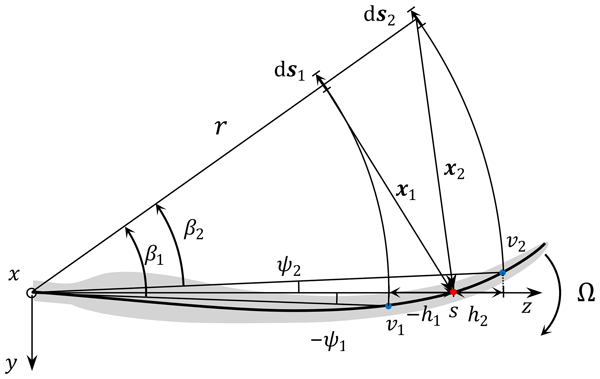
An engineering aerodynamic model for the swept horizontal-axis wind turbine blades is proposed. It uses a combination of analytical results and engineering approximations. The performance of the model is comparable with heavier high-fidelity models but has similarly low computational cost as currently used low-fidelity models. The model could be used for an efficient and accurate load calculation of swept wind turbine blades and could eventually be integrated in a design optimization framework.
Lawrence Cheung, Prakash Mohan, Marc T. Henry de Frahan, Gopal R. Yalla, Alan Hsieh, Kenneth Brown, Nathaniel deVelder, Sam Kaufman-Martin, Marc Day, and Michael Sprague
Wind Energ. Sci., 11, 3719–3743, https://doi.org/10.5194/wes-11-3719-2026, https://doi.org/10.5194/wes-11-3719-2026, 2026
Short summary
Short summary
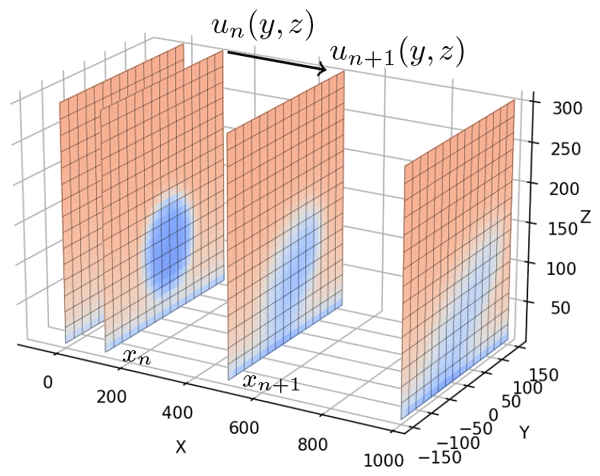
Modeling turbine wakes is critical to maximizing wind farm energy production but is also challenging due to the complicated phenomena that must be accounted for, including wind shear, veer, atmospheric stratification, and overlapping wakes. Our work introduces a new, efficient method of modeling wakes which naturally captures these complex wake behaviors. We show that our wake modeling approach is as accurate as higher-fidelity methods, but with much less computational cost.
Nicola Bodini, Patrick Moriarty, Regis Thedin, Paula Doubrawa, Cristina Archer, Myra Blaylock, Carlo Bottasso, Bruno Carmo, Lawrence Cheung, Camille Dubreuil, Rogier Floors, Thomas Herges, Daniel Houck, Ali Kanjari, Colleen M. Kaul, Christopher Kelley, Ru Li, Julie K. Lundquist, Desirae Major, Anh Kiet Nguyen, Mike Optis, Luan R. C. Parada, Alfredo Peña, Julian Quick, David Ricarte, William C. Radünz, Raj K. Rai, Oscar García-Santiago, Jonas Schulte, Knut S. Seim, M. Paul van der Laan, Kisorthman Vimalakanthan, and Adam Wise
Wind Energ. Sci., 11, 3107–3135, https://doi.org/10.5194/wes-11-3107-2026, https://doi.org/10.5194/wes-11-3107-2026, 2026
Short summary
Short summary
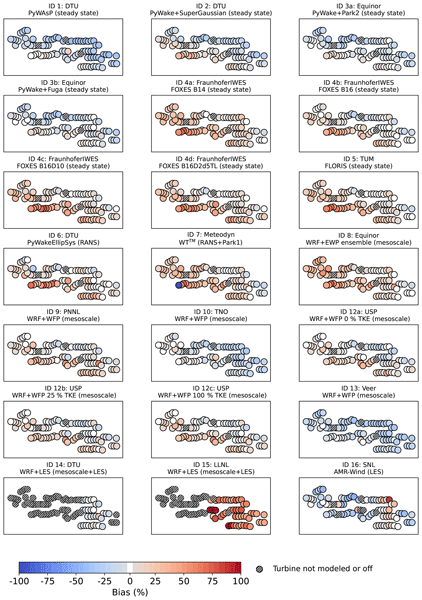
Predicting wind farm energy production is challenging because wind patterns are complex. We tested 16 different models against real data from a major field experiment to see which worked best. Surprisingly, the most expensive and detailed models were not always more accurate than simpler ones. We found that feeding models better weather data was the most effective way to improve accuracy. These results help the industry choose the right tools for designing more-efficient wind farms.
Øyvind Waage Hanssen-Bauer, Paula Doubrawa, Helge A. Madsen, Henrik Asmuth, Jason Jonkman, Gunner C. Larsen, Stefan Ivanell, and Roy Stenbro
Wind Energ. Sci., 11, 1913–1948, https://doi.org/10.5194/wes-11-1913-2026, https://doi.org/10.5194/wes-11-1913-2026, 2026
Short summary
Short summary
We studied how different industry-oriented computer models predict the behavior of winds behind turbines in a wind farm. These
wakesreduce energy output and can affect turbines further down the row. By comparing these three models with more detailed simulations, we found they agree well on overall power but differ in how they capture turbulence and wear on machines. Our results show where the models need improvement to make wind farm computer models more accurate and reliable in the future.
Gopal R. Yalla, Kenneth Brown, Lawrence Cheung, Dan Houck, Nathaniel deVelder, and Balaji Jayaraman
Wind Energ. Sci. Discuss., https://doi.org/10.5194/wes-2025-250, https://doi.org/10.5194/wes-2025-250, 2025
Revised manuscript under review for WES
Short summary
Short summary
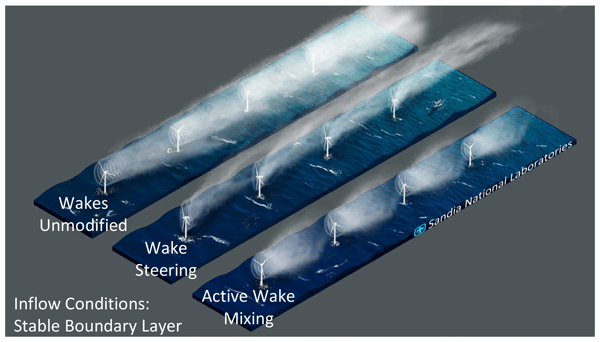
This study examines the increase in annual energy production of a wind farm when using a new control technology designed to re-energize the wind between turbines by enhancing the mixing in the flow behind a turbine. High-fidelity computer simulations are used to create training data for a lower-fidelity model that efficiently predicts wind farm performance. Additionally, the power performance gains are compared to a standard control approach that steers wakes away from downstream turbines.
Helge Aagaard Madsen, Alejandro Gomez Gonzalez, Thanasis Barlas, Anders Smærup Olsen, Sigurd Brabæk Ildvedsen, and Andreas Fischer
Wind Energ. Sci., 10, 2499–2513, https://doi.org/10.5194/wes-10-2499-2025, https://doi.org/10.5194/wes-10-2499-2025, 2025
Short summary
Short summary
In this article, we present the measurements of local aerodynamic sectional characteristics on a full-scale rotor blade with a novel add-on instrumentation comprising a wake rake, a pressure belt, and a five-hole Pitot tube. In general, the demonstration of this instrumentation opens a range of promising new options for optimizing airfoil sectional performance in its real operating environment, e.g., the size and position of vortex generators.
Gopal R. Yalla, Kenneth Brown, Lawrence Cheung, Dan Houck, Nathaniel deVelder, and Nicholas Hamilton
Wind Energ. Sci., 10, 2449–2474, https://doi.org/10.5194/wes-10-2449-2025, https://doi.org/10.5194/wes-10-2449-2025, 2025
Short summary
Short summary
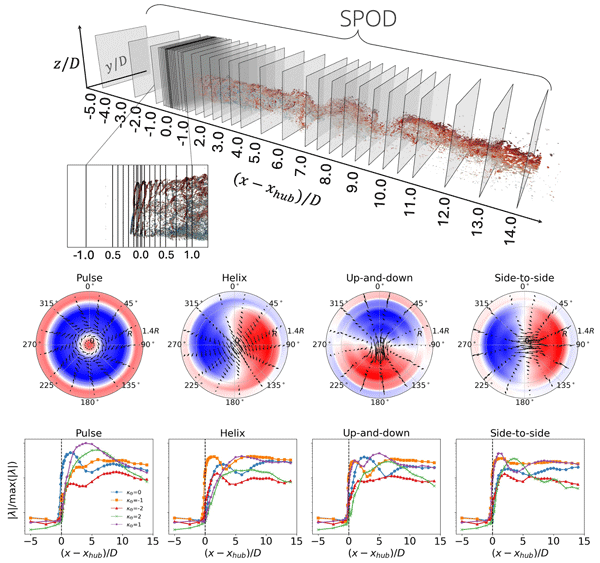
When wind reaches the first set of turbines in a wind farm, energy is extracted, reducing the energy available for downstream turbines. This study examines emerging technologies aimed at re-energizing the wind between turbines in a wind farm to improve overall power production. Optimizing these technologies depends on understanding the complex flow features of the atmosphere and the wakes behind turbines, which is accomplished using high-fidelity computer simulations and data analysis techniques.

Pietro Bortolotti, Lee Jay Fingersh, Nicholas Hamilton, Arlinda Huskey, Chris Ivanov, Mark Iverson, Jonathan Keller, Scott Lambert, Jason Roadman, Derek Slaughter, Syhoune Thao, and Consuelo Wells
Wind Energ. Sci., 10, 2025–2050, https://doi.org/10.5194/wes-10-2025-2025, https://doi.org/10.5194/wes-10-2025-2025, 2025
Short summary
Short summary
This study compares a wind turbine with blades behind the tower (downwind) to the traditional upwind design. Testing a 1.5 MW turbine at the National Renewable Energy Laboratory's Flatirons Campus, we measured performance, loads, and noise. Numerical models matched well with observations. The downwind setup showed higher fatigue loads and sound variations but also an unexpected power improvement. Downwind rotors might be a valid alternative for future floating offshore wind applications.
Kenneth Brown, Gopal Yalla, Lawrence Cheung, Joeri Frederik, Dan Houck, Nathaniel deVelder, Eric Simley, and Paul Fleming
Wind Energ. Sci., 10, 1737–1762, https://doi.org/10.5194/wes-10-1737-2025, https://doi.org/10.5194/wes-10-1737-2025, 2025
Short summary
Short summary
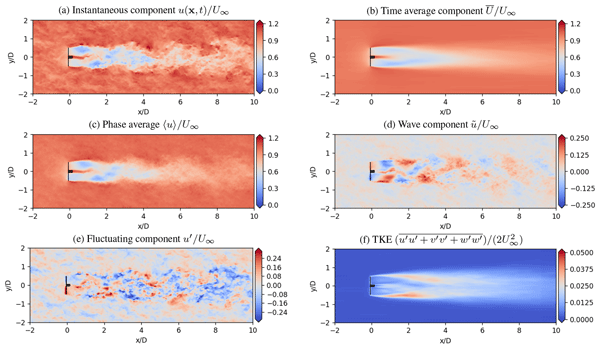
This paper presents one half of a companion paper series that studies strategies to reduce negative aerodynamic interference (i.e., wake effects) between nearby wind turbines in a wind farm. The approach leverages high-fidelity flow simulations of an open-source design for a wind turbine. Complimenting the companion paper’s analysis of the power and loading effects of the wake-control strategies, this article uncovers the underlying fluid-dynamic causes for these effects.
Lawrence Cheung, Gopal Yalla, Prakash Mohan, Alan Hsieh, Kenneth Brown, Nathaniel deVelder, Daniel Houck, Marc T. Henry de Frahan, Marc Day, and Michael Sprague
Wind Energ. Sci., 10, 1403–1420, https://doi.org/10.5194/wes-10-1403-2025, https://doi.org/10.5194/wes-10-1403-2025, 2025
Short summary
Short summary
Mitigating turbine wakes is an important aspect to maximizing wind farm energy production but is a challenge to model. We demonstrate a new approach to modeling active wake mixing, which re-energizes turbine wake through periodic blade pitching. The new model divides the wake into separate steady, unsteady, and turbulent components and solves for each in a computationally efficient manner. Our results show that the model can reasonably predict the faster wake recovery due to mixing.
Cory Frontin, Jeff Allen, Christopher J. Bay, Jared Thomas, Ethan Young, and Pietro Bortolotti
Wind Energ. Sci. Discuss., https://doi.org/10.5194/wes-2025-103, https://doi.org/10.5194/wes-2025-103, 2025
Revised manuscript has not been submitted
Short summary
Short summary
Wind farms produce energy and to do so have to occupy a non-trivial amount of space. Understanding how much energy a proposed wind farm will make (and at what cost) is technically challenging, especially when turbines are packed closely together. Plus, there's a key tradeoff in how much space a farm occupies and how cheap the energy it can produce might be: less space means more costly energy. This work shows an novel way to run computational simulations efficiently to understand that tradeoff.
Joeri A. Frederik, Eric Simley, Kenneth A. Brown, Gopal R. Yalla, Lawrence C. Cheung, and Paul A. Fleming
Wind Energ. Sci., 10, 755–777, https://doi.org/10.5194/wes-10-755-2025, https://doi.org/10.5194/wes-10-755-2025, 2025
Short summary
Short summary
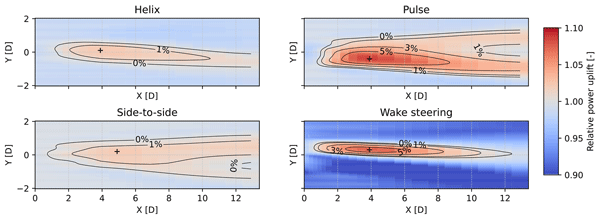
In this paper, we present results from advanced computer simulations to determine the effects of applying different control strategies to a small wind farm. We show that when there is variability in wind direction over height, steering the wake of a turbine away from other turbines is the most effective strategy. When this variability is not present, actively changing the pitch angle of the blades to increase turbulence in the wake could be more effective.
Kenneth Brown, Pietro Bortolotti, Emmanuel Branlard, Mayank Chetan, Scott Dana, Nathaniel deVelder, Paula Doubrawa, Nicholas Hamilton, Hristo Ivanov, Jason Jonkman, Christopher Kelley, and Daniel Zalkind
Wind Energ. Sci., 9, 1791–1810, https://doi.org/10.5194/wes-9-1791-2024, https://doi.org/10.5194/wes-9-1791-2024, 2024
Short summary
Short summary
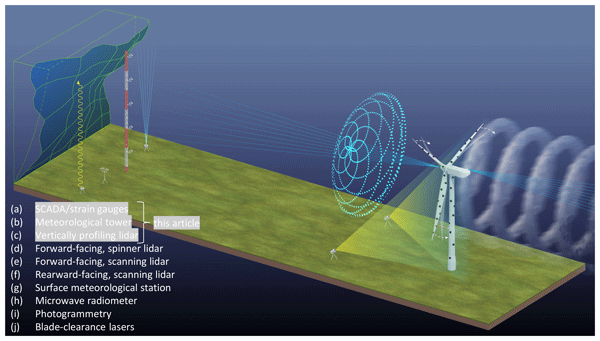
This paper presents a study of the popular wind turbine design tool OpenFAST. We compare simulation results to measurements obtained from a 2.8 MW land-based wind turbine. Measured wind conditions were used to generate turbulent flow fields through several techniques. We show that successful validation of the tool is not strongly dependent on the inflow generation technique used for mean quantities of interest. The type of inflow assimilation method has a larger effect on fatigue quantities.
Erik K. Fritz, Christopher L. Kelley, and Kenneth A. Brown
Wind Energ. Sci., 9, 1713–1726, https://doi.org/10.5194/wes-9-1713-2024, https://doi.org/10.5194/wes-9-1713-2024, 2024
Short summary
Short summary
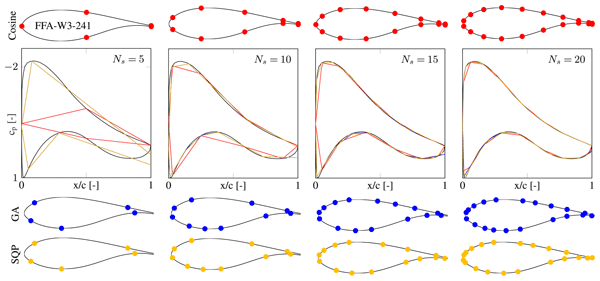
This study investigates the benefits of optimizing the spacing of pressure sensors for measurement campaigns on wind turbine blades and airfoils. It is demonstrated that local aerodynamic properties can be estimated considerably more accurately when the sensor layout is optimized compared to commonly used simpler sensor layouts. This has the potential to reduce the number of sensors without losing measurement accuracy and, thus, reduce the instrumentation complexity and experiment cost.
Andrea Gamberini, Thanasis Barlas, Alejandro Gomez Gonzalez, and Helge Aagaard Madsen
Wind Energ. Sci., 9, 1229–1249, https://doi.org/10.5194/wes-9-1229-2024, https://doi.org/10.5194/wes-9-1229-2024, 2024
Short summary
Short summary
Movable surfaces on wind turbine (WT) blades, called active flaps, can reduce the cost of wind energy. However, they still need extensive testing. This study shows that the computer model used to design a WT with flaps aligns well with measurements obtained from a 3month test on a commercial WT featuring a prototype flap. Particularly during flap actuation, there were minimal differences between simulated and measured data. These findings assure the reliability of WT designs incorporating flaps.
Helge Aagaard Madsen
Wind Energ. Sci., 8, 1853–1872, https://doi.org/10.5194/wes-8-1853-2023, https://doi.org/10.5194/wes-8-1853-2023, 2023
Short summary
Short summary
We present a linear analytical solution for a two-dimensional (2-D) actuator disc (AD) for a plane disc, a yawed disc and a coned disc. Comparisons of the 2-D model with three-dimensional computational fluid dynamics (CFD) AD simulations for a circular yawed disc and with an axis-symmetric CFD simulation of a coned disc show good correlation for the normal velocity component of the disc. This indicates that the 2-D AD model could form the basis for a consistent, simple new rotor induction model.
Paul Veers, Carlo L. Bottasso, Lance Manuel, Jonathan Naughton, Lucy Pao, Joshua Paquette, Amy Robertson, Michael Robinson, Shreyas Ananthan, Thanasis Barlas, Alessandro Bianchini, Henrik Bredmose, Sergio González Horcas, Jonathan Keller, Helge Aagaard Madsen, James Manwell, Patrick Moriarty, Stephen Nolet, and Jennifer Rinker
Wind Energ. Sci., 8, 1071–1131, https://doi.org/10.5194/wes-8-1071-2023, https://doi.org/10.5194/wes-8-1071-2023, 2023
Short summary
Short summary
Critical unknowns in the design, manufacturing, and operation of future wind turbine and wind plant systems are articulated, and key research activities are recommended.
Brandon Arthur Lobo, Özge Sinem Özçakmak, Helge Aagaard Madsen, Alois Peter Schaffarczyk, Michael Breuer, and Niels N. Sørensen
Wind Energ. Sci., 8, 303–326, https://doi.org/10.5194/wes-8-303-2023, https://doi.org/10.5194/wes-8-303-2023, 2023
Short summary
Short summary
Results from the DAN-AERO and aerodynamic glove projects provide significant findings. The effects of inflow turbulence on transition and wind turbine blades are compared to computational fluid dynamic simulations. It is found that the transition scenario changes even over a single revolution. The importance of a suitable choice of amplification factor is evident from the simulations. An agreement between the power spectral density plots from the experiment and large-eddy simulations is seen.
Camilla Marie Nyborg, Andreas Fischer, Pierre-Elouan Réthoré, and Ju Feng
Wind Energ. Sci., 8, 255–276, https://doi.org/10.5194/wes-8-255-2023, https://doi.org/10.5194/wes-8-255-2023, 2023
Short summary
Short summary
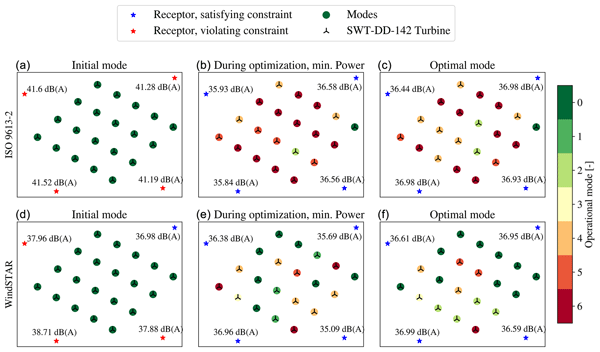
Our article presents a way of optimizing the wind farm operation by keeping the emitted noise level below a defined limit while maximizing the power output. This is done by switching between noise reducing operational modes. The method has been developed by using two different noise models, one more advanced than the other, to study the advantages of each model. Furthermore, the optimization method is applied to different wind farm cases.
Koen Boorsma, Gerard Schepers, Helge Aagard Madsen, Georg Pirrung, Niels Sørensen, Galih Bangga, Manfred Imiela, Christian Grinderslev, Alexander Meyer Forsting, Wen Zhong Shen, Alessandro Croce, Stefano Cacciola, Alois Peter Schaffarczyk, Brandon Lobo, Frederic Blondel, Philippe Gilbert, Ronan Boisard, Leo Höning, Luca Greco, Claudio Testa, Emmanuel Branlard, Jason Jonkman, and Ganesh Vijayakumar
Wind Energ. Sci., 8, 211–230, https://doi.org/10.5194/wes-8-211-2023, https://doi.org/10.5194/wes-8-211-2023, 2023
Short summary
Short summary
Within the framework of the fourth phase of the International Energy Agency's (IEA) Wind Task 29, a large comparison exercise between measurements and aeroelastic simulations has been carried out. Results were obtained from more than 19 simulation tools of various fidelity, originating from 12 institutes and compared to state-of-the-art field measurements. The result is a unique insight into the current status and accuracy of rotor aerodynamic modeling.
Kenneth A. Brown and Thomas G. Herges
Atmos. Meas. Tech., 15, 7211–7234, https://doi.org/10.5194/amt-15-7211-2022, https://doi.org/10.5194/amt-15-7211-2022, 2022
Short summary
Short summary
The character of the airflow around and within wind farms has a significant impact on the energy output and longevity of the wind turbines in the farm. For both research and control purposes, accurate measurements of the wind speed are required, and these are often accomplished with remote sensing devices. This article pertains to a field experiment of a lidar mounted to a wind turbine and demonstrates three data post-processing techniques with efficacy at extracting useful airflow information.
Thanasis Barlas, Georg Raimund Pirrung, Néstor Ramos-García, Sergio González Horcas, Ang Li, and Helge Aagaard Madsen
Wind Energ. Sci., 7, 1957–1973, https://doi.org/10.5194/wes-7-1957-2022, https://doi.org/10.5194/wes-7-1957-2022, 2022
Short summary
Short summary
An aeroelastically optimized curved wind turbine blade tip is designed, manufactured, and tested on a novel outdoor rotating rig facility at the Risø campus of the Technical University of Denmark. Detailed aerodynamic measurements for various atmospheric conditions and results are compared to a series of in-house aeroelastic tools with a range of fidelities in aerodynamic modeling. The comparison highlights details in the ability of the codes to predict the performance of such a curved tip.
Mads H. Aa. Madsen, Frederik Zahle, Sergio González Horcas, Thanasis K. Barlas, and Niels N. Sørensen
Wind Energ. Sci., 7, 1471–1501, https://doi.org/10.5194/wes-7-1471-2022, https://doi.org/10.5194/wes-7-1471-2022, 2022
Short summary
Short summary
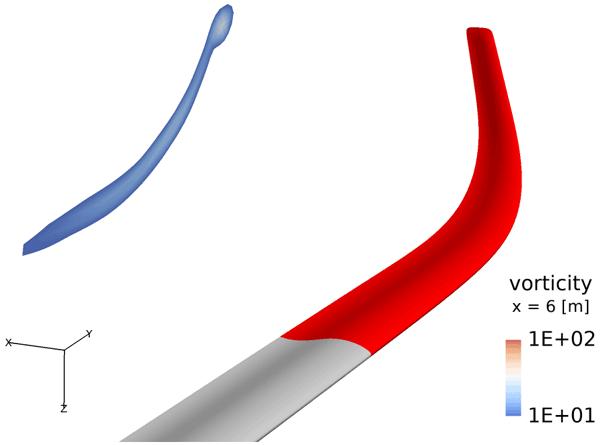
This work presents a shape optimization framework based on computational fluid dynamics. The design framework is used to optimize wind turbine blade tips for maximum power increase while avoiding that extra loading is incurred. The final results are shown to align well with related literature. The resulting tip shape could be mounted on already installed wind turbines as a sleeve-like solution or be conceived as part of a modular blade with tips designed for site-specific conditions.
John Jasa, Pietro Bortolotti, Daniel Zalkind, and Garrett Barter
Wind Energ. Sci., 7, 991–1006, https://doi.org/10.5194/wes-7-991-2022, https://doi.org/10.5194/wes-7-991-2022, 2022
Short summary
Short summary
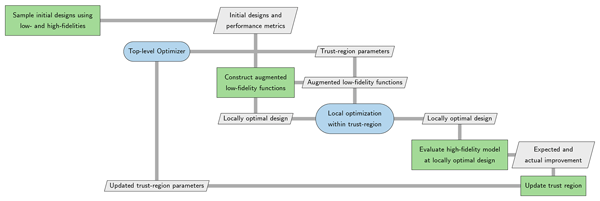
Using highly accurate simulations within a design cycle is prohibitively computationally expensive. We implement and present a multifidelity optimization method and showcase its efficacy using three different case studies. We examine aerodynamic blade design, turbine controls tuning, and a wind plant layout problem. In each case, the multifidelity method finds an optimal design that performs better than those obtained using simplified models but at a lower cost than high-fidelity optimization.
Ang Li, Georg Raimund Pirrung, Mac Gaunaa, Helge Aagaard Madsen, and Sergio González Horcas
Wind Energ. Sci., 7, 129–160, https://doi.org/10.5194/wes-7-129-2022, https://doi.org/10.5194/wes-7-129-2022, 2022
Short summary
Short summary
An engineering aerodynamic model for the swept horizontal-axis wind turbine blades is proposed. It uses a combination of analytical results and engineering approximations. The performance of the model is comparable with heavier high-fidelity models but has similarly low computational cost as currently used low-fidelity models. The model could be used for an efficient and accurate load calculation of swept wind turbine blades and could eventually be integrated in a design optimization framework.

Ernesto Camarena, Evan Anderson, Josh Paquette, Pietro Bortolotti, Roland Feil, and Nick Johnson
Wind Energ. Sci., 7, 19–35, https://doi.org/10.5194/wes-7-19-2022, https://doi.org/10.5194/wes-7-19-2022, 2022
Short summary
Short summary
The length of rotor blades of land-based wind turbines is currently constrained by logistics. Turbine manufacturers currently propose segmented solutions to overcome these limits, but blade joints come with extra masses and costs. This work investigates an alternative solution, namely the design of ultra-flexible blades that can be transported on rail via controlled bending. The results show that this is a promising pathway to further increasing the size of land-based wind turbines.
Dan Houck, David Maniaci, and Chris L. Kelley
Wind Energ. Sci. Discuss., https://doi.org/10.5194/wes-2021-122, https://doi.org/10.5194/wes-2021-122, 2021
Preprint withdrawn
Short summary
Short summary
Like young children without help, wind turbines are bad at sharing. Those that are first in line (most upstream) take all the fresh air leaving little for those downstream. This research shows how turbines can operate to share the wind resource better and what parameters are most important for optimizing this technique. Results indicate that power gains of 10 % can be achieved if upstream turbines are operated differently, which may help operators produce more wind power.
Thanasis Barlas, Georg Raimund Pirrung, Néstor Ramos-García, Sergio González Horcas, Robert Flemming Mikkelsen, Anders Smærup Olsen, and Mac Gaunaa
Wind Energ. Sci., 6, 1311–1324, https://doi.org/10.5194/wes-6-1311-2021, https://doi.org/10.5194/wes-6-1311-2021, 2021
Short summary
Short summary
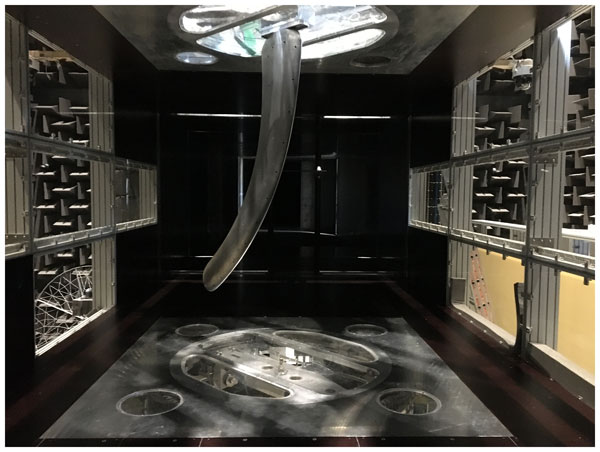
Curved blade tips can potentially have a significant impact on wind turbine performance and loads. A swept tip shape optimized for wind turbine applications is tested in a wind tunnel. A range of numerical aerodynamic simulation tools with various levels of fidelity are compared. We show that all numerical tools except for the simplest blade element momentum based are in good agreement with the measurements, suggesting the required level of model fidelity necessary for the design of such tips.
Cited articles
Bangga, G.: Three-dimensional flow in the root region of wind turbine rotors, Opus Publication Server of the University of Stuttgart (University of Stuttgart), https://doi.org/10.18419/opus-11032, 2018. a
Bergh, H. and Tijdeman, H.: Theoretical and experimental results for the dynamic response of pressure measuring systems, TR F.238, Amsterdam Nationaal Luchtvaarlaboratorium (National Aeronautical and Astronautical Research Institute), https://www.researchgate.net/profile/H-Tijdeman/publication (last access: 18 August 2026), 1965. a
Bortolotti, P., Kapila, A., and Bottasso, C. L.: Comparison between upwind and downwind designs of a 10 MW wind turbine rotor, Wind Energ. Sci., 4, 115–125, https://doi.org/10.5194/wes-4-115-2019, 2019. a, b
Bortolotti, P., Johnson, N., Abbas, N. J., Anderson, E., Camarena, E., and Paquette, J.: Land-based wind turbines with flexible rail-transportable blades – Part 1: Conceptual design and aeroservoelastic performance, Wind Energ. Sci., 6, 1277–1290, https://doi.org/10.5194/wes-6-1277-2021, 2021. a
Bortolotti, P., Fingersh, L. J., Hamilton, N., Huskey, A., Ivanov, C., Iverson, M., Keller, J., Lambert, S., Roadman, J., Slaughter, D., Thao, S., and Wells, C.: Upwind vs. downwind: loads and acoustics of a 1.5 MW wind turbine, Wind Energ. Sci., 10, 2025–2050, https://doi.org/10.5194/wes-10-2025-2025, 2025. a, b, c, d, e
Brown, K., Molinaro, N., Meyers, T., Borgoltz, A., Devenport, W., Luedke, J., and Pesetsky, D.: Sensitivity of wind turbine airfoil sections to geometry variations inherent in modular blades, Wind Engineering, 42, 529–546, 2018. a
Brown, K., Fleming, J., Langford, M., Walton, W., Ng, W., Schwartz, K., Wisda, D., and Burdisso, R.: Reduced-order prediction of unsteady propeller loading and noise from pylon wake ingestion, AIAA J., 59, 3304–3316, https://doi.org/10.2514/1.J060109, 2021. a
Brown, K., Bortolotti, P., Branlard, E., Chetan, M., Dana, S., deVelder, N., Doubrawa, P., Hamilton, N., Ivanov, H., Jonkman, J., Kelley, C., and Zalkind, D.: One-to-one aeroservoelastic validation of operational loads and performance of a 2.8 MW wind turbine model in OpenFAST, Wind Energ. Sci., 9, 1791–1810, https://doi.org/10.5194/wes-9-1791-2024, 2024. a
Damiani, R. R. and Hayman, G.: The Unsteady Aerodynamics Module For FAST8, Tech. rep., National Renewable Energy Laboratory (NREL), Golden, CO (United States), https://doi.org/10.2172/1576488, 2019. a
Drela, M. and Giles, M. B.: Viscous-inviscid analysis of transonic and low Reynolds number airfoils, AIAA J., 25, 1347–1355, https://doi.org/10.2514/3.9789, 1987. a
Eames, I., Jonsson, C., and Johnson, P. B.: The growth of a cylinder wake in turbulent flow, J. Turbul., 12, N39, https://doi.org/10.1080/14685248.2011.619985, 2011. a
Fritz, E. K., Kelley, C. L., and Brown, K. A.: On optimizing the sensor spacing for pressure measurements on wind turbine airfoils, Wind Energ. Sci., 9, 1713–1726, https://doi.org/10.5194/wes-9-1713-2024, 2024. a
Hubbard, H. and Shepherd, K.: Aeroacoustics of large wind turbines, J. Acoust. Soc. Am., 89, 2495–2508, https://doi.org/10.1121/1.401021, 1991. a
Ildvedsen, S.: Design of a windtunnel test section for 2D aerofoils, Bs thesis, Technical University of Denmark, 2017. a
Jeong, J. H. and Ha, K.: Numerical investigation of three-dimensional and vortical flow phenomena to enhance the power performance of a wind turbine blade, Appl. Sci.-Basel, 11, 1–16, https://doi.org/10.3390/app11010072, 2021. a
Kelley, N. D.: Acoustic noise generation by the DOE/NASA MOD-1 wind turbine, https://ntrs.nasa.gov/citations/19820015850 (last access: 17 August 2026), 1981. a
Klein, L., Gude, J., Wenz, F., Lutz, T., and Krämer, E.: Advanced computational fluid dynamics (CFD)–multi-body simulation (MBS) coupling to assess low-frequency emissions from wind turbines, Wind Energ. Sci., 3, 713–728, https://doi.org/10.5194/wes-3-713-2018, 2018. a, b
Leishman, G. J.: Principles of helicopter aerodynamics with CD extra, Cambridge University Press, 757–761, ISBN 0-521-85860-7, 2006. a
Madsen, H. A.: Low frequency noise from wind turbines mechanisms of generation and its modelling, J. Low Freq. Noise V. A., 29, 239–251, https://doi.org/10.1260/0263-0923.29.4.239, 2010. a
Madsen, H. A. and Barlas, A.: downwind-turbine-pressure-variations-blade-tower, Zenodo [video], https://doi.org/10.5281/zenodo.22230718, 2026.
Madsen, H. A., Johansen, J., Sørensen, N. N., Larsen, G. C., and Hansen, M. H.: Simulation of low frequency noise from a downwind wind turbine rotor, technical Papers, 42. Aiaa Aerospace Sciences Meeting and Exhibit, 11, 7549–7560, https://doi.org/10.2514/6.2007-623, 2007. a, b, c
Madsen, H. A., Barlas, T., Fischer, A., Olsen, A., and Gomez Gonzalez, A.: Inflow and pressure measurements on a full scale turbine with a pressure belt and a five hole pitot tube, J. Phys. Conf. Ser., 2265, 022096, https://doi.org/10.1088/1742-6596/2265/2/022096, 2022. a, b
Madsen, H. A., Gomez Gonzalez, A., Barlas, T., Olsen, A. S., Ildvedsen, S. B., and Fischer, A.: Blade surface pressure and drag measurement of a blade section on a 4.3 MW turbine with trailing-edge flaps, Wind Energ. Sci., 10, 2499–2513, https://doi.org/10.5194/wes-10-2499-2025, 2025. a
Mears, L. J., Nikoueeyan, P., Hind, M. D., Strike, J., Perry, M., Wimpenny, B., and Naughton, J. W.: Unsteady Surface Pressure Characterization on Launch Vehicle in Liftoff Configuration, J. Spacecraft Rockets, 61, 1248–1257, https://doi.org/10.2514/1.a36032, 2024. a
Mendoza, I., Hur, J., Thao, S., and Curtis, A.: Power Performance Test Report for the U.S. Department of Energy 1.5-Megawatt Wind Turbine, Tech. rep., National Renewable Energy Lab. (NREL), Golden, CO (United States), https://doi.org/10.2172/1215120, 2015. a
Michelsen, J. A.: Forskning i aeroelasticitet (Research in aeroelasticity) EFP-2001, chap. 6. Beregning af laminar-turbulent omslag i 2D og 3D (Computation of laminar-turbulent transition in 2D and 3D), Risø-R-1349(DA), Forskningscenter Risø (now DTU Wind), https://backend.orbit.dtu.dk/ws/portalfiles/portal/7712406/ris_r_1349.pdf (last access: 17 August 2026), 2002. a
Moriarty, P. J. and Hansen, A. C.: AeroDyn Theory Manual, Tech. rep., National Renewable Energy Lab., Golden, CO (US), https://doi.org/10.2172/15014831, 2005. a
Munduate, X., Coton, F. N., and Galbraith, R. A. M.: An investigation of the aerodynamic response of a wind turbine blade to tower shadow, J. Sol. Energy Eng., 126, 1034–1040, 2004. a
Nikoueeyan, P. and Naughton, J. W.: Evaluation of Embedded Miniature Pressure Scanners for Unsteady Measurements in a Low-Speed Wind Tunnel Testing Application, in: AIAA SCITECH 2024 Forum, American Institute of Aeronautics and Astronautics, https://doi.org/10.2514/6.2024-1123, 2024. a
Noyes, C., Qin, C., Loth, E., and Schreck, S.: Measurements and predictions of wind turbine tower shadow and fairing effects, J. Wind Eng. Ind. Aerod., 179, 297–307, 2018. a
OpenFAST: OpenFAST v3.3.0, released on 28 October 2022, , https://github.com/OpenFAST/openfast (last access: 17 August 2026), 2022. a
Powles, S.: The Effects of Tower Shadow on the Dynamics of a Horizontal-Axis Wind Turbine, Wind Engineering, 7, 26–42, http://www.jstor.org/stable/43749009 (last access: 17 August 2026), 1983. a
Santos, R. and van Dam, J.: Mechanical Loads Test Report for the U.S. Department of Energy 1.5-Megawatt Wind Turbine, National Renewable Energy Laboratory, https://doi.org/10.2172/1215119, 2015. a
Simpson, J. G., Kaminski, M., and Loth, E.: Influence of tower shadow on downwind flexible rotors: Field tests and simulations, Wind Energy, 25, 881–896, https://doi.org/10.1002/we.2703, 2022. a
Sørensen, N.: General purpose flow solver applied to flow over hills, PhD thesis, Risø National Laboratory, https://backend.orbit.dtu.dk/ws/portalfiles/portal/12280331/Ris_R_827.pdf (last access: 18 August 2026), 1995. a
van Ingen, J.: A Suggested Semi-Empirical Method for the Calculation of the Boundary Layer Transition Region, Tech. Rep., Delft Univ. of Technology, Rept. VTH-74, Dept. of Aerospace Engineering, https://resolver.tudelft.nl/uuid:cff1fb47-883f-4cdc-ad07-07d264f3fd10 (last access: 18 August 2026), 1956. a
Viterna, L. A.: Method for predicting impulsive noise generated by wind turbine rotors, https://ntrs.nasa.gov/citations/19820013840 (last access: 18 August 2026), 1982. a
Wang, T. and Coton, F. N.: A high resolution tower shadow model for downwind wind turbines, J. Wind Eng. Ind. Aerod., 89, 873–892, 2001. a
Zahle, F., Sørensen, N. N., and Johansen, J.: Wind Turbine Rotor-Tower Interaction Using an Incompressible Overset Grid Method, Wind Energy, 12, 594–619, https://doi.org/10.1002/we.327, 2009. a, b
Zajamsek, B., Yauwenas, Y., Doolan, C. J., Hansen, K. L., Timchenko, V., Reizes, J., and Hansen, C. H.: Experimental and numerical investigation of blade–tower interaction noise, J. Sound Vib., 443, 362–375, https://doi.org/10.1016/j.jsv.2018.11.048, 2019. a
Short summary
We present a detailed experimental investigation of the flow details of the blade/tower interaction (BTI) on a 1.5 MW wind turbine operating in a downwind configuration. The objective is to clarify some of the most important barriers for the downwind turbine concept linked to the impulsive loading from the blade/tower interaction generating low-frequency noise and increased loading. Unique instrumentation was used, comprising two extruded pressure belts on one of the blades and on the tower.
We present a detailed experimental investigation of the flow details of the blade/tower...


Altmetrics
Final-revised paper
Preprint