
Articles | Volume 11, issue 9
https://doi.org/10.5194/wes-11-3587-2026
© Author(s) 2026. This work is distributed under
the Creative Commons Attribution 4.0 License.
the Creative Commons Attribution 4.0 License.
https://doi.org/10.5194/wes-11-3587-2026
© Author(s) 2026. This work is distributed under
the Creative Commons Attribution 4.0 License.
the Creative Commons Attribution 4.0 License.
Research article
| 
18 Sep 2026
Research article |
| 18 Sep 2026
| 18 Sep 2026
Turbulence characterization in near-coastal environment using triple short-range lidars and mast anemometry

Department of Mechanical and Structural Engineering and Materials Science, University of Stavanger, 4021 Stavanger, Norway
Julia Gottschall
Fraunhofer Institute for Wind Energy Systems IWES, 27572 Bremerhaven, Germany
Faculty of Geosciences, University of Bremen, 28359 Bremen, Germany
Jasna Bogunović Jakobsen
Department of Mechanical and Structural Engineering and Materials Science, University of Stavanger, 4021 Stavanger, Norway
Related authors
No articles found.
Jakob Mann, Ansh Patel, Mikael Sjöholm, Gunhild Rolighed Thorsen, Elliot Irving Simon, Lin-Ya Hung, and Julia Gottschall
Wind Energ. Sci., 11, 3153–3170, https://doi.org/10.5194/wes-11-3153-2026, https://doi.org/10.5194/wes-11-3153-2026, 2026
Short summary
Short summary
Turbulence over the ocean at heights relevant to modern offshore wind turbines, i.e., up to 300 m or more, is not well studied. It is important to know the properties of this turbulence because it is responsible for most of the dynamic loads on these structures, and consequently it is relevant to how the latter should be designed. This data description paper explains the efforts made to provide measurements of this offshore turbulence using five Doppler lidars.
Astrid Lampert, Beatriz Cañadillas, Thomas Rausch, Lea Schmitt, Bughsin' Djath, Johannes Schulz-Stellenfleth, Andreas Platis, Kjell zum Berge, Ines Schäfer, Jens Bange, Lukas Gruchot, Thomas Neumann, Martin Dörenkämper, Bernhard Stoevesandt, Julia Gottschall, Lukas Vollmer, Stefan Emeis, Mares Barekzai, Simon Siedersleben, Martin Kühn, Gerald Steinfeld, Detlev Heinemann, Joachim Peinke, Hendrik Heißelmann, Jörge Schneemann, Gabriele Centurelli, Philipp Waldmann, and Konrad Bärfuss
Wind Energ. Sci., 11, 3057–3075, https://doi.org/10.5194/wes-11-3057-2026, https://doi.org/10.5194/wes-11-3057-2026, 2026
Short summary
Short summary
Two major aircraft measurement campaigns above the North Sea provide insights into modifications of the wind field and sea surface induced by wind farms. The aircraft performed transects at hub height upstream and downstream of wind farm clusters and identified different effects, e.g. how long it takes for the wind speed to recover after the wind farm, how changes across the coastline interact with wind energy, and if wind farms are well represented in numerical simulations.
Arianna Marie Jordan, Lin-Ya Hung, Gerrit Wolken-Möhlmann, and Julia Gottschall
Wind Energ. Sci. Discuss., https://doi.org/10.5194/wes-2026-114, https://doi.org/10.5194/wes-2026-114, 2026
Preprint under review for WES
Short summary
Short summary
Wind energy needs accurate airflow tools around turbines. We tested dual-Doppler radar at a research wind farm in Germany alongside lidar (a point-based wind sensor). The method matched lidar well at most heights and mapped wind shadows behind turbines, including wake meandering. Data quality depended on rainfall, with rainy periods giving the best coverage and fog the worst. This information is useful for implementation of dual-Doppler radar as a wind measurement tool for the industry.
Farkhondeh Rouholahnejad, Tanguy Lunel, and Julia Gottschall
Wind Energ. Sci. Discuss., https://doi.org/10.5194/wes-2026-99, https://doi.org/10.5194/wes-2026-99, 2026
Preprint under review for WES
Short summary
Short summary
Offshore wind farms rely on accurate measurements of wind and turbulence. Using three scanning lidars and an offshore meteorological mast, we investigated whether dual-Doppler lidar systems must measure exactly the same air volume to provide reliable turbulence estimates. We show that moderate beam separations can be tolerated under homogeneous offshore conditions and that the resulting differences provide useful information about spatial variability in the wind field.
Matthew Young, Matthew Docherty, Lin-Ya Hung, Andrew Oldroyd, and Julia Gottschall
Wind Energ. Sci. Discuss., https://doi.org/10.5194/wes-2026-94, https://doi.org/10.5194/wes-2026-94, 2026
Preprint under review for WES
Short summary
Short summary
This study compares different ways of checking and correcting the pointing accuracy of scanning wind measurement systems used for offshore wind energy projects. Accurate positioning is essential for reliable wind measurements and reducing project risk. The results show that drone-based testing provides the most accurate results, while sea-surface methods offer a practical alternative when other reference points are unavailable.
Hugo Rubio, Ville Vakkari, Martin Kühn, and Julia Gottschall
Wind Energ. Sci. Discuss., https://doi.org/10.5194/wes-2026-50, https://doi.org/10.5194/wes-2026-50, 2026
Preprint withdrawn
Short summary
Short summary
Offshore wind farms need accurate wind data, but collecting measurements at sea is often difficult and expensive. In this study, we investigate how wind measurements from a lidar mounted on a moving ship can improve the accuracy of commonly used reanalysis datasets. Using a statistical correction method, we are able to reduce errors in wind speed estimates. This efficient approach can make offshore wind planning and resource assessment more reliable in areas where measurements are limited.
Carlo L. Bottasso, Sandrine Aubrun, Nicolaos A. Cutululis, Julia Gottschall, Athanasios Kolios, Jakob Mann, and Paul Veers
Wind Energ. Sci., 11, 347–348, https://doi.org/10.5194/wes-11-347-2026, https://doi.org/10.5194/wes-11-347-2026, 2026
Short summary
Short summary
This editorial celebrates the 10th anniversary of Wind Energy Science, reflecting on a decade of rapid scientific progress and the journal’s role in advancing fundamental, interdisciplinary research. It highlights key developments in wind energy, the importance of open science and academia–industry collaboration, and emerging challenges such as data sharing and artificial intelligence. Above all, it honors the research community that has shaped the journal and looks ahead to the next decade.
Stefan Ivanell, Bjarke T. Olsen, Antoine Mathieu, Cristina Mulet-Benzo, Abdul Haseeb Syed, Warit Chanprasert, Mikael Sjöholm, Jakob Mann, and Julia Gottschall
Wind Energ. Sci. Discuss., https://doi.org/10.5194/wes-2025-286, https://doi.org/10.5194/wes-2025-286, 2026
Preprint under review for WES
Short summary
Short summary
Modern GW-scale offshore wind farms face challenges from atmospheric dynamics. This study examines how boundary layer height (BLH) and large-scale turbulence affect efficiency and loads. Using WRF simulations, lidar data, and CFD modeling for a 100-turbine, 15 MW wind farm at three representative sites, we show that low BLH reduces performance. Turbulence-induced low-frequency fluctuations increase fatigue loads, underscoring the need to include BLH and turbulence in design models.
Warren Watson, Gerrit Wolken-Möhlmann, and Julia Gottschall
Wind Energ. Sci., 10, 2791–2820, https://doi.org/10.5194/wes-10-2791-2025, https://doi.org/10.5194/wes-10-2791-2025, 2025
Short summary
Short summary
In this study, we compare turbulence intensity measurements from two buoy-mounted wind lidars with data from a fixed lidar and a meteorological mast. Turbulence intensity is essential for understanding wind conditions but is often overestimated by floating systems due to wave motion. We applied a physics-based compensation to reduce these effects. Our findings show that motion compensation significantly improves accuracy, making floating lidar systems suitable for offshore wind site assessments.
Cristina Mulet-Benzo, Andrew Black, and Julia Gottschall
Wind Energ. Sci. Discuss., https://doi.org/10.5194/wes-2025-155, https://doi.org/10.5194/wes-2025-155, 2025
Revised manuscript not accepted
Short summary
Short summary
Wind turbine wake modeling requires accurate representation of atmospheric conditions, especially the atmospheric boundary layer height (ABLH). Scanning lidars provide a viable solution for ABLH determination. This study assesses ABLH data from coastal and offshore scanning lidars, comparing it to ABLH derived from models typically used for wake modelling. The results demonstrate a general overestimation of the models compared to the lidar, and a bias sensitivity to the diurnal cycle.
Hugo Rubio, Daniel Hatfield, Charlotte Bay Hasager, Martin Kühn, and Julia Gottschall
Atmos. Meas. Tech., 18, 4949–4968, https://doi.org/10.5194/amt-18-4949-2025, https://doi.org/10.5194/amt-18-4949-2025, 2025
Short summary
Short summary
Due to the scarcity of offshore in situ observations, alternative data sources are essential for a reliable understanding of offshore winds. Therefore, this study delves into the world of satellite remote sensing (ASCAT) and numerical models (ERA5), exploring their capabilities and limitations in characterising offshore winds. This investigation evaluates these two datasets against measurements from a floating ship-based lidar, collected during a novel measurement campaign in the Baltic Sea.
Farkhondeh (Hanie) Rouholahnejad and Julia Gottschall
Wind Energ. Sci., 10, 143–159, https://doi.org/10.5194/wes-10-143-2025, https://doi.org/10.5194/wes-10-143-2025, 2025
Short summary
Short summary
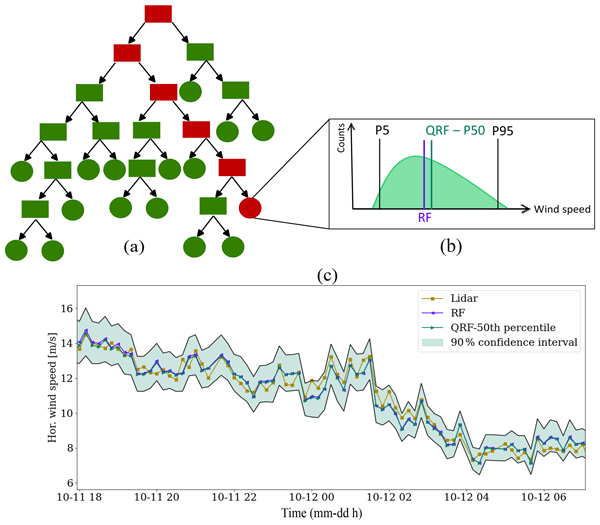
In wind energy, precise wind speed prediction at hub height is vital. Our study in the Dutch North Sea reveals that the on-site-trained random forest model outperforms the global reanalysis data, ERA5, in accuracy and precision. Trained within a 200 km range, the model effectively extends the wind speed vertically but experiences bias. It also outperforms ERA5 corrected with measurements in capturing wind speed variations and fine wind patterns, highlighting its potential for site assessment.
Martin Georg Jonietz Alvarez, Warren Watson, and Julia Gottschall
Wind Energ. Sci., 9, 2217–2233, https://doi.org/10.5194/wes-9-2217-2024, https://doi.org/10.5194/wes-9-2217-2024, 2024
Short summary
Short summary
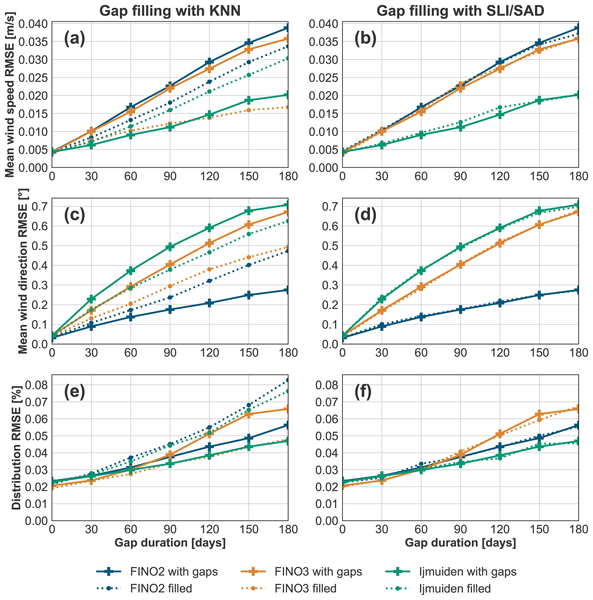
Offshore wind measurements are often affected by gaps. We investigated how these gaps affect wind resource assessments and whether filling them reduces their effect. We find that the effect of gaps on the estimated long-term wind resource is lower than expected and that data gap filling does not significantly change the outcome. These results indicate a need to reduce current wind data availability requirements for offshore measurement campaigns.
Marta Bertelè, Paul J. Meyer, Carlo R. Sucameli, Johannes Fricke, Anna Wegner, Julia Gottschall, and Carlo L. Bottasso
Wind Energ. Sci., 9, 1419–1429, https://doi.org/10.5194/wes-9-1419-2024, https://doi.org/10.5194/wes-9-1419-2024, 2024
Short summary
Short summary
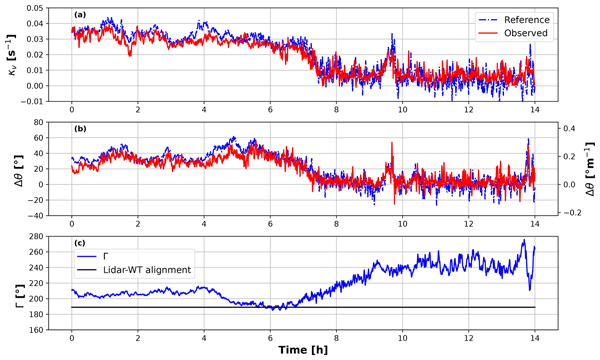
A neural observer is used to estimate shear and veer from the operational data of a large wind turbine equipped with blade load sensors. Comparison with independent measurements from a nearby met mast and profiling lidar demonstrate the ability of the
rotor as a sensorconcept to provide high-quality estimates of these inflow quantities based simply on already available standard operational data.
Moritz Gräfe, Vasilis Pettas, Julia Gottschall, and Po Wen Cheng
Wind Energ. Sci., 8, 925–946, https://doi.org/10.5194/wes-8-925-2023, https://doi.org/10.5194/wes-8-925-2023, 2023
Short summary
Short summary
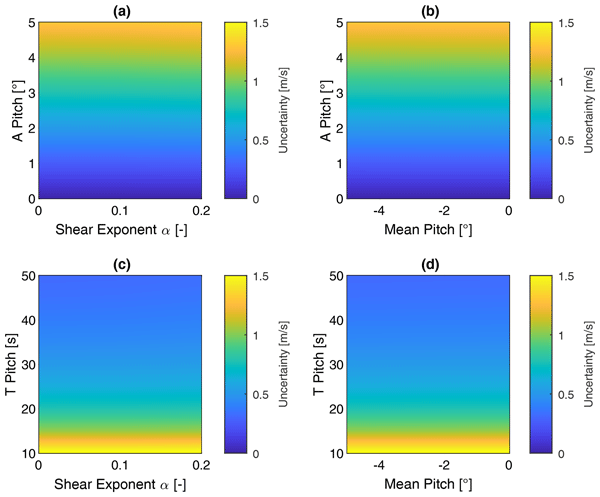
Inflow wind field measurements from nacelle-based lidar systems offer great potential for different applications including turbine control, load validation and power performance measurements. On floating wind turbines nacelle-based lidar measurements are affected by the dynamic behavior of the floating foundations. Therefore, the effects on lidar wind speed measurements induced by floater dynamics must be well understood. A new model for quantification of these effects is introduced in our work.
Hugo Rubio, Martin Kühn, and Julia Gottschall
Wind Energ. Sci., 7, 2433–2455, https://doi.org/10.5194/wes-7-2433-2022, https://doi.org/10.5194/wes-7-2433-2022, 2022
Short summary
Short summary
A proper development of offshore wind farms requires the accurate description of atmospheric phenomena like low-level jets. In this study, we evaluate the capabilities and limitations of numerical models to characterize the main jets' properties in the southern Baltic Sea. For this, a comparison against ship-mounted lidar measurements from the NEWA Ferry Lidar Experiment has been implemented, allowing the investigation of the model's capabilities under different temporal and spatial constraints.
Rieska Mawarni Putri, Etienne Cheynet, Charlotte Obhrai, and Jasna Bogunovic Jakobsen
Wind Energ. Sci., 7, 1693–1710, https://doi.org/10.5194/wes-7-1693-2022, https://doi.org/10.5194/wes-7-1693-2022, 2022
Short summary
Short summary
As offshore wind turbines' sizes are increasing, thorough knowledge of wind characteristics in the marine atmospheric boundary layer (MABL) is becoming crucial to help improve offshore wind turbine design and reliability. The present study discusses the wind characteristics at the first offshore wind farm, Vindeby, and compares them with the wind measurements at the FINO1 platform. Consistent wind characteristics are found between Vindeby measurements and the FINO1 measurements.
Etienne Cheynet, Martin Flügge, Joachim Reuder, Jasna B. Jakobsen, Yngve Heggelund, Benny Svardal, Pablo Saavedra Garfias, Charlotte Obhrai, Nicolò Daniotti, Jarle Berge, Christiane Duscha, Norman Wildmann, Ingrid H. Onarheim, and Marte Godvik
Atmos. Meas. Tech., 14, 6137–6157, https://doi.org/10.5194/amt-14-6137-2021, https://doi.org/10.5194/amt-14-6137-2021, 2021
Short summary
Short summary
The COTUR campaign explored the structure of wind turbulence above the ocean to improve the design of future multi-megawatt offshore wind turbines. Deploying scientific instruments offshore is both a financial and technological challenge. Therefore, lidar technology was used to remotely measure the wind above the ocean from instruments located on the seaside. The experimental setup is tailored to the study of the spatial correlation of wind gusts, which governs the wind loading on structures.
Cited articles
Allen, C., Viselli, A., Dagher, H., Goupee, A., Gaertner, E., Abbas, N., Hall, M., and Barter, G.: Definition of the UMaine VolturnUS-S Reference Platform Developed for the IEA Wind 15-Megawatt Offshore Reference Wind Turbine, Technical report NREL/TP-5000-76773, https://www.nrel.gov/docs/fy20osti/76773.pdf (last access: 15 November 2025), 2020. a
Bowen, A. J., Flay, R. G. K., and Panofsky, A.: Vertical coherence and phase delay between wind components in strong winds below 20 m, Bound.-Lay. Meteorol., 26, 313–324, https://doi.org/10.1007/BF00119530, 1983. a, b, c
Caughey, S. J.: Boundary-layer turbulence spectra in stable conditions, Bound.-Lay. Meteorol., 11, 3–14, https://doi.org/10.1007/BF00221819, 1977. a
Chen, Y., Schlipf, D., and Cheng, P. W.: Parameterization of wind evolution using lidar, Wind Energ. Sci., 6, 61–91, https://doi.org/10.5194/wes-6-61-2021, 2021. a
Cheynet, E., Jakobsen, J. B., Snæbjörnsson, J., Mikkelsen, T., Sjöholm, M., Mann, J., Hansen, P., Angelou, N., and Svardal, B.: Application of short-range dual-Doppler lidars to evaluate the coherence of turbulence, Exp. Fluids, 57, 184, https://doi.org/10.1007/s00348-016-2275-9, 2016a. a, b, c, d
Cheynet, E., Jakobsen, J. B., Svardal, B., Reuder, J., and Kumer, V.: Wind Coherence Measurement by a Single Pulsed Doppler Wind Lidar, Energ. Proced., 94, 462–477, https://doi.org/10.1016/j.egypro.2016.09.217, 2016b. a
Cheynet, E., Flügge, M., Reuder, J., Jakobsen, J. B., Heggelund, Y., Svardal, B., Saavedra Garfias, P., Obhrai, C., Daniotti, N., Berge, J., Duscha, C., Wildmann, N., Onarheim, I. H., and Godvik, M.: The COTUR project: remote sensing of offshore turbulence for wind energy application, Atmos. Meas. Tech., 14, 6137–6157, https://doi.org/10.5194/amt-14-6137-2021, 2021. a
Davenport, A. G.: The spectrum of horizontal gustiness near the ground in high winds, Q. J. Roy. Meteor. Soc., 87, 194–211, https://doi.org/10.1002/qj.49708737208, 1961. a
Davoust, S. and von Terzi, D.: Analysis of wind coherence in the longitudinal direction using turbine mounted lidar, J. Phys. Conf. Ser., 753, 072005, https://doi.org/10.1088/1742-6596/753/7/072005, 2016. a
Doubrawa, P., Churchfield, M. J., Godvik, M., and Sirnivas, S.: Load response of a floating wind turbine to turbulent atmospheric flow, Appl. Energy, 242, 1588–1599, https://doi.org/10.1016/j.apenergy.2019.01.165, 2019. a
Drobinski, P., Carlotti, P., Newsom, R. K., Banta, R. M., Foster, R. C., and Redelsperger, J.-L.: The Structure of the Near-Neutral Atmospheric Surface Layer, J. Atmos. Sci., 61, 699–714, https://doi.org/10.1175/1520-0469(2004)061<0699:TSOTNA>2.0.CO;2, 2004. a
ESA: Copernicus Global Digital Elevation Model, OpenTopography [data set], https://doi.org/10.5069/G9028PQB (last access: 9 March 2026), 2024. a, b
Giyanani, A., Sjöholm, M., Thorsen, G. R., Schuhmacher, and Gottschall, J.: Wind speed reconstruction from three synchronized short-range WindScanner lidars in a large wind turbine inflow field campaign and the associated uncertainties, J. Phys. Conf. Ser., 2265, 022032, https://doi.org/10.1088/1742-6596/2265/2/022032, 2022. a, b, c
Højstrup, J.: Velocity Spectra in the Unstable Planetary Boundary Layer, J. Atmos. Sci., 39, 2239–2248, https://doi.org/10.1175/1520-0469(1982)039<2239:VSITUP>2.0.CO;2, 1982. a
Hui, M. C. H., Larsen, A., and Xiang, H. F.: Wind turbulence characteristics study at the Stonecutters Bridge site: Part II: Wind power spectra, integral length scales and coherences, J. Wind Eng. Ind. Aerod., 97, 48–59, https://doi.org/10.1016/j.jweia.2008.11.003, 2009. a
Kaimal, J. C., Wyngaard, J. C., Izumi, Y., and Coté, O. R.: Spectral characteristics of surface-layer turbulence, Q. J. Roy. Meteor. Soc., 98, 563–589, https://doi.org/10.1002/qj.49709841707, 1972. a, b
Knight, J. M. and Obhrai, C.: The influence of an unstable turbulent wind spectrum on the loads and motions on floating Offshore Wind Turbines, IOP Conf. Ser.: Mater. Sci. Eng., 700, 012005, https://doi.org/10.1088/1757-899X/700/1/012005, 2019. a
Kraichnan, R. H.: Inertial Ranges in Two‐Dimensional Turbulence, Phys. Fluids, 10, 1417–1423, https://doi.org/10.1063/1.1762301, 1967. a
Larsén, X. G., Larsen, S. E., and Petersen, E. L.: Full-Scale Spectrum of Boundary-Layer Winds, Bound.-Lay. Meteorol., 159, 349–371, https://doi.org/10.1007/s10546-016-0129-x, 2016. a, b, c
Lothon, M., Lenschow, D. H., and Mayor, S. D.: Coherence and Scale of Vertical Velocity in the Convective Boundary Layer from a Doppler Lidar, Bound.-Lay. Meteorol., 121, 521–536, https://doi.org/10.1007/s10546-006-9077-1, 2006. a
Mann, J.: The spatial structure of neutral atmospheric surface-layer turbulence, J. Fluid Mech., 273, 141–168, https://doi.org/10.1017/S0022112094001886, 1994. a, b
Mann, J., Patel, A., Sjöholm, M., Rolighed Thorsen, G., Simon, E. I., Hung, L.-Y., and Gottschall, J.: An experimental campaign to measure turbulence in the marine boundary layer, Wind Energ. Sci., 11, 3153–3170, https://doi.org/10.5194/wes-11-3153-2026, 2026. a
Meyer, P.: Sonic anemometers post processing report, Tech. rep., Fraunhofer Institute for Wind Energy Systems (IWES), 2024. a
Meyer, P. J., Giyanani, A., and Gottschall, J.: Constrained synthetic wind fields from high-resolution 3D WindScanner measurements, J. Phys. Conf. Ser., 2767, 042036, https://doi.org/10.1088/1742-6596/2767/4/042036, 2024. a
Midjiyawa, Z., Cheynet, E., Reuder, J., Ágústsson, H., and Kvamsdal, T.: Potential and challenges of wind measurements using met-masts in complex topography for bridge design: Part II – Spectral flow characteristics, J. Wind Eng. Ind. Aerod., 211, 104585, https://doi.org/10.1016/j.jweia.2021.104585, 2021. a
Mikkelsen, T. K., Larsen, S. E., Jørgensen, H. E., Astrup, P., and Larsén, X. G.: Scaling of turbulence spectra measured in strong shear flow near the Earth’s surface, Phys. Scr., 92, 124002, https://doi.org/10.1088/1402-4896/aa91b2, 2017a. a
Mikkelsen, T. K., Sjöholm, M., Angelou, N., and Mann, J.: 3D WindScanner lidar measurements of wind and turbulence around wind turbines, buildings and bridges, IOP Conf. Ser.: Mater. Sci. Eng, 276, 012004, https://doi.org/10.1088/1757-899X/276/1/012004, 2017b. a
Nafisifard, M., Jakobsen, J. B., Snæbjörnsson, J. T., Sjöholm, M., and Mann, J.: Triple-lidar measurements of wind across a virtual rotor plane over a sea surface, J. Phys. Conf. Ser., 2626, 012022, https://doi.org/10.1088/1742-6596/2626/1/012022, 2023. a
Nastrom, G. D., Jasperson, W. H., and Gage, K. S.: Kinetic energy spectrum of large- and mesoscale atmospheric processes, Nature, 310, 36–38, https://doi.org/10.1038/310036a0, 1984. a
Nybø, A., Nielsen, F. G., and Godvik, M.: Quasi-static response of a bottom-fixed wind turbine subject to various incident wind fields, Wind Energy, 24, 1482–1500, https://doi.org/10.1002/we.2642, 2021. a, b
Nybø, A., Nielsen, F. G., and Godvik, M.: Sensitivity of the dynamic response of a multimegawatt floating wind turbine to the choice of turbulence model, Wind Energy, 25, 1013–1029, https://doi.org/10.1002/we.2712, 2022. a
Patel, A., Mann, J., Sjöholm, M., Thorsen, G. R., Syed, A. H., Simon, E. I., Hung, L.-Y., and Gottschall, J.: Lidar observations of turbulence for tall offshore wind turbines, J. Fluid Mech., 1028, A9, https://doi.org/10.1017/jfm.2025.11103, 2026. a, b, c
Pereira, D.: Wind Rose, https://se.mathworks.com/matlabcentral/fileexchange/47248-wind-rose, (last access: 13 March 2026), 2026. a
Putri, R. M., Obhrai, C., and Jakobsen, J. B.: Response sensitivity of a semisubmersible floating offshore wind turbine to different wind spectral models, J. Phys. Conf. Ser., 1618, 022012, https://doi.org/10.1088/1742-6596/1618/2/022012, 2020a. a
Putri, R. M., Obhrai, C., Jakobsen, J. B., and Ong, M. C.: Numerical Analysis of the Effect of Offshore Turbulent Wind Inflow on the Response of a Spar Wind Turbine, Energies, 13, 2506, https://doi.org/10.3390/en13102506, 2020b. a
Rivera-Arreba, I., Wise, A. S., Hermile, M., Chow, F. K., and Bachynski-Polić, E. E.: Effects of atmospheric stability on the structural response of a 12 MW semisubmersible floating wind turbine, Wind Energy, 25, 1917–1937, https://doi.org/10.1002/we.2775, 2022. a, b
Robertson, A. N., Shaler, K., Sethuraman, L., and Jonkman, J.: Sensitivity analysis of the effect of wind characteristics and turbine properties on wind turbine loads, Wind Energ. Sci., 4, 479–513, https://doi.org/10.5194/wes-4-479-2019, 2019. a
Schotanus, P., Nieuwstadt, F., and De Bruin, H.: Temperature measurement with a sonic anemometer and its application to heat and moisture fluxes, Bound.-Lay. Meteorol., 26, 81–93, https://doi.org/10.1007/BF00164332, 1983. a
Skaare, B., Nielsen, F. G., Hanson, T. D., Yttervik, R., Havmøller, O., and Rekdal, A.: Analysis of measurements and simulations from the Hywind Demo floating wind turbine, Wind Energy, 18, 1105–1122, https://doi.org/10.1002/we.1750, 2015. a
Syed, A. H. and Mann, J.: A Model for Low-Frequency, Anisotropic Wind Fluctuations and Coherences in the Marine Atmosphere, Bound.-Lay. Meteorol., 190, 1, https://doi.org/10.1007/s10546-023-00850-w, 2024. a, b
Syed, A. H., Hannesdóttir, Á., and Mann, J.: Dynamic response and loads analysis of a large offshore wind turbine under low-frequency wind fluctuations, Wind Energ. Sci., 11, 3321–3336, https://doi.org/10.5194/wes-11-3321-2026, 2026. a
Vogt, L.: Wind turbulence spectra and spatial coherence at Testfeld BHV, Zenodo [data set], https://doi.org/10.5281/zenodo.19632137, 2026. a
Vogt, L., Gottschall, J., and Jakobsen, J. B.: Vertical and Lateral Wind Coherence Estimation Using Three Synchronized Continuous-Wave Lidars, J. Phys. Conf. Ser., 3224, 022001, https://doi.org/10.1088/1742-6596/3224/2/022001, 2026. a
Welch, P.: The use of fast Fourier transform for the estimation of power spectra: a method based on time averaging over short, modified periodograms, IEEE Trans. Audio Electroacoust., 15, 70–73, https://doi.org/10.1109/TAU.1967.1161901, 1967. a
Wiley, W., Jonkman, J., Robertson, A., and Shaler, K.: Sensitivity analysis of numerical modeling input parameters on floating offshore wind turbine loads, Wind Energ. Sci., 8, 1575–1595, https://doi.org/10.5194/wes-8-1575-2023, 2023. a
Short summary
A combined dataset of sonic and cup anemometer measurements, together with synchronized short-range lidar observations, is used to derive turbulence characteristics, including integral length scales, auto-spectra, and spatial coherence. The instruments exhibit strong agreement and consistent trends across atmospheric stability. Deviations at high frequencies are attributed to spatial averaging effects. Empirical models fitted to the data closely reproduce the spectral estimates.
A combined dataset of sonic and cup anemometer measurements, together with synchronized...


Altmetrics
Final-revised paper
Preprint