
Articles | Volume 11, issue 8
https://doi.org/10.5194/wes-11-3077-2026
© Author(s) 2026. This work is distributed under
the Creative Commons Attribution 4.0 License.
the Creative Commons Attribution 4.0 License.
https://doi.org/10.5194/wes-11-3077-2026
© Author(s) 2026. This work is distributed under
the Creative Commons Attribution 4.0 License.
the Creative Commons Attribution 4.0 License.
Research article
| 
27 Aug 2026
Research article |
| 27 Aug 2026
| 27 Aug 2026
On the effects of bat protection strategies on energy production and structural loads of wind farms

DTU Wind and Energy Systems, Technical University of Denmark, Roskilde, Denmark
Tuhfe Göçmen
DTU Wind and Energy Systems, Technical University of Denmark, Roskilde, Denmark
Thomas Duc
ENGIE Green France, 6 rue Alexander Fleming, 69007 Lyon, France
Andreas Vad
Wind Energy Institute, Technical University of Munich, Garching b. München, Germany
Antonina Vukobrat
Wind Energy Institute, Technical University of Munich, Garching b. München, Germany
Related authors
Andreas Vad, Adrien Guilloré, Abhinav Anand, Vasilis Pettas, Anik H. Shah, Ion Lizarraga-Saenz, Maria Aparicio-Sanchez, Irene Eguinoa, Nicolau Conti Gost, Iasonas Tsaklis, Ariane Frère, Koen W. Hermans, Joseph K. Kamau, Nikolay Dimitrov, Tuhfe Göçmen, and Carlo L. Bottasso
Wind Energ. Sci. Discuss., https://doi.org/10.5194/wes-2026-45, https://doi.org/10.5194/wes-2026-45, 2026
Revised manuscript under review for WES
Short summary
Short summary
A modular, computationally efficient framework for wind‑farm response modeling is presented. It combines an engineering wake model with surrogate models trained on extensive aeroelastic simulations generated using a novel method for synthetic waked and clean inflows. The wind‑farm‑agnostic framework supports multiple turbine types and layouts, enabling accurate, low‑cost predictions for design, operation, and control.
Moritz Gräfe, Vasilis Pettas, Nikolay Dimitrov, and Po Wen Cheng
Wind Energ. Sci., 9, 2175–2193, https://doi.org/10.5194/wes-9-2175-2024, https://doi.org/10.5194/wes-9-2175-2024, 2024
Short summary
Short summary
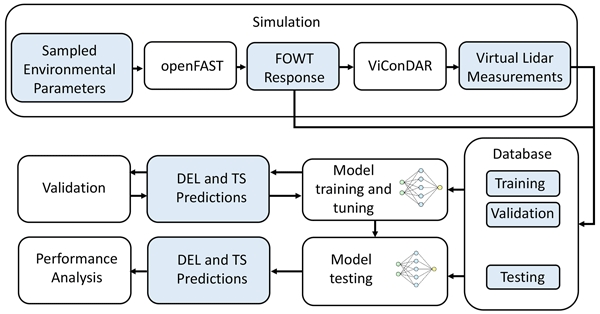
This study explores a methodology using floater motion and nacelle-based lidar wind speed measurements to estimate the tension and damage equivalent loads (DELs) on floating offshore wind turbines' mooring lines. Results indicate that fairlead tension time series and DELs can be accurately estimated from floater motion time series. Using lidar measurements as model inputs for DEL predictions leads to similar accuracies as using displacement measurements of the floater.
Moritz Gräfe, Vasilis Pettas, Julia Gottschall, and Po Wen Cheng
Wind Energ. Sci., 8, 925–946, https://doi.org/10.5194/wes-8-925-2023, https://doi.org/10.5194/wes-8-925-2023, 2023
Short summary
Short summary
Inflow wind field measurements from nacelle-based lidar systems offer great potential for different applications including turbine control, load validation and power performance measurements. On floating wind turbines nacelle-based lidar measurements are affected by the dynamic behavior of the floating foundations. Therefore, the effects on lidar wind speed measurements induced by floater dynamics must be well understood. A new model for quantification of these effects is introduced in our work.
Konstanze Kölle, Tuhfe Göçmen, Irene Eguinoa, Leonardo Andrés Alcayaga Román, Maria Aparicio-Sanchez, Ju Feng, Johan Meyers, Vasilis Pettas, and Ishaan Sood
Wind Energ. Sci., 7, 2181–2200, https://doi.org/10.5194/wes-7-2181-2022, https://doi.org/10.5194/wes-7-2181-2022, 2022
Short summary
Short summary
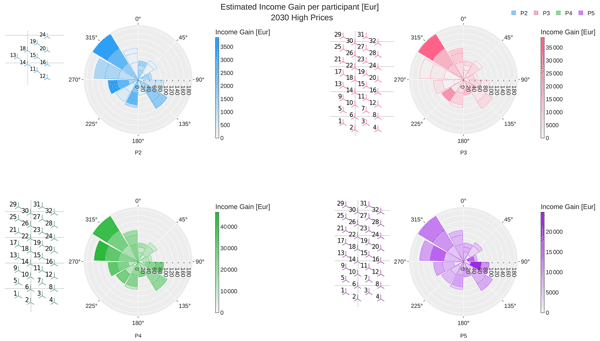
The paper studies wind farm flow control (WFFC) in simulations with variable electricity prices. The results indicate that considering the electricity price in the operational strategy can be beneficial with respect to the gained income compared to focusing on the power gain only. Moreover, revenue maximization by balancing power production and structural load reduction is demonstrated at the example of a single wind turbine.
Vasilis Pettas, Matthias Kretschmer, Andrew Clifton, and Po Wen Cheng
Wind Energ. Sci., 6, 1455–1472, https://doi.org/10.5194/wes-6-1455-2021, https://doi.org/10.5194/wes-6-1455-2021, 2021
Short summary
Short summary
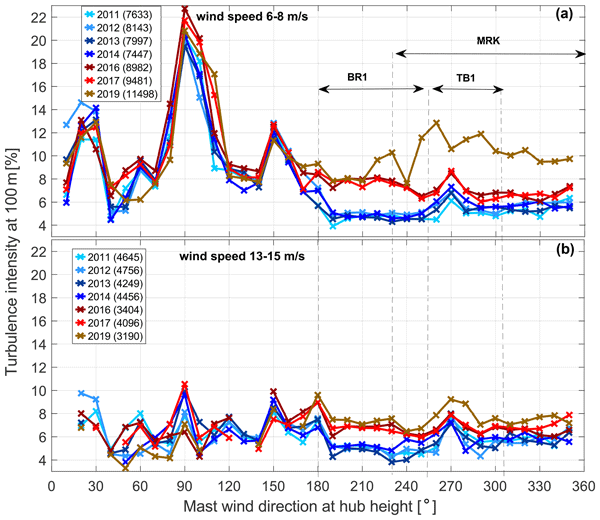
This study aims to quantify the effect of inter-farm interactions based on long-term measurement data from the Alpha Ventus (AV) wind farm and the nearby FINO1 platform. AV was initially the only operating farm in the area, but in subsequent years several farms were built around it. This setup allows us to quantify the farm wake effects on the microclimate of AV and also on turbine loads and operational characteristics depending on the distance and size of the neighboring farms.
Thomas Duc and Arthur Finez
Wind Energ. Sci., 11, 3249–3272, https://doi.org/10.5194/wes-11-3249-2026, https://doi.org/10.5194/wes-11-3249-2026, 2026
Short summary
Short summary
This work presents the outcomes of an acoustic experimental campaign conducted on an industrial wind turbine under normal operation and yaw misalignment. The objective of this test was to study the effect of yaw misalignment on turbine noise magnitude and directivity. The results show a slight increase in the noise emitted by the turbine when it is misaligned and a rotation of the noise directivity pattern consistent with the rotation of the nacelle.
Mauricio Souza de Alencar, Tuhfe Göçmen, and Nicolaos A. Cutululis
Wind Energ. Sci. Discuss., https://doi.org/10.5194/wes-2026-124, https://doi.org/10.5194/wes-2026-124, 2026
Preprint under review for WES
Short summary
Short summary
This study created a large public collection of optimized cable layouts for real, built offshore wind farms, planned projects, and computer-generated sites. By comparing several design choices and solving approaches across thousands of cases, it shows how architectural constraints affect cable use and problem difficulty. The results reveal when branching can reduce cable needs and provide a reliable basis for improving future wind farm design, testing new methods, and training data-driven tools.
Andreas Vad, Adrien Guilloré, Abhinav Anand, Vasilis Pettas, Anik H. Shah, Ion Lizarraga-Saenz, Maria Aparicio-Sanchez, Irene Eguinoa, Nicolau Conti Gost, Iasonas Tsaklis, Ariane Frère, Koen W. Hermans, Joseph K. Kamau, Nikolay Dimitrov, Tuhfe Göçmen, and Carlo L. Bottasso
Wind Energ. Sci. Discuss., https://doi.org/10.5194/wes-2026-45, https://doi.org/10.5194/wes-2026-45, 2026
Revised manuscript under review for WES
Short summary
Short summary
A modular, computationally efficient framework for wind‑farm response modeling is presented. It combines an engineering wake model with surrogate models trained on extensive aeroelastic simulations generated using a novel method for synthetic waked and clean inflows. The wind‑farm‑agnostic framework supports multiple turbine types and layouts, enabling accurate, low‑cost predictions for design, operation, and control.
Charbel Assaad, Juan Pablo Murcia Leon, Julian Quick, Tuhfe Göçmen, Sami Ghazouani, and Kaushik Das
Wind Energ. Sci., 10, 559–578, https://doi.org/10.5194/wes-10-559-2025, https://doi.org/10.5194/wes-10-559-2025, 2025
Short summary
Short summary
This research develops a new method for assessing hybrid power plant (HPP) profitability, combining wind and battery systems. It addresses the need for an efficient, accurate, and comprehensive operational model by approximating a state-of-the-art energy management system (EMS) for spot market power bidding using machine learning. The approach significantly reduces computational demands while maintaining high accuracy. It thus opens new possibilities in terms of optimizing the design of HPPs.
Moritz Gräfe, Vasilis Pettas, Nikolay Dimitrov, and Po Wen Cheng
Wind Energ. Sci., 9, 2175–2193, https://doi.org/10.5194/wes-9-2175-2024, https://doi.org/10.5194/wes-9-2175-2024, 2024
Short summary
Short summary
This study explores a methodology using floater motion and nacelle-based lidar wind speed measurements to estimate the tension and damage equivalent loads (DELs) on floating offshore wind turbines' mooring lines. Results indicate that fairlead tension time series and DELs can be accurately estimated from floater motion time series. Using lidar measurements as model inputs for DEL predictions leads to similar accuracies as using displacement measurements of the floater.
Jens Visbech, Tuhfe Göçmen, Özge Sinem Özçakmak, Alexander Meyer Forsting, Ásta Hannesdóttir, and Pierre-Elouan Réthoré
Wind Energ. Sci., 9, 1811–1826, https://doi.org/10.5194/wes-9-1811-2024, https://doi.org/10.5194/wes-9-1811-2024, 2024
Short summary
Short summary
Leading-edge erosion (LEE) can impact wind turbine aerodynamics and wind farm efficiency. This study couples LEE prediction, aerodynamic loss modeling, and wind farm flow modeling to show that LEE's effects on wake dynamics can affect overall energy production. Without preventive initiatives, the effects of LEE increase over time, resulting in significant annual energy production (AEP) loss.
Jaime Liew, Tuhfe Göçmen, Alan W. H. Lio, and Gunner Chr. Larsen
Wind Energ. Sci., 8, 1387–1402, https://doi.org/10.5194/wes-8-1387-2023, https://doi.org/10.5194/wes-8-1387-2023, 2023
Short summary
Short summary
We present recent research on dynamically modelling wind farm wakes and integrating these enhancements into the wind farm simulator, HAWC2Farm. The simulation methodology is showcased by recreating dynamic scenarios observed in the Lillgrund offshore wind farm. We successfully recreate scenarios with turning winds, turbine shutdown events, and wake deflection events. The research provides opportunities to better identify wake interactions in wind farms, allowing for more reliable designs.
Moritz Gräfe, Vasilis Pettas, Julia Gottschall, and Po Wen Cheng
Wind Energ. Sci., 8, 925–946, https://doi.org/10.5194/wes-8-925-2023, https://doi.org/10.5194/wes-8-925-2023, 2023
Short summary
Short summary
Inflow wind field measurements from nacelle-based lidar systems offer great potential for different applications including turbine control, load validation and power performance measurements. On floating wind turbines nacelle-based lidar measurements are affected by the dynamic behavior of the floating foundations. Therefore, the effects on lidar wind speed measurements induced by floater dynamics must be well understood. A new model for quantification of these effects is introduced in our work.

Robert Braunbehrens, Andreas Vad, and Carlo L. Bottasso
Wind Energ. Sci., 8, 691–723, https://doi.org/10.5194/wes-8-691-2023, https://doi.org/10.5194/wes-8-691-2023, 2023
Short summary
Short summary
The paper presents a new method in which wind turbines in a wind farm act as local sensors, in this way detecting the flow that develops within the power plant. Through this technique, we are able to identify effects on the flow generated by the plant itself and by the orography of the terrain. The new method not only delivers a flow model of much improved quality but can also help in understanding phenomena that drive the farm performance.
Jens Visbech, Tuhfe Göçmen, Charlotte Bay Hasager, Hristo Shkalov, Morten Handberg, and Kristian Pagh Nielsen
Wind Energ. Sci., 8, 173–191, https://doi.org/10.5194/wes-8-173-2023, https://doi.org/10.5194/wes-8-173-2023, 2023
Short summary
Short summary
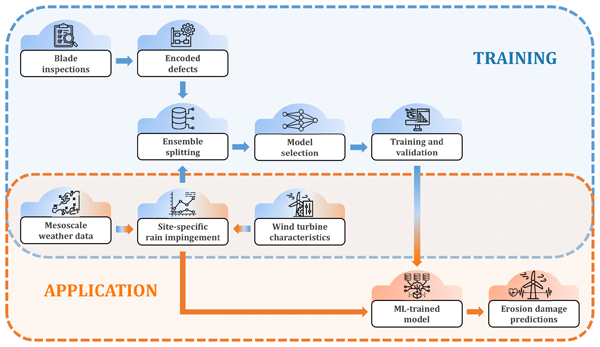
This paper presents a data-driven framework for modeling erosion damage based on real blade inspections and mesoscale weather data. The outcome of the framework is a machine-learning-based model that can predict and/or forecast leading-edge erosion damage based on weather data and user-specified wind turbine characteristics. The model output fits directly into the damage terminology used by the industry and can therefore support site-specific maintenance planning and scheduling of repairs.
Johan Meyers, Carlo Bottasso, Katherine Dykes, Paul Fleming, Pieter Gebraad, Gregor Giebel, Tuhfe Göçmen, and Jan-Willem van Wingerden
Wind Energ. Sci., 7, 2271–2306, https://doi.org/10.5194/wes-7-2271-2022, https://doi.org/10.5194/wes-7-2271-2022, 2022
Short summary
Short summary
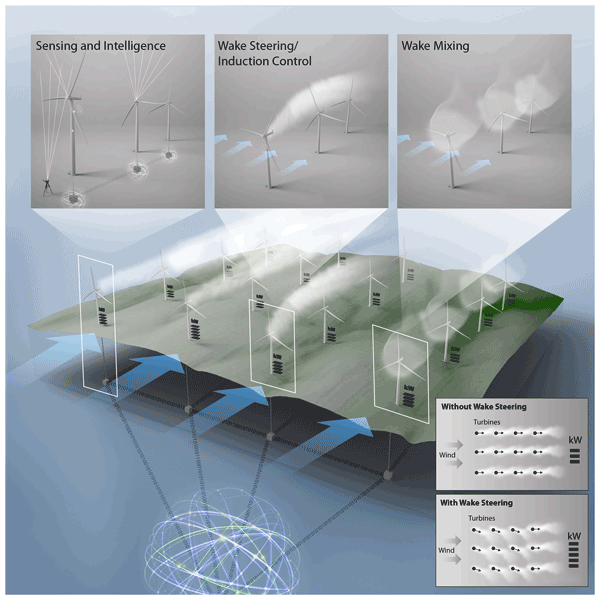
We provide a comprehensive overview of the state of the art and the outstanding challenges in wind farm flow control, thus identifying the key research areas that could further enable commercial uptake and success. To this end, we have structured the discussion on challenges and opportunities into four main areas: (1) insight into control flow physics, (2) algorithms and AI, (3) validation and industry implementation, and (4) integrating control with system design
(co-design).
Konstanze Kölle, Tuhfe Göçmen, Irene Eguinoa, Leonardo Andrés Alcayaga Román, Maria Aparicio-Sanchez, Ju Feng, Johan Meyers, Vasilis Pettas, and Ishaan Sood
Wind Energ. Sci., 7, 2181–2200, https://doi.org/10.5194/wes-7-2181-2022, https://doi.org/10.5194/wes-7-2181-2022, 2022
Short summary
Short summary
The paper studies wind farm flow control (WFFC) in simulations with variable electricity prices. The results indicate that considering the electricity price in the operational strategy can be beneficial with respect to the gained income compared to focusing on the power gain only. Moreover, revenue maximization by balancing power production and structural load reduction is demonstrated at the example of a single wind turbine.
Tuhfe Göçmen, Filippo Campagnolo, Thomas Duc, Irene Eguinoa, Søren Juhl Andersen, Vlaho Petrović, Lejla Imširović, Robert Braunbehrens, Jaime Liew, Mads Baungaard, Maarten Paul van der Laan, Guowei Qian, Maria Aparicio-Sanchez, Rubén González-Lope, Vinit V. Dighe, Marcus Becker, Maarten J. van den Broek, Jan-Willem van Wingerden, Adam Stock, Matthew Cole, Renzo Ruisi, Ervin Bossanyi, Niklas Requate, Simon Strnad, Jonas Schmidt, Lukas Vollmer, Ishaan Sood, and Johan Meyers
Wind Energ. Sci., 7, 1791–1825, https://doi.org/10.5194/wes-7-1791-2022, https://doi.org/10.5194/wes-7-1791-2022, 2022
Short summary
Short summary
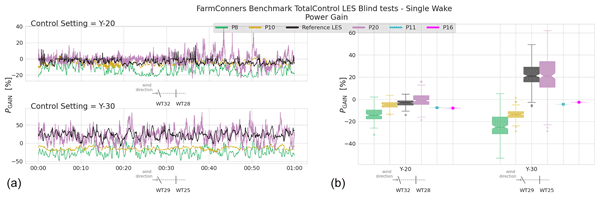
The FarmConners benchmark is the first of its kind to bring a wide variety of data sets, control settings, and model complexities for the (initial) assessment of wind farm flow control benefits. Here we present the first part of the benchmark results for three blind tests with large-scale rotors and 11 participating models in total, via direct power comparisons at the turbines as well as the observed or estimated power gain at the wind farm level under wake steering control strategy.
Vasilis Pettas, Matthias Kretschmer, Andrew Clifton, and Po Wen Cheng
Wind Energ. Sci., 6, 1455–1472, https://doi.org/10.5194/wes-6-1455-2021, https://doi.org/10.5194/wes-6-1455-2021, 2021
Short summary
Short summary
This study aims to quantify the effect of inter-farm interactions based on long-term measurement data from the Alpha Ventus (AV) wind farm and the nearby FINO1 platform. AV was initially the only operating farm in the area, but in subsequent years several farms were built around it. This setup allows us to quantify the farm wake effects on the microclimate of AV and also on turbine loads and operational characteristics depending on the distance and size of the neighboring farms.
Eric Simley, Paul Fleming, Nicolas Girard, Lucas Alloin, Emma Godefroy, and Thomas Duc
Wind Energ. Sci., 6, 1427–1453, https://doi.org/10.5194/wes-6-1427-2021, https://doi.org/10.5194/wes-6-1427-2021, 2021
Short summary
Short summary
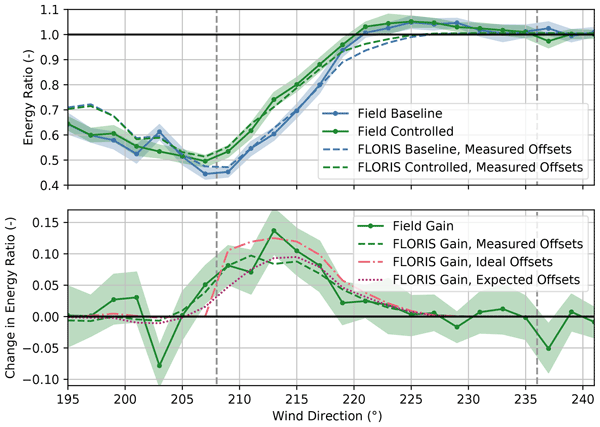
Wake steering is a wind farm control strategy in which upstream wind turbines are misaligned with the wind to deflect their low-velocity wakes away from downstream turbines, increasing overall power production. Here, we present results from a two-turbine wake-steering experiment at a commercial wind plant. By analyzing the wind speed dependence of wake steering, we find that the energy gained tends to increase for higher wind speeds because of both the wind conditions and turbine operation.
Cited articles
Adams, E. M., Gulka, J., and Williams, K. A.: A review of the effectiveness of operational curtailment for reducing bat fatalities at terrestrial wind farms in North America, PLoS ONE, 16, https://doi.org/10.1371/journal.pone.0256382, 2021. a
Ardillon, E., Bakhoday Paskyabi, M., Cousin, A., Dimitrov, N., Dupoiron, M., Eldevik, S., Fekhari, E., Ferreira, C., Guiton, M., Jezequel, B., Joulin, P.-A., Lovera, A., Mayol, L., and Penchah, M. R.: Turbine Loading and Wake Model Uncertainty, D3-2, European Union, https://hal.science/hal-04096504 (last access: 25 August 2026), 2023. a
Arnett, E. B. and May, R. F.: Mitigating wind energy impacts on wildlife: approaches for multiple taxa, Human–Wildlife Interactions, 10, 28–41, https://www.jstor.org/stable/10.2307/24874154 (last access: 25 August 2026), 2016. a
Arnett, E. B., Huso, M. M., Schirmacher, M. R., and Hayes, J. P.: Altering turbine speed reduces bat mortality at wind-energy facilities, Front. Ecol. Environ., 9, 209–214, https://doi.org/10.1890/100103, 2011. a
Bennett, E. M., Florent, S. N., Venosta, M., Gibson, M., Jackson, A., and Stark, E.: Curtailment as a successful method for reducing bat mortality at a southern Australian wind farm, Austral Ecol., 47, 1329–1339, https://doi.org/10.1111/aec.13220, 2022. a
BirdLife International: BirdLife Position on Wind Energy and Birds and Bats in the European Union, Position paper, EU Birds and Habitats Directive Task Force, BirdLife International, https://ornithologiki.gr/images/ekdoseis/pdf/2016_Wind_energy_birds_and_bats_BirdLife.pdf (last access: 25 August 2026), 2016. a, b
Bortolotti, P., Tarres, H. C., Dykes, K., Merz, K., Sethuraman, L., Verelst, D., and Zahle, F.: IEA Wind Task 37 on Systems Engineering in Wind Energy – WP2.1 Reference Wind Turbines, Tech. rep., International Energy Agency, https://www.osti.gov/biblio/1529216 (last access:25 August 2026), 2019. a
Braunbehrens, R., Vad, A., and Bottasso, C. L.: The wind farm as a sensor: learning and explaining orographic and plant-induced flow heterogeneities from operational data, Wind Energ. Sci., 8, 691–723, https://doi.org/10.5194/wes-8-691-2023, 2023. a, b
Crespo, A. and Hernández, J.: Turbulence characteristics in wind-turbine wakes, J. Wind Eng. Ind. Aerod., 61, 71–85, https://doi.org/10.1016/0167-6105(95)00033-X, 1996. a
Cryan, P. M., Gorresen, P. M., Hein, C. D., Schirmacher, M. R., Diehl, R. H., Huso, M. M., Hayman, D. T. S., Fricker, P. D., Bonaccorso, F. J., Johnson, D. H., Heist, K., and Dalton, D. C.: Behavior of bats at wind turbines, P. Natl. Acad. Sci. USA, 111, 15126–15131, https://doi.org/10.1073/pnas.1406672111, 2014. a
Doubrawa, P., Shaler, K., and Jonkman, J.: Difference in load predictions obtained with effective turbulence vs. a dynamic wake meandering modeling approach, Wind Energ. Sci., 8, 1475–1493, https://doi.org/10.5194/wes-8-1475-2023, 2023. a
ecoObs GmbH: batcorder 3.1: Automatic recording of bat calls in real-time, Product webpage, https://ecoobs.com/batcorder.html (last access: 10 March 2026). a
Ellerbrok, J. S., Farwig, N., Peter, F., Rehling, F., and Voigt, C. C.: Forest gaps around wind turbines attract bat species with high collision risk, Biol. Conserv., 288, https://doi.org/10.1016/j.biocon.2023.110347, 2023. a
Elmeros, M. and Møller, J. D.: Flagermus, vindmøller og solceller: Uddybning af udvalgte emner i Håndbog om dyrearter på Habitatdirektivets bilag IV, del 2, Fagligt notat (rådgivningsnotat) 2025|07, Aarhus Universitet, DCE – Nationalt Center for Miljø og Energi, institut for Ecoscience. Rekvirent: Miljøstyrelsen (nu Styrelsen for Grøn Arealomlægning og Vandmiljø), https://pure.au.dk/portal/da/publications/flagermus-vindmøller-og-solceller-uddybning-af-udvalgte-emner-i-h/ (last access: 25 August 2026), 2025. a
Fleming, P., Annoni, J., and Mudafort, R.: FLORIS v3.5 Wake Modeling and Wind Farm Controls Software [SWR-17-43 and SWR-14-20], https://doi.org/10.11578/dc.20230807.1, 2023. a, b
Frick, W. F., Whitby, M., Wilson, D., MacEwan, K. L., Hulka, S., Akre, K. L., and O'Mara, M. T.: A global decision framework for reducing bat fatalities at wind energy facilities, Ecological Solutions and Evidence, 7, e70189, https://doi.org/10.1002/2688-8319.70189, 2026. a
Garcia-Rosa, P. B. and Tande, J. O. G.: Mitigation measures for preventing collision of birds with wind turbines, J. Phys. Conf. Ser., 2626, 012072, https://doi.org/10.1088/1742-6596/2626/1/012072, 2023. a
Gräfe, M., Pettas, V., and Dimitrov, N.: WINPACT (Version v1.0.0), Zenodo [code], https://doi.org/10.5281/zenodo.17641606, 2025. a
Gräfe, M., Pettas, V., Ioannou, A., Kolios, A., and Dimitrov, N.: Wind farm project valuation under revenue-driven farm control considering life time extension, J. Phys. Conf. Ser., 3224, 062063, https://doi.org/10.1088/1742-6596/3224/6/062063, 2026. a
Groupe Chiroptères de la SFEPM: Diagnostic chiroptèrologique des projets éoliens terrestres: Actualisation 2016 des recommandations de la SFEPM, Tech. rep., Société Française pour l'Étude et la Protection des Mammifères (SFEPM), Paris, France, https://www.sfepm.org/sites/default/files/inline-files/20160201_diagnostic_V2.1.pdf (last access: 25 August 2026), 2016. a
Guilloré, A., Chaudhary, A., Anand, A., Vad, A., Shah, A. H., Pettas, V., Göçmen, T., and Bottasso, C. L.: Efficient generation of location-agnostic wind turbine load surrogate models using wake slices, J. Phys. Conf. Ser., 3224, 032106, https://doi.org/10.1088/1742-6596/3224/3/032106, 2026. a
Guilloré, A., Campagnolo, F., and Bottasso, C. L.: A control-oriented load surrogate model based on sector-averaged inflow quantities: capturing damage for unwaked, waked, wake-steering and curtailed wind turbines, J. Phys. Conf. Ser., 2767, 032019, https://doi.org/10.1088/1742-6596/2767/3/032019, 2024. a
Hayes, M. A., Hooton, L. A., Gilland, K. L., Grandgent, C., Smith, R. L., Lindsay, S. R., Collins, J. D., Schumacher, S. M., Rabie, P. A., Gruver, J. C., and Goodrich-Mahoney, J.: A smart curtailment approach for reducing bat fatalities and curtailment time at wind energy facilities, Ecol. Appl., 29, https://doi.org/10.1002/eap.1881, 2019. a
Hersbach, H., Bell, B., Berrisford, P., Hirahara, S., Horányi, A., Muñoz Sabater, J., Nicolas, J., Peubey, C., Radu, R., Schepers, D., Simmons, A., Soci, C., Abdalla, S., Abellan, X., Balsamo, G., Bechtold, P., Biavati, G., Bidlot, J.-R., Bonavita, M., De Chiara, G., Dahlgren, P., Dee, D., Diamantakis, M., Dragani, R., Flemming, J., Forbes, R., Fuentes, M., Geer, A., Haimberger, L., Healy, S., Hogan, R. J., Hólm, E., Janisková, M., Keeley, S., Laloyaux, P., Lopez, P., Lupu, C., Radnoti, G., de Rosnay, P., Rozum, I., Vamborg, F., Villaume, S., and Thépaut, J.-N.: The ERA5 global reanalysis, Q. J. Roy. Meteor. Soc., 146, 1999–2049, https://doi.org/10.1002/qj.3803, 2020. a
International Electrotechnical Commission: Wind energy generation systems – Part 1: Design requirements, IEC 61400-1:2019, https://webstore.iec.ch/en/publication/26423 (last access: 25 August 2026), 2019. a
King, J., Fleming, P., King, R., Martínez-Tossas, L. A., Bay, C. J., Mudafort, R., and Simley, E.: Control-oriented model for secondary effects of wake steering, Wind Energ. Sci., 6, 701–714, https://doi.org/10.5194/wes-6-701-2021, 2021. a
Kunz, T. H., Arenett, E. B., Cooper, B. M., Erickson, W. P., Larkin, R. P., Mabee, T., Morrisson, M. L., Strickland, M. D., and Szewzcak, J. M.: Assessing Impacts of Wind‐Energy Development on Nocturnally Active Birds and Bats: A Guidance Document, J. Wildlife Manage., 71, 2449–2486, https://doi.org/10.2193/2007-270, 2007. a
Larsen, T. and Hansen, A.: How 2 HAWC2, the user's manual, no. 1597 (ver. 3-1) (EN) in Denmark. Forskningscenter Risoe. Risoe-R, Risø National Laboratory, ISBN 978-87-550-3583-6, 2007. a
Luan, C. and Moan, T.: On Short-Term Fatigue Analysis for Wind Turbine Tower of Two Semi-Submersible Wind Turbines Including Effect of Startup and Shutdown Processes, J. Offshore Mech. Arct., 143, 012003, https://doi.org/10.1115/1.4047542, 2021. a
Maclaurin, G., Hein, C., Williams, T., Roberts, O., Lantz, E., Buster, G., and Lopez, A.: National-scale impacts on wind energy production under curtailment scenarios to reduce bat fatalities, Wind Energy, 25, 1514–1529, https://doi.org/10.1002/we.2741, 2022. a
Mann, J.: Wind field simulation, Probabilist. Eng. Mech., 13, 269–282, 1998. a
Măntoiu, D. Ş., Kravchenko, K., Lehnert, L. S., Vlaschenko, A., Moldovan, O. T., Mirea, I. C., Stanciu, R. C., Zaharia, R., Popescu-Mirceni, R., Nistorescu, M. C., and Voigt, C. C.: Wildlife and infrastructure: impact of wind turbines on bats in the Black Sea coast region, Eur. J. Wildlife Res., 66, 44, https://doi.org/10.1007/s10344-020-01378-x, 2020. a
Marques, A. T., Batalha, H., Rodrigues, S., Costa, H., Pereira, M. J. R., Fonseca, C., Mascarenhas, M., and Bernardino, J.: Understanding bird collisions at wind farms: An updated review on the causes and possible mitigation strategies, Biol. Conserv., 179, 40–52, https://doi.org/10.1016/j.biocon.2014.08.017, 2014. a
Martin, C. M., Arnett, E. B., Stevens, R. D., and Wallace, M. C.: Reducing bat fatalities at wind facilities while improving the economic efficiency of operational mitigation, J. Mammal., 98, 378–385, https://doi.org/10.1093/jmammal/gyx005, 2017. a
Meng, F., Lio, W. H., and Barlas, T.: DTUWEC: an open-source DTU Wind Energy Controller with advanced industrial features, J. Phys. Conf. Ser., 1618, 022009, https://doi.org/10.1088/1742-6596/1618/2/022009, 2020. a
Miner, M. A.: Cumulative Damage in Fatigue, J. Appl. Mech., 12, A159–A164, https://doi.org/10.1115/1.4009458, 1945. a
Natarajan, A. and Buhl, T.: Variation of Loads on Offshore Wind Turbine Drivetrains During Measured Shutdown Events, Journal of Ocean and Wind Energy, 3, 46–52, https://doi.org/10.17736/jowe.2016.ilr05, 2016. a
NatureScot, Natural England, Natural Resources Wales, RenewableUK, ScottishPower Renewables, Ecotricity Ltd, University of Exeter, and Bat Conservation Trust (BCT): Bats and Onshore Wind Turbines: Survey, Assessment and Mitigation, Guidance document, https://www.nature.scot/bats-and-onshore-wind-turbines-survey-assessment-and-mitigation (last access: 25 August 2026), 2021. a
Newman, C., Solick, D., Fitchett, B., Nassary, P., Whitby, M., Frick, W., Huso, M., Hein, C., and Gottlieb, I.: Evaluation of the Turbine Integrated Mortality Reduction (TIMR) Technology as a Smart Curtailment Approach (Final Summary Report), Tech. rep., Golden Field Office, https://doi.org/10.2172/2397339, 2024. a
NIEA, Natural Environment Division: Guidance on Bat Surveys, Assessment & Mitigation for Onshore Wind Turbine Developments in Northern Ireland, Guidance document, Northern Ireland Environment Agency (NIEA), Natural Environment Division, Northern Ireland, UK, https://www.daera-ni.gov.uk/publications/niea-natural-environment-division (last access: 25 August 2026), 2021. a
Pettas, V.: Wind turbine operational optimization considering revenue and fatigue objectives, Dissertation, Universität Stuttgart, Stuttgart, Germany, https://doi.org/10.18419/opus-13959, 2024. a
Pettas, V. and Cheng, P. W.: Surrogate modeling and aeroelastic analysis of a wind turbine with down-regulation, power boosting, and IBC capabilities, Energies, 17, 1284, https://doi.org/10.3390/en17061284, 2024. a
Pettas, V., Gräfe, M., Dirik, D. G., Ramaswamy, H. R., Riva, R., Quick, J., and Réthoré, P.-E.: A framework to evaluate structural fatigue accumulation and health metrics of wind farms under different operational strategies, J. Phys. Conf. Ser., 3224, 032079, https://doi.org/10.1088/1742-6596/3224/3/032079, 2026. a, b
Porté-Agel, F., Bastankhah, M., and Shamsoddin, S.: Wind-turbine and wind-farm flows: A review, Bound.-Lay. Meteorol., 174, 1–59, https://doi.org/10.1007/s10546-019-00473-0, 2019. a
Rabie, P. A., Welch-Acosta, B., Nasman, K., Schumacher, S., Schueller, S., and Gruver, J.: Efficacy and cost of acoustic-informed and wind speed-only turbine curtailment to reduce bat fatalities at a wind energy facility in Wisconsin, PLOS ONE, 17, e0266500, https://doi.org/10.1371/journal.pone.0266500, 2022. a
Ramaswamy, H., Guilloré, A., Riva, R., Quick, J., Pettas, V., Murcia, J. P., Campagnolo, F., Bottasso, C. L., and Réthoré, P. E.: Comparison of wind turbine load surrogate model performances with multi-scale local inflow parameterization, J. Phys. Conf. Ser., 3224, 032073, https://doi.org/10.1088/1742-6596/3224/3/032073, 2026. a
Richardson, S. M., Lintott, P. R., Hosken, D. J., Economou, T., and Mathews, F.: Peaks in bat activity at turbines and the implications for mitigating the impact of wind energy developments on bats, Sci. Rep., 11, 3636, https://doi.org/10.1038/s41598-021-82014-9, 2021. a, b
Rnjak, D., Janeš, M., Krizan, J., and Antonić, O.: Reducing bat mortality at wind farms using site-specific mitigation measures: A case study in the Mediterranean region, Croatia, Mammalia, 87, 259–270, https://doi.org/10.1515/mammalia-2022-0100, 2023. a
Rodrigues, L., Bach, L., Dubourg-Savage, M.-J., Karapandža, B., Kovač, D., Mervyn, T., Dekker, J., Kepel, A., Bach, P., Collins, J., Harbusch, C., Park, K., Micevski, B., and Minderman, J.: Guidelines for consideration of bats in wind farm projects: Revision 2014, Tech. Rep. 6, UNEP/EUROBATS Secretariat, Bonn, Germany, ISBN 978-92-95058-31-6, 2015. a, b
Rydell, J., Bach, L., Dubourg-Savage, M. J., Green, M., Rodrigues, L., and Hedenström, A.: Bat mortality at wind turbines in northwestern Europe, Acta Chiropterol., 12, 261–274, https://doi.org/10.3161/150811010X537846, 2010. a, b
Schuster, E., Bulling, L., and Köppel, J.: Consolidating the State of Knowledge: A Synoptical Review of Wind Energy's Wildlife Effects, Environ. Manage., 56, 300–331, https://doi.org/10.1007/s00267-015-0501-5, 2015. a
Sobchenko, A., Maynard, I., Kilpatrick, R., and LaFreniere, K.: Investigation on the Impacts of Smart Curtailment for Bat Fatality Mitigation in Alberta, Wind Energ. Sci. Discuss. [preprint], https://doi.org/10.5194/wes-2025-164, 2025. a
Thurber, B. G., Kilpatrick, R. J., Tang, G. H., Wakim, C., and Zimmerling, J. R.: Economic Impacts of Curtailing Wind Turbine Operations for the Protection of Bat Populations in Ontario, Wind, 3, 291–301, https://doi.org/10.3390/wind3030017, 2023. a
Vad, A., Guilloré, A., Anand, A., Pettas, V., Shah, A. H., Lizarraga-Saenz, I., Aparicio-Sanchez, M., Eguinoa, I., Conti Gost, N., Tsaklis, I., Frère, A., Hermans, K. W., Kamau, J. K., Dimitrov, N., Göçmen, T., and Bottasso, C. L.: Modeling wind farm response: a modular, integrated, and multi-stakeholder approach, Wind Energ. Sci. Discuss. [preprint], https://doi.org/10.5194/wes-2026-45, in review, 2026a. a
Vad, A., Anand, A., Guilloré, A., Lizarraga-Saenz, I., Aparicio-Sanchez, M., Conti Gost, N., Tsaklis, I., Göçmen, T., and Gonzalez Lope, R.: Code repositories of the wind farm response framework and data preparation scripts as supplement for the journal publication “Modeling wind farm response: a modular, integrated, and multi-stakeholder approach”, Zenodo [code], https://doi.org/10.5281/zenodo.18633504, 2026b. a
Vallejo, G., Saywers, D., Rodriguez, R., Quillen, J., and Denman, K.: Bat Smart Curtailment: Efficacy and Operational Testing, Department of Energy, Office of Energy Efficiency & Renewable Energy, Wind Energy Technologies Office (WETO), https://doi.org/10.2172/2212448, 2023. a
Voigt, C. C., Kaiser, K., Look, S., Scharnweber, K., and Scholz, C.: Wind turbines without curtailment produce large numbers of bat fatalities throughout their lifetime: A call against ignorance and neglect, Global Ecology and Conservation, 37, e02149, https://doi.org/10.1016/j.gecco.2022.e02149, 2022. a, b
Voigt, C. C., Bernard, E., Huang, J. C.-C., Frick, W. F., Kerbiriou, C., MacEwan, K., Mathews, F., Rodríguez-Durán, A., Scholz, C., Webala, P. W., Welbergen, J., and Whitby, M.: Toward solving the global green–green dilemma between wind energy production and bat conservation, BioScience, 74, 240–252, https://doi.org/10.1093/biosci/biae023, 2024. a, b
Wellig, S. D., Nusslé, S., Miltner, D., Kohle, O., Glaizot, O., Braunisch, V., Obrist, M. K., and Arlettaz, R.: Mitigating the negative impacts of tall wind turbines on bats: Vertical activity profiles and relationships to wind speed, PLOS ONE, 13, e0192493, https://doi.org/10.1371/journal.pone.0192493, 2018. a
Whitby, M. D., O'Mara, M. T., Hein, C. D., Huso, M., and Frick, W. F.: A decade of curtailment studies demonstrates a consistent and effective strategy to reduce bat fatalities at wind turbines in North America, Ecological Solutions and Evidence, 5, https://doi.org/10.1002/2688-8319.12371, 2024. a
Wulfert, K., Vaut, L., Lau, M., Köstermeyer, H., Blew, J., and Engel, E.: Artenschutz und rechtliche Neuregelungen zum Windenergieausbau an Land: Endbericht, Tech. Rep. 760, Bundesamt für Naturschutz (BfN), Bonn, Germany, ISBN 978-3-89624-524-3, https://doi.org/10.19217/skr760, 2025. a
Ziegler, L., Schulze, A., and Henning, M.: Optimization of curtailment intervals of wind turbines through assessment of measured loads during start-up and shutdown events, J. Phys. Conf. Ser., 2767, 032006, https://doi.org/10.1088/1742-6596/2767/3/032006, 2024. a, b
Short summary
Bat protection in wind farms can require temporarily stopping turbines, reducing energy production and affecting structural loading. We developed a data-driven method combining operational records, bat activity measurements, wind-farm flow modeling, and load models to estimate production impacts and long-term fatigue. In a French onshore case study, event-triggered curtailment reduced production losses relative to fixed schedules, while load impacts were small and depended on wind conditions.
Bat protection in wind farms can require temporarily stopping turbines, reducing energy...


Altmetrics
Final-revised paper
Preprint