
Articles | Volume 11, issue 2
https://doi.org/10.5194/wes-11-621-2026
© Author(s) 2026. This work is distributed under
the Creative Commons Attribution 4.0 License.
the Creative Commons Attribution 4.0 License.
https://doi.org/10.5194/wes-11-621-2026
© Author(s) 2026. This work is distributed under
the Creative Commons Attribution 4.0 License.
the Creative Commons Attribution 4.0 License.
Research article
| 
20 Feb 2026
Research article |
| 20 Feb 2026
| 20 Feb 2026
Added value of site load measurements in probabilistic lifetime extension: a Lillgrund case study
Department of Wind Energy, Technical University of Denmark, Roskilde, Denmark
DNV A/S, Tuborg Parkvej 8, Hellerup, Denmark
Jennifer Marie Rinker
Department of Wind Energy, Technical University of Denmark, Roskilde, Denmark
Paul Veers
National Laboratory of the Rockies (NLR, formerly NREL), Golden, CO, USA
Katherine Dykes
Department of Wind Energy, Technical University of Denmark, Roskilde, Denmark
Related authors
Shadan Mozafari, Paul Veers, Jennifer Rinker, and Katherine Dykes
Wind Energ. Sci., 9, 799–820, https://doi.org/10.5194/wes-9-799-2024, https://doi.org/10.5194/wes-9-799-2024, 2024
Short summary
Short summary
Turbulence is one of the main drivers of fatigue in wind turbines. There is some debate on how to model the turbulence in normal wind conditions in the design phase. To address such debates, we study the fatigue load distribution and reliability following different models of the International Electrotechnical Commission 61400-1 standard. The results show the lesser importance of load uncertainty due to turbulence distribution compared to the uncertainty of material resistance and Miner’s rule.
Georgios Deskos, Jiali Wang, Sanjay Arwade, Murray Fisher, Brian Hirth, Xiaoli Guo Larsén, Julie K. Lundquist, Andrew Myers, Weichiang Pang, William J. Pringle, Robert Rogers, Miguel Sanchez-Gomez, Chao Sun, Atsushi Yamaguchi, and Paul Veers
Wind Energ. Sci., 11, 2749–2782, https://doi.org/10.5194/wes-11-2749-2026, https://doi.org/10.5194/wes-11-2749-2026, 2026
Short summary
Short summary
Wind energy is expanding into regions exposed to tropical cyclones, where extreme winds and waves can damage turbines and disrupt energy production. We reviewed observations, simulations, engineering standards, and risk quantification frameworks to identify the most important gaps. Today's design rules, originally built for milder storms, do not capture cyclone hazards. Closing these gaps requires better offshore measurements, improved models, and risk-informed design standards.
Mads Greve Pedersen, Jennifer Marie Rinker, Isaac Farreras Alcover, and Jan Høgsberg
Wind Energ. Sci., 11, 2053–2091, https://doi.org/10.5194/wes-11-2053-2026, https://doi.org/10.5194/wes-11-2053-2026, 2026
Short summary
Short summary
Offshore wind turbines are prone to fatigue caused by wind, wave, and operational loads, and lifetime extension may be enabled by monitoring stress histories. However, this is challenging because parts of the structure are sub‑sea and sub‑soil parts. Model‑based virtual sensing offers a solution, but current models simplify the rotor, which can lead to errors. This work addresses these errors and concludes that accuracy may be improved by including a flexible-rotor model and environmental variability.
Esperanza Soto Sagredo, Søren Juhl Andersen, Ásta Hannesdóttir, and Jennifer Marie Rinker
Wind Energ. Sci., 11, 1705–1731, https://doi.org/10.5194/wes-11-1705-2026, https://doi.org/10.5194/wes-11-1705-2026, 2026
Short summary
Short summary
Large wind turbines are highly sensitive to changing winds, yet current measurements miss important details. This study compares three methods to reconstruct the full wind field ahead of a turbine in real time using lidar data and simulations. The results show these approaches can capture detailed inflow structures, which could help turbines anticipate wind changes, improve control strategies, and reduce structural loads.
Alex Rybchuk, Henrik Asmuth, Armin Haghshenas, Ásta Hannesdóttir, Jan Friedrich, Jaime Liew, Jennifer M. Rinker, Daniel R. Houck, Regis Thedin, and Patrick Moriarty
Wind Energ. Sci. Discuss., https://doi.org/10.5194/wes-2026-77, https://doi.org/10.5194/wes-2026-77, 2026
Preprint under review for WES
Short summary
Short summary
Wind turbine engineers use wind simulation tools as part of the design process. We conducted a benchmark study for these tools. We collected detailed wind data from two sets of environments (a field campaign and a research-grade simulation). We gave benchmark participants limited information about this data, and they used their wind simulation tools of choice to reconstruct the winds. We compared the output of the different simulation codes, identifying strengths and shortcomings.

Branko Kosović, Sukanta Basu, Jacob Berg, Larry K. Berg, Sue E. Haupt, Xiaoli G. Larsén, Joachim Peinke, Richard J. A. M. Stevens, Paul Veers, and Simon Watson
Wind Energ. Sci., 11, 509–555, https://doi.org/10.5194/wes-11-509-2026, https://doi.org/10.5194/wes-11-509-2026, 2026
Short summary
Short summary
Most human activity happens in the layer of the atmosphere which extends a few hundred meters to a couple of kilometers above the surface of the Earth. The flow in this layer is turbulent. Turbulence impacts wind power production and turbine lifespan. Optimizing wind turbine performance requires understanding how turbulence affects both wind turbine efficiency and reliability. This paper points to gaps in our knowledge that need to be addressed to effectively utilize wind resources.
Carlo L. Bottasso, Sandrine Aubrun, Nicolaos A. Cutululis, Julia Gottschall, Athanasios Kolios, Jakob Mann, and Paul Veers
Wind Energ. Sci., 11, 347–348, https://doi.org/10.5194/wes-11-347-2026, https://doi.org/10.5194/wes-11-347-2026, 2026
Short summary
Short summary
This editorial celebrates the 10th anniversary of Wind Energy Science, reflecting on a decade of rapid scientific progress and the journal’s role in advancing fundamental, interdisciplinary research. It highlights key developments in wind energy, the importance of open science and academia–industry collaboration, and emerging challenges such as data sharing and artificial intelligence. Above all, it honors the research community that has shaped the journal and looks ahead to the next decade.

Majid Bastankhah, Marcus Becker, Matthew Churchfield, Caroline Draxl, Jay Prakash Goit, Mehtab Khan, Luis A. Martinez Tossas, Johan Meyers, Patrick Moriarty, Wim Munters, Asim Önder, Sara Porchetta, Eliot Quon, Ishaan Sood, Nicole van Lipzig, Jan-Willem van Wingerden, Paul Veers, and Simon Watson
Wind Energ. Sci., 9, 2171–2174, https://doi.org/10.5194/wes-9-2171-2024, https://doi.org/10.5194/wes-9-2171-2024, 2024
Short summary
Short summary
Dries Allaerts was born on 19 May 1989 and passed away at his home in Wezemaal, Belgium, on 10 October 2024 after battling cancer. Dries started his wind energy career in 2012 and had a profound impact afterward on the community, in terms of both his scientific realizations and his many friendships and collaborations in the field. His scientific acumen, open spirit of collaboration, positive attitude towards life, and playful and often cheeky sense of humor will be deeply missed by many.
Shadan Mozafari, Paul Veers, Jennifer Rinker, and Katherine Dykes
Wind Energ. Sci., 9, 799–820, https://doi.org/10.5194/wes-9-799-2024, https://doi.org/10.5194/wes-9-799-2024, 2024
Short summary
Short summary
Turbulence is one of the main drivers of fatigue in wind turbines. There is some debate on how to model the turbulence in normal wind conditions in the design phase. To address such debates, we study the fatigue load distribution and reliability following different models of the International Electrotechnical Commission 61400-1 standard. The results show the lesser importance of load uncertainty due to turbulence distribution compared to the uncertainty of material resistance and Miner’s rule.
Amalia Ida Hietanen, Thor Heine Snedker, Katherine Dykes, and Ilmas Bayati
Wind Energ. Sci., 9, 417–438, https://doi.org/10.5194/wes-9-417-2024, https://doi.org/10.5194/wes-9-417-2024, 2024
Short summary
Short summary
The layout of a floating offshore wind farm was optimized to maximize the relative net present value (NPV). By modeling power generation, losses, inter-array cables, anchors and operational costs, an increase of EUR 34.5 million in relative NPV compared to grid-based layouts was achieved. A sensitivity analysis was conducted to examine the impact of economic factors, providing valuable insights. This study contributes to enhancing the efficiency and cost-effectiveness of floating wind farms.
Lena Kitzing, David Rudolph, Sophie Nyborg, Helena Solman, Tom Cronin, Gundula Hübner, Elizabeth Gill, Katherine Dykes, Suzanne Tegen, and Julia Kirch Kirkegaard
Wind Energ. Sci. Discuss., https://doi.org/10.5194/wes-2023-174, https://doi.org/10.5194/wes-2023-174, 2024
Preprint withdrawn
Short summary
Short summary
Social aspects are gaining traction in wind energy. A recent publication by Kirkegaard et al. lays out social grand challenges. We discuss them for a more technologically focused audience. We describe the role of social sciences in wind energy research, showing insights, topics, and value-added for public engagement and planning, just ownership and value-based design. We reflect how social and technical sciences can jointly advance wind energy research into a new interdisciplinary era.
Maaike Sickler, Bart Ummels, Michiel Zaaijer, Roland Schmehl, and Katherine Dykes
Wind Energ. Sci., 8, 1225–1233, https://doi.org/10.5194/wes-8-1225-2023, https://doi.org/10.5194/wes-8-1225-2023, 2023
Short summary
Short summary
This paper investigates the effect of wind farm layout on the performance of offshore wind farms. A regular farm layout is compared to optimised irregular layouts. The irregular layouts have higher annual energy production, and the power production is less sensitive to wind direction. However, turbine towers require thicker walls to counteract increased fatigue due to increased turbulence levels in the farm. The study shows that layout optimisation can be used to maintain high-yield performance.
Paul Veers, Carlo L. Bottasso, Lance Manuel, Jonathan Naughton, Lucy Pao, Joshua Paquette, Amy Robertson, Michael Robinson, Shreyas Ananthan, Thanasis Barlas, Alessandro Bianchini, Henrik Bredmose, Sergio González Horcas, Jonathan Keller, Helge Aagaard Madsen, James Manwell, Patrick Moriarty, Stephen Nolet, and Jennifer Rinker
Wind Energ. Sci., 8, 1071–1131, https://doi.org/10.5194/wes-8-1071-2023, https://doi.org/10.5194/wes-8-1071-2023, 2023
Short summary
Short summary
Critical unknowns in the design, manufacturing, and operation of future wind turbine and wind plant systems are articulated, and key research activities are recommended.
Regis Thedin, Eliot Quon, Matthew Churchfield, and Paul Veers
Wind Energ. Sci., 8, 487–502, https://doi.org/10.5194/wes-8-487-2023, https://doi.org/10.5194/wes-8-487-2023, 2023
Short summary
Short summary
We investigate coherence and correlation and highlight their importance for disciplines like wind energy structural dynamic analysis, in which blade loading and fatigue depend on turbulence structure. We compare coherence estimates to those computed using a model suggested by international standards. We show the differences and highlight additional information that can be gained using large-eddy simulation, further improving analytical coherence models used in synthetic turbulence generators.
Paul Veers, Katherine Dykes, Sukanta Basu, Alessandro Bianchini, Andrew Clifton, Peter Green, Hannele Holttinen, Lena Kitzing, Branko Kosovic, Julie K. Lundquist, Johan Meyers, Mark O'Malley, William J. Shaw, and Bethany Straw
Wind Energ. Sci., 7, 2491–2496, https://doi.org/10.5194/wes-7-2491-2022, https://doi.org/10.5194/wes-7-2491-2022, 2022
Short summary
Short summary
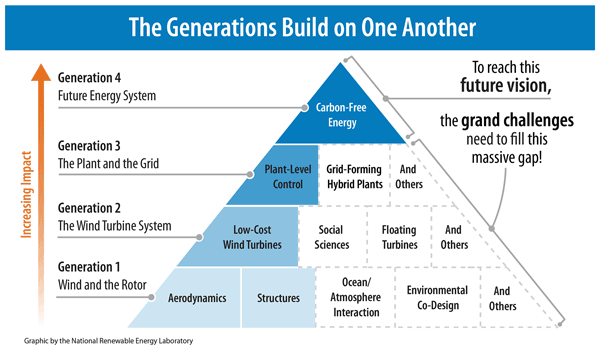
Wind energy will play a central role in the transition of our energy system to a carbon-free future. However, many underlying scientific issues remain to be resolved before wind can be deployed in the locations and applications needed for such large-scale ambitions. The Grand Challenges are the gaps in the science left behind during the rapid growth of wind energy. This article explains the breadth of the unfinished business and introduces 10 articles that detail the research needs.
Johan Meyers, Carlo Bottasso, Katherine Dykes, Paul Fleming, Pieter Gebraad, Gregor Giebel, Tuhfe Göçmen, and Jan-Willem van Wingerden
Wind Energ. Sci., 7, 2271–2306, https://doi.org/10.5194/wes-7-2271-2022, https://doi.org/10.5194/wes-7-2271-2022, 2022
Short summary
Short summary
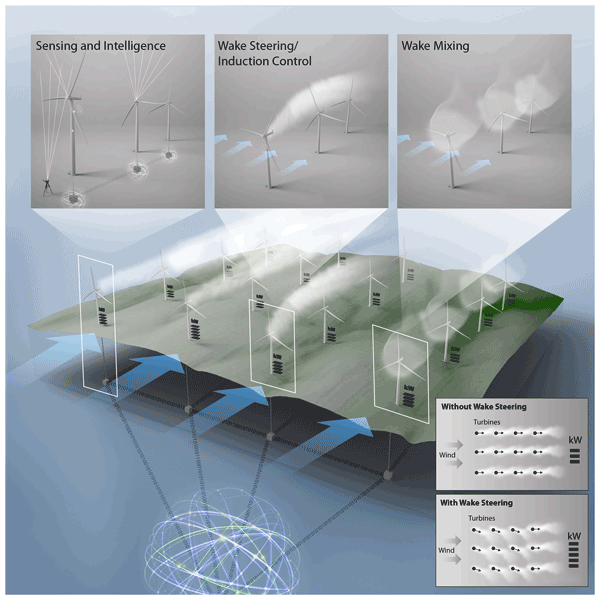
We provide a comprehensive overview of the state of the art and the outstanding challenges in wind farm flow control, thus identifying the key research areas that could further enable commercial uptake and success. To this end, we have structured the discussion on challenges and opportunities into four main areas: (1) insight into control flow physics, (2) algorithms and AI, (3) validation and industry implementation, and (4) integrating control with system design
(co-design).
Cited articles
Amiri, A. K., Kazacoks, R., McMillan, D., Feuchtwang, J., and Leithead, W.: Farm-wide assessment of wind turbine lifetime extension using detailed tower model and actual operational history, Journal of Physics: Conference Series, IOP Publishing, 1222, 012034, https://doi.org/10.1088/1742-6596/1222/1/012034, 2019. a
Bayo, R. T. and Parro, G.: Site suitability assessment with dynamic wake meandering model. A certification point of view, Energy Procedia, 76, 177–186, 2015. a
Bergström, H.: Meteorological conditions at Lillgrund, 6_2 LG Pilot Report, Swedish Energy Agency, Eskilstuna and Vattenfall Vindkraft AB, Stockholm, Sweden, 2009. a
Dahlberg, J. Å.: Assessment of the Lillgrund Windfarm, 6-1 LG Pilot Report, Swedish Energy Agency, Eskilstuna and Vattenfall Vindkraft AB, Stockholm, Sweden, http://osti.gov/etdeweb/servlets/purl/979752 (last access: 19 February 2026), 2009. a
de Oliveira, J. T.: Bivariate models for extremes; statistical decision, in: Statistical Extremes and Applications, 131–153, Springer Netherlands, Dordrecht, https://doi.org/10.1007/978-94-017-3069-3_10, 1984. a
Dimitrov, N. and Natarajan, A.: From SCADA to lifetime assessment and performance optimization: how to use models and machine learning to extract useful insights from limited data, Journal of Physics: Conference Series, IOP Publishing, 1222, 012032, https://doi.org/10.1088/1742-6596/1222/1/012032, 2019. a
Dimitrov, N. and Natarajan, A.: Advanced integrated supervisory and wind turbine control for optimal operation of large wind power plants (Vol. 2), Total Control Deliverable D2-5: Probabilistic framework to quantify the reliability levels of wind turbine structures under enhanced control methods, Technical report, Technical University of Denmark (DTU), https://www.totalcontrolproject.eu/-/media/sites/totalcontrol/publications/public-deliverables/d2-5_probabilistic-framework-to-quantify-the-reliability-levels-of-wt-structures_dtu.pdf (last access: 19 February 2026), 2020. a
DNV: DNV-ST-0262: Lifetime extension of wind turbines, DNV, Høvik, Norway, 2016, amended 2021. a
Emeis, S.: Current issues in wind energy meteorology, Meteorological Applications, 21, 803–819, 2014. a
Endo, T., Mitsunaga, K., and Nakagawa, H.: Fatigue of metals subjected to varying stress-prediction of fatigue lives, Preliminary Proceedings of the Chugoku-Shikoku District Meeting, Tokyo, Japan, The Japan Society of Mechanical Engineers, 41–44, November 1967. a
Faber, M. H.: Statistics and probability theory: in pursuit of engineering decision support, Vol. 18, Springer Science and Business Media, London, https://doi.org/10.1007/978-94-007-4056-3, 2012. a
Fraisse, A. and Brøndsted, P.: Compression fatigue of Wind Turbine Blade composites materials and damage mechanisms, Proceedings of the 21st International Conference on Composite Materials (ICCM-21), 20–25 August 2017, Xi'an, China, 20–25, https://backend.orbit.dtu.dk/ws/portalfiles/portal/136539059/Compression_fatigue_of_Wind_Turbine_Blade_composites_materials_and_damage_mechanisms.pdf (last access: 28 January 2026), 2017. a
Frandsen, S. T. and Madsen, P. H.: Spatially average of turbulence intensity inside large wind turbine arrays, in: Offshore wind energy in Mediterranean and other European seas, Resources, technology, applications, European Seminar Offshore Wind Energy in Mediterranean and Other European Seas (OWEMES 2003), Univ. of Naples, Naples, Italy, 10–12 April 2003, 97–106, 2003. a
Hübler, C., Weijtjens, W., Rolfes, R., and Devriendt, C.: Reliability analysis of fatigue damage extrapolations of wind turbines using offshore strain measurements, Journal of Physics: Conference Series, IOP Publishing, 1037, 032035, https://doi.org/10.1088/1742-6596/1037/3/032035, 2018. a
International Organization for Standardization (ISO): ISO 2394: 2015 – General principles on reliability for structures, Geneva, Switzerland, ISO 2394:2015 – General principles on reliability for structures, 2015. a
Kim, S.-H., Shin, H.-K., Joo, Y.-C., and Kim, K.-H.: A study of the wake effects on the wind characteristics and fatigue loads for the turbines in a wind farm, Renewable Energy, 74, 536–543, 2015. a
Larsen, T. J. and Hansen, A. M.: How 2 HAWC2, the user's manual (Ver. 13.0), Risø National Laboratory, Technical university of Denmark, Roskilde, Denmark, https://tools.windenergy.dtu.dk/HAWC2/downloads/13.1.0/manual/How2HAWC2.pdf (last access: 19 February 2026), 2007. a
Lee, S., Churchfield, M., Moriarty, P., Jonkman, J., and Michalakes, J.: A numerical study of atmospheric and wake turbulence impacts on wind turbine fatigue loadings, Journal of Solar Energy Engineering, 135, https://doi.org/10.1115/1.4023319, 2013. a
Liew, J., Göçmen, T., Lio, A. W. H., and Larsen, G. Chr.: Extending the dynamic wake meandering model in HAWC2Farm: a comparison with field measurements at the Lillgrund wind farm, Wind Energ. Sci., 8, 1387–1402, https://doi.org/10.5194/wes-8-1387-2023, 2023. a
Ling, Y., Shantz, C., Mahadevan, S., and Sankararaman, S.: Stochastic prediction of fatigue loading using real-time monitoring data, International Journal of Fatigue, 33, 868–879, 2011. a
Mann, J.: Wind field simulation, Probabilistic Engineering Mechanics, 13, 269–282, 1998. a
Mikkelsen, L. P.: The fatigue damage evolution in the load-carrying composite laminates of wind turbine blades, Fatigue Life Prediction of Composites and Composite Structures, Elsevier, 569–603, https://doi.org/10.1016/b978-0-08-102575-8.00016-4, 2020. a
Miner, M. A.: Cumulative damage in fatigue, Journal of Applied Mechanics, 12, A159–A164, 1945. a
Montavon, C., Jones, I., Staples, C., Strachan, C., and Gutierrez, I.: Practical issues in the use of CFD for modeling wind farms, Proc. European Wind Energy Conference, 16–19 March 2009, Marseille, France, 2009. a
Mozafari, S.: ShadanMozafari/WES_LifetimeExtension: LTE Matlab codes (lifetime_extension), Zenodo [code], https://doi.org/10.5281/zenodo.18338715, 2026. a, b
Mozafari, S., Dykes, K., Rinker, J. M., and Veers, P. S.: Extrapolation of the rainflow-counted load ranges for fatigue assessment of the wind turbine’s blades, in: AIAA SciTech 2023 Forum, 23–27 January, National Harbor, MD, USA, Reston, VA, American Institute of Aeronautics and Astronautics (AIAA), Paper AIAA 2023-1541, https://doi.org/10.2514/6.2023-1541, 2023a. a, b, c, d
Natarajan, A.: Damage equivalent load synthesis and stochastic extrapolation for fatigue life validation, Wind Energ. Sci., 7, 1171–1181, https://doi.org/10.5194/wes-7-1171-2022, 2022. a
Natarajan, A., Dimitrov, N. K., Peter, D. R., Bergami, L., Madsen, J., Olesen, N. A., Krogh, T., Nielsen, J. S., Sørensen, J. D., Pedersen, M., and Ohlsen, G.: Demonstration of requirements for life extension of wind turbines beyond their design life, Technical university of Denmark, Roskilde, Denmark, https://backend.orbit.dtu.dk/ws/portalfiles/portal/204904301/Final_Report_LifeWind_DTU.pdf (last access: 19 February 2026), 2020. a, b
Palmgren, A.: Die Lebensdauer von Kugellagern, Zeitschrift des Vereines Deutscher Ingenieure, 68, 339–341, 1924. a
Robertson, A. N., Shaler, K., Sethuraman, L., and Jonkman, J.: Sensitivity analysis of the effect of wind characteristics and turbine properties on wind turbine loads, Wind Energ. Sci., 4, 479–513, https://doi.org/10.5194/wes-4-479-2019, 2019. a, b
Toft, H. S. and Sørensen, J. D.: Reliability-based design of wind turbine blades, Structural Safety, 33, 333–342, 2011. a
Toft, H. S., Svenningsen, L., Sørensen, J. D., Moser, W., and Thøgersen, M. L.: Uncertainty in wind climate parameters and their influence on wind turbine fatigue loads, Renewable Energy, 90, 352–361, 2016. a
Vitulli, J., Larsen, G. C., Pedersen, M., Ott, S., and Friis-Møller, M.: Optimal open-loop wind farm control, Journal of Physics: Conference Series, IOP Publishing, 1256, 012027, https://doi.org/10.1088/1742-6596/1256/1/012027, 2019. a, b
Yan, B. W., Li, Q. S., Chan, P. W., He, Y. C., and Shu, Z. R.: Characterising wind shear exponents in the offshore area using Lidar measurements, Applied Ocean Research, 127, 103293, https://doi.org/10.1016/j.apor.2022.103293, 2022. a
Zhang, X. and Natarajan, A.: Gaussian mixture model for extreme wind turbulence estimation, Wind Energ. Sci., 7, 2135–2148, https://doi.org/10.5194/wes-7-2135-2022, 2022. a
Ziegler, L. and Muskulus, M.: Fatigue reassessment for lifetime extension of offshore wind monopile substructures, Journal of Physics: Conference Series, 753, 092010, https://doi.org/10.1088/1742-6596/753/9/092010, 2016. a
Short summary
The study showcases the added value of using structural response measurements in lifetime extension assessments within wind farms. In addition, it answers two of the common questions in different methods of assessment. First, it assesses the applicability of the Frandsen model for estimating conservative waked turbulence in the compact layout of wind farms. Second, it showcases probabilistic extrapolation of short- to mid-term data for long-term site-specific fatigue assessments.
The study showcases the added value of using structural response measurements in lifetime...


Altmetrics
Final-revised paper
Preprint