
Articles | Volume 11, issue 1
https://doi.org/10.5194/wes-11-175-2026
© Author(s) 2026. This work is distributed under
the Creative Commons Attribution 4.0 License.
the Creative Commons Attribution 4.0 License.
https://doi.org/10.5194/wes-11-175-2026
© Author(s) 2026. This work is distributed under
the Creative Commons Attribution 4.0 License.
the Creative Commons Attribution 4.0 License.
Research article
| 
16 Jan 2026
Research article |
| 16 Jan 2026
| 16 Jan 2026
Field comparison of load-based wind turbine wake tracking with a scanning lidar reference

School of Mathematics and Science, Institute of Physics, Carl von Ossietzky Universität Oldenburg, 26129 Oldenburg, Germany
ForWind – Center for Wind Energy Research, Küpkersweg 70, 26129 Oldenburg, Germany
Gunner Christian Larsen
Department of Wind and Energy Systems, Technical University of Denmark, 4000 Roskilde, Denmark
Alan Wai Hou Lio
Department of Wind and Energy Systems, Technical University of Denmark, 4000 Roskilde, Denmark
Paul Hulsman
School of Mathematics and Science, Institute of Physics, Carl von Ossietzky Universität Oldenburg, 26129 Oldenburg, Germany
ForWind – Center for Wind Energy Research, Küpkersweg 70, 26129 Oldenburg, Germany
Martin Kühn
School of Mathematics and Science, Institute of Physics, Carl von Ossietzky Universität Oldenburg, 26129 Oldenburg, Germany
ForWind – Center for Wind Energy Research, Küpkersweg 70, 26129 Oldenburg, Germany
Vlaho Petrović
School of Mathematics and Science, Institute of Physics, Carl von Ossietzky Universität Oldenburg, 26129 Oldenburg, Germany
ForWind – Center for Wind Energy Research, Küpkersweg 70, 26129 Oldenburg, Germany
Related authors
Frederik Berger, Lars Neuhaus, David Onnen, Michael Hölling, Gerard Schepers, and Martin Kühn
Wind Energ. Sci., 7, 1827–1846, https://doi.org/10.5194/wes-7-1827-2022, https://doi.org/10.5194/wes-7-1827-2022, 2022
Short summary
Short summary
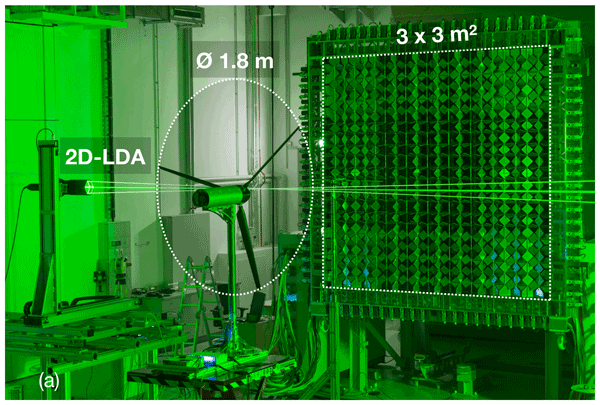
We proof the dynamic inflow effect due to gusts in wind tunnel experiments with MoWiTO 1.8 in the large wind tunnel of ForWind – University of Oldenburg, where we created coherent gusts with an active grid. The effect is isolated in loads and rotor flow by comparison of a quasi-steady and a dynamic case. The observed effect is not caught by common dynamic inflow engineering models. An improvement to the Øye dynamic inflow model is proposed, matching experiment and corresponding FVWM simulations.
Frederik Berger, David Onnen, Gerard Schepers, and Martin Kühn
Wind Energ. Sci., 6, 1341–1361, https://doi.org/10.5194/wes-6-1341-2021, https://doi.org/10.5194/wes-6-1341-2021, 2021
Short summary
Short summary
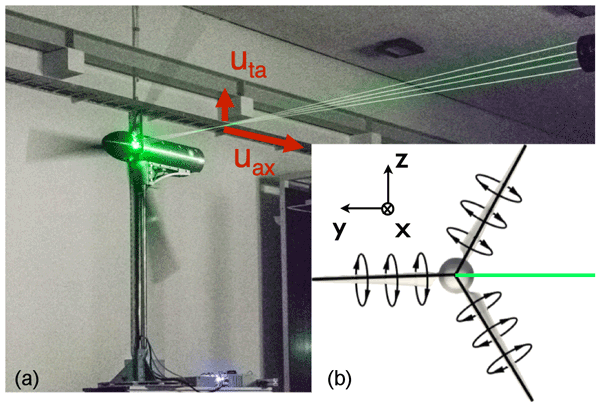
Dynamic inflow denotes the unsteady aerodynamic response to fast changes in rotor loading and leads to load overshoots. We performed a pitch step experiment with MoWiTO 1.8 in the large wind tunnel of ForWind – University of Oldenburg. We measured axial and tangential inductions with a recent method with a 2D-LDA system and performed load and wake measurements. These radius-resolved measurements allow for new insights into the dynamic inflow phenomenon.
Annika Gaiser, Gerald Steinfeld, Gabriele Centurelli, and Martin Kühn
Wind Energ. Sci. Discuss., https://doi.org/10.5194/wes-2026-140, https://doi.org/10.5194/wes-2026-140, 2026
Preprint under review for WES
Short summary
Short summary
Wind farm wakes can reach far downstream, influencing the power production of other wind farms. In pursuit of improved wake recovery, we investigate how vertically staggered wind farms influence the flow field and wake recovery budget by using large-eddy simulations. Flow circulation forms inside the wind farm for certain setups and at one wake boundary, which influences wake recovery through advection and causes local speed-ups. The wake and power of a second, downstream wind farm is affected.
Astrid Lampert, Beatriz Cañadillas, Thomas Rausch, Lea Schmitt, Bughsin' Djath, Johannes Schulz-Stellenfleth, Andreas Platis, Kjell zum Berge, Ines Schäfer, Jens Bange, Lukas Gruchot, Thomas Neumann, Martin Dörenkämper, Bernhard Stoevesandt, Julia Gottschall, Lukas Vollmer, Stefan Emeis, Mares Barekzai, Simon Siedersleben, Martin Kühn, Gerald Steinfeld, Detlev Heinemann, Joachim Peinke, Hendrik Heißelmann, Jörge Schneemann, Gabriele Centurelli, Philipp Waldmann, and Konrad Bärfuss
Wind Energ. Sci., 11, 3057–3075, https://doi.org/10.5194/wes-11-3057-2026, https://doi.org/10.5194/wes-11-3057-2026, 2026
Short summary
Short summary
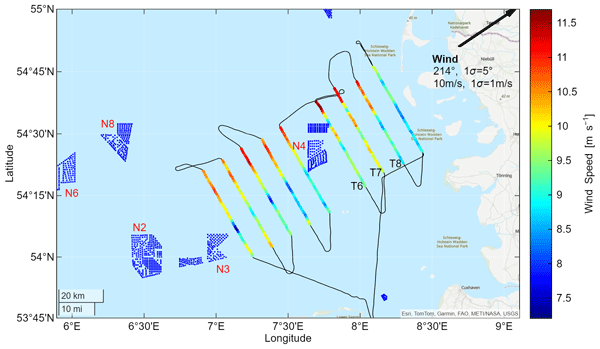
Two major aircraft measurement campaigns above the North Sea provide insights into modifications of the wind field and sea surface induced by wind farms. The aircraft performed transects at hub height upstream and downstream of wind farm clusters and identified different effects, e.g. how long it takes for the wind speed to recover after the wind farm, how changes across the coastline interact with wind energy, and if wind farms are well represented in numerical simulations.
Sinem Uluocak, Andreas Rott, Alfredo Peña, and Martin Kühn
EGUsphere, https://doi.org/10.5194/egusphere-2026-825, https://doi.org/10.5194/egusphere-2026-825, 2026
This preprint is open for discussion and under review for Atmospheric Measurement Techniques (AMT).
Short summary
Short summary
Wind lidar turbulence measurements are limited by large probe volume of lidar, which attenuates turbulence scales smaller than the probe volume. This process is known as probe volume averaging. This wind tunnel study enabled an experimental investigation of probe volume averaging for the first time, using 32 distinct probe volumes over integral length scale ratios. The study demonstrated the capability of lidar to measure along-wind turbulence statistics.
Øyvind Waage Hanssen-Bauer, Paula Doubrawa, Helge A. Madsen, Henrik Asmuth, Jason Jonkman, Gunner C. Larsen, Stefan Ivanell, and Roy Stenbro
Wind Energ. Sci., 11, 1913–1948, https://doi.org/10.5194/wes-11-1913-2026, https://doi.org/10.5194/wes-11-1913-2026, 2026
Short summary
Short summary
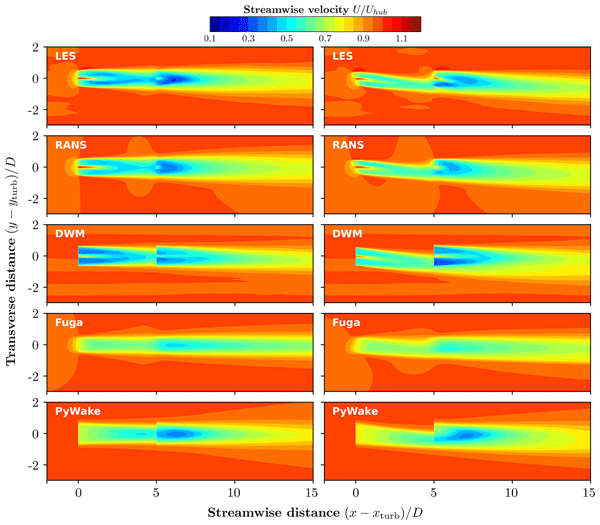
We studied how different industry-oriented computer models predict the behavior of winds behind turbines in a wind farm. These
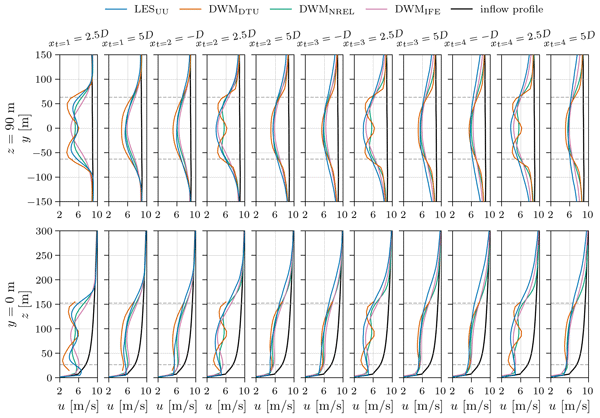
wakesreduce energy output and can affect turbines further down the row. By comparing these three models with more detailed simulations, we found they agree well on overall power but differ in how they capture turbulence and wear on machines. Our results show where the models need improvement to make wind farm computer models more accurate and reliable in the future.
Julia Steiner, Emily Louise Hodgson, Maarten Paul van der Laan, Leonardo Alcayaga, Mads Pedersen, Søren Juhl Andersen, Gunner Larsen, and Pierre-Elouan Réthoré
Wind Energ. Sci., 11, 1679–1703, https://doi.org/10.5194/wes-11-1679-2026, https://doi.org/10.5194/wes-11-1679-2026, 2026
Short summary
Short summary
Wake steering is a promising strategy for wind farm optimization, but its success hinges on accurate wake models. We assess models of varying fidelity for a 22 MW reference turbine, comparing single- and two-turbine cases against large-eddy simulations. All models reproduced qualitative trends for power and loads (if applicable), but quantitative agreement varied, and in general the error increased with increasing yaw angle.
Hugo Rubio, Ville Vakkari, Martin Kühn, and Julia Gottschall
Wind Energ. Sci. Discuss., https://doi.org/10.5194/wes-2026-50, https://doi.org/10.5194/wes-2026-50, 2026
Preprint withdrawn
Short summary
Short summary
Offshore wind farms need accurate wind data, but collecting measurements at sea is often difficult and expensive. In this study, we investigate how wind measurements from a lidar mounted on a moving ship can improve the accuracy of commonly used reanalysis datasets. Using a statistical correction method, we are able to reduce errors in wind speed estimates. This efficient approach can make offshore wind planning and resource assessment more reliable in areas where measurements are limited.
Johannes Paulsen, Gerald Steinfeld, Martin Kühn, and Martin Dörenkämper
Wind Energ. Sci. Discuss., https://doi.org/10.5194/wes-2026-23, https://doi.org/10.5194/wes-2026-23, 2026
Revised manuscript under review for WES
Short summary
Short summary
We investigated the potential benefits in wake development and power production of a new turbine concept with a low specific rating and low induction and compared it to a reference design with same rated power. Our results show that the design can strongly increase the AEP and shows especially strong benefits during doldrum events and in strongly cluster wake affected areas. While the inner farm wake wakes are strongly decreased by the new concept, the outer farm wakes are slightly stronger.
Daniel Ribnitzky, Vlaho Petrović, and Martin Kühn
Wind Energ. Sci., 11, 469–491, https://doi.org/10.5194/wes-11-469-2026, https://doi.org/10.5194/wes-11-469-2026, 2026
Short summary
Short summary
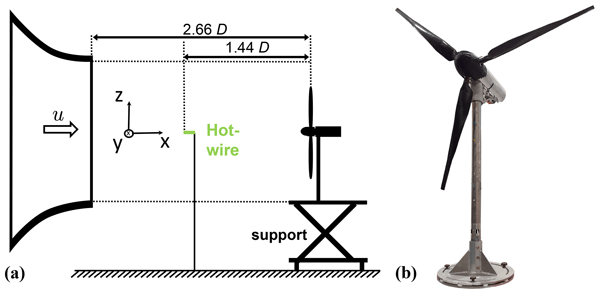
We developed controllers for the Hybrid-Lambda Rotor, which enables two operating modes below rated power via different tip speed ratios, balancing load reduction and power output. A baseline controller with a model-based wind speed estimator, a load feedback controller and an inflow feed-forward controller were implemented on the MoWiTO 1.8 model turbine and tested in wind tunnel experiments. In depth scaling, considerations ensure the transferability of the results to the full-scale model.
Johannes Paulsen, Jörge Schneemann, Gerald Steinfeld, Frauke Theuer, and Martin Kühn
Wind Energ. Sci., 11, 321–346, https://doi.org/10.5194/wes-11-321-2026, https://doi.org/10.5194/wes-11-321-2026, 2026
Short summary
Short summary
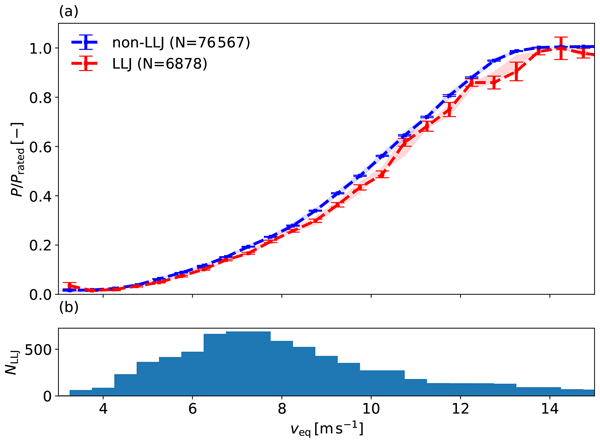
While low-level jets (LLJs) have been well characterised, their impact on offshore wind farms is not well understood. This study uses multi-elevation lidar scans to derive vertical wind profiles up to 350 m, detecting LLJs in up to 22.6 % of available measurements. Further, we analyse their effect on power conversion efficiency using operational wind farm data, observing a slightly negative influence and increased power fluctuations during LLJ events.
Manuel Alejandro Zúñiga Inestroza, Paul Hulsman, Vlaho Petrović, and Martin Kühn
Wind Energ. Sci., 10, 2257–2278, https://doi.org/10.5194/wes-10-2257-2025, https://doi.org/10.5194/wes-10-2257-2025, 2025
Short summary
Short summary
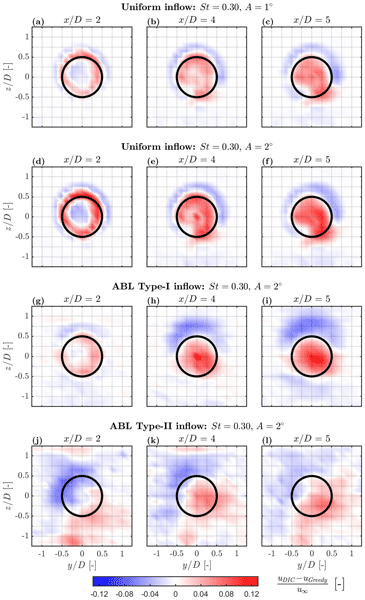
Wake effects cause power losses that degrade wind farm efficiency. This paper presents a wind tunnel investigation of dynamic induction control (DIC), a strategy to mitigate wake losses by improving turbine–flow interactions. WindScanner lidar measurements are used to explore the wake development of model turbines in response to DIC. Our results demonstrate consistent benefits and adaptability under realistic inflow conditions, highlighting DIC’s potential to increase wind farm power production.
Hugo Rubio, Daniel Hatfield, Charlotte Bay Hasager, Martin Kühn, and Julia Gottschall
Atmos. Meas. Tech., 18, 4949–4968, https://doi.org/10.5194/amt-18-4949-2025, https://doi.org/10.5194/amt-18-4949-2025, 2025
Short summary
Short summary
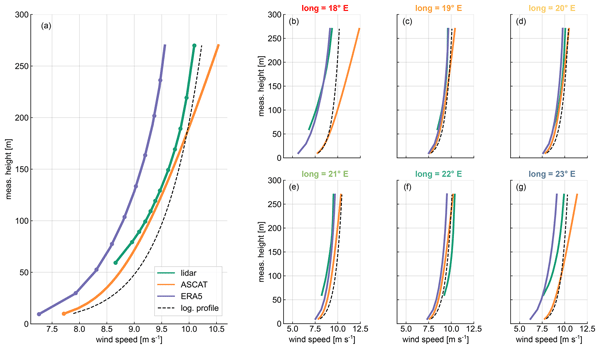
Due to the scarcity of offshore in situ observations, alternative data sources are essential for a reliable understanding of offshore winds. Therefore, this study delves into the world of satellite remote sensing (ASCAT) and numerical models (ERA5), exploring their capabilities and limitations in characterising offshore winds. This investigation evaluates these two datasets against measurements from a floating ship-based lidar, collected during a novel measurement campaign in the Baltic Sea.
Arjun Anantharaman, Jörge Schneemann, Frauke Theuer, Laurent Beaudet, Valentin Bernard, Paul Deglaire, and Martin Kühn
Wind Energ. Sci., 10, 1849–1867, https://doi.org/10.5194/wes-10-1849-2025, https://doi.org/10.5194/wes-10-1849-2025, 2025
Short summary
Short summary
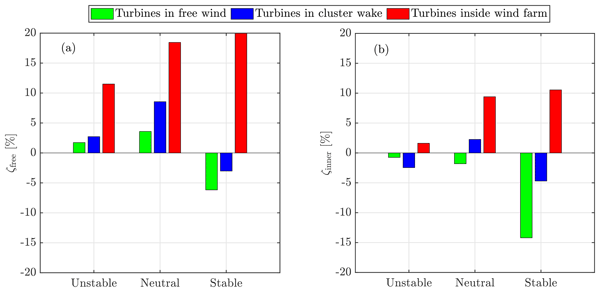
The offshore wind farm sector is expanding rapidly, and the interactions between wind farms are important to analyse for both existing and planned wind farms. We developed a new methodology to quantify how much the reductions in wind speed behind a farm can affect the loads on turbines which are tens of kilometres downstream. We find a 2.5 % increase in the turbine loads and discuss how further measurements could add to the design standards of future wind farms.
Daniel Ribnitzky, Vlaho Petrović, and Martin Kühn
Wind Energ. Sci., 10, 1329–1349, https://doi.org/10.5194/wes-10-1329-2025, https://doi.org/10.5194/wes-10-1329-2025, 2025
Short summary
Short summary
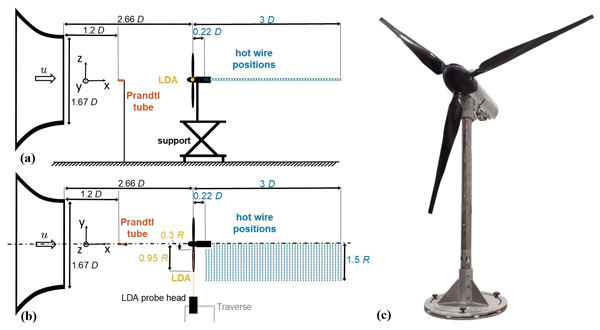
In this paper, the Hybrid-Lambda Rotor is scaled to wind tunnel size and validated in wind tunnel experiments. The objectives are to derive a scaling methodology, to investigate the influence of the steep gradients of axial induction along the blade span, and to characterize the near wake. The study reveals complex three-dimensional flow patterns for blade designs with non-uniform loading, and it can offer new inspirations when solving other scaling problems for complex wind turbine systems.
Frauke Theuer, Janna Kristina Seifert, Jörge Schneemann, and Martin Kühn
Wind Energ. Sci. Discuss., https://doi.org/10.5194/wes-2024-141, https://doi.org/10.5194/wes-2024-141, 2024
Revised manuscript accepted for WES
Short summary
Short summary
To be useful for end-users the forecast horizon of lidar-based minute-scale forecasts needs to be extended to at least 15 minutes. In this work, we adapt a lidar-based forecasting methodology to predict wind speed and power with horizons of up to 30 minutes. We found that the skill of the lidar-based approach highly depends on atmospheric conditions and the forecast characteristics. It was able to outperform persistence up to a 16 minute forecast horizon during unstable conditions.
Anantha Padmanabhan Kidambi Sekar, Paul Hulsman, Marijn Floris van Dooren, and Martin Kühn
Wind Energ. Sci., 9, 1483–1505, https://doi.org/10.5194/wes-9-1483-2024, https://doi.org/10.5194/wes-9-1483-2024, 2024
Short summary
Short summary
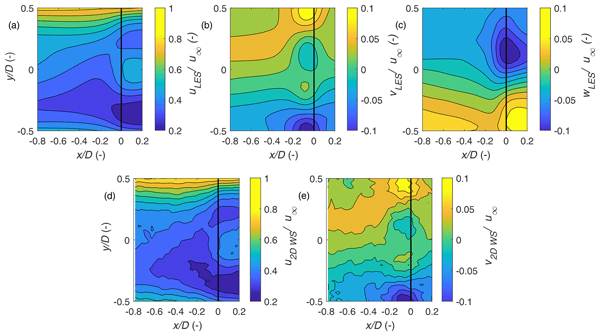
We present induction zone measurements conducted with two synchronised lidars at a two-turbine wind farm. The induction zone flow was characterised for free, fully waked and partially waked flows. Due to the short turbine spacing, the lidars captured the interaction of the atmospheric boundary layer, induction zone and wake, evidenced by induction asymmetry and induction zone–wake interactions. The measurements will aid the process of further improving existing inflow and wake models.
Daniel Ribnitzky, Frederik Berger, Vlaho Petrović, and Martin Kühn
Wind Energ. Sci., 9, 359–383, https://doi.org/10.5194/wes-9-359-2024, https://doi.org/10.5194/wes-9-359-2024, 2024
Short summary
Short summary
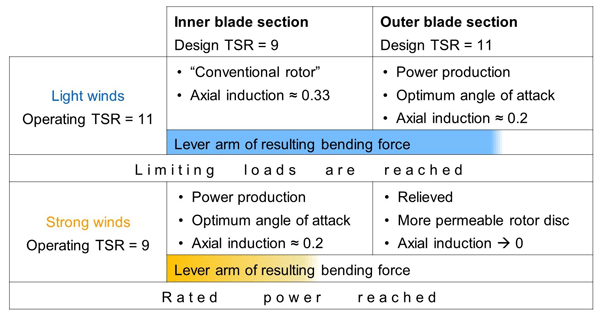
This paper provides an innovative blade design methodology for offshore wind turbines with very large rotors compared to their rated power, which are tailored for an increased power feed-in at low wind speeds. Rather than designing the blade for a single optimized operational point, we include the application of peak shaving in the design process and introduce a design for two tip speed ratios. We describe how enlargement of the rotor diameter can be realized to improve the value of wind power.
Andreas Rott, Leo Höning, Paul Hulsman, Laura J. Lukassen, Christof Moldenhauer, and Martin Kühn
Wind Energ. Sci., 8, 1755–1770, https://doi.org/10.5194/wes-8-1755-2023, https://doi.org/10.5194/wes-8-1755-2023, 2023
Short summary
Short summary
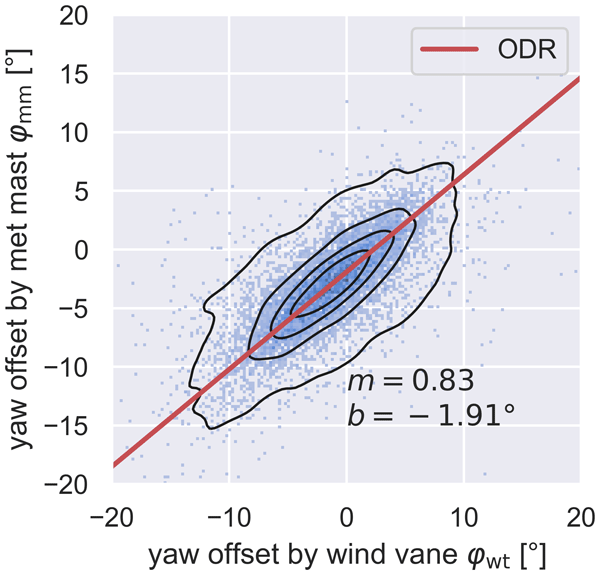
This study examines wind vane measurements of commercial wind turbines and their impact on yaw control. The authors discovered that rotor interference can cause an overestimation of wind vane measurements, leading to overcorrection of the yaw controller. A correction function that improves the yaw behaviour is presented and validated in free-field experiments on a commercial wind turbine. This work provides new insights into wind direction measurements and suggests ways to optimize yaw control.
Balthazar Arnoldus Maria Sengers, Andreas Rott, Eric Simley, Michael Sinner, Gerald Steinfeld, and Martin Kühn
Wind Energ. Sci., 8, 1693–1710, https://doi.org/10.5194/wes-8-1693-2023, https://doi.org/10.5194/wes-8-1693-2023, 2023
Short summary
Short summary
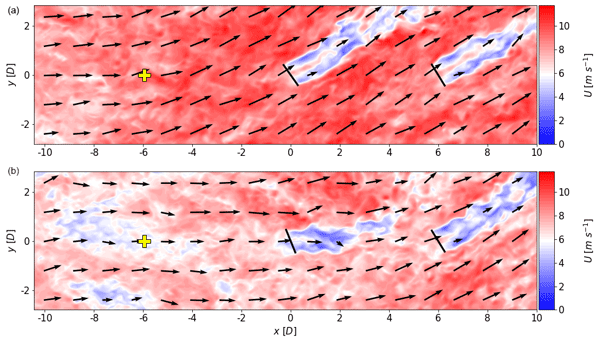
Unexpected wind direction changes are undesirable, especially when performing wake steering. This study explores whether the yaw controller can benefit from accessing wind direction information before a change reaches the turbine. Results from two models with different fidelities demonstrate that wake steering can indeed benefit from preview information.
Paul Hulsman, Luis A. Martínez-Tossas, Nicholas Hamilton, and Martin Kühn
Wind Energ. Sci. Discuss., https://doi.org/10.5194/wes-2023-112, https://doi.org/10.5194/wes-2023-112, 2023
Manuscript not accepted for further review
Short summary
Short summary
This paper presents an approach to analytically estimate the wake deficit within the near-wake region by modifying the curled wake model. This is done by incorporating a new initial condition at the rotor using an azimuth-dependent Gaussian profile, an adjusted turbulence model in the near-wake region and the far-wake region and an iterative process to determine the velocity field, while considering the relation of the pressure gradient and accounting the conservation of mass.
Jaime Liew, Tuhfe Göçmen, Alan W. H. Lio, and Gunner Chr. Larsen
Wind Energ. Sci., 8, 1387–1402, https://doi.org/10.5194/wes-8-1387-2023, https://doi.org/10.5194/wes-8-1387-2023, 2023
Short summary
Short summary
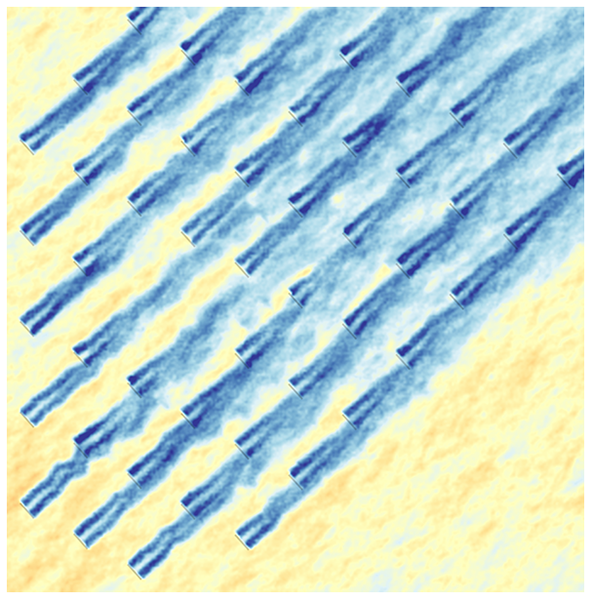
We present recent research on dynamically modelling wind farm wakes and integrating these enhancements into the wind farm simulator, HAWC2Farm. The simulation methodology is showcased by recreating dynamic scenarios observed in the Lillgrund offshore wind farm. We successfully recreate scenarios with turning winds, turbine shutdown events, and wake deflection events. The research provides opportunities to better identify wake interactions in wind farms, allowing for more reliable designs.
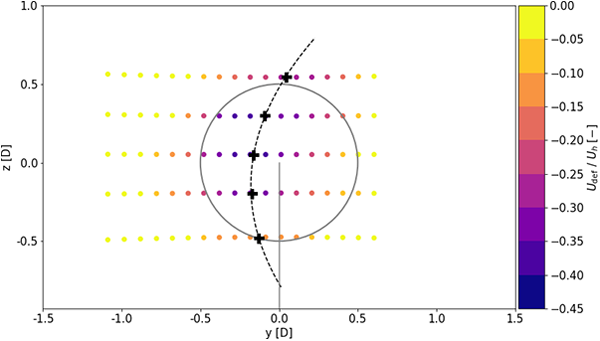
Balthazar Arnoldus Maria Sengers, Gerald Steinfeld, Paul Hulsman, and Martin Kühn
Wind Energ. Sci., 8, 747–770, https://doi.org/10.5194/wes-8-747-2023, https://doi.org/10.5194/wes-8-747-2023, 2023
Short summary
Short summary
The optimal misalignment angles for wake steering are determined using wake models. Although mostly analytical, data-driven models have recently shown promising results. This study validates a previously proposed data-driven model with results from a field experiment using lidar measurements. In a comparison with a state-of-the-art analytical model, it shows systematically more accurate estimates of the available power. Also when using only commonly available input data, it gives good results.
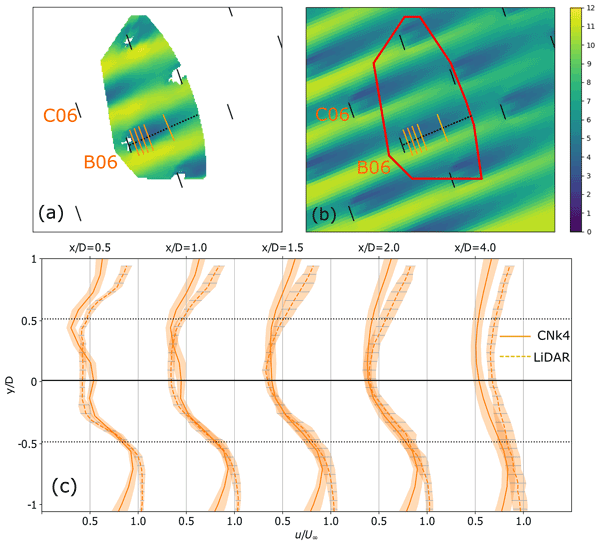
Ishaan Sood, Elliot Simon, Athanasios Vitsas, Bart Blockmans, Gunner C. Larsen, and Johan Meyers
Wind Energ. Sci., 7, 2469–2489, https://doi.org/10.5194/wes-7-2469-2022, https://doi.org/10.5194/wes-7-2469-2022, 2022
Short summary
Short summary
In this work, we conduct a validation study to compare a numerical solver against measurements obtained from the offshore Lillgrund wind farm. By reusing a previously developed inflow turbulent dataset, the atmospheric conditions at the wind farm were recreated, and the general performance trends of the turbines were captured well. The work increases the reliability of numerical wind farm solvers while highlighting the challenges of accurately representing large wind farms using such solvers.
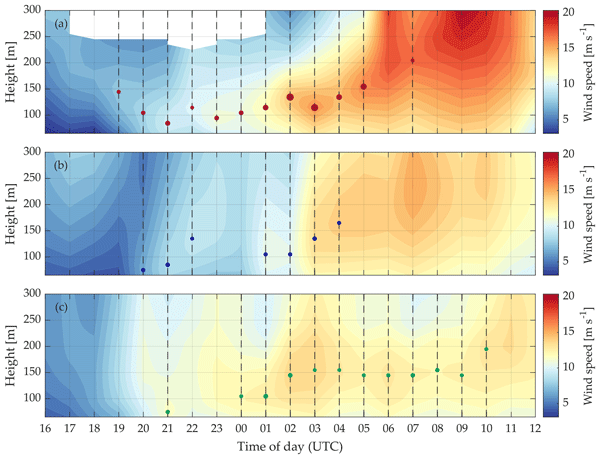
Hugo Rubio, Martin Kühn, and Julia Gottschall
Wind Energ. Sci., 7, 2433–2455, https://doi.org/10.5194/wes-7-2433-2022, https://doi.org/10.5194/wes-7-2433-2022, 2022
Short summary
Short summary
A proper development of offshore wind farms requires the accurate description of atmospheric phenomena like low-level jets. In this study, we evaluate the capabilities and limitations of numerical models to characterize the main jets' properties in the southern Baltic Sea. For this, a comparison against ship-mounted lidar measurements from the NEWA Ferry Lidar Experiment has been implemented, allowing the investigation of the model's capabilities under different temporal and spatial constraints.
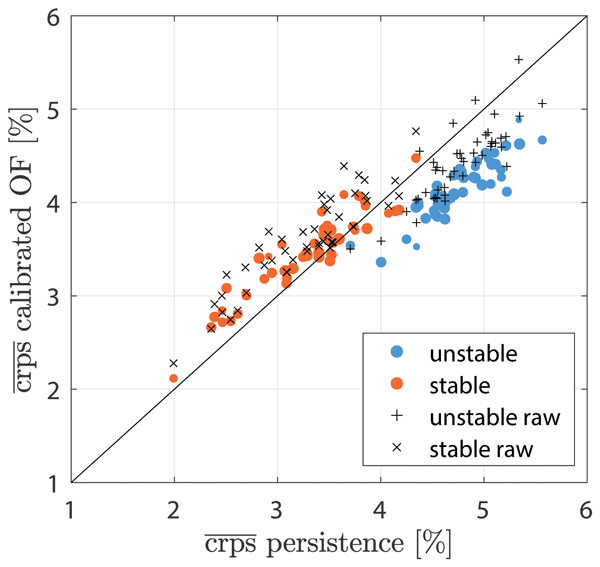
Frauke Theuer, Andreas Rott, Jörge Schneemann, Lueder von Bremen, and Martin Kühn
Wind Energ. Sci., 7, 2099–2116, https://doi.org/10.5194/wes-7-2099-2022, https://doi.org/10.5194/wes-7-2099-2022, 2022
Short summary
Short summary
Remote-sensing-based approaches have shown potential for minute-scale forecasting and need to be further developed towards an operational use. In this work we extend a lidar-based forecast to an observer-based probabilistic power forecast by combining it with a SCADA-based method. We further aggregate individual turbine power using a copula approach. We found that the observer-based forecast benefits from combining lidar and SCADA data and can outperform persistence for unstable stratification.
Frederik Berger, Lars Neuhaus, David Onnen, Michael Hölling, Gerard Schepers, and Martin Kühn
Wind Energ. Sci., 7, 1827–1846, https://doi.org/10.5194/wes-7-1827-2022, https://doi.org/10.5194/wes-7-1827-2022, 2022
Short summary
Short summary
We proof the dynamic inflow effect due to gusts in wind tunnel experiments with MoWiTO 1.8 in the large wind tunnel of ForWind – University of Oldenburg, where we created coherent gusts with an active grid. The effect is isolated in loads and rotor flow by comparison of a quasi-steady and a dynamic case. The observed effect is not caught by common dynamic inflow engineering models. An improvement to the Øye dynamic inflow model is proposed, matching experiment and corresponding FVWM simulations.
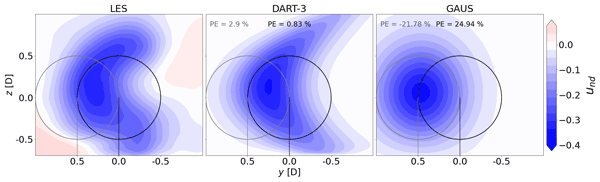
Balthazar Arnoldus Maria Sengers, Matthias Zech, Pim Jacobs, Gerald Steinfeld, and Martin Kühn
Wind Energ. Sci., 7, 1455–1470, https://doi.org/10.5194/wes-7-1455-2022, https://doi.org/10.5194/wes-7-1455-2022, 2022
Short summary
Short summary
Wake steering aims to redirect the wake away from a downstream turbine. This study explores the potential of a data-driven surrogate model whose equations can be interpreted physically. It estimates wake characteristics from measurable input variables by utilizing a simple linear model. The model shows encouraging results in estimating available power in the far wake, with significant improvements over currently used analytical models in conditions where wake steering is deemed most effective.
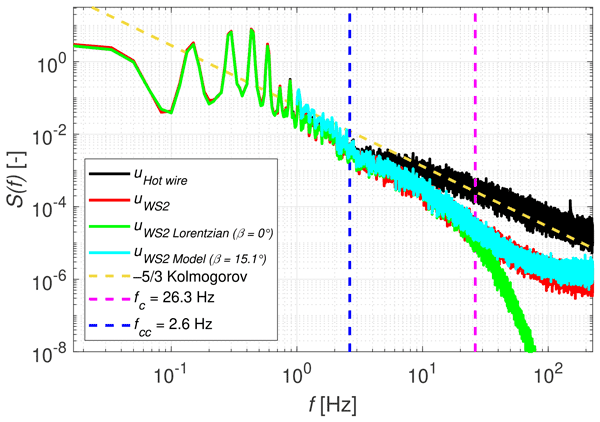
Marijn Floris van Dooren, Anantha Padmanabhan Kidambi Sekar, Lars Neuhaus, Torben Mikkelsen, Michael Hölling, and Martin Kühn
Atmos. Meas. Tech., 15, 1355–1372, https://doi.org/10.5194/amt-15-1355-2022, https://doi.org/10.5194/amt-15-1355-2022, 2022
Short summary
Short summary
The remote sensing technique lidar is widely used for wind speed measurements for both industrial and academic applications. Lidars can measure wind statistics accurately but cannot fully capture turbulent fluctuations in the high-frequency range, since they are partly filtered out. This paper therefore investigates the turbulence spectrum measured by a continuous-wave lidar and analytically models the lidar's measured spectrum with a Lorentzian filter function and a white noise term.
Andreas Rott, Jörge Schneemann, Frauke Theuer, Juan José Trujillo Quintero, and Martin Kühn
Wind Energ. Sci., 7, 283–297, https://doi.org/10.5194/wes-7-283-2022, https://doi.org/10.5194/wes-7-283-2022, 2022
Short summary
Short summary
We present three methods that can determine the alignment of a lidar placed on the transition piece of an offshore wind turbine based on measurements with the instrument: a practical implementation of hard targeting for north alignment, a method called sea surface levelling to determine the levelling of the system from water surface measurements, and a model that can determine the dynamic levelling based on the operating status of the wind turbine.
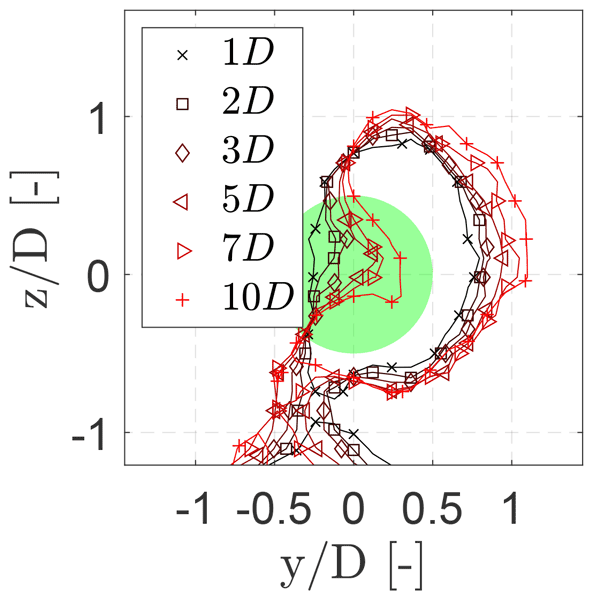
Paul Hulsman, Martin Wosnik, Vlaho Petrović, Michael Hölling, and Martin Kühn
Wind Energ. Sci., 7, 237–257, https://doi.org/10.5194/wes-7-237-2022, https://doi.org/10.5194/wes-7-237-2022, 2022
Short summary
Short summary
Due to the possibility of mapping the wake fast at multiple locations with the WindScanner, a thorough understanding of the development of the wake is acquired at different inflow conditions and operational conditions. The lidar velocity data and the energy dissipation rate compared favourably with hot-wire data from previous experiments, lending credibility to the measurement technique and methodology used here. This will aid the process to further improve existing wake models.
Liang Dong, Wai Hou Lio, and Eric Simley
Wind Energ. Sci., 6, 1491–1500, https://doi.org/10.5194/wes-6-1491-2021, https://doi.org/10.5194/wes-6-1491-2021, 2021
Short summary
Short summary
This paper suggests that the impacts of different turbulence models should be considered as uncertainties while evaluating the benefits of lidar-assisted control (LAC) in wind turbine design. The value creation of LAC, evaluated using the Kaimal turbulence model, will be diminished if the Mann turbulence model is used instead. In particular, the difference in coherence is more significant for larger rotors.
Frederik Berger, David Onnen, Gerard Schepers, and Martin Kühn
Wind Energ. Sci., 6, 1341–1361, https://doi.org/10.5194/wes-6-1341-2021, https://doi.org/10.5194/wes-6-1341-2021, 2021
Short summary
Short summary
Dynamic inflow denotes the unsteady aerodynamic response to fast changes in rotor loading and leads to load overshoots. We performed a pitch step experiment with MoWiTO 1.8 in the large wind tunnel of ForWind – University of Oldenburg. We measured axial and tangential inductions with a recent method with a 2D-LDA system and performed load and wake measurements. These radius-resolved measurements allow for new insights into the dynamic inflow phenomenon.
Cited articles
Annoni, J., Bay, C., Johnson, K., Dall'Anese, E., Quon, E., Kemper, T., and Fleming, P.: Wind direction estimation using SCADA data with consensus-based optimization, Wind Energ. Sci., 4, 355–368, https://doi.org/10.5194/wes-4-355-2019, 2019. a
Bartl, J., Mühle, F., Schottler, J., Sætran, L., Peinke, J., Adaramola, M., and Hölling, M.: Wind tunnel experiments on wind turbine wakes in yaw: effects of inflow turbulence and shear, Wind Energ. Sci., 3, 329–343, https://doi.org/10.5194/wes-3-329-2018, 2018. a, b
Becker, M., Allaerts, D., and van Wingerden, J. W.: Ensemble-Based Flow Field Estimation Using the Dynamic Wind Farm Model FLORIDyn, Energies, 15, 1–23, https://doi.org/10.3390/en15228589, 2022. a, b
Bertelè, M., Bottasso, C. L., Cacciola, S., Daher Adegas, F., and Delport, S.: Wind inflow observation from load harmonics, Wind Energ. Sci., 2, 615–640, https://doi.org/10.5194/wes-2-615-2017, 2017. a
Branlard, E., Martínez-Tossas, L. A., and Jonkman, J.: A time-varying formulation of the curled wake model within the FAST.Farm framework, Wind Energy, 26, 44–63, https://doi.org/10.1002/we.2785, 2022. a, b
Braunbehrens, R. and Segalini, A.: A statistical model for wake meandering behind wind turbines, Journal of Wind Engineering and Industrial Aerodynamics, 193, 103954, https://doi.org/10.1016/j.jweia.2019.103954, 2019. a
Braunbehrens, R., Tamaro, S., and Bottasso, C. L.: Towards the multi-scale Kalman filtering of dynamic wake models: observing turbulent fluctuations and wake meandering, J. Phys. Conf. Ser., 2505, 012044, https://doi.org/10.1088/1742-6596/2505/1/012044, 2023. a
Brown, R. G. and Hwang, P. Y. C.: Introduction to random signals and applied kalman filtering, vol. 2, https://doi.org/10.1002/rnc.4590020307, 1992. a
Brugger, P., Markfort, C., and Porté-Agel, F.: Field measurements of wake meandering at a utility-scale wind turbine with nacelle-mounted Doppler lidars, Wind Energ. Sci., 7, 185–199, https://doi.org/10.5194/wes-7-185-2022, 2022. a, b
Cacciola, S., Bertelè, M., Schreiber, J., and Bottasso, C. L.: Wake center position tracking using downstream wind turbine hub loads, J. Phys. Conf. Ser., 753, 032036, https://doi.org/10.1088/1742-6596/753/3/032036, 2016. a, b, c, d
Coquelet, M., Lejeune, M., Bricteux, L., van Vondelen, A. A. W., van Wingerden, J.-W., and Chatelain, P.: On the robustness of a blade-load-based wind speed estimator to dynamic pitch control strategies, Wind Energ. Sci., 9, 1923–1940, https://doi.org/10.5194/wes-9-1923-2024, 2024. a
Coudou, N., Moens, M., Marichal, Y., Van Beeck, J., Bricteux, L., and Chatelain, P.: Development of wake meandering detection algorithms and their application to large eddy simulations of an isolated wind turbine and a wind farm, J. Phys. Conf. Ser., 1037, 072024, https://doi.org/10.1088/1742-6596/1037/7/072024, 2018. a
Doekemeijer, B. and van Wingerden, J. W.: Observability of the ambient conditions in model-based estimation for wind farm control: A focus on static models, Wind Energy, 23, 1777–1791, https://doi.org/10.1002/we.2495, 2020. a, b, c
Doekemeijer, B. M., Kern, S., Maturu, S., Kanev, S., Salbert, B., Schreiber, J., Campagnolo, F., Bottasso, C. L., Schuler, S., Wilts, F., Neumann, T., Potenza, G., Calabretta, F., Fioretti, F., and van Wingerden, J.-W.: Field experiment for open-loop yaw-based wake steering at a commercial onshore wind farm in Italy, Wind Energ. Sci., 6, 159–176, https://doi.org/10.5194/wes-6-159-2021, 2021. a
Dong, L., Lio, A. W. H., and Meng, F.: Wake position tracking using dynamic wake meandering model and rotor loads, Journal of Renewable and Sustainable Energy, 13, 023301, https://doi.org/10.1063/5.0032917, 2021. a, b, c, d
Eichstadt, S., Makarava, N., and Elster, C.: On the evaluation of uncertainties for state estimation with the Kalman filter, Measurement Science and Technology, 27, 125009, https://doi.org/10.1088/0957-0233/27/12/125009, 2016. a
Fleming, P., Annoni, J., Shah, J. J., Wang, L., Ananthan, S., Zhang, Z., Hutchings, K., Wang, P., Chen, W., and Chen, L.: Field test of wake steering at an offshore wind farm, Wind Energ. Sci., 2, 229–239, https://doi.org/10.5194/wes-2-229-2017, 2017. a
Hulsman, P., Sucameli, C., Petrović, V., Rott, A., Gerds, A., and Kühn, M.: Turbine power loss during yaw-misaligned free field tests at different atmospheric conditions, J. Phys. Conf. Ser., 2265, 032074, https://doi.org/10.1088/1742-6596/2265/3/032074, 2022. a, b
Hulsman, P., Howland, M., Göçmen, T., Petrović, V., and Kühn, M.: Self-Learning Data-Driven Wind Farm Control Strategy Using Field Measurements, in: 2024 American Control Conference (ACC), IEEE, 1057–1064, ISBN 979-8-3503-8265-5, https://doi.org/10.23919/ACC60939.2024.10644839, 2024. a
JCGM: Guide to the expression of uncertainty in measurement – Part 6: Developing and using measurement models, International Organization for Standardization Geneva, JCGM GUM-6, 1–103, https://www.bipm.org/en/publications/guides (last access: 15 December 2025), 2020. a
Jiménez, Á., Crespo, A., and Migoya, E.: Application of a LES technique to characterize the wake deflection of a wind turbine in yaw, Wind Energy, 13, 559–572, https://doi.org/10.1002/we.380, 2009. a, b
Keane, A., Aguirre, P. E. O., Ferchland, H., Clive, P., and Gallacher, D.: An analytical model for a full wind turbine wake, J. Phys. Conf. Ser., 753, 032039, https://doi.org/10.1088/1742-6596/753/3/032039, 2016. a
Kidambi Sekar, A. P., Hulsman, P., van Dooren, M. F., and Kühn, M.: Synchronised WindScanner field measurements of the induction zone between two closely spaced wind turbines, Wind Energ. Sci., 9, 1483–1505, https://doi.org/10.5194/wes-9-1483-2024, 2024. a, b
Larsen, G., Ott, S., Liew, J., van der Laan, M., Simon, E., Thorsen, G., and Jacobs, P.: Yaw induced wake deflection-a full-scale validation study, J. Phys. Conf. Ser., 1618, 062047, https://doi.org/10.1088/1742-6596/1618/6/062047, 2020. a
Larsen, G. C. and Lio, A. W. H.: Low-pass filtering of meandering scales, J. Phys. Conf. Ser., 3016, 012020, https://doi.org/10.1088/1742-6596/3016/1/012020, 2025. a
Larsen, G. C., Machefaux, E., and Chougule, A.: Wake meandering under non-neutral atmospheric stability conditions – Theory and facts, J. Phys. Conf. Ser., 625, 012036, https://doi.org/10.1088/1742-6596/625/1/012036, 2015. a
Lejeune, M., Moens, M., and Chatelain, P.: A Meandering-Capturing Wake Model Coupled to Rotor-Based Flow-Sensing for Operational Wind Farm Flow Prediction, Frontiers in Energy Research, 10, 1–20, https://doi.org/10.3389/fenrg.2022.884068, 2022. a
Lio, A. W., Meng, F., and Larsen, G. C.: Real‐time rotor effective wind speed estimation based on actuator disc theory: Design and full‐scale experimental validation, Wind Energy, 26, 1123–1139, https://doi.org/10.1002/we.2858, 2023. a
Lu, Q., Bowyer, R., and Jones, B.: Analysis and design of Coleman transform-based individual pitch controllers for wind-turbine load reduction, Wind Energy, 18, 1451–1468, https://doi.org/10.1002/we.1769, 2015. a
Machefaux, E., Larsen, G. C., Troldborg, N., Gaunaa, M., and Rettenmeier, A.: Empirical modeling of single-wake advection and expansion using full-scale pulsed lidar-based measurements, Wind Energy, 18, 2085–2103, https://doi.org/10.1002/we.1805, 2015. a, b, c
Meyers, J., Bottasso, C., Dykes, K., Fleming, P., Gebraad, P., Giebel, G., Göçmen, T., and van Wingerden, J.-W.: Wind farm flow control: prospects and challenges, Wind Energ. Sci., 7, 2271–2306, https://doi.org/10.5194/wes-7-2271-2022, 2022. a, b
Mulders, S. P., Pamososuryo, A. K., Disario, G. E., and van Wingerden, J.: Analysis and optimal individual pitch control decoupling by inclusion of an azimuth offset in the multiblade coordinate transformation, Wind Energy, 22, 341–359, https://doi.org/10.1002/we.2289, 2019. a
Onnen, D., Petrović, V., Neuhaus, L., Langidis, A., and Kühn, M.: Wind tunnel testing of wake tracking methods using a model turbine and tailored inflow patterns resembling a meandering wake, 2023 American Control Conference (ACC), 837–842, https://doi.org/10.23919/ACC55779.2023.10155916, 2023. a, b
Raach, S., Schlipf, D., and Cheng, P. W.: Lidar-based wake tracking for closed-loop wind farm control, Wind Energ. Sci., 2, 257–267, https://doi.org/10.5194/wes-2-257-2017, 2017. a
Rott, A., Doekemeijer, B., Seifert, J. K., van Wingerden, J.-W., and Kühn, M.: Robust active wake control in consideration of wind direction variability and uncertainty, Wind Energ. Sci., 3, 869–882, https://doi.org/10.5194/wes-3-869-2018, 2018. a, b
Schneemann, J., Theuer, F., Rott, A., Dörenkämper, M., and Kühn, M.: Offshore wind farm global blockage measured with scanning lidar, Wind Energ. Sci., 6, 521–38, https://doi.org/10.5194/wes-6-521-2021, 2021. a, b, c
Schreiber, J., Cacciola, S., Campagnolo, F., Petrović, V., Mourembles, D., and Bottasso, C. L.: Wind shear estimation and wake detection by rotor loads – First wind tunnel verification, J. Phys. Conf. Ser., 753, 032027, https://doi.org/10.1088/1742-6596/753/3/032027, 2016. a, b
Schreiber, J., Bottasso, C. L., and Bertelè, M.: Field testing of a local wind inflow estimator and wake detector, Wind Energ. Sci., 5, 867–884, https://doi.org/10.5194/wes-5-867-2020, 2020. a, b, c
Sengers, B. A. M., Steinfeld, G., Hulsman, P., and Kühn, M.: Validation of an interpretable data-driven wake model using lidar measurements from a field wake steering experiment, Wind Energ. Sci., 8, 747–770, https://doi.org/10.5194/wes-8-747-2023, 2023. a, b, c, d
Simley, E., Fleming, P., and King, J.: Design and analysis of a wake steering controller with wind direction variability, Wind Energ. Sci., 5, 451–468, https://doi.org/10.5194/wes-5-451-2020, 2020. a, b, c, d
Soltani, M. N., Knudsen, T., Svenstrup, M., Wisniewski, R., Brath, P., Ortega, R., and Johnson, K.: Estimation of rotor effective wind speed: A comparison, IEEE Transactions on Control Systems Technology, 21, 1155–1167, https://doi.org/10.1109/TCST.2013.2260751, 2013. a, b, c
Thies-Clima: Data Sheet – Wind Direction Transmitter 4.3151.xx.40x, https://www.thiesclima.com/en/db/dnl/4.3151.xx.40x_wr-geber-firstclass_eng.pdf (last access: 15 December 2025), 2025a. a
Thies-Clima: Data Sheet – Wind Transmitter 4.3352.00.4xx, https://www.thiesclima.com/pdf/en/first-class--ice-classified/wind-transmitter-first-class-advanced-x~4.3352.00.4xx/ (last access: 15 December 2025), 2025b. a
Trimble: Data Sheet – Zephyr 3 GNSS Antenna, https://geonovus.ee/wp-content/uploads/pdf/Datasheet - Trimble Zephyr 3.pdf (last access: 15 December 2025), 2025. a
Trujillo, J.-J., Bingöl, F., Larsen, G. C., Mann, J., and Kühn, M.: Light detection and ranging measurements of wake dynamics. Part II: two-dimensional scanning, Wind Energy, 14, 61–75, https://doi.org/10.1002/we.402, 2011. a, b
Vollmer, L., Steinfeld, G., Heinemann, D., and Kühn, M.: Estimating the wake deflection downstream of a wind turbine in different atmospheric stabilities: an LES study, Wind Energ. Sci., 1, 129–141, https://doi.org/10.5194/wes-1-129-2016, 2016. a, b
Short summary
Neighbouring wind turbines influence each other, as they leave a complex footprint of reduced wind speed and changed turbulence in the flow, called wake. Modern wind farm control sees the turbines as team players and aims to mitigate the negative effects of such interaction. To do so, the exact flow situation in the wind farm must be known. We show how to use wind turbines as sensors for waked inflow, test this in the field and compare it with independent laser measurements of the flow field.
Neighbouring wind turbines influence each other, as they leave a complex footprint of reduced...


Altmetrics
Final-revised paper
Preprint