
Articles | Volume 11, issue 6
https://doi.org/10.5194/wes-11-2257-2026
© Author(s) 2026. This work is distributed under
the Creative Commons Attribution 4.0 License.
the Creative Commons Attribution 4.0 License.
https://doi.org/10.5194/wes-11-2257-2026
© Author(s) 2026. This work is distributed under
the Creative Commons Attribution 4.0 License.
the Creative Commons Attribution 4.0 License.
Research article
| 
29 Jun 2026
Research article |
| 29 Jun 2026
| 29 Jun 2026
Performance of reanalysis and mesoscale models off the coast of Hawai'i
Lindsay M. Sheridan
CORRESPONDING AUTHOR

Pacific Northwest National Laboratory, Richland, Washington, United States
Raghavendra Krishnamurthy
Pacific Northwest National Laboratory, Richland, Washington, United States
Tien Manh Nguyen
University of Hawai'i, Honolulu, Hawai'i, United States
Yi-Leng Chen
University of Hawai'i, Honolulu, Hawai'i, United States
William I. Gustafson Jr.
Pacific Northwest National Laboratory, Richland, Washington, United States
Pacific Northwest National Laboratory, Richland, Washington, United States
Feng Hsiao
University of Hawai'i, Honolulu, Hawai'i, United States
Rob K. Newsom
Pacific Northwest National Laboratory, Richland, Washington, United States
Preston Spicer
Pacific Northwest National Laboratory, Richland, Washington, United States
Evgueni Kassianov
Pacific Northwest National Laboratory, Richland, Washington, United States
Mikhail Pekour
Pacific Northwest National Laboratory, Richland, Washington, United States
Nicola Bodini
National Laboratory of the Rockies, Golden, Colorado, United States
Mark Severy
Pacific Northwest National Laboratory, Richland, Washington, United States
Related authors
Kevin Menear, Sameer Shaik, Lindsay Sheridan, Dmitry Duplyakin, and Caleb Phillips
Wind Energ. Sci. Discuss., https://doi.org/10.5194/wes-2026-75, https://doi.org/10.5194/wes-2026-75, 2026
Preprint under review for WES
Short summary
Short summary
Wind energy projects use public wind maps to estimate power potential, but these maps have errors that vary by location. We compared major maps against real measurements across the United States and found that each has distinct weaknesses. We built a machine learning model that combines multiple maps into more accurate estimates, cutting typical errors by a third. These results are freely available online to help communities make better decisions when planning small-scale wind energy projects.
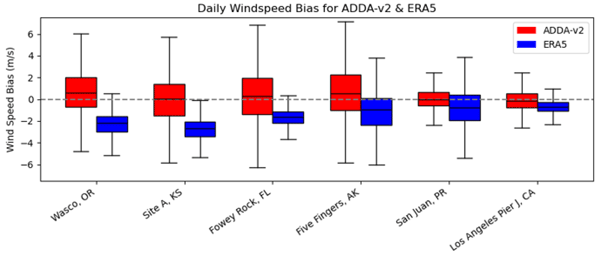
Kyle Peco, Jiali Wang, Chunyong Jung, Gökhan Sever, Lindsay Sheridan, Jeremy Feinstein, Rao Kotamarthi, Caroline Draxl, Ethan Young, Avi Purkayastha, and Andrew Kumler
Wind Energ. Sci., 11, 13–35, https://doi.org/10.5194/wes-11-13-2026, https://doi.org/10.5194/wes-11-13-2026, 2026
Short summary
Short summary
This study presents a new wind dataset, generated by a convection-permitting regional climate model across North America. By validating the dataset against wind observations, we have demonstrated that this dataset captures the wind patterns over complex terrains more realistically than the European Centre for
Medium-Range Weather Forecasts (ECMWF) reanalysis version 5 (ERA5). Additionally, this study quantifies model uncertainty in wind speed, comparing it against interannual variability, to better inform wind farm siting.
Medium-Range Weather Forecasts (ECMWF) reanalysis version 5 (ERA5). Additionally, this study quantifies model uncertainty in wind speed, comparing it against interannual variability, to better inform wind farm siting.
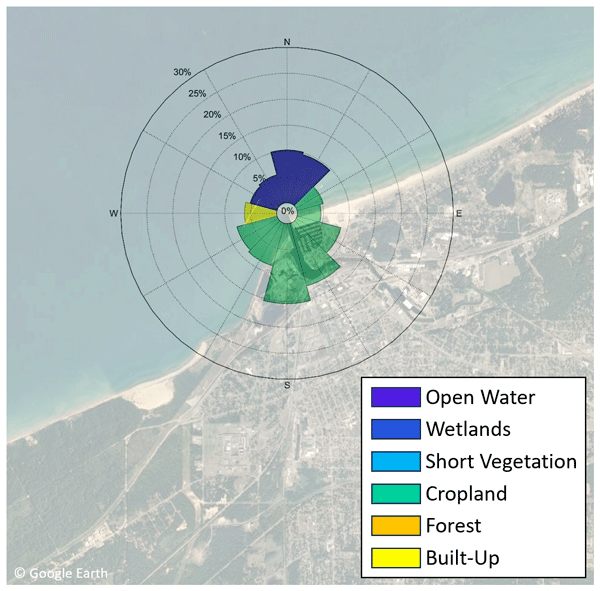
Lindsay M. Sheridan, Jiali Wang, Caroline Draxl, Nicola Bodini, Caleb Phillips, Dmitry Duplyakin, Heidi Tinnesand, Raj K. Rai, Julia E. Flaherty, Larry K. Berg, Chunyong Jung, Ethan Young, and Rao Kotamarthi
Wind Energ. Sci., 10, 1551–1574, https://doi.org/10.5194/wes-10-1551-2025, https://doi.org/10.5194/wes-10-1551-2025, 2025
Short summary
Short summary
Three recent wind resource datasets are assessed for their skills in representing annual average wind speeds and seasonal, diurnal, and interannual trends in the wind resource in coastal locations to support customers interested in small and midsize wind energy.
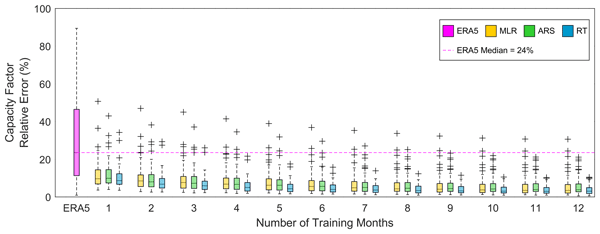
Lindsay M. Sheridan, Dmitry Duplyakin, Caleb Phillips, Heidi Tinnesand, Raj K. Rai, Julia E. Flaherty, and Larry K. Berg
Wind Energ. Sci., 10, 1451–1470, https://doi.org/10.5194/wes-10-1451-2025, https://doi.org/10.5194/wes-10-1451-2025, 2025
Short summary
Short summary
A total of 12 months of onsite wind measurement is standard for correcting model-based long-term wind speed estimates for utility-scale wind farms; however, the time and capital investment involved in gathering onsite measurements must be reconciled with the energy needs and funding opportunities for distributed wind projects. This study aims to answer the question of how short you can go in terms of the observational time period needed to make impactful improvements to long-term wind speed estimates.
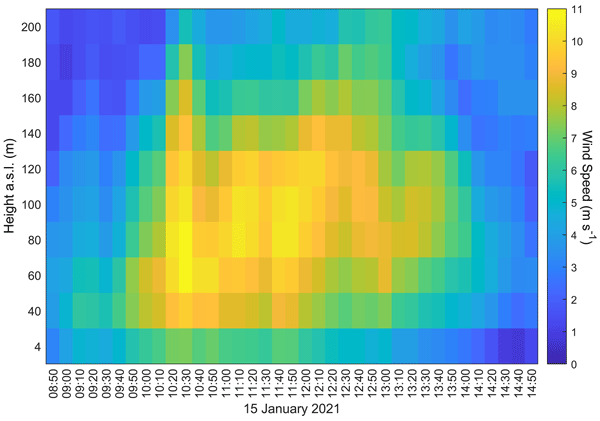
Lindsay M. Sheridan, Raghavendra Krishnamurthy, William I. Gustafson Jr., Ye Liu, Brian J. Gaudet, Nicola Bodini, Rob K. Newsom, and Mikhail Pekour
Wind Energ. Sci., 9, 741–758, https://doi.org/10.5194/wes-9-741-2024, https://doi.org/10.5194/wes-9-741-2024, 2024
Short summary
Short summary
In 2020, lidar-mounted buoys owned by the US Department of Energy (DOE) were deployed off the California coast in two wind energy lease areas and provided valuable year-long analyses of offshore low-level jet (LLJ) characteristics at heights relevant to wind turbines. In addition to the LLJ climatology, this work provides validation of LLJ representation in atmospheric models that are essential for assessing the potential energy yield of offshore wind farms.
Raghavendra Krishnamurthy, Gabriel García Medina, Brian Gaudet, William I. Gustafson Jr., Evgueni I. Kassianov, Jinliang Liu, Rob K. Newsom, Lindsay M. Sheridan, and Alicia M. Mahon
Earth Syst. Sci. Data, 15, 5667–5699, https://doi.org/10.5194/essd-15-5667-2023, https://doi.org/10.5194/essd-15-5667-2023, 2023
Short summary
Short summary
Our understanding and ability to observe and model air–sea processes has been identified as a principal limitation to our ability to predict future weather. Few observations exist offshore along the coast of California. To improve our understanding of the air–sea transition zone and support the wind energy industry, two buoys with state-of-the-art equipment were deployed for 1 year. In this article, we present details of the post-processing, algorithms, and analyses.
Lindsay M. Sheridan, Raghu Krishnamurthy, Gabriel García Medina, Brian J. Gaudet, William I. Gustafson Jr., Alicia M. Mahon, William J. Shaw, Rob K. Newsom, Mikhail Pekour, and Zhaoqing Yang
Wind Energ. Sci., 7, 2059–2084, https://doi.org/10.5194/wes-7-2059-2022, https://doi.org/10.5194/wes-7-2059-2022, 2022
Short summary
Short summary
Using observations from lidar buoys, five reanalysis and analysis models that support the wind energy community are validated offshore and at rotor-level heights along the California Pacific coast. The models are found to underestimate the observed wind resource. Occasions of large model error occur in conjunction with stable atmospheric conditions, wind speeds associated with peak turbine power production, and mischaracterization of the diurnal wind speed cycle in summer months.
Caleb Phillips, Lindsay M. Sheridan, Patrick Conry, Dimitrios K. Fytanidis, Dmitry Duplyakin, Sagi Zisman, Nicolas Duboc, Matt Nelson, Rao Kotamarthi, Rod Linn, Marc Broersma, Timo Spijkerboer, and Heidi Tinnesand
Wind Energ. Sci., 7, 1153–1169, https://doi.org/10.5194/wes-7-1153-2022, https://doi.org/10.5194/wes-7-1153-2022, 2022
Short summary
Short summary
Adoption of distributed wind turbines for energy generation is hindered by challenges associated with siting and accurate estimation of the wind resource. This study evaluates classic and commonly used methods alongside new state-of-the-art models derived from simulations and machine learning approaches using a large dataset from the Netherlands. We find that data-driven methods are most effective at predicting production at real sites and new models reliably outperform classic methods.
Lindsay M. Sheridan, Caleb Phillips, Alice C. Orrell, Larry K. Berg, Heidi Tinnesand, Raj K. Rai, Sagi Zisman, Dmitry Duplyakin, and Julia E. Flaherty
Wind Energ. Sci., 7, 659–676, https://doi.org/10.5194/wes-7-659-2022, https://doi.org/10.5194/wes-7-659-2022, 2022
Short summary
Short summary
The small wind community relies on simplified wind models and energy production simulation tools to obtain energy generation expectations. We gathered actual wind speed and turbine production data across the US to test the accuracy of models and tools for small wind turbines. This study provides small wind installers and owners with the error metrics and sources of error associated with using models and tools to make performance estimates, empowering them to adjust expectations accordingly.
Ye Liu, Huilin Huang, Troy M. Saltiel, Sha Feng, Andre Coleman, and Ann Almgren
EGUsphere, https://doi.org/10.5194/egusphere-2026-5430, https://doi.org/10.5194/egusphere-2026-5430, 2026
This preprint is open for discussion and under review for Geoscientific Model Development (GMD).
Short summary
Short summary
ERF-LSFIRE v1.0 is a new coupled fire–atmosphere modeling framework that links a C++/AMReX level-set surface-fire model with ERF. We document the model formulation and coupling strategy, verify the fire-spread implementation against analytical solutions, and demonstrate standalone, one-way, and two-way coupled simulations for two real wildfire events.
Bianca Adler, Laura Bianco, David D. Turner, Joseph Olson, Xia Sun, Joshua Gebauer, Nicola Bodini, Stefano Letizia, and James M. Wilczak
Geosci. Model Dev., 19, 8627–8649, https://doi.org/10.5194/gmd-19-8627-2026, https://doi.org/10.5194/gmd-19-8627-2026, 2026
Short summary
Short summary
Accurate operational forecasts of temperature and wind in the coastal marine boundary layer are important for a wide range of applications. Leveraging data that were collected along the United States northeast coast during a multi-year period for the Third Wind Forecast Improvement project, we investigated the performance of the operational forecast model and identified systematic errors in wind and temperature forecasts that are now being addressed by the model developers.
Nicola Bodini, Grant Buster, and David D. Turner
Earth Syst. Sci. Data Discuss., https://doi.org/10.5194/essd-2026-680, https://doi.org/10.5194/essd-2026-680, 2026
Preprint under review for ESSD
Short summary
Short summary
Alaska's power systems depend on weather, yet weather stations there are few and far between. We turned seven years of hourly output from a national weather forecast model into an easy-to-use record of wind and temperature across Alaska, and checked it against measurements from more than 150 sites. The data generally match observations well, and are freely available to support energy planning, resilient power grids, and artificial intelligence research in this remote region.
Nicola Bodini, Patrick Moriarty, Regis Thedin, Paula Doubrawa, Cristina Archer, Myra Blaylock, Carlo Bottasso, Bruno Carmo, Lawrence Cheung, Camille Dubreuil, Rogier Floors, Thomas Herges, Daniel Houck, Ali Kanjari, Colleen M. Kaul, Christopher Kelley, Ru Li, Julie K. Lundquist, Desirae Major, Anh Kiet Nguyen, Mike Optis, Luan R. C. Parada, Alfredo Peña, Julian Quick, David Ricarte, William C. Radünz, Raj K. Rai, Oscar García-Santiago, Jonas Schulte, Knut S. Seim, M. Paul van der Laan, Kisorthman Vimalakanthan, and Adam Wise
Wind Energ. Sci., 11, 3107–3135, https://doi.org/10.5194/wes-11-3107-2026, https://doi.org/10.5194/wes-11-3107-2026, 2026
Short summary
Short summary
Predicting wind farm energy production is challenging because wind patterns are complex. We tested 16 different models against real data from a major field experiment to see which worked best. Surprisingly, the most expensive and detailed models were not always more accurate than simpler ones. We found that feeding models better weather data was the most effective way to improve accuracy. These results help the industry choose the right tools for designing more-efficient wind farms.
Robert Jackson, Paytsar Muradyan, Raghavendra Krishnamurthy, Rob Newsom, Sonia Wharton, Matteo Puccioni, Bhupendra Raut, Seongha Park, Rajesh Sankaran, Scott Collis, Joseph O'Brien, and V. Rao Kotamarthi
EGUsphere, https://doi.org/10.5194/egusphere-2026-2568, https://doi.org/10.5194/egusphere-2026-2568, 2026
This preprint is open for discussion and under review for Atmospheric Measurement Techniques (AMT).
Short summary
Short summary
The winds in the lowest layer of our atmosphere are commonly sensed using Doppler LiDARs. These LiDARs are commonly set to scan the atmosphere in a single way, which can sometimes miss the most interesting events in our lower atmosphere such as high wind events and mountain valley flow reversals. Here, we present an infrastructure for intelligent sensing, using Argonne National Laboratory's state of the art cloud-based edge computing system Waggle.
Jiakun Liang, William I. Gustafson Jr., Dana R. Caulton, and Jennifer D. Small Griswold
EGUsphere, https://doi.org/10.5194/egusphere-2026-2786, https://doi.org/10.5194/egusphere-2026-2786, 2026
Short summary
Short summary
Aircraft measurements are essential for studying clouds, but they capture only limited portions of a cloud field. This study uses high-resolution atmospheric simulations to assess how flight patterns and sampling strategies affect the representativeness of aircraft measurements. The results show that sampling design strongly influences measurement accuracy, providing guidance for future aircraft observations and model evaluation.
Nicola Bodini, Joseph Olson, Brian Gaudet, Giacomo Valerio Iungo, Mojtaba Shams Solari, Sayahnya Roy, Julie K. Lundquist, Nathan Agarwal, Timothy A. Myers, Bianca Adler, Jeffrey D. Mirocha, Eric James, Laura Bianco, James M. Wilczak, and David D. Turner
Wind Energ. Sci., 11, 1949–1961, https://doi.org/10.5194/wes-11-1949-2026, https://doi.org/10.5194/wes-11-1949-2026, 2026
Short summary
Short summary
To improve offshore wind forecasts, the Third Wind Forecast Improvement Project monitored the United States east coast for 18 months. We compiled a daily log of weather events using advanced scanners and expert notes. This public dataset identifies important wind patterns, helping scientists test computer models and choose specific cases to study.
Kevin Menear, Sameer Shaik, Lindsay Sheridan, Dmitry Duplyakin, and Caleb Phillips
Wind Energ. Sci. Discuss., https://doi.org/10.5194/wes-2026-75, https://doi.org/10.5194/wes-2026-75, 2026
Preprint under review for WES
Short summary
Short summary
Wind energy projects use public wind maps to estimate power potential, but these maps have errors that vary by location. We compared major maps against real measurements across the United States and found that each has distinct weaknesses. We built a machine learning model that combines multiple maps into more accurate estimates, cutting typical errors by a third. These results are freely available online to help communities make better decisions when planning small-scale wind energy projects.
Aliza Abraham, Nicola Bodini, Nicholas Hamilton, Brian Hirth, John Schroeder, and Patrick Moriarty
Wind Energ. Sci. Discuss., https://doi.org/10.5194/wes-2026-82, https://doi.org/10.5194/wes-2026-82, 2026
Revised manuscript under review for WES
Short summary
Short summary
Thunderstorms can cause sudden changes in wind speed and direction called "wind ramps". While wind turbines are designed to withstand simplified versions of such wind ramps, this paper shows that real wind ramps are much more variable and complex than those prescribed in the design standard. This variability makes it difficult for wind farm operators to predict the conditions that each wind turbine will experience, adding uncertainty to the prediction of wind farm power.
Nicola Bodini, Emina Maric, Ulrike Egerer, Grant Buster, Luke Lavin, Pavlo Pinchuk, Brandon Benton, and David D. Turner
Wind Energ. Sci. Discuss., https://doi.org/10.5194/wes-2026-67, https://doi.org/10.5194/wes-2026-67, 2026
Revised manuscript accepted for WES
Short summary
Short summary
To plan a reliable United States power grid, engineers need continuous weather data. Because the previous standard record ended in 2013, we created a new, easy-to-use weather database by repackaging complex weather forecasting models onto the same historical grid. We compared our data against real-world observations nationwide, finding it is highly accurate. This provides a seamless, reliable new standard to help plan the future of our national energy system.
Nicola Bodini, Aliza Abraham, Paula Doubrawa, Stefano Letizia, Julie K. Lundquist, Patrick Moriarty, and Ryan Scott
Wind Energ. Sci. Discuss., https://doi.org/10.5194/wes-2026-33, https://doi.org/10.5194/wes-2026-33, 2026
Revised manuscript under review for WES
Short summary
Short summary
Wind turbines create "wakes" of slowed air that reduce power for nearby turbines. To help improve wind energy models, we analyzed data from a large field experiment. We focused on a single day with changing weather patterns. We found that even simple terrain features interacted with the wind to create large variations in power output – up to 80 percent – across a wind farm. This detailed dataset provides a real-world case needed to validate and improve wind energy design tools.

Yelena Pichugina, Alan W. Brewer, Sunil Baidar, Robert Banta, Edward Strobach, Brandi McCarty, Brian Carroll, Nicola Bodini, Stefano Letizia, Richard Marchbanks, Michael Zucker, Maxwell Holloway, and Patrick Moriarty
Wind Energ. Sci., 11, 417–442, https://doi.org/10.5194/wes-11-417-2026, https://doi.org/10.5194/wes-11-417-2026, 2026
Short summary
Short summary
The truck-based Doppler lidar system was used during the American Wake Experiment (AWAKEN) to obtain the high-frequency, simultaneous measurements of the horizontal wind speed, direction, and vertical velocity from a moving platform. The paper presents the unique capability of the novel lidar system to characterize the temporal, vertical, and spatial variability in winds at various distances from operating turbines and obtain quantitative estimates of wind speed reduction in the waked flow.
Kyle Peco, Jiali Wang, Chunyong Jung, Gökhan Sever, Lindsay Sheridan, Jeremy Feinstein, Rao Kotamarthi, Caroline Draxl, Ethan Young, Avi Purkayastha, and Andrew Kumler
Wind Energ. Sci., 11, 13–35, https://doi.org/10.5194/wes-11-13-2026, https://doi.org/10.5194/wes-11-13-2026, 2026
Short summary
Short summary
This study presents a new wind dataset, generated by a convection-permitting regional climate model across North America. By validating the dataset against wind observations, we have demonstrated that this dataset captures the wind patterns over complex terrains more realistically than the European Centre for
Medium-Range Weather Forecasts (ECMWF) reanalysis version 5 (ERA5). Additionally, this study quantifies model uncertainty in wind speed, comparing it against interannual variability, to better inform wind farm siting.
Medium-Range Weather Forecasts (ECMWF) reanalysis version 5 (ERA5). Additionally, this study quantifies model uncertainty in wind speed, comparing it against interannual variability, to better inform wind farm siting.
Jungmin Lee, Virendra P. Ghate, Arka Mitra, Lee M. Miller, Raghavendra Krishnamurthy, and Ulrike Egerer
Wind Energ. Sci., 10, 2755–2769, https://doi.org/10.5194/wes-10-2755-2025, https://doi.org/10.5194/wes-10-2755-2025, 2025
Short summary
Short summary
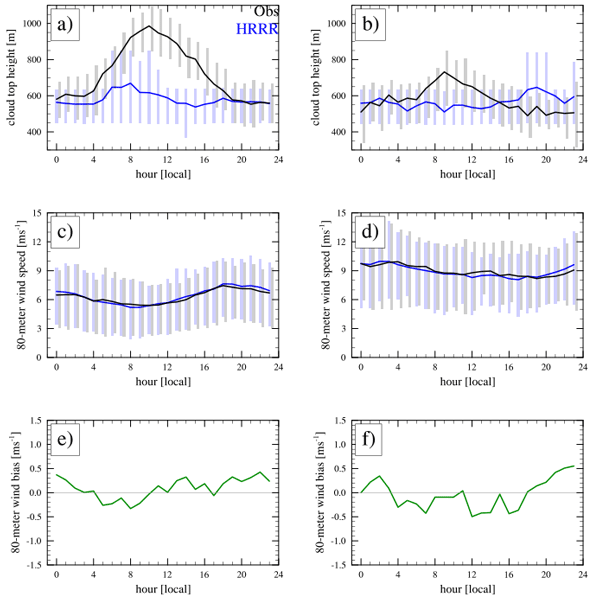
This study evaluates how well the High-Resolution Rapid Refresh (HRRR) model represents wind and cloud patterns off coastal California near Morro Bay and Humboldt. Comparisons with buoy and satellite data show that the model captures overall cloudiness but underestimates cloud top height and misses daily variations. HRRR performs well under cloudy skies but shows larger errors under clear conditions.
Matteo Puccioni, Sonia Wharton, Stephan F. J. De Wekker, Robert S. Arthur, Tianyi Li, Ye Liu, Sha Feng, Kyle Pressel, Raj K. Rai, Larry K. Berg, and Jerome D. Fast
Wind Energ. Sci. Discuss., https://doi.org/10.5194/wes-2025-215, https://doi.org/10.5194/wes-2025-215, 2025
Revised manuscript not accepted
Short summary
Short summary
A multi-wind Lidar campaign is conducted in a forest in the United States Southeast, a region featuring low wind resources due to the forest drag. Although the latter reduces the wind for hundreds of meters above ground, we found this effect to be negligible for heights above 8 times the tree height where the wind is dominated by local atmospheric events. This scenario opens to the development of taller turbines harvesting the wind farther away from the ground where the forest drag is minimal.
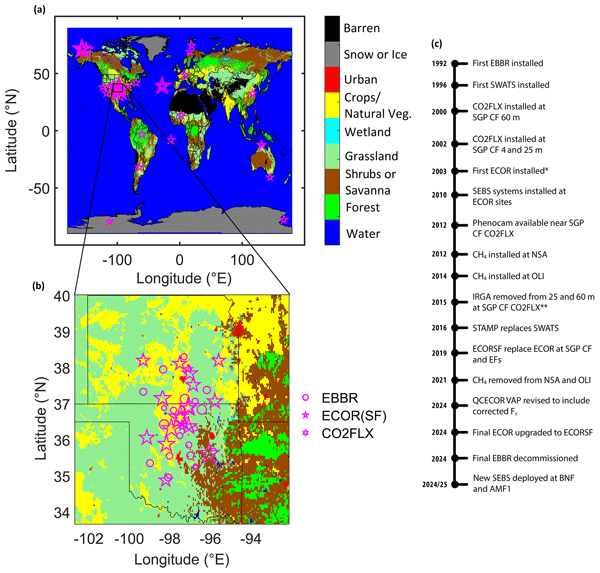
Ryan C. Sullivan, David P. Billesbach, Sebastien Biraud, Stephen Chan, Richard Hart, Evan Keeler, Jenni Kyrouac, Sujan Pal, Mikhail Pekour, Sara L. Sullivan, Adam Theisen, Matt Tuftedal, and David R. Cook
Earth Syst. Sci. Data, 17, 5007–5038, https://doi.org/10.5194/essd-17-5007-2025, https://doi.org/10.5194/essd-17-5007-2025, 2025
Short summary
Short summary
Turbulent fluxes quantify the exchange of energy, water, or trace gases into and out of the atmosphere. The U.S. Department of Energy Atmospheric Radiation Measurement user facility has been making atmospheric measurements since the early 1990s, including measurements of turbulent fluxes using two well-established methods: the energy balance Bowen ratio and eddy covariance. This paper documents key aspects of these datasets, including their history, changes through time, and best use practices.
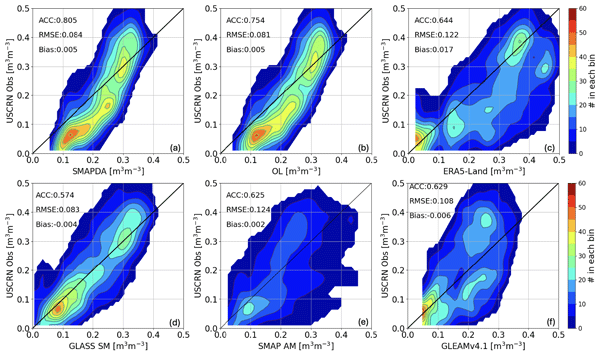
Sheng-Lun Tai, Zhao Yang, Brian Gaudet, Koichi Sakaguchi, Larry Berg, Colleen Kaul, Yun Qian, Ye Liu, and Jerome Fast
Earth Syst. Sci. Data, 17, 4587–4611, https://doi.org/10.5194/essd-17-4587-2025, https://doi.org/10.5194/essd-17-4587-2025, 2025
Short summary
Short summary
Our study created a high-resolution soil moisture dataset for the eastern US by integrating satellite data with a land surface model and advanced algorithms, achieving 1 km scale analyses. Validated against multiple in situ networks and analysis datasets, it demonstrated superior accuracy. This dataset is vital for understanding soil moisture dynamics, especially during droughts, and highlights the need to mitigate soil-type-dependent biases in the model.
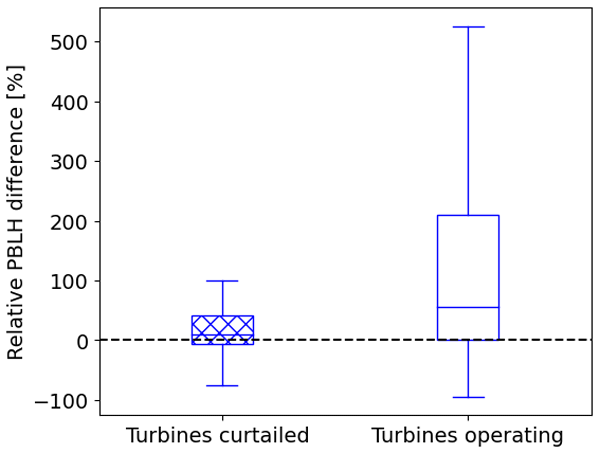
Aliza Abraham, Matteo Puccioni, Arianna Jordan, Emina Maric, Nicola Bodini, Nicholas Hamilton, Stefano Letizia, Petra M. Klein, Elizabeth N. Smith, Sonia Wharton, Jonathan Gero, Jamey D. Jacob, Raghavendra Krishnamurthy, Rob K. Newsom, Mikhail Pekour, William Radünz, and Patrick Moriarty
Wind Energ. Sci., 10, 1681–1705, https://doi.org/10.5194/wes-10-1681-2025, https://doi.org/10.5194/wes-10-1681-2025, 2025
Short summary
Short summary
This study is the first to use real-world atmospheric measurements to show that large wind plants can increase the height of the planetary boundary layer, the part of the atmosphere near the surface where life takes place. The planetary boundary layer height governs processes like pollutant transport and cloud formation and is a key parameter for modeling the atmosphere. The results of this study provide important insights into interactions between wind plants and their local environment.
Lindsay M. Sheridan, Jiali Wang, Caroline Draxl, Nicola Bodini, Caleb Phillips, Dmitry Duplyakin, Heidi Tinnesand, Raj K. Rai, Julia E. Flaherty, Larry K. Berg, Chunyong Jung, Ethan Young, and Rao Kotamarthi
Wind Energ. Sci., 10, 1551–1574, https://doi.org/10.5194/wes-10-1551-2025, https://doi.org/10.5194/wes-10-1551-2025, 2025
Short summary
Short summary
Three recent wind resource datasets are assessed for their skills in representing annual average wind speeds and seasonal, diurnal, and interannual trends in the wind resource in coastal locations to support customers interested in small and midsize wind energy.

Damao Zhang, Jennifer Comstock, Chitra Sivaraman, Kefei Mo, Raghavendra Krishnamurthy, Jingjing Tian, Tianning Su, Zhanqing Li, and Natalia Roldán-Henao
Atmos. Meas. Tech., 18, 3453–3475, https://doi.org/10.5194/amt-18-3453-2025, https://doi.org/10.5194/amt-18-3453-2025, 2025
Short summary
Short summary
Planetary boundary layer height (PBLHT) is an important parameter in atmospheric process studies and numerical model simulations. We use machine learning methods to produce a best-estimate planetary boundary layer height (PBLHT-BE-ML) by integrating four PBLHT estimates derived from remote sensing measurements. We demonstrated that PBLHT-BE-ML greatly improved the comparisons against sounding-derived PBLHT.
Lindsay M. Sheridan, Dmitry Duplyakin, Caleb Phillips, Heidi Tinnesand, Raj K. Rai, Julia E. Flaherty, and Larry K. Berg
Wind Energ. Sci., 10, 1451–1470, https://doi.org/10.5194/wes-10-1451-2025, https://doi.org/10.5194/wes-10-1451-2025, 2025
Short summary
Short summary
A total of 12 months of onsite wind measurement is standard for correcting model-based long-term wind speed estimates for utility-scale wind farms; however, the time and capital investment involved in gathering onsite measurements must be reconciled with the energy needs and funding opportunities for distributed wind projects. This study aims to answer the question of how short you can go in terms of the observational time period needed to make impactful improvements to long-term wind speed estimates.
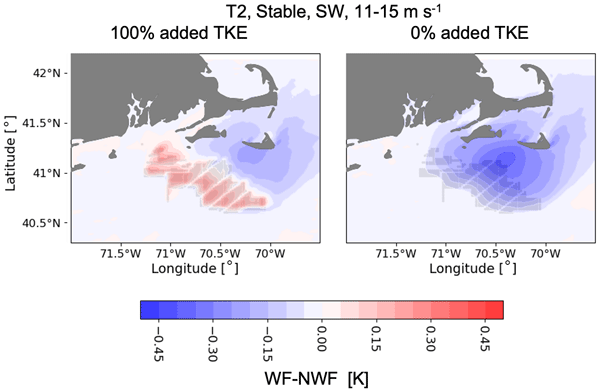
Daphne Quint, Julie K. Lundquist, Nicola Bodini, and David Rosencrans
Wind Energ. Sci., 10, 1269–1301, https://doi.org/10.5194/wes-10-1269-2025, https://doi.org/10.5194/wes-10-1269-2025, 2025
Short summary
Short summary
Offshore wind farms along the US East Coast can have limited effects on local weather. To study these effects, we include wind farms near Massachusetts and Rhode Island, and we test different amounts of turbulence in our model. We analyze changes in wind, temperature, and turbulence. Simulated effects on surface temperature and turbulence change depending on how much turbulence is added to the model. The extent of the wind farm wake depends on how deep the atmospheric boundary layer is.
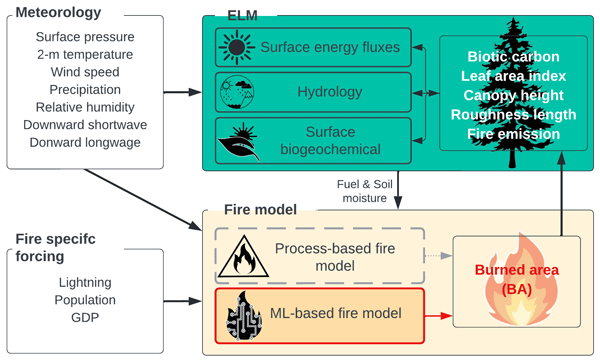
Ye Liu, Huilin Huang, Sing-Chun Wang, Tao Zhang, Donghui Xu, and Yang Chen
Geosci. Model Dev., 18, 4103–4117, https://doi.org/10.5194/gmd-18-4103-2025, https://doi.org/10.5194/gmd-18-4103-2025, 2025
Short summary
Short summary
This study integrates machine learning with a land surface model to improve wildfire predictions in North America. Traditional models struggle with accurately simulating burned areas due to simplified processes. By combining the predictive power of machine learning with a land model, our hybrid framework better captures fire dynamics. This approach enhances our understanding of wildfire behavior and aids in developing more effective climate and fire management strategies.
Macy Frost Chang, Raghavendra Krishnamurthy, and Fotini Katopodes Chow
Wind Energ. Sci. Discuss., https://doi.org/10.5194/wes-2025-85, https://doi.org/10.5194/wes-2025-85, 2025
Preprint under review for WES
Short summary
Short summary
The development of offshore wind energy sites hinges on accurate prediction of hub-height wind speeds. This paper compares three machine learning (ML) algorithms to a standard log-law wind extrapolation at two offshore buoy sites. The ML methods demonstrate new capabilities for providing accurate and adaptable predictions of offshore wind characteristics in comparison to conventional approaches. These ML techniques can help inform the development of offshore wind energy projects.
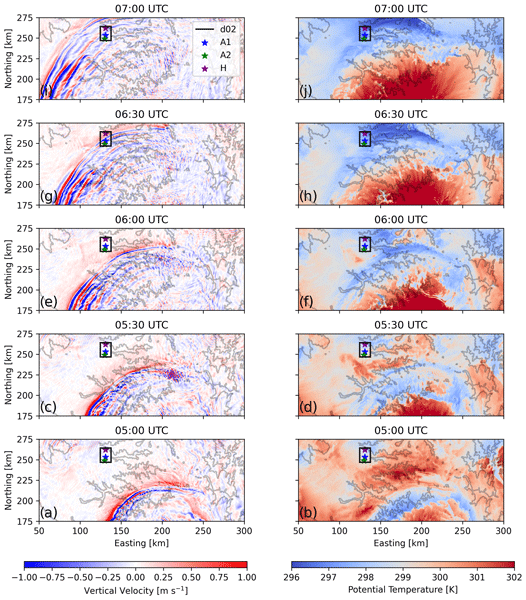
Adam S. Wise, Robert S. Arthur, Aliza Abraham, Sonia Wharton, Raghavendra Krishnamurthy, Rob Newsom, Brian Hirth, John Schroeder, Patrick Moriarty, and Fotini K. Chow
Wind Energ. Sci., 10, 1007–1032, https://doi.org/10.5194/wes-10-1007-2025, https://doi.org/10.5194/wes-10-1007-2025, 2025
Short summary
Short summary
Wind farms can be subject to rapidly changing weather events. In the United States Great Plains, some of these weather events can result in waves in the atmosphere that ultimately affect how much power a wind farm can produce. We modeled a specific event of waves observed in Oklahoma. We determined how to accurately model the event and analyzed how it affected a wind farm’s power production, finding that the waves both decreased power and made it more variable.
Arka Mitra, Virendra Ghate, and Raghavendra Krishnamurthy
Wind Energ. Sci. Discuss., https://doi.org/10.5194/wes-2025-55, https://doi.org/10.5194/wes-2025-55, 2025
Revised manuscript not accepted
Short summary
Short summary
This study introduces a new metric to quantify the spatiotemporal variability of wind resources and a novel numerical technique to locate the optimal wind resource within a large wind farm. The new metric and the novel optimization technique are applied to assist in the pre-construction wind resource assessments of two Californian offshore wind energy areas. This optimization is stable for a diverse choice of wind turbines and is easily scalable and adaptable to any other offshore location.
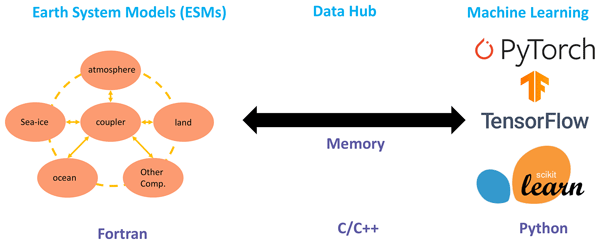
Tao Zhang, Cyril Morcrette, Meng Zhang, Wuyin Lin, Shaocheng Xie, Ye Liu, Kwinten Van Weverberg, and Joana Rodrigues
Geosci. Model Dev., 18, 1917–1928, https://doi.org/10.5194/gmd-18-1917-2025, https://doi.org/10.5194/gmd-18-1917-2025, 2025
Short summary
Short summary
Earth system models (ESMs) struggle with the uncertainties associated with parameterizing subgrid physics. Machine learning (ML) algorithms offer a solution by learning the important relationships and features from high-resolution models. To incorporate ML parameterizations into ESMs, we develop a Fortran–Python interface that allows for calling Python functions within Fortran-based ESMs. Through two case studies, this interface demonstrates its feasibility, modularity, and effectiveness.
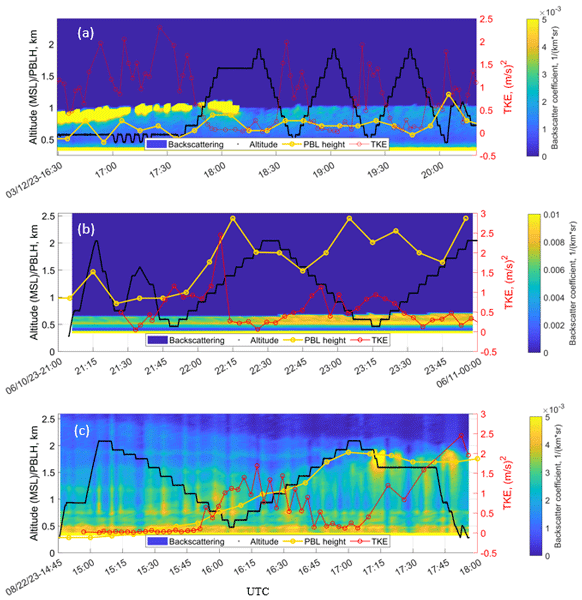
Fan Mei, Qi Zhang, Damao Zhang, Jerome D. Fast, Gourihar Kulkarni, Mikhail S. Pekour, Christopher R. Niedek, Susanne Glienke, Israel Silber, Beat Schmid, Jason M. Tomlinson, Hardeep S. Mehta, Xena Mansoura, Zezhen Cheng, Gregory W. Vandergrift, Nurun Nahar Lata, Swarup China, and Zihua Zhu
Atmos. Chem. Phys., 25, 3425–3444, https://doi.org/10.5194/acp-25-3425-2025, https://doi.org/10.5194/acp-25-3425-2025, 2025
Short summary
Short summary
This study highlights the unique capability of the ArcticShark, an uncrewed aerial system, in measuring vertically resolved atmospheric properties. Data from 32 research flights in 2023 reveal seasonal patterns and correlations with conventional measurements. The consistency and complementarity of in situ and remote sensing methods are highlighted. The study demonstrates the ArcticShark’s versatility in bridging data gaps and improving the understanding of vertical atmospheric structures.
Huilin Huang, Yun Qian, Gautam Bisht, Jiali Wang, Tirthankar Chakraborty, Dalei Hao, Jianfeng Li, Travis Thurber, Balwinder Singh, Zhao Yang, Ye Liu, Pengfei Xue, William J. Sacks, Ethan Coon, and Robert Hetland
Geosci. Model Dev., 18, 1427–1443, https://doi.org/10.5194/gmd-18-1427-2025, https://doi.org/10.5194/gmd-18-1427-2025, 2025
Short summary
Short summary
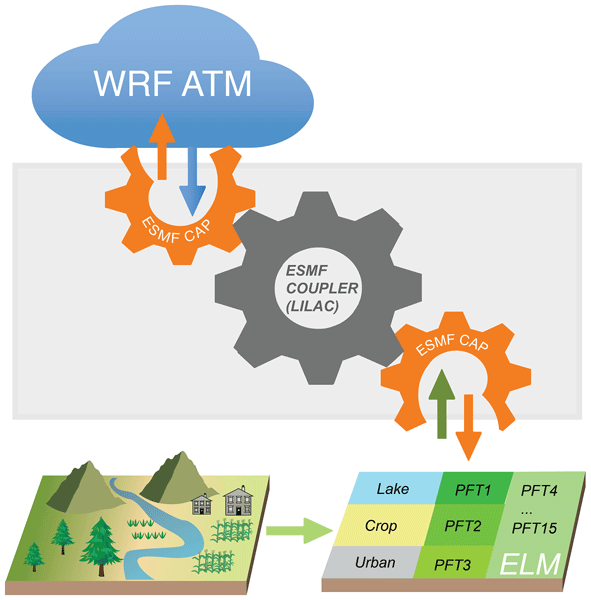
We integrate the E3SM Land Model (ELM) with the WRF model through the Lightweight Infrastructure for Land Atmosphere Coupling (LILAC) Earth System Modeling Framework (ESMF). This framework includes a top-level driver, LILAC, for variable communication between WRF and ELM and ESMF caps for ELM initialization, execution, and finalization. The LILAC–ESMF framework maintains the integrity of the ELM's source code structure and facilitates the transfer of future ELM model developments to WRF-ELM.
Ye Liu, Timothy W. Juliano, Raghavendra Krishnamurthy, Brian J. Gaudet, and Jungmin Lee
Wind Energ. Sci., 10, 483–495, https://doi.org/10.5194/wes-10-483-2025, https://doi.org/10.5194/wes-10-483-2025, 2025
Short summary
Short summary
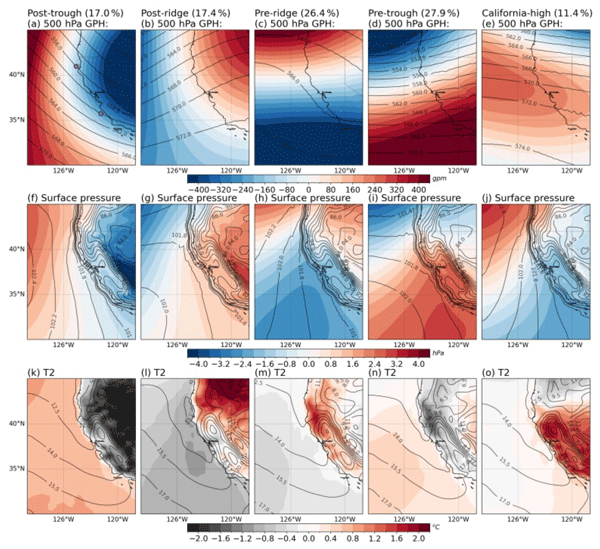
Our study reveals how different weather patterns influence wind conditions off the US West Coast. We identified key weather patterns affecting wind speeds at potential wind farm sites using advanced machine learning. This research helps improve weather prediction models, making wind energy production more reliable and efficient.
Raghavendra Krishnamurthy, Rob K. Newsom, Colleen M. Kaul, Stefano Letizia, Mikhail Pekour, Nicholas Hamilton, Duli Chand, Donna Flynn, Nicola Bodini, and Patrick Moriarty
Wind Energ. Sci., 10, 361–380, https://doi.org/10.5194/wes-10-361-2025, https://doi.org/10.5194/wes-10-361-2025, 2025
Short summary
Short summary
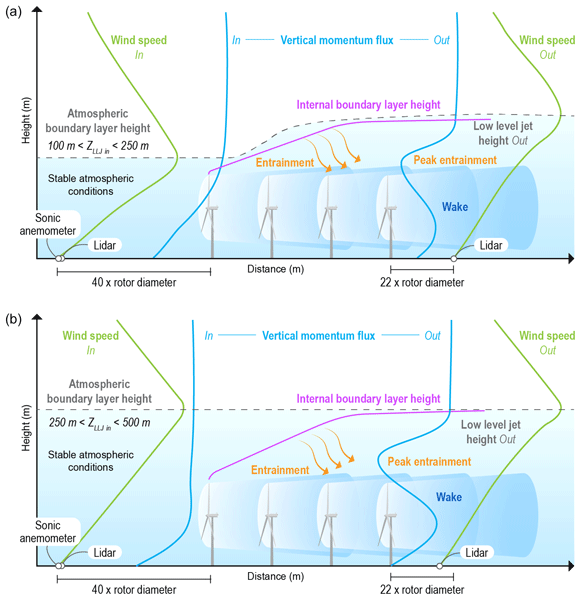
This study examines how atmospheric phenomena affect the recovery of wind farm wake – the disturbed air behind turbines. In regions like Oklahoma, where wind farms are often clustered, understanding wake recovery is crucial. We found that wind farms can alter phenomena like low-level jets, which are common in Oklahoma, by deflecting them above the wind farm. As a result, the impact of wakes can be observed up to 1–2 km above ground level.
David Rosencrans, Julie K. Lundquist, Mike Optis, and Nicola Bodini
Wind Energ. Sci., 10, 59–81, https://doi.org/10.5194/wes-10-59-2025, https://doi.org/10.5194/wes-10-59-2025, 2025
Short summary
Short summary
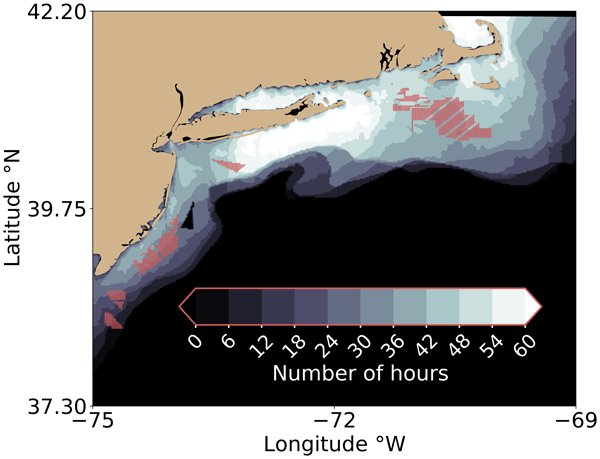
The US offshore wind industry is growing rapidly. Expansion into cold climates will subject turbines and personnel to hazardous icing. We analyze the 21-year icing risk for US east coast wind areas based on numerical weather prediction simulations and further assess impacts from wind farm wakes over one winter season. Sea spray icing at 10 m can occur up to 67 h per month. However, turbine–atmosphere interactions reduce icing hours within wind plant areas.
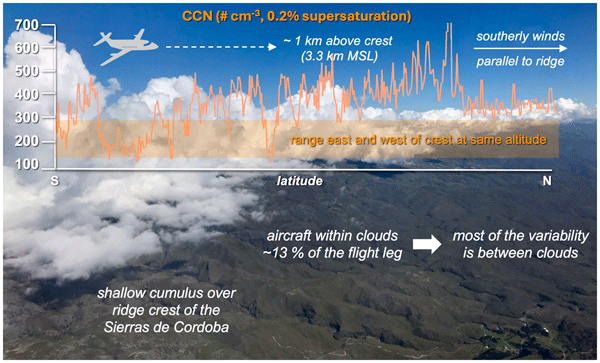
Jerome D. Fast, Adam C. Varble, Fan Mei, Mikhail Pekour, Jason Tomlinson, Alla Zelenyuk, Art J. Sedlacek III, Maria Zawadowicz, and Louisa Emmons
Atmos. Chem. Phys., 24, 13477–13502, https://doi.org/10.5194/acp-24-13477-2024, https://doi.org/10.5194/acp-24-13477-2024, 2024
Short summary
Short summary
Aerosol property measurements recently collected on the ground and by a research aircraft in central Argentina during the Cloud, Aerosol, and Complex Terrain Interactions (CACTI) campaign exhibit large spatial and temporal variability. These measurements coupled with coincident meteorological information provide a valuable data set needed to evaluate and improve model predictions of aerosols in a traditionally data-sparse region of South America.
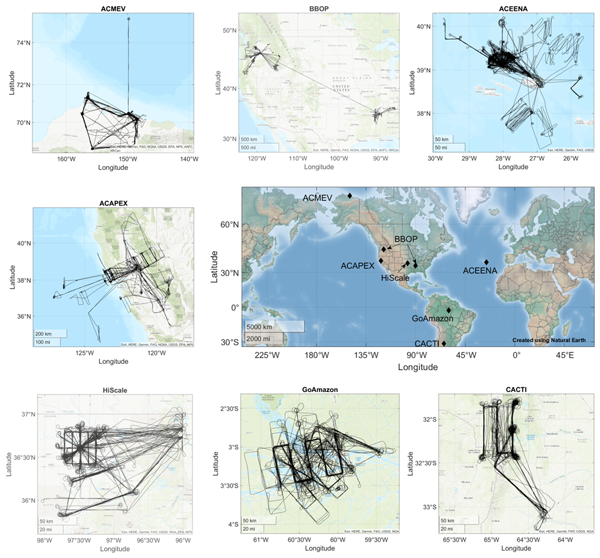
Fan Mei, Jennifer M. Comstock, Mikhail S. Pekour, Jerome D. Fast, Krista L. Gaustad, Beat Schmid, Shuaiqi Tang, Damao Zhang, John E. Shilling, Jason M. Tomlinson, Adam C. Varble, Jian Wang, L. Ruby Leung, Lawrence Kleinman, Scot Martin, Sebastien C. Biraud, Brian D. Ermold, and Kenneth W. Burk
Earth Syst. Sci. Data, 16, 5429–5448, https://doi.org/10.5194/essd-16-5429-2024, https://doi.org/10.5194/essd-16-5429-2024, 2024
Short summary
Short summary
Our study explores a comprehensive dataset from airborne field studies (2013–2018) conducted using the US Department of Energy's Gulfstream 1 (G-1). The 236 flights span diverse regions, including the Arctic, US Southern Great Plains, US West Coast, eastern North Atlantic, Amazon Basin in Brazil, and Sierras de Córdoba range in Argentina. This dataset provides unique insights into atmospheric dynamics, aerosols, and clouds and makes data available in a more accessible format.
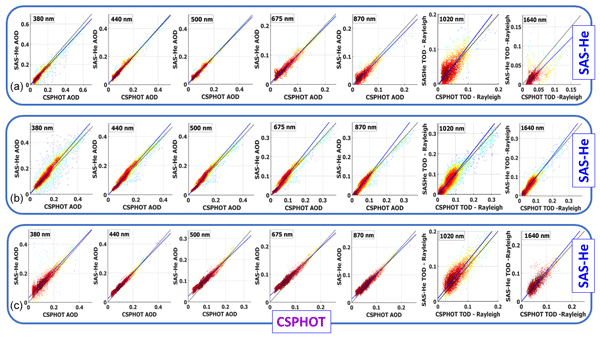
Evgueni Kassianov, Connor J. Flynn, James C. Barnard, Brian D. Ermold, and Jennifer M. Comstock
Atmos. Meas. Tech., 17, 4997–5013, https://doi.org/10.5194/amt-17-4997-2024, https://doi.org/10.5194/amt-17-4997-2024, 2024
Short summary
Short summary
Conventional ground-based radiometers commonly measure solar radiation at a few wavelengths within a narrow spectral range. These limitations prevent improved retrievals of aerosol, cloud, and surface characteristics. To address these limitations, an advanced ground-based radiometer with expanded spectral coverage and hyperspectral capability is introduced. Its good performance is demonstrated using reference data collected over three coastal regions with diverse types of aerosols and clouds.
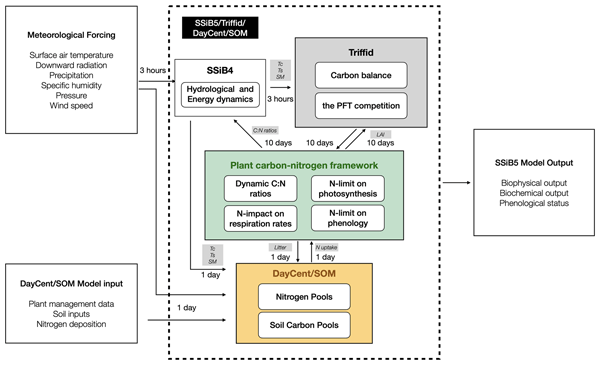
Zheng Xiang, Yongkang Xue, Weidong Guo, Melannie D. Hartman, Ye Liu, and William J. Parton
Geosci. Model Dev., 17, 6437–6464, https://doi.org/10.5194/gmd-17-6437-2024, https://doi.org/10.5194/gmd-17-6437-2024, 2024
Short summary
Short summary
A process-based plant carbon (C)–nitrogen (N) interface coupling framework has been developed which mainly focuses on plant resistance and N-limitation effects on photosynthesis, plant respiration, and plant phenology. A dynamic C / N ratio is introduced to represent plant resistance and self-adjustment. The framework has been implemented in a coupled biophysical-ecosystem–biogeochemical model, and testing results show a general improvement in simulating plant properties with this framework.
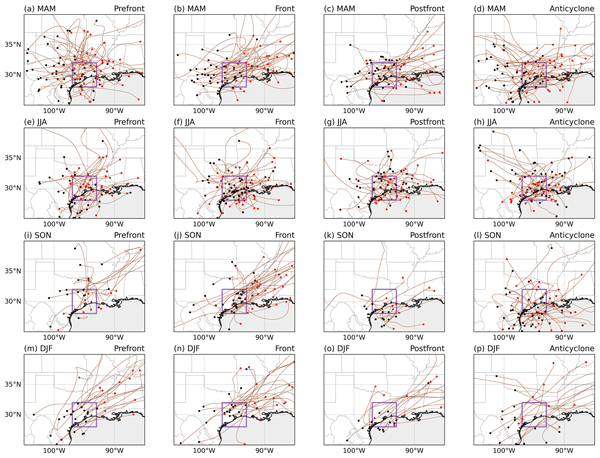
Ye Liu, Yun Qian, Larry K. Berg, Zhe Feng, Jianfeng Li, Jingyi Chen, and Zhao Yang
Atmos. Chem. Phys., 24, 8165–8181, https://doi.org/10.5194/acp-24-8165-2024, https://doi.org/10.5194/acp-24-8165-2024, 2024
Short summary
Short summary
Deep convection under various large-scale meteorological patterns (LSMPs) shows distinct precipitation features. In southeastern Texas, mesoscale convective systems (MCSs) contribute significantly to precipitation year-round, while isolated deep convection (IDC) is prominent in summer and fall. Self-organizing maps (SOMs) reveal convection can occur without large-scale lifting or moisture convergence. MCSs and IDC events have distinct life cycles influenced by specific LSMPs.
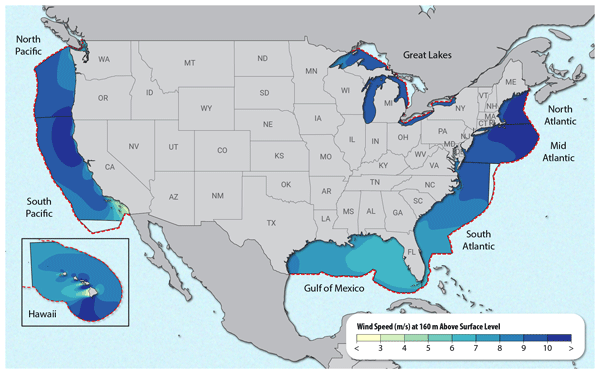
Nicola Bodini, Mike Optis, Stephanie Redfern, David Rosencrans, Alex Rybchuk, Julie K. Lundquist, Vincent Pronk, Simon Castagneri, Avi Purkayastha, Caroline Draxl, Raghavendra Krishnamurthy, Ethan Young, Billy Roberts, Evan Rosenlieb, and Walter Musial
Earth Syst. Sci. Data, 16, 1965–2006, https://doi.org/10.5194/essd-16-1965-2024, https://doi.org/10.5194/essd-16-1965-2024, 2024
Short summary
Short summary
This article presents the 2023 National Offshore Wind data set (NOW-23), an updated resource for offshore wind information in the US. It replaces the Wind Integration National Dataset (WIND) Toolkit, offering improved accuracy through advanced weather prediction models. The data underwent regional tuning and validation and can be accessed at no cost.
Lindsay M. Sheridan, Raghavendra Krishnamurthy, William I. Gustafson Jr., Ye Liu, Brian J. Gaudet, Nicola Bodini, Rob K. Newsom, and Mikhail Pekour
Wind Energ. Sci., 9, 741–758, https://doi.org/10.5194/wes-9-741-2024, https://doi.org/10.5194/wes-9-741-2024, 2024
Short summary
Short summary
In 2020, lidar-mounted buoys owned by the US Department of Energy (DOE) were deployed off the California coast in two wind energy lease areas and provided valuable year-long analyses of offshore low-level jet (LLJ) characteristics at heights relevant to wind turbines. In addition to the LLJ climatology, this work provides validation of LLJ representation in atmospheric models that are essential for assessing the potential energy yield of offshore wind farms.
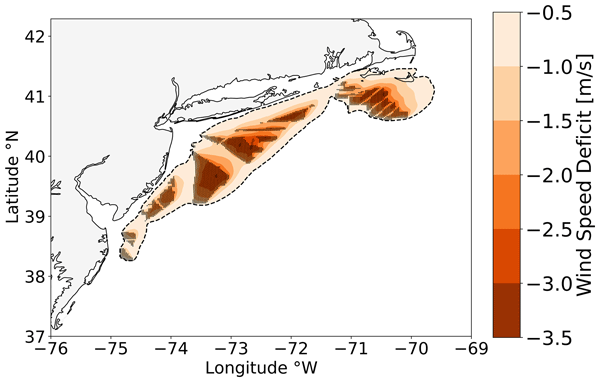
David Rosencrans, Julie K. Lundquist, Mike Optis, Alex Rybchuk, Nicola Bodini, and Michael Rossol
Wind Energ. Sci., 9, 555–583, https://doi.org/10.5194/wes-9-555-2024, https://doi.org/10.5194/wes-9-555-2024, 2024
Short summary
Short summary
The US offshore wind industry is developing rapidly. Using yearlong simulations of wind plants in the US mid-Atlantic, we assess the impacts of wind turbine wakes. While wakes are the strongest and longest during summertime stably stratified conditions, when New England grid demand peaks, they are predictable and thus manageable. Over a year, wakes reduce power output by over 35 %. Wakes in a wind plant contribute the most to that reduction, while wakes between wind plants play a secondary role.
Raghavendra Krishnamurthy, Gabriel García Medina, Brian Gaudet, William I. Gustafson Jr., Evgueni I. Kassianov, Jinliang Liu, Rob K. Newsom, Lindsay M. Sheridan, and Alicia M. Mahon
Earth Syst. Sci. Data, 15, 5667–5699, https://doi.org/10.5194/essd-15-5667-2023, https://doi.org/10.5194/essd-15-5667-2023, 2023
Short summary
Short summary
Our understanding and ability to observe and model air–sea processes has been identified as a principal limitation to our ability to predict future weather. Few observations exist offshore along the coast of California. To improve our understanding of the air–sea transition zone and support the wind energy industry, two buoys with state-of-the-art equipment were deployed for 1 year. In this article, we present details of the post-processing, algorithms, and analyses.
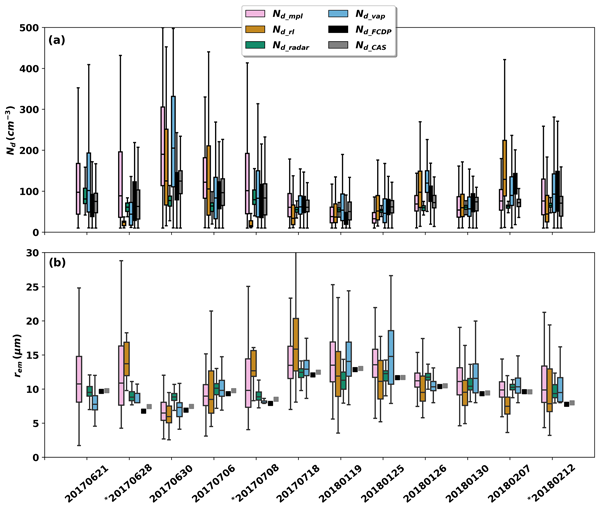
Damao Zhang, Andrew M. Vogelmann, Fan Yang, Edward Luke, Pavlos Kollias, Zhien Wang, Peng Wu, William I. Gustafson Jr., Fan Mei, Susanne Glienke, Jason Tomlinson, and Neel Desai
Atmos. Meas. Tech., 16, 5827–5846, https://doi.org/10.5194/amt-16-5827-2023, https://doi.org/10.5194/amt-16-5827-2023, 2023
Short summary
Short summary
Cloud droplet number concentration can be retrieved from remote sensing measurements. Aircraft measurements are used to validate four ground-based retrievals of cloud droplet number concentration. We demonstrate that retrieved cloud droplet number concentrations align well with aircraft measurements for overcast clouds, but they may substantially differ for broken clouds. The ensemble of various retrievals can help quantify retrieval uncertainties and identify reliable retrieval scenarios.
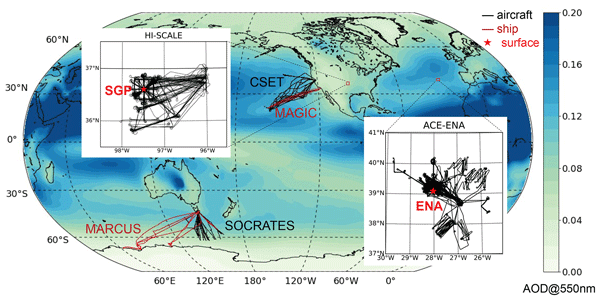
Shuaiqi Tang, Adam C. Varble, Jerome D. Fast, Kai Zhang, Peng Wu, Xiquan Dong, Fan Mei, Mikhail Pekour, Joseph C. Hardin, and Po-Lun Ma
Geosci. Model Dev., 16, 6355–6376, https://doi.org/10.5194/gmd-16-6355-2023, https://doi.org/10.5194/gmd-16-6355-2023, 2023
Short summary
Short summary
To assess the ability of Earth system model (ESM) predictions, we developed a tool called ESMAC Diags to understand how aerosols, clouds, and aerosol–cloud interactions are represented in ESMs. This paper describes its version 2 functionality. We compared the model predictions with measurements taken by planes, ships, satellites, and ground instruments over four regions across the world. Results show that this new tool can help identify model problems and guide future development of ESMs.
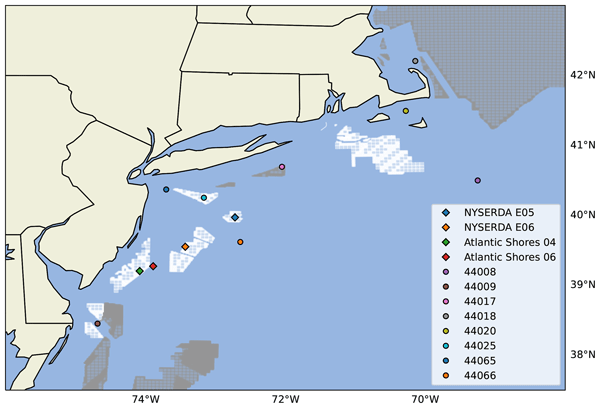
Nicola Bodini, Simon Castagneri, and Mike Optis
Wind Energ. Sci., 8, 607–620, https://doi.org/10.5194/wes-8-607-2023, https://doi.org/10.5194/wes-8-607-2023, 2023
Short summary
Short summary
The National Renewable Energy Laboratory (NREL) has published updated maps of the wind resource along all US coasts. Given the upcoming offshore wind development, it is essential to quantify the uncertainty that comes with the modeled wind resource data set. The paper proposes a novel approach to quantify this numerical uncertainty by leveraging available observations along the US East Coast.
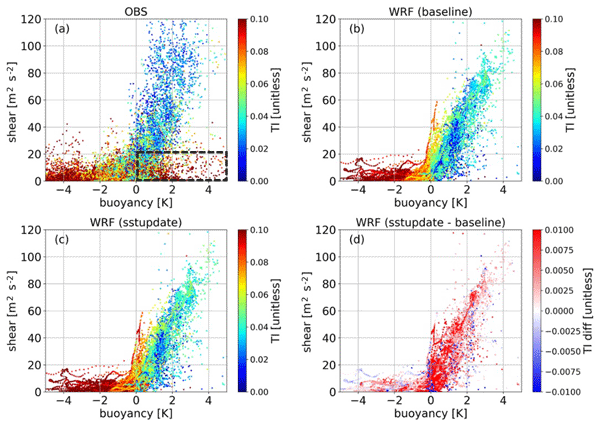
Sheng-Lun Tai, Larry K. Berg, Raghavendra Krishnamurthy, Rob Newsom, and Anthony Kirincich
Wind Energ. Sci., 8, 433–448, https://doi.org/10.5194/wes-8-433-2023, https://doi.org/10.5194/wes-8-433-2023, 2023
Short summary
Short summary
Turbulence intensity is critical for wind turbine design and operation as it affects wind power generation efficiency. Turbulence measurements in the marine environment are limited. We use a model to derive turbulence intensity and test how sea surface temperature data may impact the simulated turbulence intensity and atmospheric stability. The model slightly underestimates turbulence, and improved sea surface temperature data reduce the bias. Error with unrealistic mesoscale flow is identified.
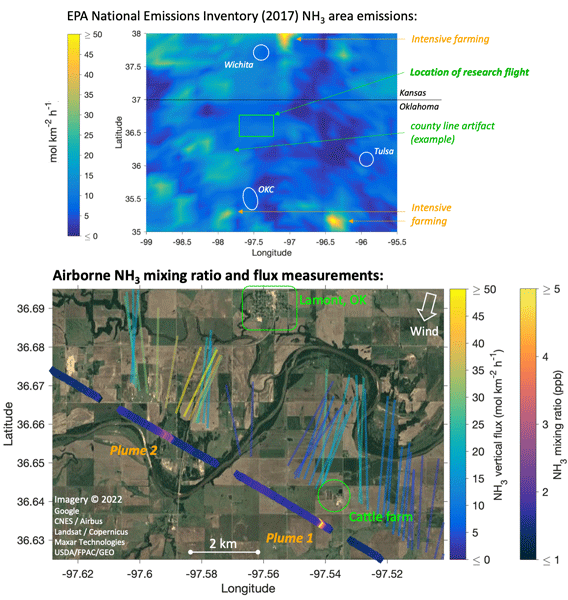
Siegfried Schobesberger, Emma L. D'Ambro, Lejish Vettikkat, Ben H. Lee, Qiaoyun Peng, David M. Bell, John E. Shilling, Manish Shrivastava, Mikhail Pekour, Jerome Fast, and Joel A. Thornton
Atmos. Meas. Tech., 16, 247–271, https://doi.org/10.5194/amt-16-247-2023, https://doi.org/10.5194/amt-16-247-2023, 2023
Short summary
Short summary
We present a new, highly sensitive technique for measuring atmospheric ammonia, an important trace gas that is emitted mainly by agriculture. We deployed the instrument on an aircraft during research flights over rural Oklahoma. Due to its fast response, we could analyze correlations with turbulent winds and calculate ammonia emissions from nearby areas at 1 to 2 km resolution. We observed high spatial variability and point sources that are not resolved in the US National Emissions Inventory.
Huilin Huang, Yun Qian, Ye Liu, Cenlin He, Jianyu Zheng, Zhibo Zhang, and Antonis Gkikas
Atmos. Chem. Phys., 22, 15469–15488, https://doi.org/10.5194/acp-22-15469-2022, https://doi.org/10.5194/acp-22-15469-2022, 2022
Short summary
Short summary
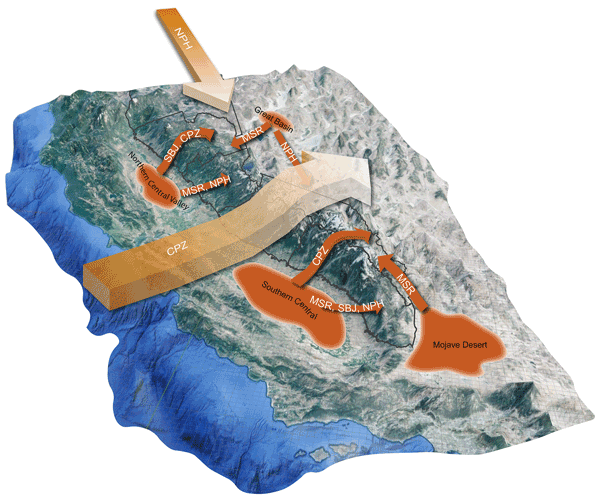
Using a clustering method developed in the field of artificial neural networks, we identify four typical dust transport patterns across the Sierra Nevada, associated with the mesoscale and regional-scale wind circulations. Our results highlight the connection between dust transport and dominant weather patterns, which can be used to understand dust transport in a changing climate.
Zheng Xiang, Yongkang Xue, Weidong Guo, Melannie D. Hartman, Ye Liu, and William J. Parton
EGUsphere, https://doi.org/10.5194/egusphere-2022-1111, https://doi.org/10.5194/egusphere-2022-1111, 2022
Preprint archived
Short summary
Short summary
A process-based plant Carbon (C)-Nitrogen (N) interface coupling framework has been developed, which mainly focuses on the plant resistance and N limitation effects on photosynthesis, plant respiration, and plant phenology. A dynamic C / N ratio is introduced to represent plant resistance and self-adjustment. The framework has been implemented in a coupled biophysical-ecosystem-biogeochemical model and testing results show a general improvement in simulating plant properties with this framework.
Alex Rybchuk, Timothy W. Juliano, Julie K. Lundquist, David Rosencrans, Nicola Bodini, and Mike Optis
Wind Energ. Sci., 7, 2085–2098, https://doi.org/10.5194/wes-7-2085-2022, https://doi.org/10.5194/wes-7-2085-2022, 2022
Short summary
Short summary
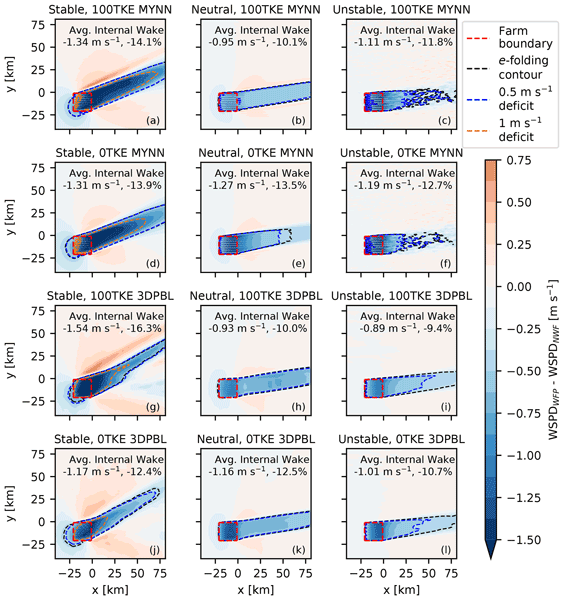
Numerical weather prediction models are used to predict how wind turbines will interact with the atmosphere. Here, we characterize the uncertainty associated with the choice of turbulence parameterization on modeled wakes. We find that simulated wind speed deficits in turbine wakes can be significantly sensitive to the choice of turbulence parameterization. As such, predictions of future generated power are also sensitive to turbulence parameterization choice.
Lindsay M. Sheridan, Raghu Krishnamurthy, Gabriel García Medina, Brian J. Gaudet, William I. Gustafson Jr., Alicia M. Mahon, William J. Shaw, Rob K. Newsom, Mikhail Pekour, and Zhaoqing Yang
Wind Energ. Sci., 7, 2059–2084, https://doi.org/10.5194/wes-7-2059-2022, https://doi.org/10.5194/wes-7-2059-2022, 2022
Short summary
Short summary
Using observations from lidar buoys, five reanalysis and analysis models that support the wind energy community are validated offshore and at rotor-level heights along the California Pacific coast. The models are found to underestimate the observed wind resource. Occasions of large model error occur in conjunction with stable atmospheric conditions, wind speeds associated with peak turbine power production, and mischaracterization of the diurnal wind speed cycle in summer months.
Fan Mei, Mikhail S. Pekour, Darielle Dexheimer, Gijs de Boer, RaeAnn Cook, Jason Tomlinson, Beat Schmid, Lexie A. Goldberger, Rob Newsom, and Jerome D. Fast
Earth Syst. Sci. Data, 14, 3423–3438, https://doi.org/10.5194/essd-14-3423-2022, https://doi.org/10.5194/essd-14-3423-2022, 2022
Short summary
Short summary
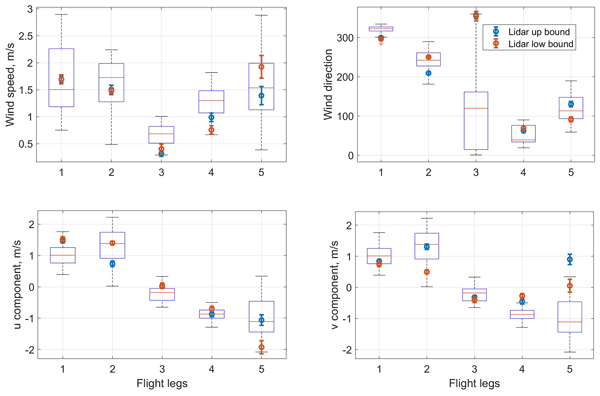
This work focuses on an expanding number of data sets observed using ARM TBS (133 flights) and UAS (seven flights) platforms by the Department of Energy (DOE) Atmospheric Radiation Measurement (ARM) user facility. These data streams provide new perspectives on spatial variability of atmospheric and surface parameters, helping to address critical science questions in Earth system science research, such as the aerosol–cloud interaction in the boundary layer.
Sagar P. Parajuli, Georgiy L. Stenchikov, Alexander Ukhov, Suleiman Mostamandi, Paul A. Kucera, Duncan Axisa, William I. Gustafson Jr., and Yannian Zhu
Atmos. Chem. Phys., 22, 8659–8682, https://doi.org/10.5194/acp-22-8659-2022, https://doi.org/10.5194/acp-22-8659-2022, 2022
Short summary
Short summary
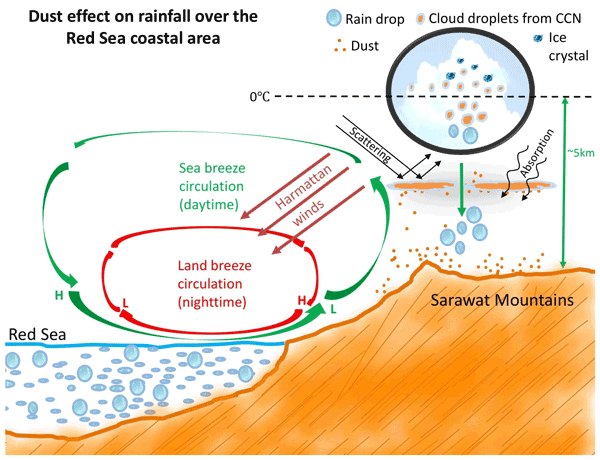
Rainfall affects the distribution of surface- and groundwater resources, which are constantly declining over the Middle East and North Africa (MENA) due to overexploitation. Here, we explored the effects of dust on rainfall using WRF-Chem model simulations. Although dust is considered a nuisance from an air quality perspective, our results highlight the positive fundamental role of dust particles in modulating rainfall formation and distribution, which has implications for cloud seeding.
Caleb Phillips, Lindsay M. Sheridan, Patrick Conry, Dimitrios K. Fytanidis, Dmitry Duplyakin, Sagi Zisman, Nicolas Duboc, Matt Nelson, Rao Kotamarthi, Rod Linn, Marc Broersma, Timo Spijkerboer, and Heidi Tinnesand
Wind Energ. Sci., 7, 1153–1169, https://doi.org/10.5194/wes-7-1153-2022, https://doi.org/10.5194/wes-7-1153-2022, 2022
Short summary
Short summary
Adoption of distributed wind turbines for energy generation is hindered by challenges associated with siting and accurate estimation of the wind resource. This study evaluates classic and commonly used methods alongside new state-of-the-art models derived from simulations and machine learning approaches using a large dataset from the Netherlands. We find that data-driven methods are most effective at predicting production at real sites and new models reliably outperform classic methods.
Lindsay M. Sheridan, Caleb Phillips, Alice C. Orrell, Larry K. Berg, Heidi Tinnesand, Raj K. Rai, Sagi Zisman, Dmitry Duplyakin, and Julia E. Flaherty
Wind Energ. Sci., 7, 659–676, https://doi.org/10.5194/wes-7-659-2022, https://doi.org/10.5194/wes-7-659-2022, 2022
Short summary
Short summary
The small wind community relies on simplified wind models and energy production simulation tools to obtain energy generation expectations. We gathered actual wind speed and turbine production data across the US to test the accuracy of models and tools for small wind turbines. This study provides small wind installers and owners with the error metrics and sources of error associated with using models and tools to make performance estimates, empowering them to adjust expectations accordingly.
Vincent Pronk, Nicola Bodini, Mike Optis, Julie K. Lundquist, Patrick Moriarty, Caroline Draxl, Avi Purkayastha, and Ethan Young
Wind Energ. Sci., 7, 487–504, https://doi.org/10.5194/wes-7-487-2022, https://doi.org/10.5194/wes-7-487-2022, 2022
Short summary
Short summary
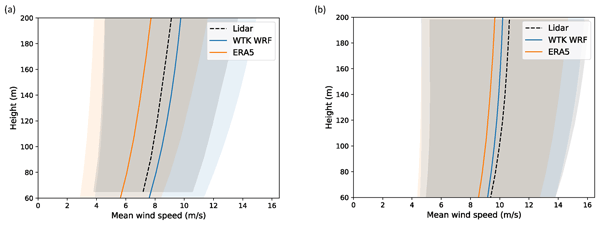
In this paper, we have assessed to which extent mesoscale numerical weather prediction models are more accurate than state-of-the-art reanalysis products in characterizing the wind resource at heights of interest for wind energy. The conclusions of our work will be of primary importance to the wind industry for recommending the best data sources for wind resource modeling.
Ye Liu, Yun Qian, and Larry K. Berg
Wind Energ. Sci., 7, 37–51, https://doi.org/10.5194/wes-7-37-2022, https://doi.org/10.5194/wes-7-37-2022, 2022
Short summary
Short summary
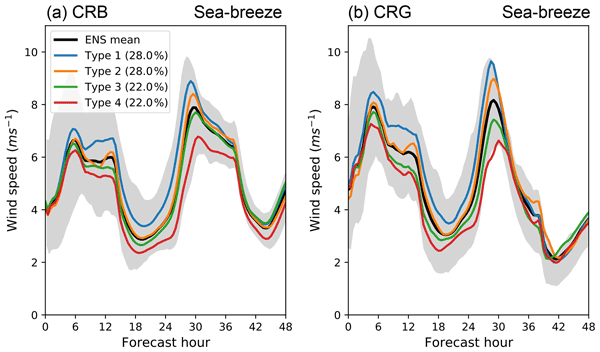
Uncertainties in initial conditions (ICs) decrease the accuracy of wind speed forecasts. We find that IC uncertainties can alter wind speed by modulating the weather system. IC uncertainties in local thermal gradient and large-scale circulation jointly contribute to wind speed forecast uncertainties. Wind forecast accuracy in the Columbia River Basin is confined by initial uncertainties in a few specific regions, providing useful information for more intense measurement and modeling studies.
Huilin Huang, Yongkang Xue, Ye Liu, Fang Li, and Gregory S. Okin
Geosci. Model Dev., 14, 7639–7657, https://doi.org/10.5194/gmd-14-7639-2021, https://doi.org/10.5194/gmd-14-7639-2021, 2021
Short summary
Short summary
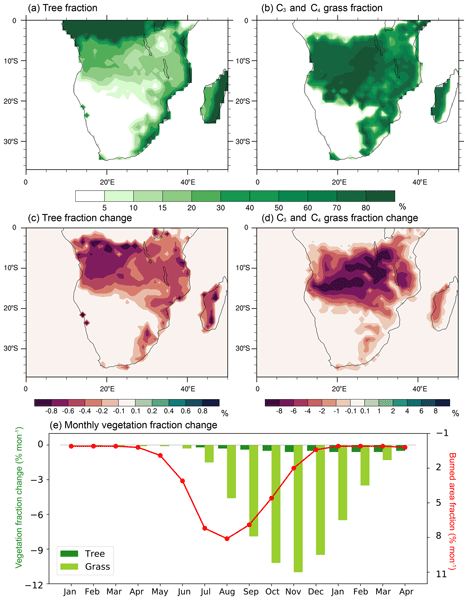
This study applies a fire-coupled dynamic vegetation model to quantify fire impact at monthly to annual scales. We find fire reduces grass cover by 4–8 % annually for widespread areas in south African savanna and reduces tree cover by 1 % at the periphery of tropical Congolese rainforest. The grass cover reduction peaks at the beginning of the rainy season, which quickly diminishes before the next fire season. In contrast, the reduction of tree cover is irreversible within one growing season.
Fan Mei, Steven Spielman, Susanne Hering, Jian Wang, Mikhail S. Pekour, Gregory Lewis, Beat Schmid, Jason Tomlinson, and Maynard Havlicek
Atmos. Meas. Tech., 14, 7329–7340, https://doi.org/10.5194/amt-14-7329-2021, https://doi.org/10.5194/amt-14-7329-2021, 2021
Short summary
Short summary
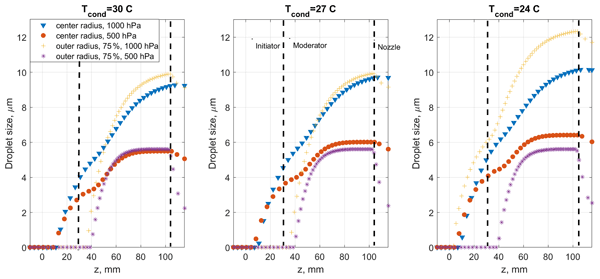
This study focuses on understanding a versatile water-based condensation particle counter (vWCPC 3789) performance under various ambient pressure conditions (500–1000 hPa). A vWCPC has the advantage of avoiding health and safety concerns. However, its performance characterization under low pressure is rare but crucial for ensuring successful airborne deployment. This paper provides advanced knowledge of operating a vWCPC 3789 to capture the spatial variations of atmospheric aerosols.
Nicola Bodini, Weiming Hu, Mike Optis, Guido Cervone, and Stefano Alessandrini
Wind Energ. Sci., 6, 1363–1377, https://doi.org/10.5194/wes-6-1363-2021, https://doi.org/10.5194/wes-6-1363-2021, 2021
Short summary
Short summary
We develop two machine-learning-based approaches to temporally extrapolate uncertainty in hub-height wind speed modeled by a numerical weather prediction model. We test our approaches in the California Outer Continental Shelf, where a significant offshore wind energy development is currently being planned, and we find that both provide accurate results.
Cited articles
Argüeso, D. and Businger, S.: Wind power characteristics off O'ahu, Hawai'i, Renew. Energ., 128, 324–336, https://doi.org/10.1016/j.renene.2018.05.080, 2018.
AXYS Technologies Inc: TRIAXYSTM Directional Wave Buoy User's Manual, Version 12, Sydney, British Columbia, Canada, 2012.
Bianco, L., Mendeke, R., Lindblom, J., Djalalova, I. V., Turner, D. D., and Wilczak, J. M.: Evaluating the ability of the operational High Resolution Rapid Refresh model version 3 (HRRRv3) and version 4 (HRRRv4) to forecast wind ramp events in the US Great Plains, Wind Energ. Sci., 10, 2117–2136, https://doi.org/10.5194/wes-10-2117-2025, 2025.
Bodini, N., Optis, M., Redfern, S., Rosencrans, D., Rybchuk, A., Lundquist, J. K., Pronk, V., Castagneri, S., Purkayastha, A., Draxl, C., Krishnamurthy, R., Young, E., Roberts, B., Rosenlieb, E., and Musial, W.: The 2023 National Offshore Wind data set (NOW-23), Earth Syst. Sci. Data, 16, 1965–2006, https://doi.org/10.5194/essd-16-1965-2024, 2024a.
Bodini, N., Optis, M., Liu, M. Gaudet, B., Krishnamurthy, R., Kumler, A., Rosencrans, D., Rybchuk, A., Tai, S.-L., Berg, L., Musial, W., Lundquist, J. K., Purkayastha, A., Young, A., and Draxl, C.: Causes of and Solutions to Wind Speed Bias in NREL's 2020 Offshore Wind Resource Assessment for the California Pacific Outer Continental Shelf, National Renewable Energy Laboratory (NREL), Golden, Colorado, United States, NREL/TP-5000-88215, https://docs.nlr.gov/docs/fy24osti/88215.pdf (last access: 9 September 2025), 2024b.
Bucci, L.: Hurricane Dora, National Hurricane Center Tropical Cyclone Report, EP052023, https://www.nhc.noaa.gov/data/tcr/EP052023_Dora.pdf (last access: 5 March 2024).
Buster, G., Pinchuk, P. Lavin, L., Benton, B., and Bodini, N.: Bias Correcting NOAA's High-Resolution Rapid Refresh (HRRR) Wind Resource Data for Grid Integration Applications, https://docs.nlr.gov/docs/fy25osti/91749.pdf (last access: 6 September 2025), 2024.
Carta, J. A., Velázquez, S., and Cabrera, P.: A review of measure-correlate-predict (MCP) methods used to estimate long-term wind characteristics at a target site, Renew. Sust. Energ. Rev., 27, 362–400, https://doi.org/10.1016/j.rser.2013.07.004, 2013.
CDS (Climate Data Store): Complete ERA5 global atmospheric reanalysis [data set], https://cds.climate.copernicus.eu/datasets/reanalysis-era5-complete (last access: 7 January 2025), 2025a.
CDS (Climate Data Store): ERA5 hourly data on single levels from 1940 to present [data set], https://cds.climate.copernicus.eu/datasets/reanalysis-era5-single-levels (last access: 26 November 2025), 2025b.
Cowin, E., Wang, C., and Walsh, S. D. C.: Assessing predictions of Australian Offshore Wind Energy Resources from Reanalysis Datasets, Energies, 16, 3404, https://doi.org/10.3390/en16083404, 2023.
Davis, N. N., Badger, J., Hahmann, A. N., Hansen, B. O., Mortensen, N. G., Kelly, M., Larsén, X. G., Olsen, B. T., Floors, R., Lizcano, G., Casso, P., Lacave, O., Bosch, A., Bauwens, I., Knight, O. J., Potter van Loon, A., Fox, R., Parvanyan, T., Krohn Hansen, S. B., Heathfield, D., Onninen, M., and Drummond, R.: The Global Wind Atlas: A High-Resolution Dataset of Climatologies and Associated Web-Based Application, B. Am. Meteorol. Soc., 104.8, E1507–E1525, https://doi.org/10.1175/BAMS-D-21-0075.1, 2023.
DOE (U.S. Department of Energy): 10 min Lidar Winds/Derived Data, Wind Data Hub [data set], https://wdh.energy.gov/ds/buoy/lidar.z07.c0 (last access: 6 January 2025), 2025a.
DOE (U.S. Department of Energy): Hawai'i – Wind Sentinel (120), Oahu, Hawai'i/Reviewed Data, Wind Data Hub [data set], https://wdh.energy.gov/ds/buoy/buoy.z07.b0 (last access: 6 January 2025), 2025b.
DOE (U.S. Department of Energy): 1 Hz Lidar Winds/Reviewed Data, Wind Data Hub [data set], https://wdh.energy.gov/ds/buoy/lidar.z07.b0 (last access: 24 November 2025), 2025c.
Edson, J. B., Jampana, V., Weller, R. A., Bigorre, S. P., Plueddemann, A. J., Fairall, C. W., Miller, S. D., Mahrt, L., Vickers, D., and Hersbach, H.: On the Exchange of Momentum over the Open Ocean, J. Phys. Oceanogr., 43, 1589–1610, https://doi.org/10.1175/JPO-D-12-0173.1, 2013.
Fragano, C. G. and Colle, B. A.: Validation of Offshore Winds in the ERA5 Reanalysis and NREL NOW-23 WRF Analysis Using Two Floating Lidars in the New York Bight, Weather Forecast., 1307–1323, https://doi.org/10.1175/WAF-D-24-0155.1, 2025.
Gandoin, R. and Garza, J.: Underestimation of strong wind speeds offshore in ERA5: evidence, discussion and correction, Wind Energ. Sci., 9, 1727–1745, https://doi.org/10.5194/wes-9-1727-2024, 2024.
Gaudet, B. J., García Medina, G., Krishnamurthy, R., Shaw, W. J., Sheridan, L. M., Yang, Z., Newsom, R. K., and Pekour, M.: Evaluation of Coupled Wind-Wave Model Simulations of Offshore Winds in the Mid-Atlantic Bight Using Lidar-Equipped Buoys, Mon. Weather Rev., 150, 1377–1395, https://doi.org/10.1175/MWR-D-21-0166.1, 2022.
Gaudet, B. J., García Medina, G., Krishnamurthy, R., Sheridan, L. M., Yang, Z., Newsom, R. K., Pekour, M., Gustafson Jr., W. I., and Liu, J.: Assessing Impacts of Waves on Hub-Height Winds off the U.S. West Coast Using Lidar Buoys and Coupled Modeling Approaches, Pacific Northwest National Laboratory, Richland, WA, United States, PNNL-35856, https://doi.org/10.2172/2337529, 2024.
Gelaro, R., McCarty, W., Suárez, M. J., Todling, R., Molod, A., Takacs, L., Randles, C. A., Darmenov, A., Bosilovich, M. G., Reichle, R., Wargan, K., Coy, L., Cullather, R., Draper, C., Akella, S., Buchard, V., Conaty, A., da Silva, A. M., Gu, W., Kim, G.-K., Koster, R., Lucchesi, R., Merkova, D., Nielsen, J. E., Partyka, G., Pawson, S., Putnam, W., Rienecker, M., Schubert, S. D., Sienkiewicz, M., and Zhao, B.: The Modern-Era Retrospective Analysis for Research and Applications, Version 2 (MERRA-2), J. Climate, 30, 5419–5454, https://doi.org/10.1175/JCLI-D-16-0758.1, 2017.
Gorton, A. M. and Shaw, W. J.: Advancing offshore wind resource characterization using buoy-based observations, Mar. Technol. Soc. J., 54, 37–43, https://doi.org/10.4031/MTSJ.54.6.5, 2020.
Hansen, K. S., Barthelmie, R. J., Jensen, L. E., and Sommer, A.: The impact of turbulence intensity and atmospheric stability on power deficits due to wind turbine wakes at Horns Rev wind farm, Wind Energy, 15, 183–196, https://doi.org/10.1002/we.512, 2011.
Hayes, L., Stocks, M., and Blakers, A.: Accurate long-term power generation model for offshore wind farms in Europe using ERA5 reanalysis, Energy, 229, 120603, https://doi.org/10.1016/j.energy.2021.120603, 2021.
Hersbach, H., Bell, B., Berrisford, P., Hirahara, S., Horányi, A., Muñoz-Sabater, J., Nicolas, J., Peubey, C., Radu, R., Schepers, D., Simmons, A., Soci, C., Abdalla, S., Abellan, X., Balsamo, G., Bechtold, P., Biavati, G., Bidlot, J., Bonavita, M., De Chiara, G., Dahlgren, P., Dee, D., Diamantakis, M., Dragani, R., Flemming, J., Forbes, R., Fuentes, M., Geer, A., Haimberger, L., Healy, S., Hogan, R. J., Hólm, E., Janisková, M., Keeley, S., Laloyaux, P., Lopez, P., Lupu, C., Radnoti, G., de Rosnay, P., Rozum, I., Vamborg, F., Villaume, S., and Thépaut, J.-N.: The ERA5 Global Reanalysis, Q. J. Roy. Meteor. Soc., 146, 1999–2049, https://doi.org/10.1002/qj.3803, 2020.
Hsiao, F., Chen, Y.-L., and Hitzl, D. E.: Heavy rainfall events over central O'ahu under weak wind conditions during seasonal transitions, Mon. Weather Rev., 148, 4117–4141, https://doi.org/10.1175/MWR-D-19-0358.1, 2020.
Hsiao, F., Chen, Y.-L., Nguyen, H. P., Hitzl, D. E., and Ballard, R.: Effects of Trade Wind Strength on Airflow and Cloudiness over O'ahu, Mon. Weather Rev., 149, 3037–3062, https://doi.org/10.1175/MWR-D-20-0399.1, 2021.
Kalverla, P. C., Duncan Jr., J. B., Steeneveld, G.-J., and Holtslag, A. A. M.: Low-level jets over the North Sea based on ERA5 and observations: together they do better, Wind Energ. Sci., 4, 193–209, https://doi.org/10.5194/wes-4-193-2019, 2019.
Kalverla, P. C., Holtslag, A. A. M., Ronda, R. J., and Steeneveld, G.-J.: Quality of wind characteristics in recent wind atlases over the North Sea, Q. J. Roy. Meteor. Soc., 146, 1498–1515, https://doi.org/10.1002/qj.3748, 2020.
Krishnamurthy, R., García Medina, G., Gaudet, B., Gustafson Jr., W. I., Kassianov, E. I., Liu, J., Newsom, R. K., Sheridan, L. M., and Mahon, A. M.: Year-long buoy-based observations of the air–sea transition zone off the US west coast, Earth Syst. Sci. Data, 15, 5667–5699, https://doi.org/10.5194/essd-15-5667-2023, 2023.
Lee, J., Ghate, V. P., Mitra, A., Miller, L. M., Krishnamurthy, R., and Egerer, U.: Characterization of HRRR-simulated rotor layer wind speeds and clouds along the coast of California, Wind Energ. Sci., 10, 2755–2769, https://doi.org/10.5194/wes-10-2755-2025, 2025.
Longman, R. J., Elison Timm, O., Giambelluca, T. W., and Kaiser, L.: A 20-Year Analysis of Disturbance-Driven Rainfall on O`ahu, Hawai`i, Mon. Weather Rev., 149, 1767–1783, https://doi.org/10.1175/MWR-D-20-0287.1, 2021.
Lu, B.-Y., Chu, P.-S., Kim, S.-H., and Karamperidou, C.: Hawaiian Regional Climate Variability during Two Types of El Niño, J. Climate, 33, 9929–9943, https://doi.org/10.1175/JCLI-D-19-0985.1, 2020.
Mass, C. and Ovens, D.: The Meteorology of the August 2023 Maui Wildfire, Weather Forecast., 39, 1097–1115, https://doi.org/10.1175/WAF-D-23-0210.1, 2024.
McCoy, A., Musial, W., Hammond, R., Mulas Hernando, D., Duffy, P., Beiter, P., Pérez, P., Baranowski, R., Reber, G., and Spitsen, P.: Offshore Wind Market Report: 2024 Edition, National Renewable Energy Laboratory, Golden, CO, United States, NREL/TP-5000-90525, https://www.nlr.gov/docs/fy24osti/90525.pdf (last access: 25 May 2025), 2024.
Morrison, I. and Businger, S.: Synoptic Structure and Evolution of a Kona Low, Weather Forecast., 16, 81–98, https://doi.org/10.1175/1520-0434(2001)016<0081:SSAEOA>2.0.CO;2, 2001.
Müller, P., Garrett, C., and Osborne, A.: Rogue waves, Oceanogr., 18, 66–75, https://doi.org/10.5670/oceanog.2005.30, 2005.
Musial, W., Beiter, P., Nunemaker, J., Heimiller, D., Ahmann, J., and Busch, J.: Oregon Offshore Wind Site Feasibility and Cost Study, National Renewable Energy Laboratory, Golden, CO, United States, NREL/TP-5000-74597, https://doi.org/10.2172/1570430, 2019.
NDBC (National Data Buoy Center): Nondirectional and Directional Wave Data Analysis Procedures, NDBC Technical Document 96–01, Stennis Space Center, Slidell, Louisiana, USA, https://www.ndbc.noaa.gov/wavemeas.pdf (last access: 12 March 2024), 1996.
NOAA (National Oceanic and Atmospheric Administration): Kona Lows Produce Two Rounds of Flooding – February 2023, https://www.weather.gov/hfo/KonaLowFeb2023 (last access: 18 November 2025), 2023a.
NOAA (National Oceanic and Atmospheric Administration): Cold Front Brings Winds and Rain to Hawai'i – April 2023, https://www.weather.gov/hfo/coldfront_apr2023 (last access:18 November 2025), 2023b.
NOAA (National Oceanic and Atmospheric Administration): Climate Variability: Oceanic Niño Index, https://www.climate.gov/news-features/understanding-climate/climate-variability-oceanic-nino-index (last updated: 25 June 2025), 2025.
Nehzad, M., Neshat, M., Groppi, D., Marzialetti, P., Heydari, A., Sylaios, G., and Astiaso Garcia, D.: A primary offshore wind farm site assessment using reanalysis data: a case study for Samothraki island, Renew. Energ., 172, 667–679, https://doi.org/10.1016/j.renene.2021.03.045, 2021.
Nikolkina, I. and Didenkulova, I.: Rogue waves in 2006–2010, Nat. Hazards Earth Syst. Sci., 11, 2913–2924, https://doi.org/10.5194/nhess-11-2913-2011, 2011.
Nwogu, O.: Maximum entropy estimation of directional wave spectra from an array of wave probes, Appl. Ocean Res., 11, 176–182, 1989.
Pronk, V., Bodini, N., Optis, M., Lundquist, J. K., Moriarty, P., Draxl, C., Purkayastha, A., and Young, E.: Can reanalysis products outperform mesoscale numerical weather prediction models in modeling the wind resource in simple terrain?, Wind Energ. Sci., 7, 487–504, https://doi.org/10.5194/wes-7-487-2022, 2022.
Ramon, J., Lledó, L., Torralba, V., Soret, A., and Doblas-Reyes, F. J.: Which global reanalysis best represents near-surface winds?, Q. J. Roy. Meteor. Soc., 145, 3236–3251, https://doi.org/10.1002/qj.3616, 2019.
Severy, M., Gorton, A. M., Krishnamurthy, R., and Levin, M. S.: Lidar Buoy Data Dictionary: For the 2020–2021 California Deployments, Pacific Northwest National Laboratory (PNNL), Richland, WA, USA, PNNL-30947, https://doi.org/10.2172/1987710, 2021.
Sheridan, L. M., Krishnamurthy, R., Gorton, A. M., Shaw, W. J., and Newsom, R. K.: Validation of Reanalysis-Based Offshore Wind Resource Characterization Using Lidar Buoy Observation, Mar. Technol. Soc. J., 54, 44–61, https://doi.org/10.4031/MTSJ.54.6.13, 2020.
Sheridan, L. M., Krishnamurthy, R., García Medina, G., Gaudet, B. J., Gustafson Jr., W. I., Mahon, A. M., Shaw, W. J., Newsom, R. K., Pekour, M., and Yang, Z.: Offshore reanalysis wind speed assessment across the wind turbine rotor layer off the United States Pacific coast, Wind Energ. Sci., 7, 2059–2084, https://doi.org/10.5194/wes-7-2059-2022, 2022.
Sheridan, L. M., Krishnamurthy, R., Gustafson Jr., W. I., Liu, Y., Gaudet, B. J., Bodini, N., Newsom, R. K., and Pekour, M.: Offshore low-level jet observations and model representation using lidar buoy data off the California coast, Wind Energ. Sci., 9, 741–758, https://doi.org/10.5194/wes-9-741-2024, 2024.
Soares, P. M. M., Lima, D. C. A., and Nogueira, M.: Global offshore wind energy resources using the new ERA-5 reanalysis, Environ. Res. Lett., 15, 1040a2, https://doi.org/10.1088/1748-9326/abb10d, 2020.
Soukissian, T. H., Karathanaski, F. E., and Zaragkas, D. K.: Exploiting offshore wind and solar resources in the Mediterranean using ERA5 reanalysis data, Energ. Convers. Manage., 237, 114092, https://doi.org/10.1016/j.enconman.2021.114092, 2021.
Wagner, R., Cañadillas, B., Clifton, A., Feeney, S., Nygaard, N., Poodt, M., St. Martin, C. Tüxen, E., and Wagenaar, J. W.: Rotor equivalent wind speed for power curve measurement – comparative exercise for IEA Wind Annex 32, J. Phys.: Conf. Ser., 524, 012108, https://doi.org/10.1088/1742-6596/524/1/012108, 2014.
Wharton, S. and Lundquist, J. K.: Atmospheric stability affects wind turbine power collection, Environ. Res. Lett., 7, 014005, https://doi.org/10.1088/1748-9326/7/1/014005, 2012.
Wilczak, J. M., Akish, E., Capotondi, A., and Compo, G. P.: Evaluation and bias correction of the ERA5 reanalysis over the United States for wind and solar energy applications, Energies, 17, 1667, https://doi.org/10.3390/en17071667, 2024.
Zhang, Y., Chen, Y.-L., Hong, S.-Y., Juang, H.-M. H., and Kodama, K.: Validation of the coupled NCEP Meso-scale Spectral Model and an advanced land surface model over the Hawaiian Islands. Part I: Summer trade wind conditions and a heavy rainfall event, Weather Forecast., 20, 847–872, https://doi.org/10.1175/WAF891.1, 2005.
Short summary
Wind simulations can contain significant errors, which can lead to inaccurate estimates of wind energy generation. Using observations from a floating lidar off Hawai'i, we hypothesize and establish that distinct simulation datasets will exhibit diverse ranges of errors in this offshore environment. The most commonly used simulation dataset produces the largest wind speed biases due to underestimation of fast wind speeds and misrepresentation of how wind speed varies throughout the day and night.
Wind simulations can contain significant errors, which can lead to inaccurate estimates of wind...


Altmetrics
Final-revised paper
Preprint