
Articles | Volume 11, issue 8
https://doi.org/10.5194/wes-11-2817-2026
© Author(s) 2026. This work is distributed under
the Creative Commons Attribution 4.0 License.
the Creative Commons Attribution 4.0 License.
https://doi.org/10.5194/wes-11-2817-2026
© Author(s) 2026. This work is distributed under
the Creative Commons Attribution 4.0 License.
the Creative Commons Attribution 4.0 License.
Research article
| 
05 Aug 2026
Research article |
| 05 Aug 2026
| 05 Aug 2026
Multi-strategy wind farm control: alternating wake steering and helix wake mixing on a large-scale wind farm

Faculty of Mechanical Engineering, Delft University of Technology, Delft, the Netherlands
Daan van der Hoek
Faculty of Mechanical Engineering, Delft University of Technology, Delft, the Netherlands
Tim Dammann
Faculty of Mechanical Engineering, Delft University of Technology, Delft, the Netherlands
Pieter M. O. Gebraad
Youwind, Barcelona, Spain
Jenna Iori
Faculty of Aerospace Engineering, Delft University of Technology, Delft, the Netherlands
Jan-Willem van Wingerden
Faculty of Mechanical Engineering, Delft University of Technology, Delft, the Netherlands
Related authors
Matteo Baricchio, Samuel Kainz, Jan-Willem van Wingerden, and Carlo L. Bottasso
Wind Energ. Sci. Discuss., https://doi.org/10.5194/wes-2026-178, https://doi.org/10.5194/wes-2026-178, 2026
Preprint under review for WES
Short summary
Short summary
Layout and control of wind farms are traditionally optimized sequentially for economic objectives, often overlooking environmental impacts. This study investigates the effect of introducing a carbon-related objective into layout, control, and layout-control co-design optimization. Results for a large-scale offshore wind farm show that using an environmental objective can achieve economic performance comparable to that of conventional economic optimization, while the resulting layouts may differ.
Matteo Baricchio, Jenna Iori, Pieter M. O. Gebraad, and Jan-Willem van Wingerden
Wind Energ. Sci. Discuss., https://doi.org/10.5194/wes-2026-176, https://doi.org/10.5194/wes-2026-176, 2026
Preprint under review for WES
Short summary
Short summary
Wind farm layout optimization involves several implementation choices, such as flow modeling, data selection, and objective definition. This study quantifies the impact of 18 choices across 9 categories, assessing both performance metrics and layout differences using the novel metric effective layout distance, based solely on turbine positions. The results identify which choices can be simplified and which require careful attention.

Matteo Baricchio, Pieter M. O. Gebraad, and Jan-Willem van Wingerden
Wind Energ. Sci., 9, 2113–2132, https://doi.org/10.5194/wes-9-2113-2024, https://doi.org/10.5194/wes-9-2113-2024, 2024
Short summary
Short summary
Wake steering can be integrated into wind farm layout optimization through a co-design approach. This study estimates the potential of this method for a wide range of realistic conditions, adopting a tailored genetic algorithm and novel geometric yaw relations. A gain in the annual energy yield between 0.3 % and 0.4 % is obtained for a 16-tubrine farm, and a multi-objective implementation is used to limit loss in the case that wake steering is not used during farm operation.
Matteo Baricchio, Samuel Kainz, Jan-Willem van Wingerden, and Carlo L. Bottasso
Wind Energ. Sci. Discuss., https://doi.org/10.5194/wes-2026-178, https://doi.org/10.5194/wes-2026-178, 2026
Preprint under review for WES
Short summary
Short summary
Layout and control of wind farms are traditionally optimized sequentially for economic objectives, often overlooking environmental impacts. This study investigates the effect of introducing a carbon-related objective into layout, control, and layout-control co-design optimization. Results for a large-scale offshore wind farm show that using an environmental objective can achieve economic performance comparable to that of conventional economic optimization, while the resulting layouts may differ.
Bernardo Castro Valerio, Pieter M. O. Gebraad, Marc Cheah-Mane, Vinicius A. Lacerda, and Oriol Gomis-Bellmunt
Wind Energ. Sci., 11, 3887–3917, https://doi.org/10.5194/wes-11-3887-2026, https://doi.org/10.5194/wes-11-3887-2026, 2026
Short summary
Short summary
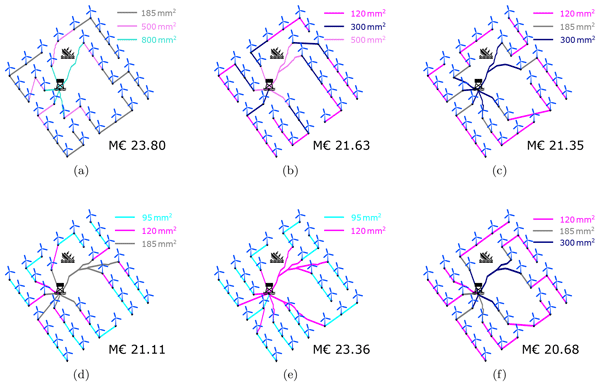
Designing inter-array cable networks is a key challenge in wind farm development. This work proposes a methodology that combines graph-based routing with mixed-integer optimisation to determine cable routes and conductor sizes while accounting for spatial constraints and electrical limits. Two strategies are investigated: an integrated optimisation and a sequential approach. The method is tested on routes from existing offshore and onshore wind farms.
Matteo Baricchio, Jenna Iori, Pieter M. O. Gebraad, and Jan-Willem van Wingerden
Wind Energ. Sci. Discuss., https://doi.org/10.5194/wes-2026-176, https://doi.org/10.5194/wes-2026-176, 2026
Preprint under review for WES
Short summary
Short summary
Wind farm layout optimization involves several implementation choices, such as flow modeling, data selection, and objective definition. This study quantifies the impact of 18 choices across 9 categories, assessing both performance metrics and layout differences using the novel metric effective layout distance, based solely on turbine positions. The results identify which choices can be simplified and which require careful attention.
Amr Hegazy, Peter Naaijen, and Jan-Willem van Wingerden
Wind Energ. Sci., 11, 3455–3474, https://doi.org/10.5194/wes-11-3455-2026, https://doi.org/10.5194/wes-11-3455-2026, 2026
Short summary
Short summary
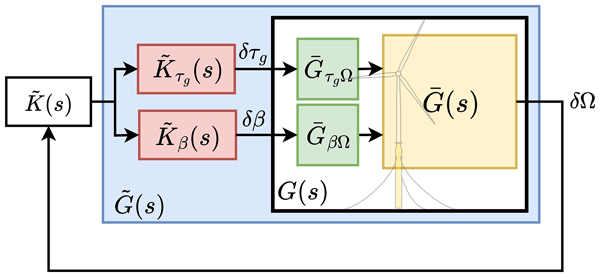
Floating wind turbines can become unstable when controlled like land-based turbines, due to motion at sea, which causes oscillations that increase damage and affect power output. This research revisits existing control strategies and introduces a controller that improves stability using only the standard speed sensor, without extra equipment. Time-domain simulations show that it matches or outperforms existing methods in reducing structural loading, highlighting the need for tailored offshore controls.
Daan van der Hoek, Tim Dammann, and Jan-Willem van Wingerden
Wind Energ. Sci., 11, 3171–3192, https://doi.org/10.5194/wes-11-3171-2026, https://doi.org/10.5194/wes-11-3171-2026, 2026
Short summary
Short summary
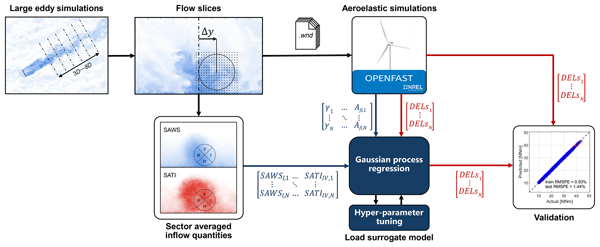
Wind farms suffer power losses and increased structural loading due to wake interactions. The helix method mitigates this by continuously moving upstream turbine blades to accelerate wake recovery. We developed two surrogate models from high-fidelity simulations: one identifying optimal pitch settings, achieving 7.5 % power gain, and one predicting fatigue loads under various conditions. This enables joint evaluation of power gains and load penalties, supporting informed wind farm control design.
Zekai Chen, Aemilius A. W. van Vondelen, and Jan-Willem van Wingerden
Wind Energ. Sci., 11, 1871–1888, https://doi.org/10.5194/wes-11-1871-2026, https://doi.org/10.5194/wes-11-1871-2026, 2026
Short summary
Short summary
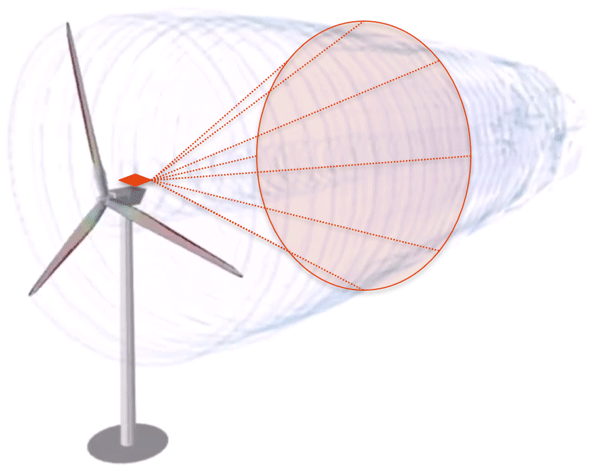
In wind farms, upstream turbine wakes negatively influence performance of downstream turbines. To mitigate this, we optimized wind farm performance by directly controlling generated wakes and using them as feedback. We used a light detection and ranging (lidar) device to track generated airflow and adjust upstream turbines in real time. This approach increased overall power output while keeping additional structural loading on the turbines low.
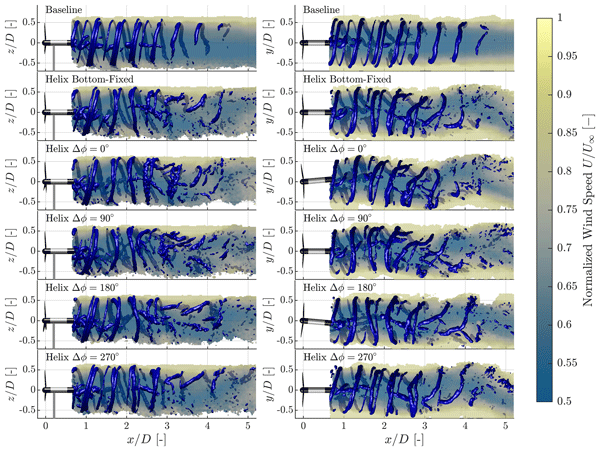
Daniel van den Berg, Daan van der Hoek, Delphine De Tavernier, Jonas Gutknecht, and Jan-Willem van Wingerden
Wind Energ. Sci., 11, 679–692, https://doi.org/10.5194/wes-11-679-2026, https://doi.org/10.5194/wes-11-679-2026, 2026
Short summary
Short summary
This paper demonstrates that floating wind turbines can utilise their natural yaw motion at sea to their advantage. By synchronising the yaw motion of the floating platform with a special control method called the helix, a turbine can mix the air in the wake more effectively, speeding up wind recovery and boosting the energy available to neighbouring turbines. This discovery opens up new possibilities for designing more efficient floating wind farms.
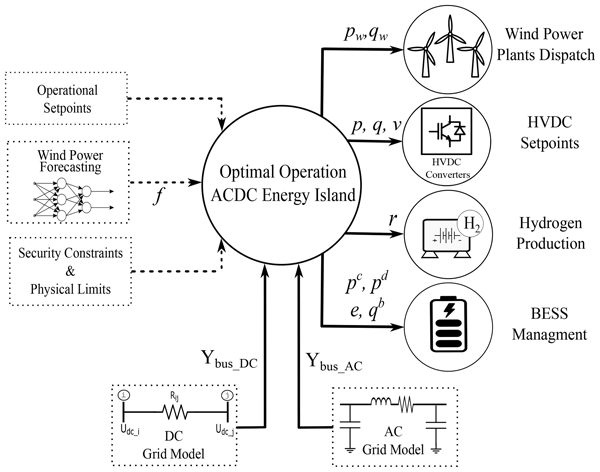
Mario Useche-Arteaga, Pieter Gebraad, Vinicius Lacerda, Marc Cheah-Mane, and Oriol Gomis-Bellmunt
Wind Energ. Sci., 11, 349–372, https://doi.org/10.5194/wes-11-349-2026, https://doi.org/10.5194/wes-11-349-2026, 2026
Short summary
Short summary
This paper develops a nonlinear optimization framework to operate offshore energy islands with hybrid AC/DC grids, energy storage, and hydrogen production. Using realistic wind forecasts, uncertainty analysis and a detailed model inspired by the Princess Elisabeth Energy Island, the results show how the proposed approach can efficiently coordinate power flows and energy conversion systems, supporting the reliable and flexible integration of offshore wind energy.
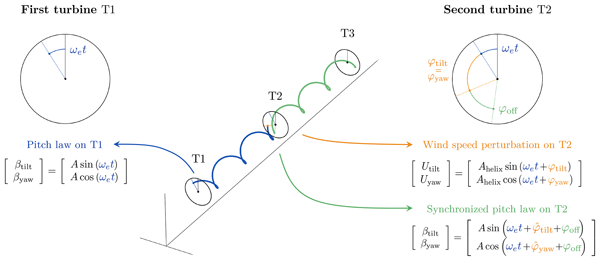
Aemilius A. W. van Vondelen, Marion Coquelet, Sachin T. Navalkar, and Jan-Willem van Wingerden
Wind Energ. Sci., 10, 2411–2433, https://doi.org/10.5194/wes-10-2411-2025, https://doi.org/10.5194/wes-10-2411-2025, 2025
Short summary
Short summary
Wind farms suffer energy losses due to wake effects between turbines. We present a new control strategy that synchronizes turbine wakes to enhance power output. By estimating and aligning the phase shifts of periodic wake structures using an advanced filtering method, downstream turbines recover more energy. Simulations show up to 10 % increased power at the third turbine. These results offer a promising direction for improving wind farm efficiency while mixing wakes.
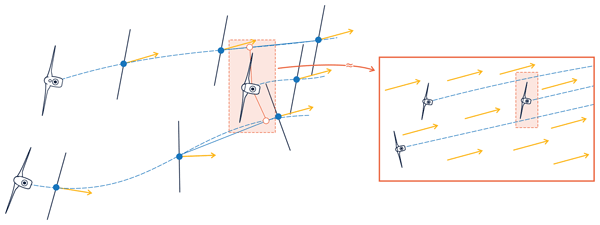
Marcus Becker, Maxime Lejeune, Philippe Chatelain, Dries Allaerts, Rafael Mudafort, and Jan-Willem van Wingerden
Wind Energ. Sci., 10, 1055–1075, https://doi.org/10.5194/wes-10-1055-2025, https://doi.org/10.5194/wes-10-1055-2025, 2025
Short summary
Short summary
Established turbine wake models are steady-state. This paper presents an open-source dynamic wake modeling framework that complements established steady-state wake models with dynamics. It is advantageous over steady-state wake models to describe wind farm power and energy over shorter periods. The model enables researchers to investigate the effectiveness of wind farm flow control strategies. This leads to a better utilization of wind farms and allows them to be used to their fullest extent.
Unai Gutierrez Santiago, Aemilius A. W. van Vondelen, Alfredo Fernández Sisón, Henk Polinder, and Jan-Willem van Wingerden
Wind Energ. Sci., 10, 207–225, https://doi.org/10.5194/wes-10-207-2025, https://doi.org/10.5194/wes-10-207-2025, 2025
Short summary
Short summary
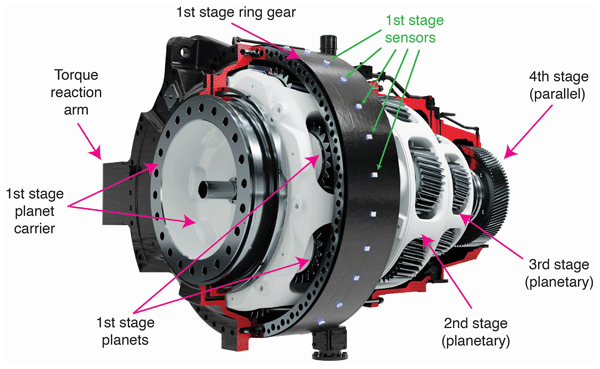
Knowing the loads applied to wind turbine gearboxes throughout their service life is becoming increasingly important as maintaining reliability with higher torque density demands is proving to be challenging. Operational deflection shapes identified from fiber-optic strain measurements have enabled the estimation of input torque, improving the assessment of the consumed life. Tracking operational deflection shapes recursively over time can potentially be used as an indicator of fault detection.
Claudia Muscari, Paolo Schito, Axelle Viré, Alberto Zasso, and Jan-Willem van Wingerden
Wind Energ. Sci. Discuss., https://doi.org/10.5194/wes-2024-149, https://doi.org/10.5194/wes-2024-149, 2025
Publication in WES not foreseen
Short summary
Short summary
This paper presents the findings of a study aimed at describing the flow system downstream of a wind turbine operated with a novel control technology. Results from heavy high-fidelity simulations are used to obtain a low-fidelity model that is quick enough to be used for the optimization of such technologies. Additionally, we were able to retrieve an improved understanding of the physics of such systems under different inflow conditions.

Majid Bastankhah, Marcus Becker, Matthew Churchfield, Caroline Draxl, Jay Prakash Goit, Mehtab Khan, Luis A. Martinez Tossas, Johan Meyers, Patrick Moriarty, Wim Munters, Asim Önder, Sara Porchetta, Eliot Quon, Ishaan Sood, Nicole van Lipzig, Jan-Willem van Wingerden, Paul Veers, and Simon Watson
Wind Energ. Sci., 9, 2171–2174, https://doi.org/10.5194/wes-9-2171-2024, https://doi.org/10.5194/wes-9-2171-2024, 2024
Short summary
Short summary
Dries Allaerts was born on 19 May 1989 and passed away at his home in Wezemaal, Belgium, on 10 October 2024 after battling cancer. Dries started his wind energy career in 2012 and had a profound impact afterward on the community, in terms of both his scientific realizations and his many friendships and collaborations in the field. His scientific acumen, open spirit of collaboration, positive attitude towards life, and playful and often cheeky sense of humor will be deeply missed by many.
Matteo Baricchio, Pieter M. O. Gebraad, and Jan-Willem van Wingerden
Wind Energ. Sci., 9, 2113–2132, https://doi.org/10.5194/wes-9-2113-2024, https://doi.org/10.5194/wes-9-2113-2024, 2024
Short summary
Short summary
Wake steering can be integrated into wind farm layout optimization through a co-design approach. This study estimates the potential of this method for a wide range of realistic conditions, adopting a tailored genetic algorithm and novel geometric yaw relations. A gain in the annual energy yield between 0.3 % and 0.4 % is obtained for a 16-tubrine farm, and a multi-objective implementation is used to limit loss in the case that wake steering is not used during farm operation.
Marion Coquelet, Maxime Lejeune, Laurent Bricteux, Aemilius A. W. van Vondelen, Jan-Willem van Wingerden, and Philippe Chatelain
Wind Energ. Sci., 9, 1923–1940, https://doi.org/10.5194/wes-9-1923-2024, https://doi.org/10.5194/wes-9-1923-2024, 2024
Short summary
Short summary
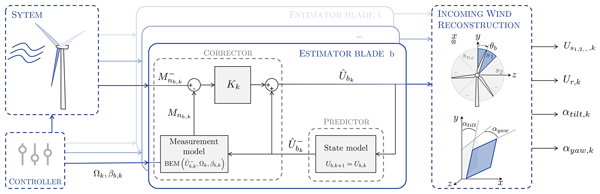
An extended Kalman filter is used to estimate the wind impinging on a wind turbine based on the blade bending moments and a turbine model. Using large-eddy simulations, this paper verifies how robust the estimator is to the turbine control strategy as it impacts loads and operating parameters. It is shown that including dynamics in the turbine model to account for delays between actuation and bending moments is needed to maintain the accuracy of the estimator when dynamic pitch control is used.
Amr Hegazy, Peter Naaijen, Vincent Leroy, Félicien Bonnefoy, Mohammad Rasool Mojallizadeh, Yves Pérignon, and Jan-Willem van Wingerden
Wind Energ. Sci., 9, 1669–1688, https://doi.org/10.5194/wes-9-1669-2024, https://doi.org/10.5194/wes-9-1669-2024, 2024
Short summary
Short summary
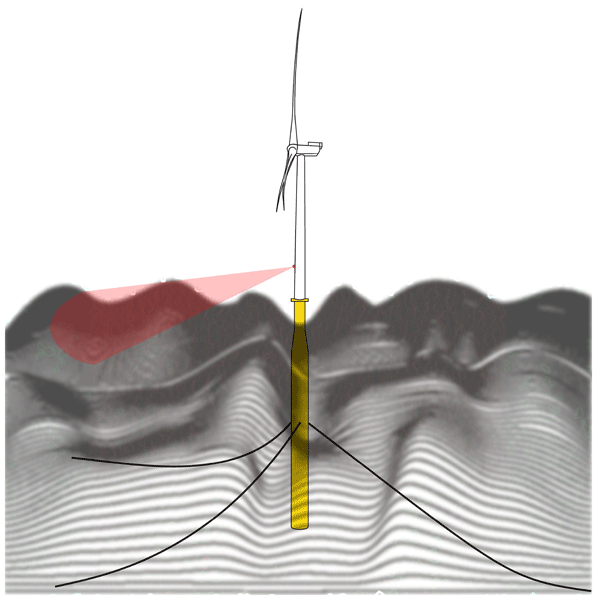
Successful wave tank experiments were conducted to evaluate the feedforward (FF) control strategy benefits in terms of structural loads and power quality of floating wind turbine components. The wave FF control strategy is effective when it comes to alleviating the effects of the wave forces on the floating offshore wind turbines, whereas wave FF control requires a significant amount of actuation to minimize the platform pitch motion, which makes such technology unfavorable for that objective.
Jenna Iori, Carlo Luigi Bottasso, and Michael Kenneth McWilliam
Wind Energ. Sci., 9, 1289–1304, https://doi.org/10.5194/wes-9-1289-2024, https://doi.org/10.5194/wes-9-1289-2024, 2024
Short summary
Short summary
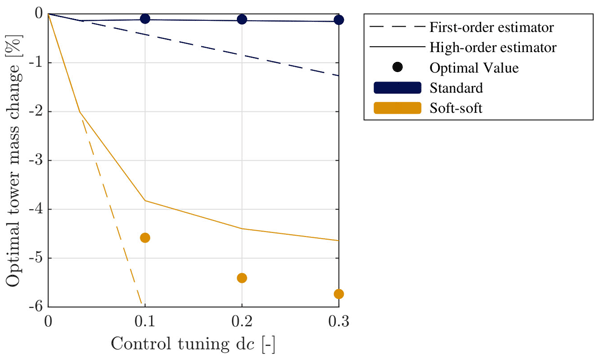
The controller of a wind turbine has an important role in regulating power production and avoiding structural failure. However, it is often designed after the rest of the turbine, and thus its potential is not fully exploited. An alternative is to design the structure and the controller simultaneously. This work develops a method to identify if a given turbine design can benefit from this new simultaneous design process. For example, a higher and cheaper turbine tower can be built this way.
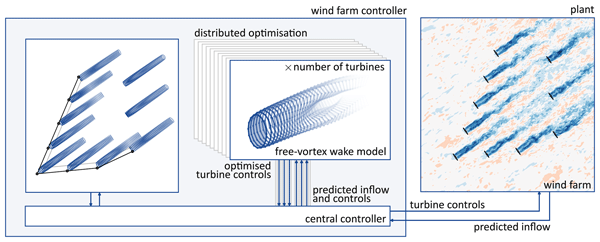
Maarten J. van den Broek, Marcus Becker, Benjamin Sanderse, and Jan-Willem van Wingerden
Wind Energ. Sci., 9, 721–740, https://doi.org/10.5194/wes-9-721-2024, https://doi.org/10.5194/wes-9-721-2024, 2024
Short summary
Short summary
Wind turbine wakes negatively affect wind farm performance as they impinge on downstream rotors. Wake steering reduces these losses by redirecting wakes using yaw misalignment of the upstream rotor. We develop a novel control strategy based on model predictions to implement wake steering under time-varying conditions. The controller is tested in a high-fidelity simulation environment and improves wind farm power output compared to a state-of-the-art reference controller.
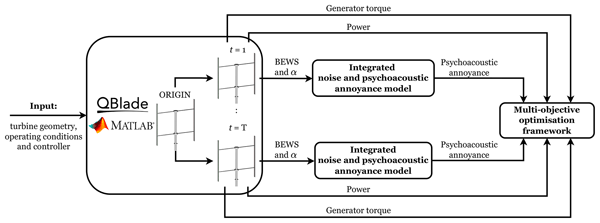
Livia Brandetti, Sebastiaan Paul Mulders, Roberto Merino-Martinez, Simon Watson, and Jan-Willem van Wingerden
Wind Energ. Sci., 9, 471–493, https://doi.org/10.5194/wes-9-471-2024, https://doi.org/10.5194/wes-9-471-2024, 2024
Short summary
Short summary
This research presents a multi-objective optimisation approach to balance vertical-axis wind turbine (VAWT) performance and noise, comparing the combined wind speed estimator and tip-speed ratio (WSE–TSR) tracking controller with a baseline. Psychoacoustic annoyance is used as a novel metric for human perception of wind turbine noise. Results showcase the WSE–TSR tracking controller’s potential in trading off the considered objectives, thereby fostering the deployment of VAWTs in urban areas.
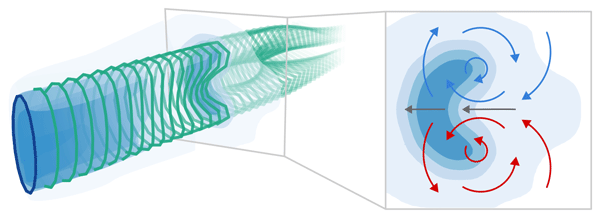
Maarten J. van den Broek, Delphine De Tavernier, Paul Hulsman, Daan van der Hoek, Benjamin Sanderse, and Jan-Willem van Wingerden
Wind Energ. Sci., 8, 1909–1925, https://doi.org/10.5194/wes-8-1909-2023, https://doi.org/10.5194/wes-8-1909-2023, 2023
Short summary
Short summary
As wind turbines produce power, they leave behind wakes of slow-moving air. We analyse three different models to predict the effects of these wakes on downstream wind turbines. The models are validated with experimental data from wind tunnel studies for steady and time-varying conditions. We demonstrate that the models are suitable for optimally controlling wind turbines to improve power production in large wind farms.
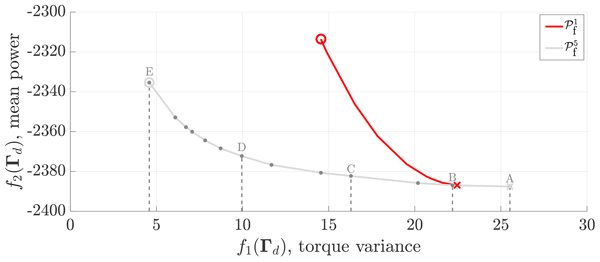
Livia Brandetti, Sebastiaan Paul Mulders, Yichao Liu, Simon Watson, and Jan-Willem van Wingerden
Wind Energ. Sci., 8, 1553–1573, https://doi.org/10.5194/wes-8-1553-2023, https://doi.org/10.5194/wes-8-1553-2023, 2023
Short summary
Short summary
This research presents the additional benefits of applying an advanced combined wind speed estimator and tip-speed ratio tracking (WSE–TSR) controller compared to the baseline Kω2. Using a frequency-domain framework and an optimal calibration procedure, the WSE–TSR tracking control scheme shows a more flexible trade-off between conflicting objectives: power maximisation and load minimisation. Therefore, implementing this controller on large-scale wind turbines will facilitate their operation.
Daniel van den Berg, Delphine de Tavernier, and Jan-Willem van Wingerden
Wind Energ. Sci., 8, 849–864, https://doi.org/10.5194/wes-8-849-2023, https://doi.org/10.5194/wes-8-849-2023, 2023
Short summary
Short summary
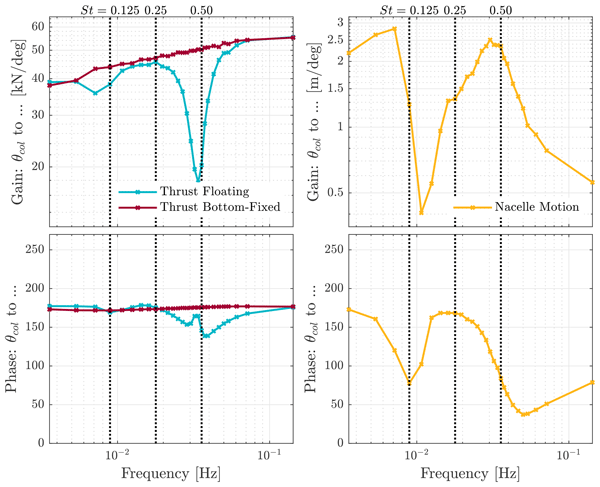
Wind turbines placed in farms interact with their wake, lowering the power production of the wind farm. This can be mitigated using so-called wake mixing techniques. This work investigates the coupling between the pulse wake mixing technique and the motion of floating wind turbines using the pulse. Frequency response experiments and time domain simulations show that extra movement is undesired and that the
optimalexcitation frequency is heavily platform dependent.
Johan Meyers, Carlo Bottasso, Katherine Dykes, Paul Fleming, Pieter Gebraad, Gregor Giebel, Tuhfe Göçmen, and Jan-Willem van Wingerden
Wind Energ. Sci., 7, 2271–2306, https://doi.org/10.5194/wes-7-2271-2022, https://doi.org/10.5194/wes-7-2271-2022, 2022
Short summary
Short summary
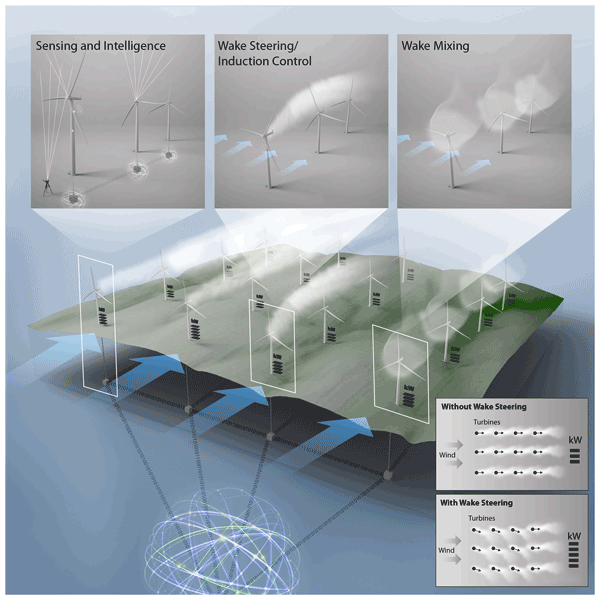
We provide a comprehensive overview of the state of the art and the outstanding challenges in wind farm flow control, thus identifying the key research areas that could further enable commercial uptake and success. To this end, we have structured the discussion on challenges and opportunities into four main areas: (1) insight into control flow physics, (2) algorithms and AI, (3) validation and industry implementation, and (4) integrating control with system design
(co-design).

Marcus Becker, Bastian Ritter, Bart Doekemeijer, Daan van der Hoek, Ulrich Konigorski, Dries Allaerts, and Jan-Willem van Wingerden
Wind Energ. Sci., 7, 2163–2179, https://doi.org/10.5194/wes-7-2163-2022, https://doi.org/10.5194/wes-7-2163-2022, 2022
Short summary
Short summary
In this paper we present a revised dynamic control-oriented wind farm model. The model can simulate turbine wake behaviour in heterogeneous and changing wind conditions at a very low computational cost. It utilizes a three-dimensional turbine wake model which also allows capturing vertical wind speed differences. The model could be used to maximise the power generation of with farms, even during events like a wind direction change. It is publicly available and open for further development.
Tuhfe Göçmen, Filippo Campagnolo, Thomas Duc, Irene Eguinoa, Søren Juhl Andersen, Vlaho Petrović, Lejla Imširović, Robert Braunbehrens, Jaime Liew, Mads Baungaard, Maarten Paul van der Laan, Guowei Qian, Maria Aparicio-Sanchez, Rubén González-Lope, Vinit V. Dighe, Marcus Becker, Maarten J. van den Broek, Jan-Willem van Wingerden, Adam Stock, Matthew Cole, Renzo Ruisi, Ervin Bossanyi, Niklas Requate, Simon Strnad, Jonas Schmidt, Lukas Vollmer, Ishaan Sood, and Johan Meyers
Wind Energ. Sci., 7, 1791–1825, https://doi.org/10.5194/wes-7-1791-2022, https://doi.org/10.5194/wes-7-1791-2022, 2022
Short summary
Short summary
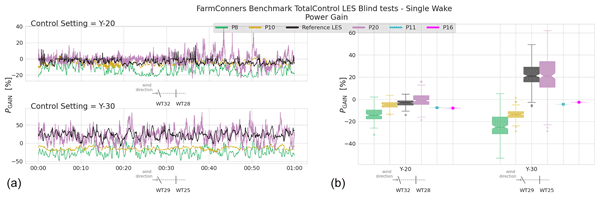
The FarmConners benchmark is the first of its kind to bring a wide variety of data sets, control settings, and model complexities for the (initial) assessment of wind farm flow control benefits. Here we present the first part of the benchmark results for three blind tests with large-scale rotors and 11 participating models in total, via direct power comparisons at the turbines as well as the observed or estimated power gain at the wind farm level under wake steering control strategy.

Daan van der Hoek, Joeri Frederik, Ming Huang, Fulvio Scarano, Carlos Simao Ferreira, and Jan-Willem van Wingerden
Wind Energ. Sci., 7, 1305–1320, https://doi.org/10.5194/wes-7-1305-2022, https://doi.org/10.5194/wes-7-1305-2022, 2022
Short summary
Short summary
The paper presents a wind tunnel experiment where dynamic induction control was implemented on a small-scale turbine. By periodically changing the pitch angle of the blades, the low-velocity turbine wake is perturbed, and hence it recovers at a faster rate. Small particles were released in the flow and subsequently recorded with a set of high-speed cameras. This allowed us to reconstruct the flow behind the turbine and investigate the effect of dynamic induction control on the wake.
Yichao Liu, Riccardo Ferrari, and Jan-Willem van Wingerden
Wind Energ. Sci., 7, 523–537, https://doi.org/10.5194/wes-7-523-2022, https://doi.org/10.5194/wes-7-523-2022, 2022
Short summary
Short summary
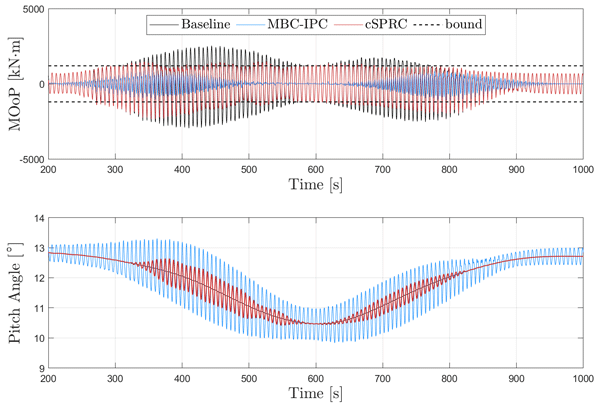
The objective of the paper is to develop a data-driven output-constrained individual pitch control approach, which will not only mitigate the blade loads but also reduce the pitch activities. This is achieved by only reducing the blade loads violating a user-defined bound, which leads to an economically viable load control strategy. The proposed control strategy shows promising results of load reduction in the wake-rotor overlapping and turbulent sheared wind conditions.
Unai Gutierrez Santiago, Alfredo Fernández Sisón, Henk Polinder, and Jan-Willem van Wingerden
Wind Energ. Sci., 7, 505–521, https://doi.org/10.5194/wes-7-505-2022, https://doi.org/10.5194/wes-7-505-2022, 2022
Short summary
Short summary
The gearbox is one of the main contributors to the overall cost of wind energy, and it is acknowledged that we still do not fully understand its loading. The study presented in this paper develops a new alternative method to measure input rotor torque in wind turbine gearboxes, overcoming the drawbacks related to measuring on a rotating shaft. The method presented in this paper could make measuring gearbox torque more cost-effective, which would facilitate its adoption in serial wind turbines.
Aemilius A. W. van Vondelen, Sachin T. Navalkar, Alexandros Iliopoulos, Daan C. van der Hoek, and Jan-Willem van Wingerden
Wind Energ. Sci., 7, 161–184, https://doi.org/10.5194/wes-7-161-2022, https://doi.org/10.5194/wes-7-161-2022, 2022
Short summary
Short summary
The damping of an offshore wind turbine is a difficult physical quantity to predict, although it plays a major role in a cost-effective turbine design. This paper presents a review of all approaches that can be used for damping estimation directly from operational wind turbine data. As each use case is different, a novel suitability table is presented to enable the user to choose the most appropriate approach for the given availability and characteristics of measurement data.
Cited articles
Anand, A., Braunbehrens, R., Guilloré, A., and Bottasso, C. L.: Economic lifetime-aware wind farm control, Wind Energ. Sci. Discuss. [preprint], https://doi.org/10.5194/wes-2025-67, in review, 2025. a
Baricchio, M.: matteobaricchi/msr: First release – code and data (2) (version 1.1.2), Zenodo [code and data set], https://doi.org/10.5281/zenodo.21669959, 2026. a
Bechmann, A. and Quick, J.: Market-Driven Wind Resource Assessment, in: WindEurope Annual Event 2025, no. 1 in: J. Phys. Conf. Ser., IOP Publishing, United Kingdom, windEurope Annual Event 2025, 8 tp 10 April 2025, WindEurope, https://doi.org/10.1088/1742-6596/3025/1/012001, 2025. a
Becker, M., Lejeune, M., Chatelain, P., Allaerts, D., Mudafort, R., and van Wingerden, J.-W.: A dynamic open-source model to investigate wake dynamics in response to wind farm flow control strategies, Wind Energ. Sci., 10, 1055–1075, https://doi.org/10.5194/wes-10-1055-2025, 2025a. a
Becker, M., van den Broek, M. J., Allaerts, D., and van Wingerden, J. W.: Closed-loop model-predictive wind farm flow control under time-varying inflow using FLORIDyn, Wind Energy, 28, https://doi.org/10.1002/we.70044, 2025b. a
Brown, K., Yalla, G., Cheung, L., Frederik, J., Houck, D., deVelder, N., Simley, E., and Fleming, P.: Comparison of wind-farm control strategies under realistic offshore wind conditions: wake quantities of interest, Wind Energ. Sci., 10, 1737–1762, https://doi.org/10.5194/wes-10-1737-2025, 2025. a, b
Campagnolo, F., Weber, R., Schreiber, J., and Bottasso, C. L.: Wind tunnel testing of wake steering with dynamic wind direction changes, Wind Energ. Sci., 5, 1273–1295, https://doi.org/10.5194/wes-5-1273-2020, 2020. a
Dammann, T., van der Hoek, D., Yu, W., and van Wingerden, J. W.: Enhanced Wind Farm Performance via Active Wake Control: A Steady-State Approach, in: 2025 American Control Conference (ACC), 2856–2861, https://doi.org/10.23919/ACC63710.2025.11107695, 2025. a
Dammann, T., van der Hoek, D., Yu, W., and van Wingerden, J. W.: A novel engineering wake model for helix-actuated wind turbine wakes, Appl. Energ., 414, 127808, https://doi.org/10.1016/j.apenergy.2026.127808, 2026a. a
Dammann, T., Yu, W., and Wingerden, J.-W. v.: Balancing Actuation Penalties and Wake Recovery: The Efficacy of the Helix in Turbulent Inflows, J. Phys. Conf. Ser., 3224, 032002, https://doi.org/10.1088/1742-6596/3224/3/032002, 2026b. a
Doekemeijer, B. M., Kern, S., Maturu, S., Kanev, S., Salbert, B., Schreiber, J., Campagnolo, F., Bottasso, C. L., Schuler, S., Wilts, F., Neumann, T., Potenza, G., Calabretta, F., Fioretti, F., and van Wingerden, J.-W.: Field experiment for open-loop yaw-based wake steering at a commercial onshore wind farm in Italy, Wind Energ. Sci., 6, 159–176, https://doi.org/10.5194/wes-6-159-2021, 2021. a, b
Fleming, P. A., Gebraad, P. M., Lee, S., van Wingerden, J. W., Johnson, K., Churchfield, M., Michalakes, J., Spalart, P., and Moriarty, P.: Evaluating techniques for redirecting turbine wakes using SOWFA, Renew. Energ., 70, 211–218, https://doi.org/10.1016/j.renene.2014.02.015, 2014. a
Fleming, P. A., Stanley, A. P. J., Bay, C. J., King, J., Simley, E., Doekemeijer, B. M., and Mudafort, R.: Serial-Refine Method for Fast Wake-Steering Yaw Optimization, J. Phys. Conf. Ser., 2265, 032109, https://doi.org/10.1088/1742-6596/2265/3/032109, 2022. a, b
Frederik, J. A. and van Wingerden, J. W.: On the load impact of dynamic wind farm wake mixing strategies, Renew. Energ., 194, 582–595, https://doi.org/10.1016/j.renene.2022.05.110, 2022. a, b, c, d
Frederik, J. A., Doekemeijer, B. M., Mulders, S. P., and van Wingerden, J. W.: The helix approach: Using dynamic individual pitch control to enhance wake mixing in wind farms, Wind Energy, 23, 1739–1751, https://doi.org/10.1002/we.2513, 2020. a, b
Frederik, J. A., Simley, E., Brown, K. A., Yalla, G. R., Cheung, L. C., and Fleming, P. A.: Comparison of wind farm control strategies under realistic offshore wind conditions: turbine quantities of interest, Wind Energ. Sci., 10, 755–777, https://doi.org/10.5194/wes-10-755-2025, 2025. a, b, c
Gaumond, M., Réthoré, P.-E., Ott, S., Peña, A., Bechmann, A., and Hansen, K. S.: Evaluation of the wind direction uncertainty and its impact on wake modeling at the Horns Rev offshore wind farm, Wind Energy, 17, 1169–1178, https://doi.org/10.1002/we.1625, 2014. a
Gebraad, P. M. O., Teeuwisse, F. W., van Wingerden, J. W., Fleming, P. A., Ruben, S. D., Marden, J. R., and Pao, L. Y.: Wind plant power optimization through yaw control using a parametric model for wake effects – a CFD simulation study, Wind Energy, 19, 95–114, https://doi.org/10.1002/we.1822, 2016. a
Gray, J. S., Hwang, J. T., Martins, J. R. R. A., Moore, K. T., and Naylor, B. A.: OpenMDAO: An open-source framework for multidisciplinary design, analysis, and optimization, Struct. Multidiscip. O., 59, 1075–1104, https://doi.org/10.1007/s00158-019-02211-z, 2019. a
Guilloré, A., Campagnolo, F., and Bottasso, C. L.: A control-oriented load surrogate model based on sector-averaged inflow quantities: capturing damage for unwaked, waked, wake-steering and curtailed wind turbines, J. Phys. Conf. Ser., 2767, 032019, https://doi.org/10.1088/1742-6596/2767/3/032019, 2024. a
Hodgson, E. L. and Andersen, S. J.: Wake steering under inflow wind direction uncertainty: an LES study, Wind Energ. Sci., 11, 2173–2190, https://doi.org/10.5194/wes-11-2173-2026, 2026. a
Jimenez, A., Crespo, A., and Migoya, E.: Application of a LES technique to characterize the wake deflection of a wind turbine in yaw, Wind Energy, 13, 559–572, https://doi.org/10.1002/we.380, 2010. a
Kainz, S., Scherzl, A., Guilloré, A., Anand, A., and Bottasso, C. L.: An initial study on the environmental value of wind farm control, J. Phys. Conf. Ser., 3131, 012044, https://doi.org/10.1088/1742-6596/3131/1/012044, 2025. a
Kuhn, M. B., Henry de Frahan, M. T., Mohan, P., Deskos, G., Churchfield, M., Cheung, L., Sharma, A., Almgren, A., Ananthan, S., Brazell, M. J., A., M. L., Thedin, R., Rood, J., Sakievich, P., Vijayakumar, G., Zhang, W., and Sprague, M. A.: AMR-Wind: A performance-portable, high-fidelity flow solver for wind farm simulations, Wind Energy, 28, https://doi.org/10.1002/we.70010, 2025. a
Liew, J., Urbán, A. M., and Andersen, S. J.: Analytical model for the power–yaw sensitivity of wind turbines operating in full wake, Wind Energ. Sci., 5, 427–437, https://doi.org/10.5194/wes-5-427-2020, 2020. a, b
Mittelmeier, N., Blodau, T., and Kühn, M.: Monitoring offshore wind farm power performance with SCADA data and an advanced wake model, Wind Energ. Sci., 2, 175–187, https://doi.org/10.5194/wes-2-175-2017, 2017. a
Mühle, F. V., Heckmeier, F. M., Campagnolo, F., and Breitsamter, C.: Wind tunnel investigations of an individual pitch control strategy for wind farm power optimization, Wind Energ. Sci., 9, 1251–1271, https://doi.org/10.5194/wes-9-1251-2024, 2024. a
Munters, W. and Meyers, J.: Towards practical dynamic induction control of wind farms: analysis of optimally controlled wind-farm boundary layers and sinusoidal induction control of first-row turbines, Wind Energ. Sci., 3, 409–425, https://doi.org/10.5194/wes-3-409-2018, 2018. a
National Renewable Energy Laboratory: OpenFAST: An Open-Source Wind Turbine Simulation Tool, https://github.com/OpenFAST/openfast (last access: 1 November 2024), version 3.5.0, 2024b. a
Pedersen, J. G., Svensson, E., Poulsen, L., and Nygaard, N. G.: Turbulence Optimized Park model with Gaussian wake profile, J. Phys. Conf. Ser., 2265, 022063, https://doi.org/10.1088/1742-6596/2265/2/022063, 2022. a
Pedersen, M. M., Forsting, A. M., van der Laan, P., Riva, R., Romàn, L. A. A., Risco, J. C., Friis-Møller, M., Quick, J., Christiansen, J. P. S., Rodrigues, R. V., Olsen, B. T., and Réthoré, P.-E.: PyWake 2.5.0: An open-source wind farm simulation tool, https://gitlab.windenergy.dtu.dk/TOPFARM/PyWake (last access: 1 November 2024), 2023. a, b
Quick, J., Annoni, J., King, R., Dykes, K., Fleming, P., and Ning, A.: Optimization Under Uncertainty for Wake Steering Strategies, J. Phys. Conf. Ser., 854, 012036, https://doi.org/10.1088/1742-6596/854/1/012036, 2017. a, b, c
Quick, J., King, J., King, R. N., Hamlington, P. E., and Dykes, K.: Wake steering optimization under uncertainty, Wind Energ. Sci., 5, 413–426, https://doi.org/10.5194/wes-5-413-2020, 2020. a
Rott, A., Doekemeijer, B., Seifert, J. K., van Wingerden, J.-W., and Kühn, M.: Robust active wake control in consideration of wind direction variability and uncertainty, Wind Energ. Sci., 3, 869–882, https://doi.org/10.5194/wes-3-869-2018, 2018. a, b
Simley, E., Fleming, P., and King, J.: Design and analysis of a wake steering controller with wind direction variability, Wind Energ. Sci., 5, 451–468, https://doi.org/10.5194/wes-5-451-2020, 2020. a
Simley, E., Millstein, D., Jeong, S., and Fleming, P.: The value of wake steering wind farm flow control in US energy markets, Wind Energ. Sci., 9, 219–234, https://doi.org/10.5194/wes-9-219-2024, 2024. a
Taschner, E., van Vondelen, A., Verzijlbergh, R., and van Wingerden, J. W.: On the performance of the helix wind farm control approach in the conventionally neutral atmospheric boundary layer, J. Phys. Conf. Ser., 2505, 012006, https://doi.org/10.1088/1742-6596/2505/1/012006, 2023. a
Taschner, E., Becker, M., Verzijlbergh, R., and Van Wingerden, J. W.: Comparison of helix and wake steering control for varying turbine spacing and wind direction, J. Phys. Conf. Ser., 2767, 032023, https://doi.org/10.1088/1742-6596/2767/3/032023, 2024. a, b, c
Türk, M. and Emeis, S.: The dependence of offshore turbulence intensity on wind speed, J. Wind Eng. Ind. Aerod., 98, 466–471, https://doi.org/10.1016/j.jweia.2010.02.005, 2010. a
van Beek, M. T., Viré, A., and Andersen, S. J.: Sensitivity and Uncertainty of the FLORIS Model Applied on the Lillgrund Wind Farm, Energies, 14, https://doi.org/10.3390/en14051293, 2021. a
van der Hoek, D., Doekemeijer, B., Andersson, L. E., and van Wingerden, J. W.: Predicting the benefit of wake steering on the annual energy production of a wind farm using large eddy simulations and Gaussian process regression, J. Phys. Conf. Ser., 1618, 022024, https://doi.org/10.1088/1742-6596/1618/2/022024, 2020. a, b
van der Hoek, D., den Abbeele, B. V., Simao Ferreira, C., and van Wingerden, J. W.: Maximizing wind farm power output with the helix approach: Experimental validation and wake analysis using tomographic particle image velocimetry, Wind Energy, 27, 463–482, https://doi.org/10.1002/we.2896, 2024. a
van Vondelen, A. A., Navalkar, S. T., Kerssemakers, D. R., and van Wingerden, J. W.: Enhanced wake mixing in wind farms using the Helix approach: A loads sensitivity study, in: 2023 American Control Conference (ACC), 831–836, https://doi.org/10.23919/ACC55779.2023.10155965, 2023. a, b
van Vondelen, A. A. W., Coquelet, M., Navalkar, S. T., and van Wingerden, J.-W.: Synchronized Helix wake mixing control, Wind Energ. Sci., 10, 2411–2433, https://doi.org/10.5194/wes-10-2411-2025, 2025. a
van Wingerden, J. W., Fleming, P. A., Göçmen, T., Eguinoa, I., Doekemeijer, B. M., Dykes, K., Lawson, M., Simley, E., King, J., Astrain, D., Iribas, M., Bottasso, C. L., Meyers, J., Raach, S., Kölle, K., and Giebel, G.: Expert Elicitation on Wind Farm Control, J. Phys. Conf. Ser., 1618, 022025, https://doi.org/10.1088/1742-6596/1618/2/022025, 2020. a
Virtanen, P., Gommers, R., Oliphant, T. E., Haberland, M., Reddy, T., Cournapeau, D., Burovski, E., Peterson, P., Weckesser, W., Bright, J., van der Walt, S. J., Brett, M., Wilson, J., Millman, K. J., Mayorov, N., Nelson, A. R. J., Jones, E., Kern, R., Larson, E., Carey, C. J., Polat, İ., Feng, Y., Moore, E. W., VanderPlas, J., Laxalde, D., Perktold, J., Cimrman, R., Henriksen, I., Quintero, E. A., Harris, C. R., Archibald, A. M., Ribeiro, A. H., Pedregosa, F., van Mulbregt, P., and SciPy 1.0 Contributors: SciPy 1.0: Fundamental Algorithms for Scientific Computing in Python, Nature Methods, 17, 261–272, https://doi.org/10.1038/s41592-019-0686-2, 2020. a
Vollmer, L., Steinfeld, G., Heinemann, D., and Kühn, M.: Estimating the wake deflection downstream of a wind turbine in different atmospheric stabilities: an LES study, Wind Energ. Sci., 1, 129–141, https://doi.org/10.5194/wes-1-129-2016, 2016. a
von Brandis, A., Centurelli, G., Schmidt, J., Vollmer, L., Djath, B., and Dörenkämper, M.: An investigation of spatial wind direction variability and its consideration in engineering models, Wind Energ. Sci., 8, 589–606, https://doi.org/10.5194/wes-8-589-2023, 2023. a
Zahle, F., Barlas, T., Lønbæk, K., Bortolotti, P., Zalkind, D., Wang, L., Labuschagne, C., Sethuraman, L., and Barter, G.: Definition of the IEA Wind 22-Megawatt Offshore Reference Wind Turbine, Tech. Rep. DTU Wind Energy Report E-0243, Department of Wind and Energy Systems, Technical University of Denmark, Roskilde, Denmark, ISBN 978-87-87335-71-3, https://doi.org/10.11581/DTU.00000317, 2024. a
Short summary
Wind farm flow control mitigates wake effects within a wind farm by adjusting the turbine settings to improve the overall farm performance. This study quantifies the value of a combined strategy in which each turbine can apply wake steering or the helix wake mixing method. The proposed method is simulated for a large-scale wind farm, for which such a combined strategy provides higher gains in annual energy production compared to the individual techniques.
Wind farm flow control mitigates wake effects within a wind farm by adjusting the turbine...


Altmetrics
Final-revised paper
Preprint