
Articles | Volume 11, issue 6
https://doi.org/10.5194/wes-11-2009-2026
© Author(s) 2026. This work is distributed under
the Creative Commons Attribution 4.0 License.
the Creative Commons Attribution 4.0 License.
https://doi.org/10.5194/wes-11-2009-2026
© Author(s) 2026. This work is distributed under
the Creative Commons Attribution 4.0 License.
the Creative Commons Attribution 4.0 License.
Research article
| 
05 Jun 2026
Research article |
| 05 Jun 2026
| 05 Jun 2026
Differences in cluster and internal wake effects from mesoscale and large-eddy simulations off the US East Coast
Miguel Sanchez-Gomez
CORRESPONDING AUTHOR

National Laboratory of the Rockies, Golden, Colorado, USA
Georgios Deskos
Parametrica Research & Analytics, 19006, Nea Peramos, Greece
Mike Optis
Veer Renewables, Courtenay, British Columbia, Canada
Julie K. Lundquist
National Laboratory of the Rockies, Golden, Colorado, USA
Johns Hopkins University, Baltimore, Maryland, USA
Michael Sinner
National Laboratory of the Rockies, Golden, Colorado, USA
National Laboratory of the Rockies, Golden, Colorado, USA
Walter Musial
National Laboratory of the Rockies, Golden, Colorado, USA
Related authors
Georgios Deskos, Jiali Wang, Sanjay Arwade, Murray Fisher, Brian Hirth, Xiaoli Guo Larsén, Julie K. Lundquist, Andrew Myers, Weichiang Pang, William J. Pringle, Robert Rogers, Miguel Sanchez-Gomez, Chao Sun, Atsushi Yamaguchi, and Paul Veers
Wind Energ. Sci., 11, 2749–2782, https://doi.org/10.5194/wes-11-2749-2026, https://doi.org/10.5194/wes-11-2749-2026, 2026
Short summary
Short summary
Wind energy is expanding into regions exposed to tropical cyclones, where extreme winds and waves can damage turbines and disrupt energy production. We reviewed observations, simulations, engineering standards, and risk quantification frameworks to identify the most important gaps. Today's design rules, originally built for milder storms, do not capture cyclone hazards. Closing these gaps requires better offshore measurements, improved models, and risk-informed design standards.
William C. Radünz, Bruno Carmo, Julie K. Lundquist, Stefano Letizia, Aliza Abraham, Adam S. Wise, Miguel Sanchez Gomez, Nicholas Hamilton, Raj K. Rai, and Pedro S. Peixoto
Wind Energ. Sci., 10, 2365–2393, https://doi.org/10.5194/wes-10-2365-2025, https://doi.org/10.5194/wes-10-2365-2025, 2025
Short summary
Short summary
We explore how simple terrain influences spatial variations in wind speed and wind farm performance during a low-level jet. Using simulations, field observations, and turbine production data, we find that downstream turbines produce more power than upstream ones, despite being subjected to wake effects. This counterintuitive result arises because the low-level jet and winds near turbine rotors are highly sensitive to topographic features, leading to stronger winds at the downstream turbines.
Geng Xia, Mike Optis, Georgios Deskos, Michael Sinner, Daniel Mulas Hernando, Julie Kay Lundquist, Andrew Kumler, Miguel Sanchez Gomez, Paul Fleming, and Walter Musial
Wind Energ. Sci. Discuss., https://doi.org/10.5194/wes-2025-154, https://doi.org/10.5194/wes-2025-154, 2025
Revised manuscript not accepted
Short summary
Short summary
This study examines energy losses from cluster wakes in offshore wind farms along the U.S. East Coast. Simulations based on real lease projects show that large wind speed deficits do not always cause equally large energy losses. The energy loss method revealed wake areas up to 30 % larger than traditional estimates, underscoring the need to consider both wind speed deficit and energy loss in planning offshore wind development.
Miguel Sanchez Gomez, Julie K. Lundquist, Jeffrey D. Mirocha, and Robert S. Arthur
Wind Energ. Sci., 8, 1049–1069, https://doi.org/10.5194/wes-8-1049-2023, https://doi.org/10.5194/wes-8-1049-2023, 2023
Short summary
Short summary
The wind slows down as it approaches a wind plant; this phenomenon is called blockage. As a result, the turbines in the wind plant produce less power than initially anticipated. We investigate wind plant blockage for two atmospheric conditions. Blockage is larger for a wind plant compared to a stand-alone turbine. Also, blockage increases with atmospheric stability. Blockage is amplified by the vertical transport of horizontal momentum as the wind approaches the front-row turbines in the array.
Nicola Bodini, Patrick Moriarty, Regis Thedin, Paula Doubrawa, Cristina Archer, Myra Blaylock, Carlo Bottasso, Bruno Carmo, Lawrence Cheung, Camille Dubreuil, Rogier Floors, Thomas Herges, Daniel Houck, Ali Kanjari, Colleen M. Kaul, Christopher Kelley, Ru Li, Julie K. Lundquist, Desirae Major, Anh Kiet Nguyen, Mike Optis, Luan R. C. Parada, Alfredo Peña, Julian Quick, David Ricarte, William C. Radünz, Raj K. Rai, Oscar García-Santiago, Jonas Schulte, Knut S. Seim, M. Paul van der Laan, Kisorthman Vimalakanthan, and Adam Wise
Wind Energ. Sci., 11, 3107–3135, https://doi.org/10.5194/wes-11-3107-2026, https://doi.org/10.5194/wes-11-3107-2026, 2026
Short summary
Short summary
Predicting wind farm energy production is challenging because wind patterns are complex. We tested 16 different models against real data from a major field experiment to see which worked best. Surprisingly, the most expensive and detailed models were not always more accurate than simpler ones. We found that feeding models better weather data was the most effective way to improve accuracy. These results help the industry choose the right tools for designing more-efficient wind farms.
Eric A. Hendricks, Timothy W. Juliano, Branko Kosović, Sue Ellen Haupt, Brian J. Gaudet, and Geng Xia
Geosci. Model Dev., 19, 7369–7387, https://doi.org/10.5194/gmd-19-7369-2026, https://doi.org/10.5194/gmd-19-7369-2026, 2026
Short summary
Short summary
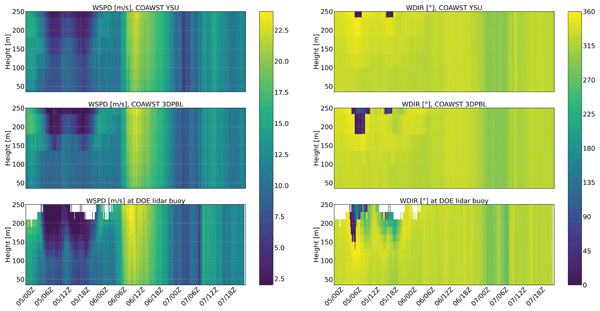
A three-dimensional planetary boundary layer (PBL) parameterization, suited for mesoscale model grid spacings of 100–1000 m with improved treatment of unresolved horizontal mixing, is added to a coupled atmosphere/wave modeling system and the first coupled simulations are executed using the parameterization. Simulations of a significant wind-wave event demonstrate that the new parameterization has similar behaviors as one-dimensional PBL parameterizations and compares well with observations.
Georgios Deskos, Jiali Wang, Sanjay Arwade, Murray Fisher, Brian Hirth, Xiaoli Guo Larsén, Julie K. Lundquist, Andrew Myers, Weichiang Pang, William J. Pringle, Robert Rogers, Miguel Sanchez-Gomez, Chao Sun, Atsushi Yamaguchi, and Paul Veers
Wind Energ. Sci., 11, 2749–2782, https://doi.org/10.5194/wes-11-2749-2026, https://doi.org/10.5194/wes-11-2749-2026, 2026
Short summary
Short summary
Wind energy is expanding into regions exposed to tropical cyclones, where extreme winds and waves can damage turbines and disrupt energy production. We reviewed observations, simulations, engineering standards, and risk quantification frameworks to identify the most important gaps. Today's design rules, originally built for milder storms, do not capture cyclone hazards. Closing these gaps requires better offshore measurements, improved models, and risk-informed design standards.
William C. Radünz, Jens H. Kasper, Richard J. A. M. Stevens, and Julie K. Lundquist
Wind Energ. Sci., 11, 2723–2747, https://doi.org/10.5194/wes-11-2723-2026, https://doi.org/10.5194/wes-11-2723-2026, 2026
Short summary
Short summary
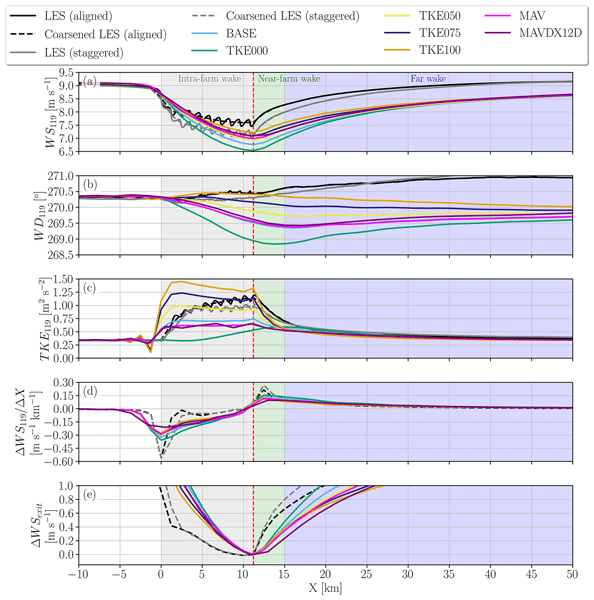
Wind farms extract energy from the wind, creating slower, more turbulent flows that can affect other farms downstream. Using high-fidelity simulations for comparison, we find that mesoscale simulations that parameterize wind farms at coarser resolution may underestimate how quickly the wind recovers downstream. This slow recovery results from missing sharp wind gradients and low turbulence. Improving these aspects can help better predict wind energy production over long distances.
Adam S. Wise, Robert S. Arthur, Jeffrey D. Mirocha, Julie K. Lundquist, and Fotini K. Chow
Wind Energ. Sci., 11, 2543–2565, https://doi.org/10.5194/wes-11-2543-2026, https://doi.org/10.5194/wes-11-2543-2026, 2026
Short summary
Short summary
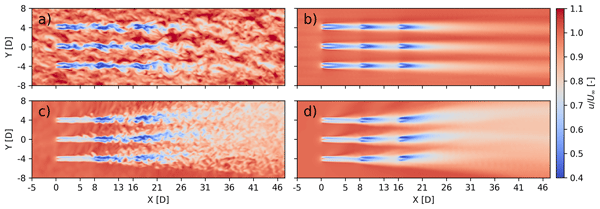
At night, wind farms can experience a wide range of intermittent wind events that can affect how much power is produced. We modeled a specific type of intermittent wind event that happens as the atmosphere gets colder and colder throughout a night. We identified a threshold to determine when these events impact wind farms and ultimately found that mainly the front of a wind farm tends to be most impacted by these sorts of events.
Valeria Vasquez-Barros, Nicola Bodini, Seth Zippel, Anthony Kirincich, and Julie K. Lundquist
Wind Energ. Sci. Discuss., https://doi.org/10.5194/wes-2026-115, https://doi.org/10.5194/wes-2026-115, 2026
Preprint under review for WES
Short summary
Short summary
Offshore wind turbines operate more than 100 meters above the ocean, but atmospheric conditions are often measured only near the sea surface. Using observations from an offshore research platform, we found that surface measurements frequently do not represent the conditions experienced by turbines because the lower atmosphere can become decoupled. These results highlight the need for measurements throughout the turbine height to improve wind energy forecasting and operations.
Nathan J. Agarwal, Julie K. Lundquist, Timothy W. Juliano, and Alex Rybchuk
Wind Energ. Sci., 11, 2369–2403, https://doi.org/10.5194/wes-11-2369-2026, https://doi.org/10.5194/wes-11-2369-2026, 2026
Short summary
Short summary
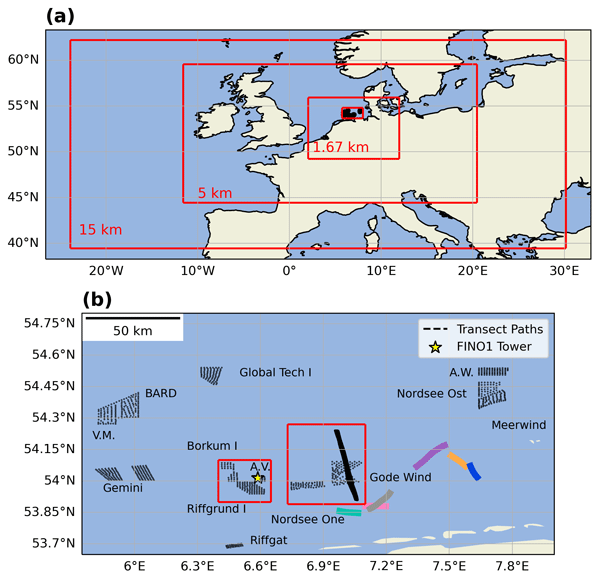
Models of wind behavior inform offshore wind farm site investment decisions. Here we compare a newly developed model to another, historically used model based on how these models represent winds and turbulence at two North Sea sites. The best model depends on the site. While the older model performs best at the site above a wind farm, the newer model performs best at the site that is at the same altitude as the wind farm. We support using the new model to represent winds at the turbine level.
Tianxia Jia, Mike Optis, Adam H. Monahan, and Slim Ibrahim
Wind Energ. Sci. Discuss., https://doi.org/10.5194/wes-2026-87, https://doi.org/10.5194/wes-2026-87, 2026
Preprint under review for WES
Short summary
Short summary
Wind farms can reduce each other's power generation by slowing the wind downwind, but testing many possible layouts with detailed weather simulation is slow and costly. We trained artificial intelligence models to learn from detailed simulations and quickly estimate power for new layouts. The models gave accurate results for unseen layouts, and some also estimated generation uncertainty. This can help planners compare wind farm design faster at lower cost, and with clearer information about risk
Nicola Bodini, Joseph Olson, Brian Gaudet, Giacomo Valerio Iungo, Mojtaba Shams Solari, Sayahnya Roy, Julie K. Lundquist, Nathan Agarwal, Timothy A. Myers, Bianca Adler, Jeffrey D. Mirocha, Eric James, Laura Bianco, James M. Wilczak, and David D. Turner
Wind Energ. Sci., 11, 1949–1961, https://doi.org/10.5194/wes-11-1949-2026, https://doi.org/10.5194/wes-11-1949-2026, 2026
Short summary
Short summary
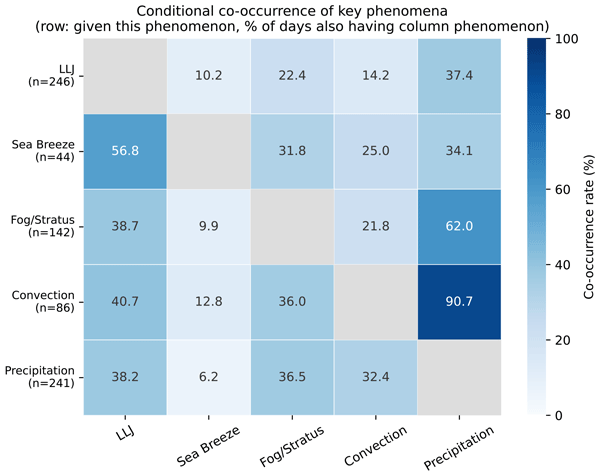
To improve offshore wind forecasts, the Third Wind Forecast Improvement Project monitored the United States east coast for 18 months. We compiled a daily log of weather events using advanced scanners and expert notes. This public dataset identifies important wind patterns, helping scientists test computer models and choose specific cases to study.
Nathan J. Agarwal and Julie K. Lundquist
Wind Energ. Sci., 11, 883–910, https://doi.org/10.5194/wes-11-883-2026, https://doi.org/10.5194/wes-11-883-2026, 2026
Short summary
Short summary
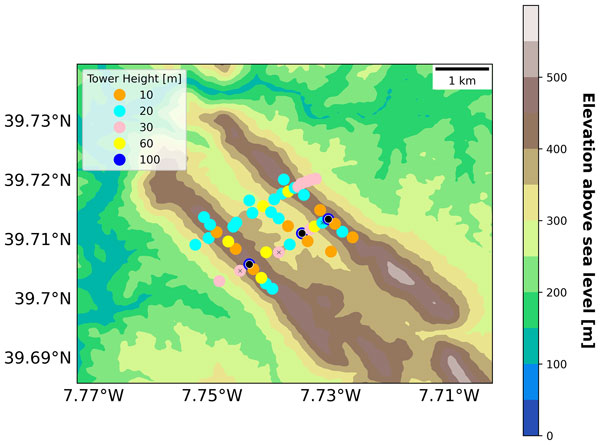
Areas with hills and valleys can be either beneficial or challenging for wind energy applications, depending on the wind patterns. Unfortunately, predicting wind patterns in these areas is also challenging, and investing in measurement towers to improve wind forecasts can be expensive. We evaluate ways in which wind farm developers and other stakeholders interested in improving atmospheric forecasts in these areas can do so in a more cost-effective way.
Kira Gramitzky, Florian Jäger, Doron Callies, Tabea Hildebrand, Julie K. Lundquist, and Lukas Pauscher
Wind Energ. Sci., 11, 861–882, https://doi.org/10.5194/wes-11-861-2026, https://doi.org/10.5194/wes-11-861-2026, 2026
Short summary
Short summary
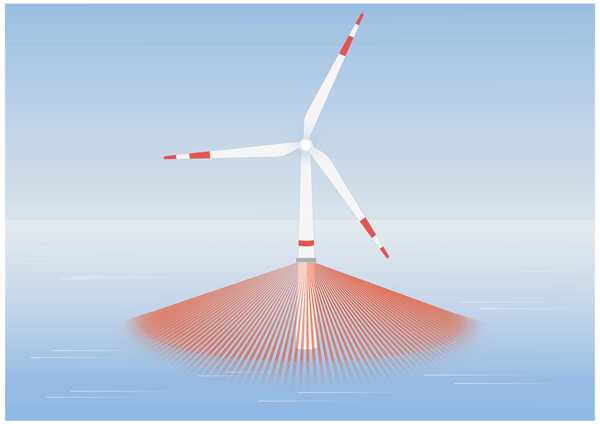
This study introduces an extended sea surface levelling method for the accurate offshore calibration of scanning lidars. This method can determine the alignment of the laser beam, including any vertical shift, and is independent of the scan pattern. Tests using real measurement data and a detailed uncertainty study confirm its reliability. The study offers a versatile calibration approach and improves confidence in offshore wind measurements with scanning lidars.
Nicola Bodini, Aliza Abraham, Paula Doubrawa, Stefano Letizia, Julie K. Lundquist, Patrick Moriarty, and Ryan Scott
Wind Energ. Sci. Discuss., https://doi.org/10.5194/wes-2026-33, https://doi.org/10.5194/wes-2026-33, 2026
Revised manuscript under review for WES
Short summary
Short summary
Wind turbines create "wakes" of slowed air that reduce power for nearby turbines. To help improve wind energy models, we analyzed data from a large field experiment. We focused on a single day with changing weather patterns. We found that even simple terrain features interacted with the wind to create large variations in power output – up to 80 percent – across a wind farm. This detailed dataset provides a real-world case needed to validate and improve wind energy design tools.

Anna Voss, Konrad B. Bärfuss, Beatriz Cañadillas, Maik Angermann, Mark Bitter, Matthias Cremer, Thomas Feuerle, Jonas Spoor, Julie K. Lundquist, Patrick Moriarty, and Astrid Lampert
Wind Energ. Sci., 11, 71–88, https://doi.org/10.5194/wes-11-71-2026, https://doi.org/10.5194/wes-11-71-2026, 2026
Short summary
Short summary
This study analyzes onshore wind farm wakes in a semi-complex terrain with data conducted with the research aircraft of TU Braunschweig during the American WAKE experimeNt (AWAKEN). Vertical profiles of temperature, humidity, and wind give insights into the stratification of the atmospheric boundary layer, while horizontal profiles downwind of wind farms reveal an amplification of the reduction in wind speed in a semi-complex terrain, in particular at a distance of 10 km.
William C. Radünz, Bruno Carmo, Julie K. Lundquist, Stefano Letizia, Aliza Abraham, Adam S. Wise, Miguel Sanchez Gomez, Nicholas Hamilton, Raj K. Rai, and Pedro S. Peixoto
Wind Energ. Sci., 10, 2365–2393, https://doi.org/10.5194/wes-10-2365-2025, https://doi.org/10.5194/wes-10-2365-2025, 2025
Short summary
Short summary
We explore how simple terrain influences spatial variations in wind speed and wind farm performance during a low-level jet. Using simulations, field observations, and turbine production data, we find that downstream turbines produce more power than upstream ones, despite being subjected to wake effects. This counterintuitive result arises because the low-level jet and winds near turbine rotors are highly sensitive to topographic features, leading to stronger winds at the downstream turbines.
Geng Xia, Mike Optis, Georgios Deskos, Michael Sinner, Daniel Mulas Hernando, Julie Kay Lundquist, Andrew Kumler, Miguel Sanchez Gomez, Paul Fleming, and Walter Musial
Wind Energ. Sci. Discuss., https://doi.org/10.5194/wes-2025-154, https://doi.org/10.5194/wes-2025-154, 2025
Revised manuscript not accepted
Short summary
Short summary
This study examines energy losses from cluster wakes in offshore wind farms along the U.S. East Coast. Simulations based on real lease projects show that large wind speed deficits do not always cause equally large energy losses. The energy loss method revealed wake areas up to 30 % larger than traditional estimates, underscoring the need to consider both wind speed deficit and energy loss in planning offshore wind development.
Daphne Quint, Julie K. Lundquist, Nicola Bodini, and David Rosencrans
Wind Energ. Sci., 10, 1269–1301, https://doi.org/10.5194/wes-10-1269-2025, https://doi.org/10.5194/wes-10-1269-2025, 2025
Short summary
Short summary
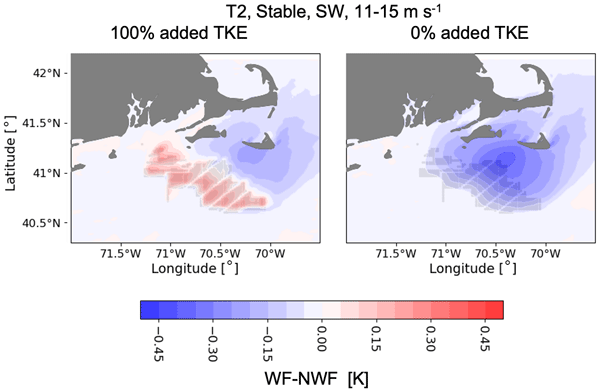
Offshore wind farms along the US East Coast can have limited effects on local weather. To study these effects, we include wind farms near Massachusetts and Rhode Island, and we test different amounts of turbulence in our model. We analyze changes in wind, temperature, and turbulence. Simulated effects on surface temperature and turbulence change depending on how much turbulence is added to the model. The extent of the wind farm wake depends on how deep the atmospheric boundary layer is.
Robert S. Arthur, Alex Rybchuk, Timothy W. Juliano, Gabriel Rios, Sonia Wharton, Julie K. Lundquist, and Jerome D. Fast
Wind Energ. Sci., 10, 1187–1209, https://doi.org/10.5194/wes-10-1187-2025, https://doi.org/10.5194/wes-10-1187-2025, 2025
Short summary
Short summary
This paper evaluates a new model configuration for wind energy forecasting in complex terrain. We compare model results to observations in the Altamont Pass (California, USA), where wind channeling through a mountain gap leads to increased energy production. We demonstrate that the new model configuration performs similarly to a more established approach, with some evidence of improved wind speed predictions, and provide guidance for future model testing.
Daphne Quint, Julie K. Lundquist, and David Rosencrans
Wind Energ. Sci., 10, 117–142, https://doi.org/10.5194/wes-10-117-2025, https://doi.org/10.5194/wes-10-117-2025, 2025
Short summary
Short summary
Offshore wind farms will be built along the East Coast of the United States. Low-level jets (LLJs) – layers of fast winds at low altitudes – also occur here. LLJs provide wind resources and also influence moisture and pollution transport, so it is important to understand how they might change. We develop and validate an automated tool to detect LLJs and compare 1 year of simulations with and without wind farms. Here, we describe LLJ characteristics and how they change with wind farms.
David Rosencrans, Julie K. Lundquist, Mike Optis, and Nicola Bodini
Wind Energ. Sci., 10, 59–81, https://doi.org/10.5194/wes-10-59-2025, https://doi.org/10.5194/wes-10-59-2025, 2025
Short summary
Short summary
The US offshore wind industry is growing rapidly. Expansion into cold climates will subject turbines and personnel to hazardous icing. We analyze the 21-year icing risk for US east coast wind areas based on numerical weather prediction simulations and further assess impacts from wind farm wakes over one winter season. Sea spray icing at 10 m can occur up to 67 h per month. However, turbine–atmosphere interactions reduce icing hours within wind plant areas.
Rachel Robey and Julie K. Lundquist
Wind Energ. Sci., 9, 1905–1922, https://doi.org/10.5194/wes-9-1905-2024, https://doi.org/10.5194/wes-9-1905-2024, 2024
Short summary
Short summary
Measurements of wind turbine wakes with scanning lidar instruments contain complex errors. We model lidars in a simulated environment to understand how and why the measured wake may differ from the true wake and validate the results with observational data. The lidar smooths out the wake, making it seem more spread out and the slowdown of the winds less pronounced. Our findings provide insights into best practices for accurately measuring wakes with lidar and interpreting observational data.
Nicola Bodini, Mike Optis, Stephanie Redfern, David Rosencrans, Alex Rybchuk, Julie K. Lundquist, Vincent Pronk, Simon Castagneri, Avi Purkayastha, Caroline Draxl, Raghavendra Krishnamurthy, Ethan Young, Billy Roberts, Evan Rosenlieb, and Walter Musial
Earth Syst. Sci. Data, 16, 1965–2006, https://doi.org/10.5194/essd-16-1965-2024, https://doi.org/10.5194/essd-16-1965-2024, 2024
Short summary
Short summary
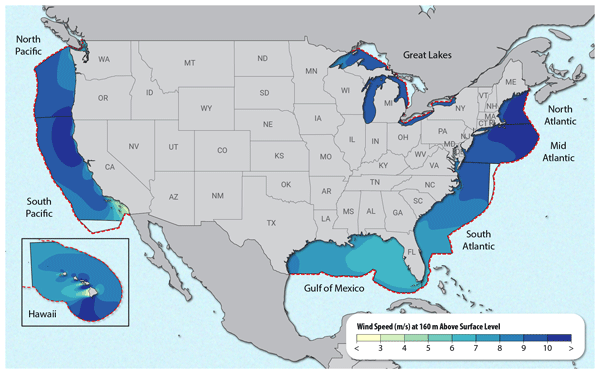
This article presents the 2023 National Offshore Wind data set (NOW-23), an updated resource for offshore wind information in the US. It replaces the Wind Integration National Dataset (WIND) Toolkit, offering improved accuracy through advanced weather prediction models. The data underwent regional tuning and validation and can be accessed at no cost.
David Rosencrans, Julie K. Lundquist, Mike Optis, Alex Rybchuk, Nicola Bodini, and Michael Rossol
Wind Energ. Sci., 9, 555–583, https://doi.org/10.5194/wes-9-555-2024, https://doi.org/10.5194/wes-9-555-2024, 2024
Short summary
Short summary
The US offshore wind industry is developing rapidly. Using yearlong simulations of wind plants in the US mid-Atlantic, we assess the impacts of wind turbine wakes. While wakes are the strongest and longest during summertime stably stratified conditions, when New England grid demand peaks, they are predictable and thus manageable. Over a year, wakes reduce power output by over 35 %. Wakes in a wind plant contribute the most to that reduction, while wakes between wind plants play a secondary role.
Balthazar Arnoldus Maria Sengers, Andreas Rott, Eric Simley, Michael Sinner, Gerald Steinfeld, and Martin Kühn
Wind Energ. Sci., 8, 1693–1710, https://doi.org/10.5194/wes-8-1693-2023, https://doi.org/10.5194/wes-8-1693-2023, 2023
Short summary
Short summary
Unexpected wind direction changes are undesirable, especially when performing wake steering. This study explores whether the yaw controller can benefit from accessing wind direction information before a change reaches the turbine. Results from two models with different fidelities demonstrate that wake steering can indeed benefit from preview information.
Miguel Sanchez Gomez, Julie K. Lundquist, Jeffrey D. Mirocha, and Robert S. Arthur
Wind Energ. Sci., 8, 1049–1069, https://doi.org/10.5194/wes-8-1049-2023, https://doi.org/10.5194/wes-8-1049-2023, 2023
Short summary
Short summary
The wind slows down as it approaches a wind plant; this phenomenon is called blockage. As a result, the turbines in the wind plant produce less power than initially anticipated. We investigate wind plant blockage for two atmospheric conditions. Blockage is larger for a wind plant compared to a stand-alone turbine. Also, blockage increases with atmospheric stability. Blockage is amplified by the vertical transport of horizontal momentum as the wind approaches the front-row turbines in the array.
Nicola Bodini, Simon Castagneri, and Mike Optis
Wind Energ. Sci., 8, 607–620, https://doi.org/10.5194/wes-8-607-2023, https://doi.org/10.5194/wes-8-607-2023, 2023
Short summary
Short summary
The National Renewable Energy Laboratory (NREL) has published updated maps of the wind resource along all US coasts. Given the upcoming offshore wind development, it is essential to quantify the uncertainty that comes with the modeled wind resource data set. The paper proposes a novel approach to quantify this numerical uncertainty by leveraging available observations along the US East Coast.
Stephanie Redfern, Mike Optis, Geng Xia, and Caroline Draxl
Wind Energ. Sci., 8, 1–23, https://doi.org/10.5194/wes-8-1-2023, https://doi.org/10.5194/wes-8-1-2023, 2023
Short summary
Short summary
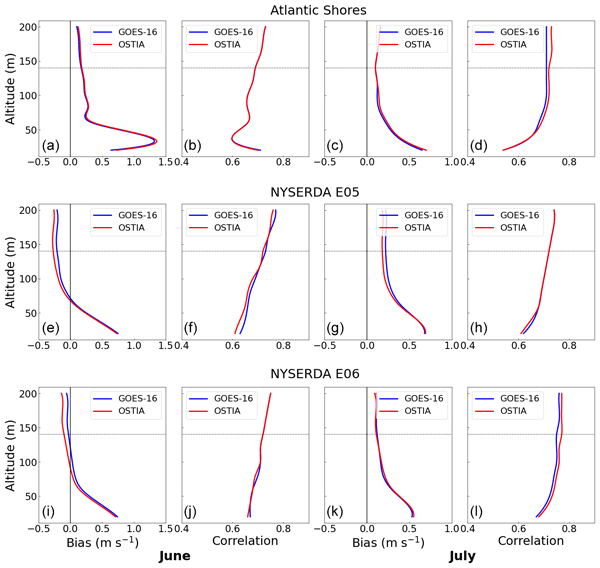
As wind farm developments expand offshore, accurate forecasting of winds above coastal waters is rising in importance. Weather models rely on various inputs to generate their forecasts, one of which is sea surface temperature (SST). In this study, we evaluate how the SST data set used in the Weather Research and Forecasting model may influence wind characterization and find meaningful differences between model output when different SST products are used.
Paul Veers, Katherine Dykes, Sukanta Basu, Alessandro Bianchini, Andrew Clifton, Peter Green, Hannele Holttinen, Lena Kitzing, Branko Kosovic, Julie K. Lundquist, Johan Meyers, Mark O'Malley, William J. Shaw, and Bethany Straw
Wind Energ. Sci., 7, 2491–2496, https://doi.org/10.5194/wes-7-2491-2022, https://doi.org/10.5194/wes-7-2491-2022, 2022
Short summary
Short summary
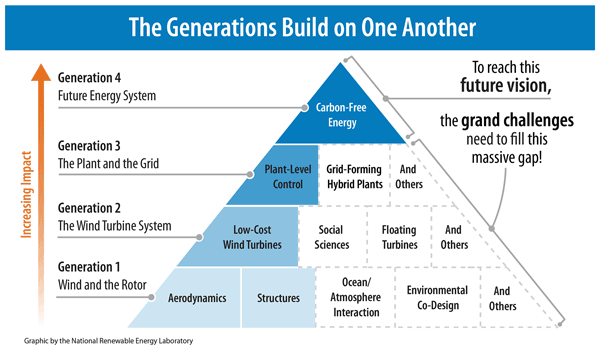
Wind energy will play a central role in the transition of our energy system to a carbon-free future. However, many underlying scientific issues remain to be resolved before wind can be deployed in the locations and applications needed for such large-scale ambitions. The Grand Challenges are the gaps in the science left behind during the rapid growth of wind energy. This article explains the breadth of the unfinished business and introduces 10 articles that detail the research needs.
William J. Shaw, Larry K. Berg, Mithu Debnath, Georgios Deskos, Caroline Draxl, Virendra P. Ghate, Charlotte B. Hasager, Rao Kotamarthi, Jeffrey D. Mirocha, Paytsar Muradyan, William J. Pringle, David D. Turner, and James M. Wilczak
Wind Energ. Sci., 7, 2307–2334, https://doi.org/10.5194/wes-7-2307-2022, https://doi.org/10.5194/wes-7-2307-2022, 2022
Short summary
Short summary
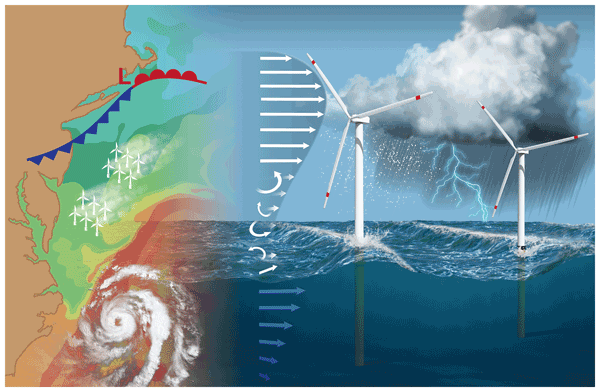
This paper provides a review of prominent scientific challenges to characterizing the offshore wind resource using as examples phenomena that occur in the rapidly developing wind energy areas off the United States. The paper also describes the current state of modeling and observations in the marine atmospheric boundary layer and provides specific recommendations for filling key current knowledge gaps.
Alex Rybchuk, Timothy W. Juliano, Julie K. Lundquist, David Rosencrans, Nicola Bodini, and Mike Optis
Wind Energ. Sci., 7, 2085–2098, https://doi.org/10.5194/wes-7-2085-2022, https://doi.org/10.5194/wes-7-2085-2022, 2022
Short summary
Short summary
Numerical weather prediction models are used to predict how wind turbines will interact with the atmosphere. Here, we characterize the uncertainty associated with the choice of turbulence parameterization on modeled wakes. We find that simulated wind speed deficits in turbine wakes can be significantly sensitive to the choice of turbulence parameterization. As such, predictions of future generated power are also sensitive to turbulence parameterization choice.
Rachel Robey and Julie K. Lundquist
Atmos. Meas. Tech., 15, 4585–4622, https://doi.org/10.5194/amt-15-4585-2022, https://doi.org/10.5194/amt-15-4585-2022, 2022
Short summary
Short summary
Our work investigates the behavior of errors in remote-sensing wind lidar measurements due to turbulence. Using a virtual instrument, we measured winds in simulated atmospheric flows and decomposed the resulting error. Dominant error mechanisms, particularly vertical velocity variations and interactions with shear, were identified in ensemble data over three test cases. By analyzing the underlying mechanisms, the response of the error behavior to further varying flow conditions may be projected.

Geng Xia, Caroline Draxl, Michael Optis, and Stephanie Redfern
Wind Energ. Sci., 7, 815–829, https://doi.org/10.5194/wes-7-815-2022, https://doi.org/10.5194/wes-7-815-2022, 2022
Short summary
Short summary
In this study, we propose a new method to detect sea breeze events from the Weather Research and Forecasting simulation. Our results suggest that the method can identify the three different types of sea breezes in the model simulation. In addition, the coastal impact, seasonal distribution and offshore wind potential associated with each type of sea breeze differ significantly, highlighting the importance of identifying the correct type of sea breeze in numerical weather/wind energy forecasting.
Vincent Pronk, Nicola Bodini, Mike Optis, Julie K. Lundquist, Patrick Moriarty, Caroline Draxl, Avi Purkayastha, and Ethan Young
Wind Energ. Sci., 7, 487–504, https://doi.org/10.5194/wes-7-487-2022, https://doi.org/10.5194/wes-7-487-2022, 2022
Short summary
Short summary
In this paper, we have assessed to which extent mesoscale numerical weather prediction models are more accurate than state-of-the-art reanalysis products in characterizing the wind resource at heights of interest for wind energy. The conclusions of our work will be of primary importance to the wind industry for recommending the best data sources for wind resource modeling.
Adam S. Wise, James M. T. Neher, Robert S. Arthur, Jeffrey D. Mirocha, Julie K. Lundquist, and Fotini K. Chow
Wind Energ. Sci., 7, 367–386, https://doi.org/10.5194/wes-7-367-2022, https://doi.org/10.5194/wes-7-367-2022, 2022
Short summary
Short summary
Wind turbine wake behavior in hilly terrain depends on various atmospheric conditions. We modeled a wind turbine located on top of a ridge in Portugal during typical nighttime and daytime atmospheric conditions and validated these model results with observational data. During nighttime conditions, the wake deflected downwards following the terrain. During daytime conditions, the wake deflected upwards. These results can provide insight into wind turbine siting and operation in hilly regions.
Paul Fleming, Michael Sinner, Tom Young, Marine Lannic, Jennifer King, Eric Simley, and Bart Doekemeijer
Wind Energ. Sci., 6, 1521–1531, https://doi.org/10.5194/wes-6-1521-2021, https://doi.org/10.5194/wes-6-1521-2021, 2021
Short summary
Short summary
The paper presents a new validation campaign of wake steering at a commercial wind farm. The campaign uses fixed yaw offset positions, rather than a table of optimal yaw offsets dependent on wind direction, to enable comparison with engineering models of wake steering. Additionally, by applying the same offset in beneficial and detrimental conditions, we are able to collect important data for assessing second-order wake model predictions.
Cited articles
4C Offshore: Global Offshore Wind Farm Database And Intelligence, https://www.4coffshore.com/windfarms/ (last access: 21 March 2025), 2025. a
Agarwal, N. J., Lundquist, J. K., Juliano, T. W., and Rybchuk, A.: A North Sea in situ evaluation of the Fitch Wind Farm Parametrization within the Mellor–Yamada–Nakanishi–Niino and 3D Planetary Boundary Layer schemes, Wind Energ. Sci. Discuss. [preprint], https://doi.org/10.5194/wes-2025-16, in review, 2025. a
Ahsbahs, T., Nygaard, N. G., Newcombe, A., and Badger, M.: Wind Farm Wakes from SAR and Doppler Radar, Remote Sensing, 12, 462, https://doi.org/10.3390/rs12030462, 2020. a
Aitken, M. L., Kosović, B., Mirocha, J. D., and Lundquist, J. K.: Large eddy simulation of wind turbine wake dynamics in the stable boundary layer using the Weather Research and Forecasting Model, J. Renew. Sustain. Energ., 6, 033137, https://doi.org/10.1063/1.4885111, 2014. a, b, c
Akhtar, N., Geyer, B., Rockel, B., Sommer, P. S., and Schrum, C.: Accelerating deployment of offshore wind energy alter wind climate and reduce future power generation potentials, Sci. Rep., 11, 11826, https://doi.org/10.1038/s41598-021-91283-3, 2021. a, b, c
Ali, K., Schultz, D. M., Revell, A., Stallard, T., and Ouro, P.: Assessment of Five Wind-Farm Parameterizations in the Weather Research and Forecasting Model: A Case Study of Wind Farms in the North Sea, Mon. Weather Rev., 151, 2333–2359, https://doi.org/10.1175/MWR-D-23-0006.1, 2023. a, b, c
Archer, C. L., Colle, B. A., Veron, D. L., Veron, F., and Sienkiewicz, M. J.: On the predominance of unstable atmospheric conditions in the marine boundary layer offshore of the U.S. northeastern coast, J. Geophys. Res.-Atmos., 121, 8869–8885, https://doi.org/10.1002/2016JD024896, 2016. a
Archer, C. L., Wu, S., Ma, Y., and Jiménez, P. A.: Two Corrections for Turbulent Kinetic Energy Generated by Wind Farms in the WRF Model, Mon. Weather Rev., 148, 4823–4835, https://doi.org/10.1175/mwr-d-20-0097.1, 2020. a
Barthelmie, R. J. and Jensen, L. E.: Evaluation of wind farm efficiency and wind turbine wakes at the Nysted offshore wind farm, Wind Energy, 13, 573–586, https://doi.org/10.1002/we.408, 2010. a, b
Barthelmie, R. J., Larsen, G. C., Frandsen, S. T., Folkerts, L., Rados, K., Pryor, S. C., Lange, B., and Schepers, G.: Comparison of Wake Model Simulations with Offshore Wind Turbine Wake Profiles Measured by Sodar, J. Atmos. Ocean. Technol., 23, 888–901, https://doi.org/10.1175/JTECH1886.1, 2006. a
Bodini, N., Lundquist, J. K., and Kirincich, A.: U.S. East Coast Lidar Measurements Show Offshore Wind Turbines Will Encounter Very Low Atmospheric Turbulence, Geophys. Res. Lett., 46, 5582–5591, https://doi.org/10.1029/2019GL082636, 2019. a, b, c
Bodini, N., Optis, M., Rossol, M., Rybchuk, A., Redfern, S., Lundquist, J. K., and Rosencrans, D.: 2023 National Offshore Wind data set (NOW-23), Open Energy Data Initiative (OEDI), National Renewable Energy Laboratory, https://doi.org/10.25984/1821404, 2020. a, b, c
Bodini, N., Optis, M., Redfern, S., Rosencrans, D., Rybchuk, A., Lundquist, J. K., Pronk, V., Castagneri, S., Purkayastha, A., Draxl, C., Krishnamurthy, R., Young, E., Roberts, B., Rosenlieb, E., and Musial, W.: The 2023 National Offshore Wind data set (NOW-23), Earth Syst. Sci. Data, 16, 1965–2006, https://doi.org/10.5194/essd-16-1965-2024, 2024. a, b, c
BOEM: Record of Decision: South Fork Wind Farm and South Fork Export Cable Project, Record of decision, U.S. Department of the Interior, Bureau of Ocean Energy Management, Washington, DC, https://www.boem.gov/sites/default/files/documents/renewable-energy/state-activities/Record of Decision South Fork_0.pdf (last access: 10 March 2025), oCS-A 0517; Final decision under NEPA and Outer Continental Shelf Lands Act, 2021. a
Borgers, R., Dirksen, M., Wijnant, I. L., Stepek, A., Stoffelen, A., Akhtar, N., Neirynck, J., Van de Walle, J., Meyers, J., and van Lipzig, N. P. M.: Mesoscale modelling of North Sea wind resources with COSMO-CLM: model evaluation and impact assessment of future wind farm characteristics on cluster-scale wake losses, Wind Energ. Sci., 9, 697–719, https://doi.org/10.5194/wes-9-697-2024, 2024. a, b
Cañadillas, B., Beckenbauer, M., Trujillo, J. J., Dörenkämper, M., Foreman, R., Neumann, T., and Lampert, A.: Offshore wind farm cluster wakes as observed by long-range-scanning wind lidar measurements and mesoscale modeling, Wind Energ. Sci., 7, 1241–1262, https://doi.org/10.5194/wes-7-1241-2022, 2022. a, b, c, d
Chen, F. and Dudhia, J.: Coupling an Advanced Land Surface–Hydrology Model with the Penn State–NCAR MM5 Modeling System. Part I: Model Implementation and Sensitivity, Mon. Weather Rev., 129, 569–585, https://doi.org/10.1175/1520-0493(2001)129<0569:caalsh>2.0.co;2, 2001. a
Dyer, A. J. and Hicks, B. B.: Flux‐gradient relationships in the constant flux layer, Q. J. Roy. Meteorol. Soc., 96, 715–721, https://doi.org/10.1002/qj.49709641012, 1970. a
Fischereit, J., Brown, R., Larsén, X. G., Badger, J., and Hawkes, G.: Review of Mesoscale Wind-Farm Parametrizations and Their Applications, Bound.-Lay. Meteorol., 182, 175–224, https://doi.org/10.1007/s10546-021-00652-y, 2022a. a, b
Fischereit, J., Schaldemose Hansen, K., Larsén, X. G., Van Der Laan, M. P., Réthoré, P.-E., and Murcia Leon, J. P.: Comparing and validating intra-farm and farm-to-farm wakes across different mesoscale and high-resolution wake models, Wind Energ. Sci., 7, 1069–1091, https://doi.org/10.5194/wes-7-1069-2022, 2022b. a, b, c, d
Fitch, A. C., Olson, J. B., Lundquist, J. K., Dudhia, J., Gupta, A. K., Michalakes, J., and Barstad, I.: Local and Mesoscale Impacts of Wind Farms as Parameterized in a Mesoscale NWP Model, Mon. Weather Rev., 140, 3017–3038, https://doi.org/10.1175/mwr-d-11-00352.1, 2012. a, b
Gaertner, E., Rinker, J., Sethuraman, L., Zahle, F., Anderson, B., Barter, G., and Abbas, N.: Definition of the IEA Wind 15-Megawatt Offshore Reference Wind Turbine, Tech. Rep. NREL/TP-5000-75698, National Renewable Energy Laboratory, https://doi.org/10.2172/1603478, 2020. a
García-Santiago, O., Hahmann, A. N., Badger, J., and Peña, A.: Evaluation of wind farm parameterizations in the WRF model under different atmospheric stability conditions with high-resolution wake simulations, Wind Energ. Sci., 9, 963–979, https://doi.org/10.5194/wes-9-963-2024, 2024. a
Göçmen, T. and Giebel, G.: Data-driven Wake Modelling for Reduced Uncertainties in short-term Possible Power Estimation, J. Phys. Conf. Ser., 1037, 072002, https://doi.org/10.1088/1742-6596/1037/7/072002, 2018. a
Hersbach, H., Bell, B., Berrisford, P., Hirahara, S., Horányi, A., Muñoz-Sabater, J., Nicolas, J., Peubey, C., Radu, R., Schepers, D., Simmons, A., Soci, C., Abdalla, S., Abellan, X., Balsamo, G., Bechtold, P., Biavati, G., Bidlot, J., Bonavita, M., De Chiara, G., Dahlgren, P., Dee, D., Diamantakis, M., Dragani, R., Flemming, J., Forbes, R., Fuentes, M., Geer, A., Haimberger, L., Healy, S., Hogan, R. J., Hólm, E., Janisková, M., Keeley, S., Laloyaux, P., Lopez, P., Lupu, C., Radnoti, G., de Rosnay, P., Rozum, I., Vamborg, F., Villaume, S., and Thépaut, J.-N.: The ERA5 global reanalysis, Q. J. Roy. Meteorol. Soc., 146, 1999–2049, 2020. a
Iacono, M. J., Delamere, J. S., Mlawer, E. J., Shephard, M. W., Clough, S. A., and Collins, W. D.: Radiative forcing by long‐lived greenhouse gases: Calculations with the AER radiative transfer models, J. Geophys. Res.-Atmos., 113, https://doi.org/10.1029/2008jd009944, 2008. a
Jacobs Engineering Group Inc.: South Fork Wind Farm Construction and Operations Plan, Tech. rep., Submitted by South Fork Wind, LLC; Bureau of Ocean Energy Management, U.S. Department of the Interior Bureau of Ocean Energy Management, https://www.boem.gov/sites/default/files/documents/renewable-energy/South-Fork-Construction-Operations-Plan.pdf (last access: 10 March 2025), 2021. a
Jonkman, J., Butterfield, S., Musial, W., and Scott, G.: Definition of a 5-MW Reference Wind Turbine for Offshore System Development, NREL, https://doi.org/10.2172/947422, 2009. a
Juliano, T. W., Kosović, B., Jiménez, P. A., Eghdami, M., Haupt, S. E., and Martilli, A.: “Gray Zone” Simulations Using a Three-Dimensional Planetary Boundary Layer Parameterization in the Weather Research and Forecasting Model, Mon. Weather Rev., 150, 1585–1619, https://doi.org/10.1175/MWR-D-21-0164.1, 2022. a
Kain, J. S.: The Kain–Fritsch Convective Parameterization: An Update, J. Appl. Meteorol., 43, 170–181, https://doi.org/10.1175/1520-0450(2004)043<0170:tkcpau>2.0.co;2, 2004. a
Khan, M. A., Watson, S. J., Allaerts, D. J. N., and Churchfield, M.: Recommendations on setup in simulating atmospheric gravity waves under conventionally neutral boundary layer conditions, J. Phys. Conf. Ser., 2767, 092042, https://doi.org/10.1088/1742-6596/2767/9/092042, 2024. a, b
Klemp, J. B., Dudhia, J., and Hassiotis, A. D.: An Upper Gravity-Wave Absorbing Layer for NWP Applications, Mon. Weather Rev., 136, 3987–4004, https://doi.org/10.1175/2008MWR2596.1, 2008. a
Kosović, B.: Subgrid-scale modelling for the large-eddy simulation of high-Reynolds-number boundary layers, J. Fluid Mech., 336, 151–182, https://doi.org/10.1017/S0022112096004697, 1997. a
Lee, J. C. Y. and Lundquist, J. K.: Evaluation of the wind farm parameterization in the Weather Research and Forecasting model (version 3.8.1) with meteorological and turbine power data, Geosci. Model Dev., 10, 4229–4244, https://doi.org/10.5194/gmd-10-4229-2017, 2017. a, b
Lundquist, J. K., DuVivier, K. K., Kaffine, D., and Tomaszewski, J. M.: Costs and consequences of wind turbine wake effects arising from uncoordinated wind energy development, Nat. Energ., 4, 26–34, https://doi.org/10.1038/s41560-018-0281-2, 2019. a, b
McCoy, A., Musial, W., Hammond, R., Mulas Hernando, D., Duffy, P., Beiter, P., Perez, P., Baranowski, R., Reber, G., and Spitsen, P.: Offshore Wind Market Report: 2024 Edition, Tech. rep., National Renewable Energy Laboratory (NREL), Golden, CO (United States), https://doi.org/10.2172/2434294, 2024. a, b
Mirocha, J. D., Lundquist, J. K., and Kosović, B.: Implementation of a Nonlinear Subfilter Turbulence Stress Model for Large-Eddy Simulation in the Advanced Research WRF Model, Mon. Weather Rev., 138, 4212–4228, https://doi.org/10.1175/2010MWR3286.1, 2010. a
Mirocha, J. D., Kosovic, B., Aitken, M. L., and Lundquist, J. K.: Implementation of a generalized actuator disk wind turbine model into the weather research and forecasting model for large-eddy simulation applications, J. Renew. Sustain. Energ., 6, 013104, https://doi.org/10.1063/1.4861061, 2014. a, b
Musial, W., Elliot, D., Fields, J., Parker, Z., and Scott, G.: Analysis of Offshore Wind Energy Leasing Areas for the Rhode Island/Massachusetts Wind Energy Area, Tech. Rep. NREL/TP-5000-58091, National Renewable Energy Laboratory, https://doi.org/10.2172/1078077, 2013. a, b
Nakanishi, M. and Niino, H.: An Improved Mellor–Yamada Level-3 Model: Its Numerical Stability and Application to a Regional Prediction of Advection Fog, Bound.-Lay. Meteorol., 119, 397–407, https://doi.org/10.1007/s10546-005-9030-8, 2006. a
Nakanishi, M. and Niino, H.: Development of an Improved Turbulence Closure Model for the Atmospheric Boundary Layer, J. Meteorol. Soc. Jpn., 87, 895–912, https://doi.org/10.2151/jmsj.87.895, 2009. a
Nygaard, N. G., Steen, S. T., Poulsen, L., and Pedersen, J. G.: Modelling cluster wakes and wind farm blockage, J. Phys. Conf. Ser., 1618, 062072, https://doi.org/10.1088/1742-6596/1618/6/062072, 2020. a, b
Nygaard, N. G., Poulsen, L., Svensson, E., and Pedersen, J. G.: Large-scale benchmarking of wake models for offshore wind farms, J. Phys. Conf. Ser., 2265, 022008, https://doi.org/10.1088/1742-6596/2265/2/022008, 2022. a
Platis, A., Siedersleben, S. K., Bange, J., Lampert, A., Bärfuss, K., Hankers, R., Cañadillas, B., Foreman, R., Schulz-Stellenfleth, J., Djath, B., Neumann, T., and Emeis, S.: First in situ evidence of wakes in the far field behind offshore wind farms, Sci. Rep., 8, 2163, https://doi.org/10.1038/s41598-018-20389-y, 2018. a
Pryor, S. C. and Barthelmie, R. J.: Power Production, Inter- and Intra-Array Wake Losses from the U.S. East Coast Offshore Wind Energy Lease Areas, Energies, 17, 1063, https://doi.org/10.3390/en17051063, 2024a. a, b, c, d
Pryor, S. C. and Barthelmie, R. J.: Wind shadows impact planning of large offshore wind farms, Appl. Energ., 359, 122755, https://doi.org/10.1016/j.apenergy.2024.122755, 2024b. a
Pryor, S. C., Barthelmie, R. J., and Shepherd, T. J.: Wind power production from very large offshore wind farms, Joule, 5, 2663–2686, https://doi.org/10.1016/j.joule.2021.09.002, 2021. a, b, c
Radünz, W. C., Kasper, J. H., Stevens, R. J. A. M., and Lundquist, J. K.: Under-resolved gradients: slow wake recovery and fast turbulence decay with mesoscale Wind Farm Parameterizations, Wind Energ. Sci. Discuss. [preprint], https://doi.org/10.5194/wes-2025-147, in review, 2025. a, b
Rai, R. K., Berg, L. K., Kosović, B., Haupt, S. E., Mirocha, J. D., Ennis, B. L., and Draxl, C.: Evaluation of the Impact of Horizontal Grid Spacing in Terra Incognita on Coupled Mesoscale–Microscale Simulations Using the WRF Framework, Mon. Weather Rev., 147, 1007–1027, https://doi.org/10.1175/MWR-D-18-0282.1, 2019. a
Rybchuk, A., Juliano, T. W., Lundquist, J. K., Rosencrans, D., Bodini, N., and Optis, M.: The sensitivity of the Fitch wind farm parameterization to a three-dimensional planetary boundary layer scheme, Wind Energ. Sci., 7, 2085–2098, https://doi.org/10.5194/wes-7-2085-2022, 2022. a
Sanchez-Gomez, M.: Supporting files for “Differences in cluster and internal wake effects from mesoscale and large-eddy simulations off the U.S. East Coast”, Zenodo [code], https://doi.org/10.5281/zenodo.20512693, 2026. a
Sanchez Gomez, M., Lundquist, J. K., Mirocha, J. D., and Arthur, R. S.: Investigating the physical mechanisms that modify wind plant blockage in stable boundary layers, Wind Energ. Sci., 8, 1049–1069, https://doi.org/10.5194/wes-8-1049-2023, 2023. a, b
Sanchez Gomez, M., Deskos, G., Lundquist, J. K., and Juliano, T. W.: Can mesoscale models capture the effect from cluster wakes offshore?, J. Phys. Conf. Ser., 2767, 062013, https://doi.org/10.1088/1742-6596/2767/6/062013, 2024. a, b, c
Schneemann, J., Rott, A., Dörenkämper, M., Steinfeld, G., and Kühn, M.: Cluster wakes impact on a far-distant offshore wind farm's power, Wind Energ. Sci., 5, 29–49, https://doi.org/10.5194/wes-5-29-2020, 2020. a
Siedersleben, S. K., Lundquist, J. K., Platis, A., Bange, J., Bärfuss, K., Lampert, A., Cañadillas, B., Neumann, T., and Emeis, S.: Micrometeorological impacts of offshore wind farms as seen in observations and simulations, Environ. Res. Lett., 13, 124012, https://doi.org/10.1088/1748-9326/aaea0b, 2018a. a, b, c
Siedersleben, S. K., Platis, A., Lundquist, J. K., Lampert, A., Bärfuss, K., Cañadillas, B., Djath, B., Schulz-Stellenfleth, J., Bange, J., Neumann, T., and Emeis, S.: Evaluation of a Wind Farm Parametrization for Mesoscale Atmospheric Flow Models with Aircraft Measurements, Meteorol. Z., 27, 401–415, https://doi.org/10.1127/metz/2018/0900, 2018b. a, b, c
Stantec Consulting Services Inc.: Sunrise Wind Farm Construction and Operations Plan, Tech. rep., Submitted by Sunrise Wind, LLC, Bureau of Ocean Energy Management, U.S. Department of the Interior Bureau of Ocean Energy Management, https://www.boem.gov/sites/default/files/documents/renewable-energy/state-activities/SRW01-COP-2021-08-23.pdf (last access: 5 April 2025), 2021. a
Thompson, G., Field, P. R., Rasmussen, R. M., and Hall, W. D.: Explicit Forecasts of Winter Precipitation Using an Improved Bulk Microphysics Scheme. Part II: Implementation of a New Snow Parameterization, Mon. Weather Rev., 136, 5095–5115, https://doi.org/10.1175/2008mwr2387.1, 2008. a
Tomaszewski, J. M. and Lundquist, J. K.: Simulated wind farm wake sensitivity to configuration choices in the Weather Research and Forecasting model version 3.8.1, Geosci. Model Dev., 13, 2645–2662, https://doi.org/10.5194/gmd-13-2645-2020, 2020. a
USCG, DHS: Port Access Route Study: The Areas Offshore of Massachusetts and Rhode Island, Federal Register, https://www.federalregister.gov/documents/2020/05/27/ (last access: 5 April 2025), 2020. a
Vanasse Hangen Brustlin, Inc.: Revolution Wind Farm Construction and Operations Plan, Tech. rep., Revolution Wind, LLC, Bureau of Ocean Energy Management, https://www.boem.gov/sites/default/files/documents/renewable-energy/state-activities/Revolution Wind COP Volume 1 March 2023_v2_508c_Section_4.4.3.1_Redacted.pdf (last access: 5 April 2025), 2023. a
Volker, P. J. H., Badger, J., Hahmann, A. N., and Ott, S.: The Explicit Wake Parametrisation V1.0: a wind farm parametrisation in the mesoscale model WRF, Geosci. Model Dev., 8, 3715–3731, https://doi.org/10.5194/gmd-8-3715-2015, 2015. a
Vollmer, L., Sengers, B. A. M., and Dörenkämper, M.: Brief communication: A simple axial induction modification to the Weather Research and Forecasting Fitch wind farm parameterization, Wind Energ. Sci., 9, 1689–1693, https://doi.org/10.5194/wes-9-1689-2024, 2024. a
Warder, S. C. and Piggott, M. D.: The future of offshore wind power production: Wake and climate impacts, Appl. Energ., 380, 124956, https://doi.org/10.1016/j.apenergy.2024.124956, 2025. a
Wyngaard, J. C.: Toward Numerical Modeling in the “Terra Incognita”, J. Atmos. Sci., 61, 1816–1826, https://doi.org/10.1175/1520-0469(2004)061<1816:TNMITT>2.0.CO;2, 2004. a
Xia, G., Optis, M., Deskos, G., Sinner, M., Mulas Hernando, D., Lundquist, J. K., Kumler, A., Sanchez-Gomez, M., Fleming, P., and Musial, W.: Understanding Cluster Wake-Induced Energy Losses off the U.S. East Coast, Wind Energ. Sci. Discuss. [preprint], https://doi.org/10.5194/wes-2025-154, in review, 2025. a, b, c, d, e
Short summary
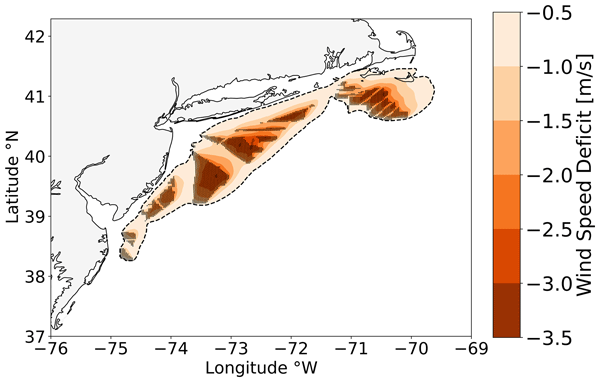
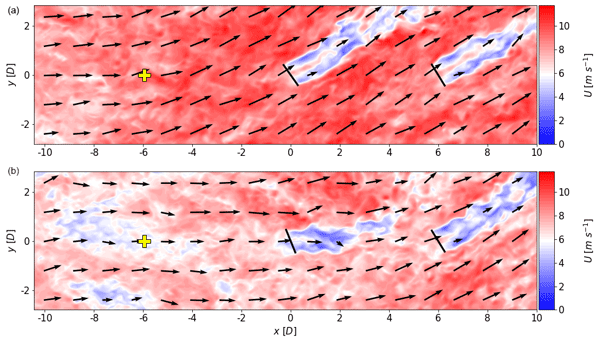
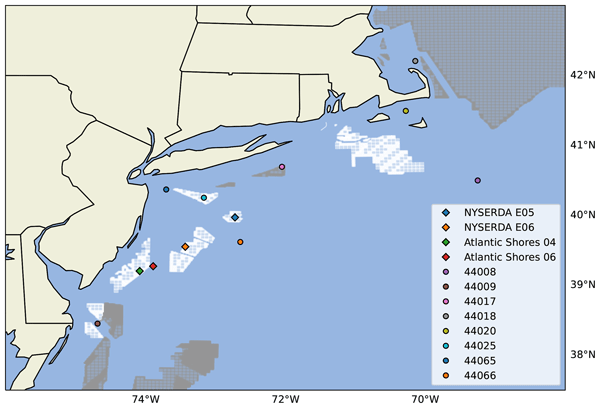
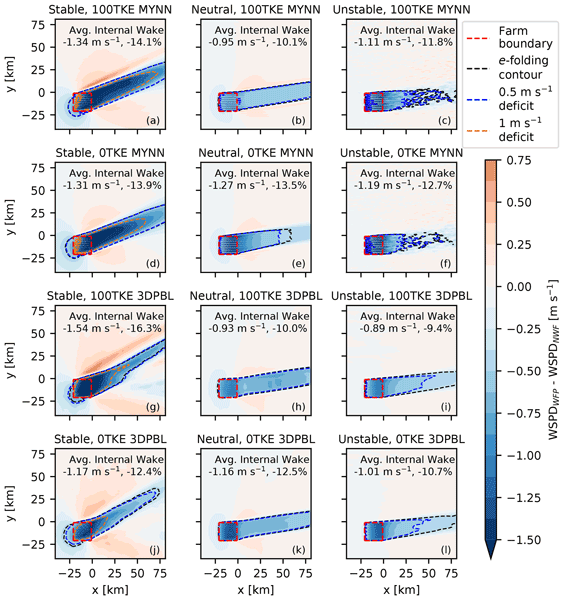
Mesoscale simulations with the Fitch wind farm parameterization were compared to large-domain large-eddy simulations for three planned offshore wind farms under varied atmospheric conditions. Mesoscale runs captured key wake deficit patterns and stability effects in the wind farm wake evolution but underestimated power losses from internal wakes, especially in aligned winds or stable conditions. Results highlight mesoscale strengths for large-scale wakes and limits for turbine-level losses.
Mesoscale simulations with the Fitch wind farm parameterization were compared to large-domain...


Altmetrics
Final-revised paper
Preprint