
Articles | Volume 11, issue 5
https://doi.org/10.5194/wes-11-1913-2026
© Author(s) 2026. This work is distributed under
the Creative Commons Attribution 4.0 License.
the Creative Commons Attribution 4.0 License.
https://doi.org/10.5194/wes-11-1913-2026
© Author(s) 2026. This work is distributed under
the Creative Commons Attribution 4.0 License.
the Creative Commons Attribution 4.0 License.
Research article
| 
26 May 2026
Research article |
| 26 May 2026
| 26 May 2026
Benchmarking of three DWM-based wake models at below-rated wind speeds
Øyvind Waage Hanssen-Bauer
CORRESPONDING AUTHOR

Institute for Energy Technology, Instituttveien 18, 2007 Kjeller, Norway
Paula Doubrawa
National Renewable Energy Laboratory, Golden, CO 80401, USA
Helge A. Madsen
Department of Wind Energy, Risø Campus, Technical University of Denmark, 4000 Roskilde, Denmark
Henrik Asmuth
Wind Energy Division, Department of Earth Sciences, Uppsala University, 621 67 Visby, Sweden
Jason Jonkman
National Renewable Energy Laboratory, Golden, CO 80401, USA
Gunner C. Larsen
Department of Wind Energy, Risø Campus, Technical University of Denmark, 4000 Roskilde, Denmark
Stefan Ivanell
Wind Energy Division, Department of Earth Sciences, Uppsala University, 621 67 Visby, Sweden
Roy Stenbro
Institute for Energy Technology, Instituttveien 18, 2007 Kjeller, Norway
Related authors
Roger Bergua, Will Wiley, Amy Robertson, Jason Jonkman, Cédric Brun, Jean-Philippe Pineau, Quan Qian, Wen Maoshi, Alec Beardsell, Joshua Cutler, Fabio Pierella, Christian Anker Hansen, Wei Shi, Jie Fu, Lehan Hu, Prokopios Vlachogiannis, Christophe Peyrard, Christopher Simon Wright, Dallán Friel, Øyvind Waage Hanssen-Bauer, Carlos Renan dos Santos, Eelco Frickel, Hafizul Islam, Arjen Koop, Zhiqiang Hu, Jihuai Yang, Tristan Quideau, Violette Harnois, Kelsey Shaler, Stefan Netzband, Daniel Alarcón, Pau Trubat, Aengus Connolly, Seán B. Leen, and Oisín Conway
Wind Energ. Sci., 9, 1025–1051, https://doi.org/10.5194/wes-9-1025-2024, https://doi.org/10.5194/wes-9-1025-2024, 2024
Short summary
Short summary
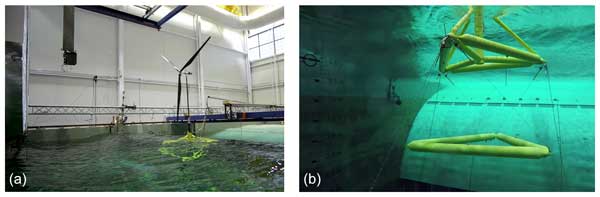
This paper provides a comparison for a floating offshore wind turbine between the motion and loading estimated by numerical models and measurements. The floating support structure is a novel design that includes a counterweight to provide floating stability to the system. The comparison between numerical models and the measurements includes system motion, tower loads, mooring line loads, and loading within the floating support structure.
Helge Aagaard Madsen, Pietro Bortolotti, Thanasis Barlas, Pourya Nikoueeyan, Christopher Kelley, Claus Brian Munk Pedersen, Per Hansen, Andreas Fischer, Chris Ivanov, Jason Roadman, Jonathan Naughton, Kenneth Brown, Mark Iverson, and Simon Thao
Wind Energ. Sci., 11, 3337–3357, https://doi.org/10.5194/wes-11-3337-2026, https://doi.org/10.5194/wes-11-3337-2026, 2026
Short summary
Short summary
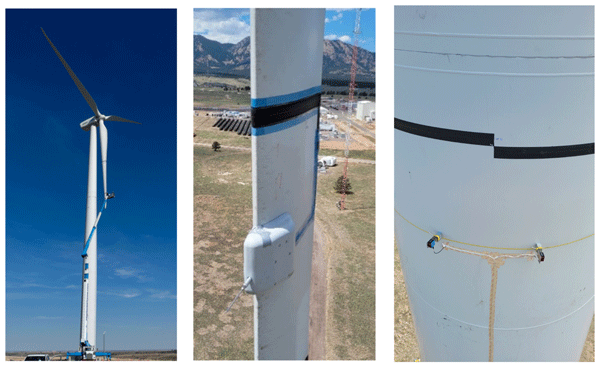
We present a detailed experimental investigation of the flow details of the blade/tower interaction (BTI) on a 1.5 MW wind turbine operating in a downwind configuration. The objective is to clarify some of the most important barriers for the downwind turbine concept linked to the impulsive loading from the blade/tower interaction generating low-frequency noise and increased loading. Unique instrumentation was used, comprising two extruded pressure belts on one of the blades and on the tower.
Nicola Bodini, Patrick Moriarty, Regis Thedin, Paula Doubrawa, Cristina Archer, Myra Blaylock, Carlo Bottasso, Bruno Carmo, Lawrence Cheung, Camille Dubreuil, Rogier Floors, Thomas Herges, Daniel Houck, Ali Kanjari, Colleen M. Kaul, Christopher Kelley, Ru Li, Julie K. Lundquist, Desirae Major, Anh Kiet Nguyen, Mike Optis, Luan R. C. Parada, Alfredo Peña, Julian Quick, David Ricarte, William C. Radünz, Raj K. Rai, Oscar García-Santiago, Jonas Schulte, Knut S. Seim, M. Paul van der Laan, Kisorthman Vimalakanthan, and Adam Wise
Wind Energ. Sci., 11, 3107–3135, https://doi.org/10.5194/wes-11-3107-2026, https://doi.org/10.5194/wes-11-3107-2026, 2026
Short summary
Short summary
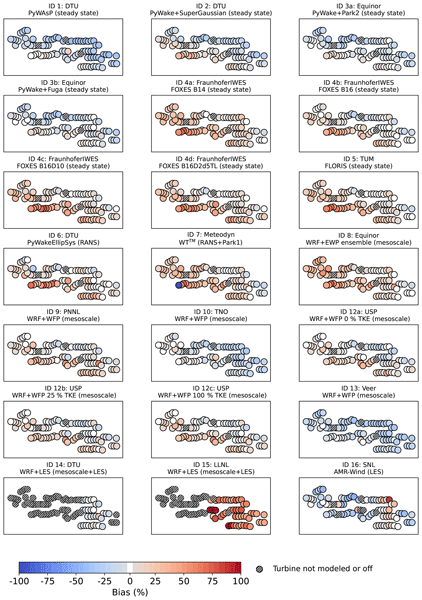
Predicting wind farm energy production is challenging because wind patterns are complex. We tested 16 different models against real data from a major field experiment to see which worked best. Surprisingly, the most expensive and detailed models were not always more accurate than simpler ones. We found that feeding models better weather data was the most effective way to improve accuracy. These results help the industry choose the right tools for designing more-efficient wind farms.
Henry Korb, Henrik Asmuth, Martin Schönherr, Martin Geier, and Stefan Ivanell
Wind Energ. Sci., 11, 2567–2583, https://doi.org/10.5194/wes-11-2567-2026, https://doi.org/10.5194/wes-11-2567-2026, 2026
Short summary
Short summary
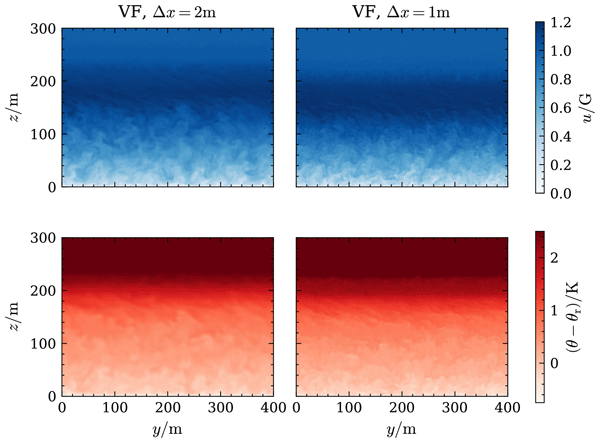
This study presents a new way to simulate the wind in the lower atmosphere while taking into account the changes in temperature. The model is much faster than previous models while having the same level of accuracy. This study is a step toward making highly accurate software to predict the output of wind farms fast enough for use in the wind industry, ultimately making electricity from wind energy cheaper and more reliable.
Will Wiley, Jason Jonkman, and Amy Robertson
Wind Energ. Sci., 11, 2447–2477, https://doi.org/10.5194/wes-11-2447-2026, https://doi.org/10.5194/wes-11-2447-2026, 2026
Short summary
Short summary
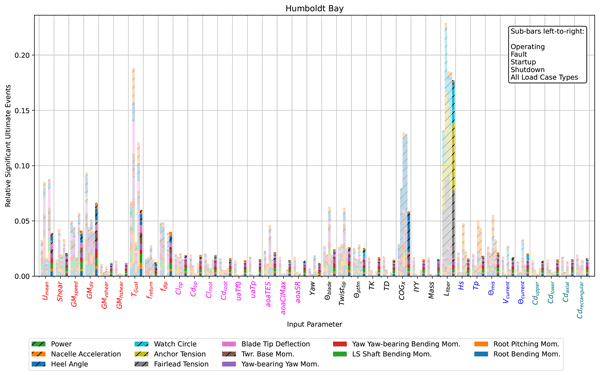
Numerical models used to analyze wind turbines are based on thousands of input parameters. Each of these parameters has uncertainty, which can impact the predicted loads. This work demonstrates a screening technique to identify which parameters ultimate loads are most sensitive to so that more focus can be given to quantifying the possible range of those parameters, with a focus on a floating offshore wind turbine in design load cases with transient events both in the inflow and operations.
Michael Karch, Friedemann Borisade, Fabian Wendt, Romain Pinguet, Thang Do, Jérôme de Lauzon, Lucas Tessier, Jon Cerrada-Garcés, Alvaro Olcoz-Alonso, Jesús Artal, Borja Servan-Camas, Julio García-Espinosa, Cai Wei Sun, Haruki Yoshimoto, Takaya Nagumo, Go Tsuneto, Roger Bergua, Lu Wang, Jason Jonkman, Amy Robertson, Constance Clement, and Guillaume Potier
Wind Energ. Sci., 11, 2427–2446, https://doi.org/10.5194/wes-11-2427-2026, https://doi.org/10.5194/wes-11-2427-2026, 2026
Short summary
Short summary
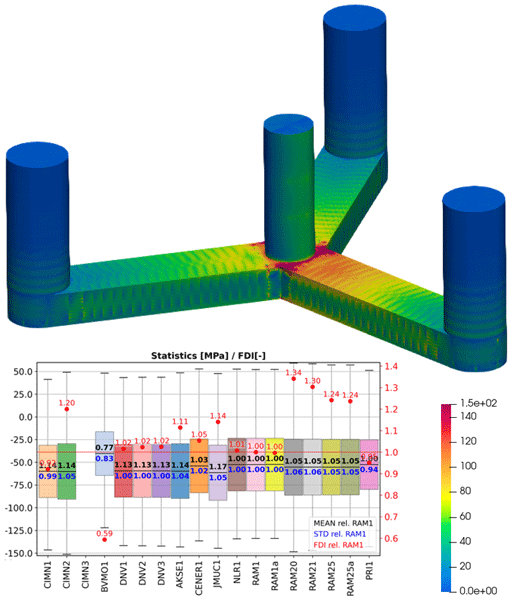
As part of the Offshore Code Comparison Collaboration 7 (OC7) project, load transfer from global analysis models to local structural designs was examined. Different load-mapping workflows from project participants were compared using a shared reference design and consistent checks. Results show that load-mapping choices, pressure application, and treatment of structural flexibility can influence predicted stresses and fatigue, highlighting key sources of uncertainty and providing guidance for more consistent global‑to‑local assessments.
Julia Steiner, Emily Louise Hodgson, Maarten Paul van der Laan, Leonardo Alcayaga, Mads Pedersen, Søren Juhl Andersen, Gunner Larsen, and Pierre-Elouan Réthoré
Wind Energ. Sci., 11, 1679–1703, https://doi.org/10.5194/wes-11-1679-2026, https://doi.org/10.5194/wes-11-1679-2026, 2026
Short summary
Short summary
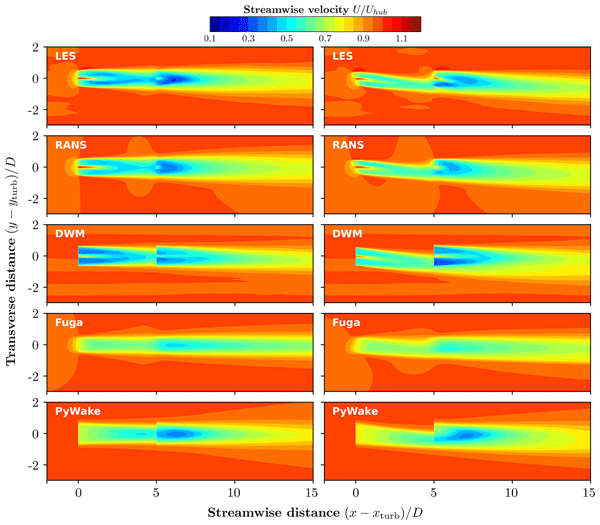
Wake steering is a promising strategy for wind farm optimization, but its success hinges on accurate wake models. We assess models of varying fidelity for a 22 MW reference turbine, comparing single- and two-turbine cases against large-eddy simulations. All models reproduced qualitative trends for power and loads (if applicable), but quantitative agreement varied, and in general the error increased with increasing yaw angle.
Marinos Manolesos, Sandrine Aubrun, Christian Bak, Paolo Bettini, Filippo Campagnolo, Alessandro Croce, Arslan Salim Dar, Michael Hölling, Stefan Ivanell, Konstantinos Kellaris, Miguel Alfonso Mendez, Pierluigi Montinari, Franz Mühle, George Papadakis, Fernardo Porté-Agel, Daniele Ragni, Sebastiano Randino, Andrea Sciacchitano, Lorenzo Schena, Gerard Schepers, Antonio Segalini, Wei Yu, and Carlo Luigi Bottasso
Wind Energ. Sci. Discuss., https://doi.org/10.5194/wes-2026-51, https://doi.org/10.5194/wes-2026-51, 2026
Manuscript not accepted for further review
Short summary
Short summary
As wind turbines grow to unprecedented sizes, ensuring their reliability requires advanced testing. We reviewed the current state of wind tunnel experiments, examining how scaled physical models are evaluated for wind flow, flexibility, and noise. We conclude that while laboratory testing remains essential, it is most powerful when integrated with computer simulations and real-world data. This combined approach will ultimately drive the design of more efficient and sustainable wind energy.
Henry Korb, Jean Bastin, Henrik Asmuth, and Stefan Ivanell
Wind Energ. Sci., 11, 983–1012, https://doi.org/10.5194/wes-11-983-2026, https://doi.org/10.5194/wes-11-983-2026, 2026
Short summary
Short summary
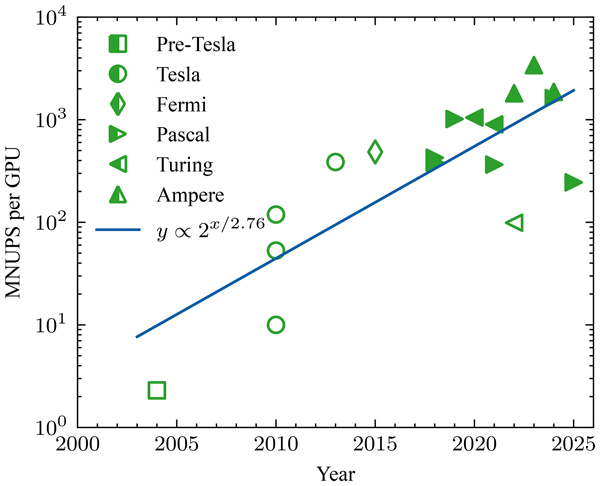
The lattice Boltzmann method (LBM) is a new method for very fast and accurate wind farm flow simulations. However, information on this method is scattered, and recent developments are unknown among the wind energy community. This review structures the different aspects of the method and answers common questions about it for wind energy researchers. We find that many of the building blocks for a wind farm simulation tool are present and that the LBM is accurate and efficient.
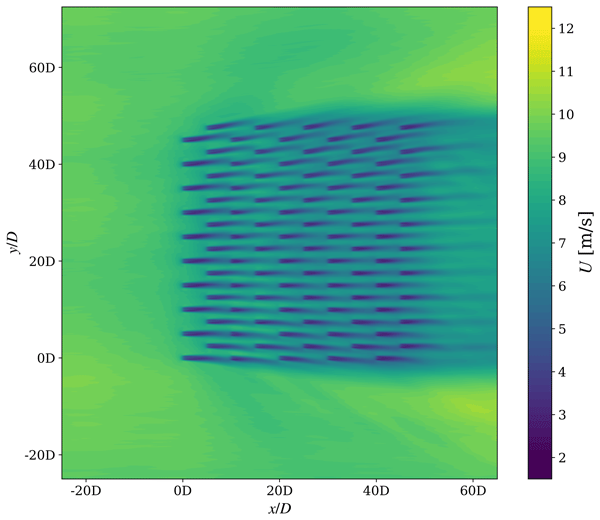
Stefan Ivanell, Warit Chanprasert, Luca Lanzilao, James Bleeg, Johan Meyers, Antoine Mathieu, Søren Juhl Andersen, Rem-Sophia Mouradi, Eric Dupont, Hugo Olivares-Espinosa, and Niels Troldborg
Wind Energ. Sci., 11, 937–960, https://doi.org/10.5194/wes-11-937-2026, https://doi.org/10.5194/wes-11-937-2026, 2026
Short summary
Short summary
This study explores how the height of the atmosphere's boundary layer impacts wind farm performance, focusing on how this factor influences energy output. By simulating different boundary layer heights and conditions, this research reveals that deeper layers promote better energy recovery. The findings highlight the importance of considering atmospheric conditions when simulating wind farms to maximize energy efficiency, offering valuable insights for the wind energy industry.
Nicola Bodini, Aliza Abraham, Paula Doubrawa, Stefano Letizia, Julie K. Lundquist, Patrick Moriarty, and Ryan Scott
Wind Energ. Sci. Discuss., https://doi.org/10.5194/wes-2026-33, https://doi.org/10.5194/wes-2026-33, 2026
Revised manuscript accepted for WES
Short summary
Short summary
Wind turbines create "wakes" of slowed air that reduce power for nearby turbines. To help improve wind energy models, we analyzed data from a large field experiment. We focused on a single day with changing weather patterns. We found that even simple terrain features interacted with the wind to create large variations in power output – up to 80 percent – across a wind farm. This detailed dataset provides a real-world case needed to validate and improve wind energy design tools.
Stefan Ivanell, Bjarke T. Olsen, Antoine Mathieu, Cristina Mulet-Benzo, Abdul Haseeb Syed, Warit Chanprasert, Mikael Sjöholm, Jakob Mann, and Julia Gottschall
Wind Energ. Sci. Discuss., https://doi.org/10.5194/wes-2025-286, https://doi.org/10.5194/wes-2025-286, 2026
Preprint under review for WES
Short summary
Short summary
Modern GW-scale offshore wind farms face challenges from atmospheric dynamics. This study examines how boundary layer height (BLH) and large-scale turbulence affect efficiency and loads. Using WRF simulations, lidar data, and CFD modeling for a 100-turbine, 15 MW wind farm at three representative sites, we show that low BLH reduces performance. Turbulence-induced low-frequency fluctuations increase fatigue loads, underscoring the need to include BLH and turbulence in design models.
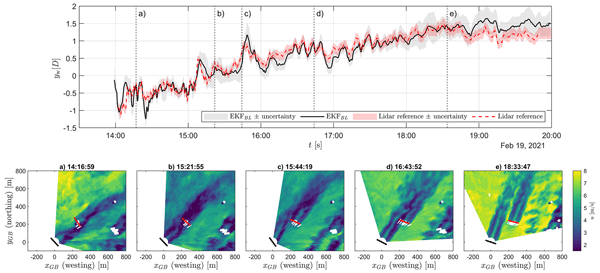
David Onnen, Gunner Christian Larsen, Alan Wai Hou Lio, Paul Hulsman, Martin Kühn, and Vlaho Petrović
Wind Energ. Sci., 11, 175–193, https://doi.org/10.5194/wes-11-175-2026, https://doi.org/10.5194/wes-11-175-2026, 2026
Short summary
Short summary
Neighbouring wind turbines influence each other, as they leave a complex footprint of reduced wind speed and changed turbulence in the flow, called wake. Modern wind farm control sees the turbines as team players and aims to mitigate the negative effects of such interaction. To do so, the exact flow situation in the wind farm must be known. We show how to use wind turbines as sensors for waked inflow, test this in the field and compare it with independent laser measurements of the flow field.
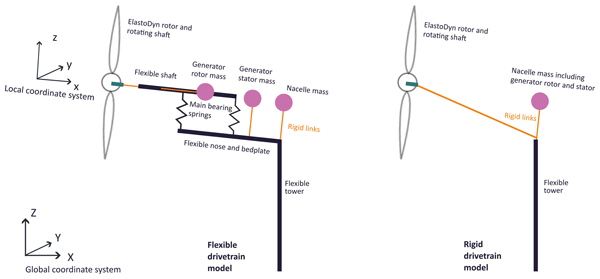
Veronica Liverud Krathe, Jason Jonkman, and Erin E. Bachynski-Polić
Wind Energ. Sci., 10, 2903–2923, https://doi.org/10.5194/wes-10-2903-2025, https://doi.org/10.5194/wes-10-2903-2025, 2025
Short summary
Short summary
This study looks into how changes in wind direction with height (veer) and drivetrain flexibility influence the behavior of large floating wind turbines. Using numerical simulations, it was found that these factors can significantly impact the fatigue damage of the turbines. These results suggest that standardized design methods for modeling wind may underestimate fatigue and that improved modeling could enhance turbine reliability as turbines continue to grow in size.
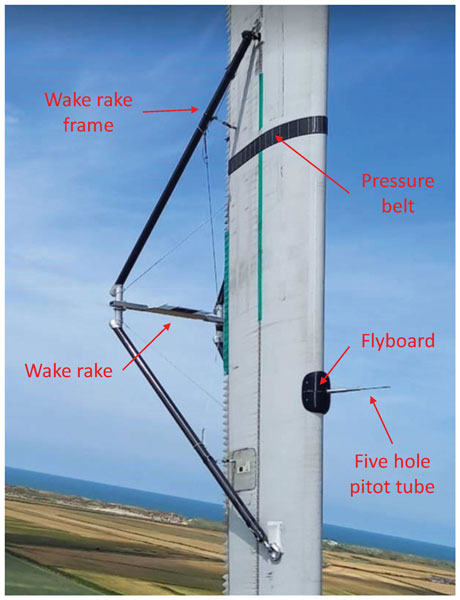
Helge Aagaard Madsen, Alejandro Gomez Gonzalez, Thanasis Barlas, Anders Smærup Olsen, Sigurd Brabæk Ildvedsen, and Andreas Fischer
Wind Energ. Sci., 10, 2499–2513, https://doi.org/10.5194/wes-10-2499-2025, https://doi.org/10.5194/wes-10-2499-2025, 2025
Short summary
Short summary
In this article, we present the measurements of local aerodynamic sectional characteristics on a full-scale rotor blade with a novel add-on instrumentation comprising a wake rake, a pressure belt, and a five-hole Pitot tube. In general, the demonstration of this instrumentation opens a range of promising new options for optimizing airfoil sectional performance in its real operating environment, e.g., the size and position of vortex generators.
Katarzyna Patryniak, Maurizio Collu, Jason Jonkman, Matthew Hall, Garrett Barter, Daniel Zalkind, and Andrea Coraddu
Wind Energ. Sci., 10, 2051–2077, https://doi.org/10.5194/wes-10-2051-2025, https://doi.org/10.5194/wes-10-2051-2025, 2025
Short summary
Short summary
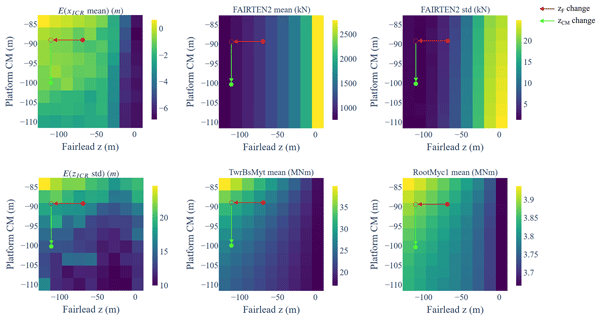
This paper studies the instantaneous centre of rotation (ICR) of floating offshore wind turbines (FOWTs). We present a method for computing the ICR and examine the correlations between the external loading, design features, ICR statistics, motions, and loads. We demonstrate how to apply the new insights to successfully modify the designs of the spar and semisubmersible FOWTs to reduce the loads in the moorings, the tower, and the blades, improving the ultimate strength and fatigue properties.

Regis Thedin, Garrett Barter, Jason Jonkman, Rafael Mudafort, Christopher J. Bay, Kelsey Shaler, and Jasper Kreeft
Wind Energ. Sci., 10, 1033–1053, https://doi.org/10.5194/wes-10-1033-2025, https://doi.org/10.5194/wes-10-1033-2025, 2025
Short summary
Short summary
We investigate asymmetries in terms of power performance and fatigue loading on a five-turbine wind farm subject to wake steering strategies. Both the yaw misalignment angle and the wind direction were varied from negative to positive. We highlight conditions in which fatigue loading is lower while still maintaining good power gains and show that a partial wake is the source of the asymmetries observed. We provide recommendations in terms of yaw misalignment angles for a given wind direction.
Will Wiley, Jason Jonkman, and Amy Robertson
Wind Energ. Sci., 10, 941–970, https://doi.org/10.5194/wes-10-941-2025, https://doi.org/10.5194/wes-10-941-2025, 2025
Short summary
Short summary
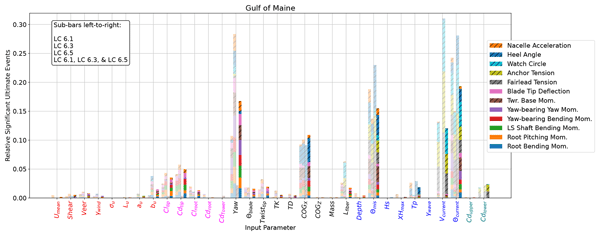
Numerical models, used to assess loads on floating offshore wind turbines, require many input parameters to describe air and water conditions, system properties, and load calculations. All parameters have some possible range, due to uncertainty and/or variations with time. The selected values can have important effects on the uncertainty in the resulting loads. This work identifies the input parameters that have the most impact on ultimate and fatigue loads for extreme storm load cases.
Lucas Carmo, Jason Jonkman, and Regis Thedin
Wind Energ. Sci., 9, 1827–1847, https://doi.org/10.5194/wes-9-1827-2024, https://doi.org/10.5194/wes-9-1827-2024, 2024
Short summary
Short summary
As floating wind turbines progress to arrays with multiple units, it becomes important to understand how the wake of a floating turbine affects the performance of other units in the array. Due to the compliance of the floating substructure, the wake of a floating wind turbine may behave differently from that of a fixed turbine. In this work, we present an investigation of the mutual interaction between the motions of floating wind turbines and wakes.
Kenneth Brown, Pietro Bortolotti, Emmanuel Branlard, Mayank Chetan, Scott Dana, Nathaniel deVelder, Paula Doubrawa, Nicholas Hamilton, Hristo Ivanov, Jason Jonkman, Christopher Kelley, and Daniel Zalkind
Wind Energ. Sci., 9, 1791–1810, https://doi.org/10.5194/wes-9-1791-2024, https://doi.org/10.5194/wes-9-1791-2024, 2024
Short summary
Short summary
This paper presents a study of the popular wind turbine design tool OpenFAST. We compare simulation results to measurements obtained from a 2.8 MW land-based wind turbine. Measured wind conditions were used to generate turbulent flow fields through several techniques. We show that successful validation of the tool is not strongly dependent on the inflow generation technique used for mean quantities of interest. The type of inflow assimilation method has a larger effect on fatigue quantities.
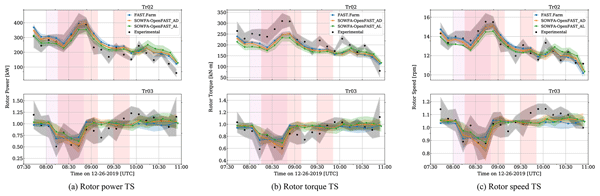
Kelsey Shaler, Eliot Quon, Hristo Ivanov, and Jason Jonkman
Wind Energ. Sci., 9, 1451–1463, https://doi.org/10.5194/wes-9-1451-2024, https://doi.org/10.5194/wes-9-1451-2024, 2024
Short summary
Short summary
This paper presents a three-way verification and validation between an engineering-fidelity model, a high-fidelity model, and measured data for the wind farm structural response and wake dynamics during an evolving stable boundary layer of a small wind farm, generally with good agreement.
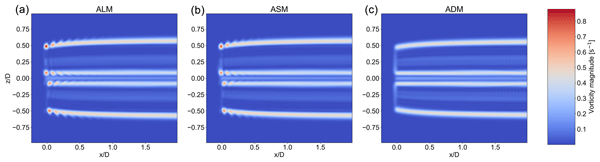
Mohammad Mehdi Mohammadi, Hugo Olivares-Espinosa, Gonzalo Pablo Navarro Diaz, and Stefan Ivanell
Wind Energ. Sci., 9, 1305–1321, https://doi.org/10.5194/wes-9-1305-2024, https://doi.org/10.5194/wes-9-1305-2024, 2024
Short summary
Short summary
This paper has put forward a set of recommendations regarding the actuator sector model implementation details to improve the capability of the model to reproduce similar results compared to those obtained by an actuator line model, which is one of the most common ways used for numerical simulations of wind farms, while providing significant computational savings. This includes among others the velocity sampling method and a correction of the sampled velocities to calculate the blade forces.
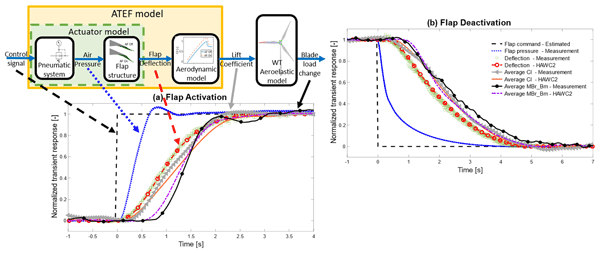
Andrea Gamberini, Thanasis Barlas, Alejandro Gomez Gonzalez, and Helge Aagaard Madsen
Wind Energ. Sci., 9, 1229–1249, https://doi.org/10.5194/wes-9-1229-2024, https://doi.org/10.5194/wes-9-1229-2024, 2024
Short summary
Short summary
Movable surfaces on wind turbine (WT) blades, called active flaps, can reduce the cost of wind energy. However, they still need extensive testing. This study shows that the computer model used to design a WT with flaps aligns well with measurements obtained from a 3month test on a commercial WT featuring a prototype flap. Particularly during flap actuation, there were minimal differences between simulated and measured data. These findings assure the reliability of WT designs incorporating flaps.
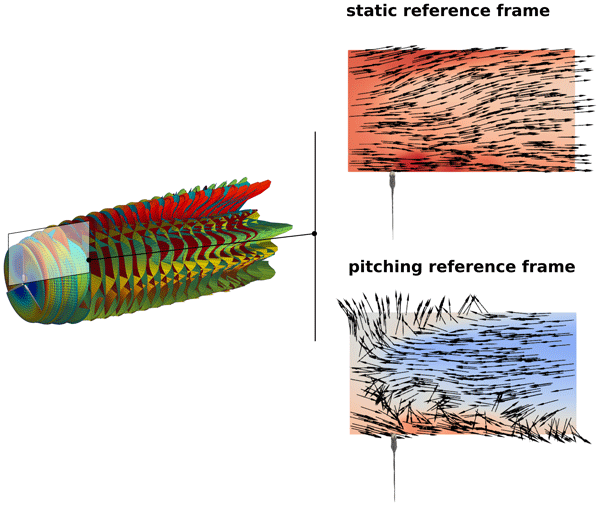
Francesco Papi, Jason Jonkman, Amy Robertson, and Alessandro Bianchini
Wind Energ. Sci., 9, 1069–1088, https://doi.org/10.5194/wes-9-1069-2024, https://doi.org/10.5194/wes-9-1069-2024, 2024
Short summary
Short summary
Blade element momentum (BEM) theory is the backbone of many industry-standard aerodynamic models. However, the analysis of floating offshore wind turbines (FOWTs) introduces new challenges, which could put BEM models to the test. This study systematically compares four aerodynamic models, ranging from BEM to computational fluid dynamics, in an attempt to shed light on the unsteady aerodynamic phenomena that are at stake in FOWTs and whether BEM is able to model them appropriately.
Roger Bergua, Will Wiley, Amy Robertson, Jason Jonkman, Cédric Brun, Jean-Philippe Pineau, Quan Qian, Wen Maoshi, Alec Beardsell, Joshua Cutler, Fabio Pierella, Christian Anker Hansen, Wei Shi, Jie Fu, Lehan Hu, Prokopios Vlachogiannis, Christophe Peyrard, Christopher Simon Wright, Dallán Friel, Øyvind Waage Hanssen-Bauer, Carlos Renan dos Santos, Eelco Frickel, Hafizul Islam, Arjen Koop, Zhiqiang Hu, Jihuai Yang, Tristan Quideau, Violette Harnois, Kelsey Shaler, Stefan Netzband, Daniel Alarcón, Pau Trubat, Aengus Connolly, Seán B. Leen, and Oisín Conway
Wind Energ. Sci., 9, 1025–1051, https://doi.org/10.5194/wes-9-1025-2024, https://doi.org/10.5194/wes-9-1025-2024, 2024
Short summary
Short summary
This paper provides a comparison for a floating offshore wind turbine between the motion and loading estimated by numerical models and measurements. The floating support structure is a novel design that includes a counterweight to provide floating stability to the system. The comparison between numerical models and the measurements includes system motion, tower loads, mooring line loads, and loading within the floating support structure.
Christoffer Hallgren, Jeanie A. Aird, Stefan Ivanell, Heiner Körnich, Ville Vakkari, Rebecca J. Barthelmie, Sara C. Pryor, and Erik Sahlée
Wind Energ. Sci., 9, 821–840, https://doi.org/10.5194/wes-9-821-2024, https://doi.org/10.5194/wes-9-821-2024, 2024
Short summary
Short summary
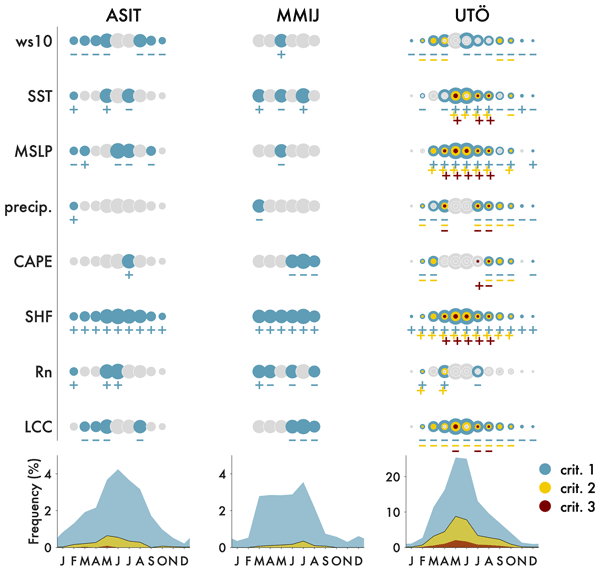
Knowing the wind speed across the rotor of a wind turbine is key in making good predictions of the power production. However, models struggle to capture both the speed and the shape of the wind profile. Using machine learning methods based on the model data, we show that the predictions can be improved drastically. The work focuses on three coastal sites, spread over the Northern Hemisphere (the Baltic Sea, the North Sea, and the US Atlantic coast) with similar results for all sites.
Emmanuel Branlard, Jason Jonkman, Cameron Brown, and Jiatian Zhang
Wind Energ. Sci., 9, 1–24, https://doi.org/10.5194/wes-9-1-2024, https://doi.org/10.5194/wes-9-1-2024, 2024
Short summary
Short summary
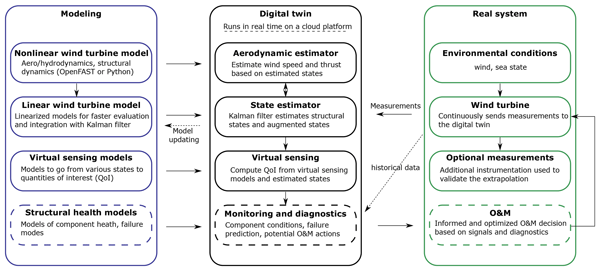
In this work, we implement, verify, and validate a physics-based digital twin solution applied to a floating offshore wind turbine. The article present methods to obtain reduced-order models of floating wind turbines. The models are used to form a digital twin which combines measurements from the TetraSpar prototype (a full-scale floating offshore wind turbine) to estimate signals that are not typically measured.
Helge Aagaard Madsen
Wind Energ. Sci., 8, 1853–1872, https://doi.org/10.5194/wes-8-1853-2023, https://doi.org/10.5194/wes-8-1853-2023, 2023
Short summary
Short summary
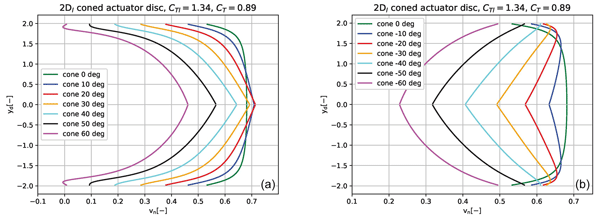
We present a linear analytical solution for a two-dimensional (2-D) actuator disc (AD) for a plane disc, a yawed disc and a coned disc. Comparisons of the 2-D model with three-dimensional computational fluid dynamics (CFD) AD simulations for a circular yawed disc and with an axis-symmetric CFD simulation of a coned disc show good correlation for the normal velocity component of the disc. This indicates that the 2-D AD model could form the basis for a consistent, simple new rotor induction model.
Stefano Cioni, Francesco Papi, Leonardo Pagamonci, Alessandro Bianchini, Néstor Ramos-García, Georg Pirrung, Rémi Corniglion, Anaïs Lovera, Josean Galván, Ronan Boisard, Alessandro Fontanella, Paolo Schito, Alberto Zasso, Marco Belloli, Andrea Sanvito, Giacomo Persico, Lijun Zhang, Ye Li, Yarong Zhou, Simone Mancini, Koen Boorsma, Ricardo Amaral, Axelle Viré, Christian W. Schulz, Stefan Netzband, Rodrigo Soto-Valle, David Marten, Raquel Martín-San-Román, Pau Trubat, Climent Molins, Roger Bergua, Emmanuel Branlard, Jason Jonkman, and Amy Robertson
Wind Energ. Sci., 8, 1659–1691, https://doi.org/10.5194/wes-8-1659-2023, https://doi.org/10.5194/wes-8-1659-2023, 2023
Short summary
Short summary
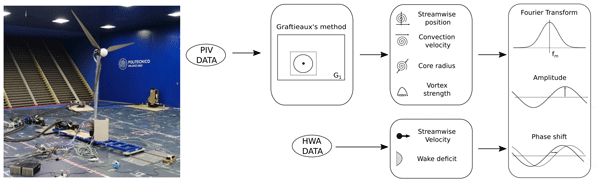
Simulations of different fidelities made by the participants of the OC6 project Phase III are compared to wind tunnel wake measurements on a floating wind turbine. Results in the near wake confirm that simulations and experiments tend to diverge from the expected linearized quasi-steady behavior when the reduced frequency exceeds 0.5. In the far wake, the impact of platform motion is overestimated by simulations and even seems to be oriented to the generation of a wake less prone to dissipation.
Christoffer Hallgren, Jeanie A. Aird, Stefan Ivanell, Heiner Körnich, Rebecca J. Barthelmie, Sara C. Pryor, and Erik Sahlée
Wind Energ. Sci., 8, 1651–1658, https://doi.org/10.5194/wes-8-1651-2023, https://doi.org/10.5194/wes-8-1651-2023, 2023
Short summary
Short summary
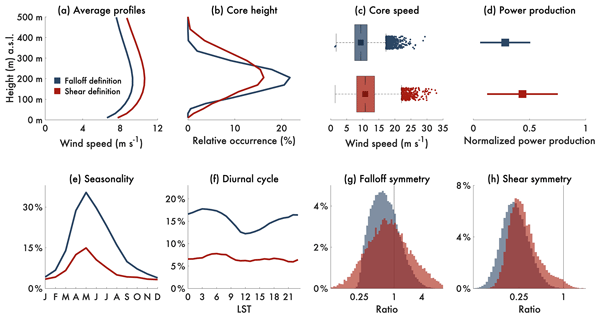
Low-level jets (LLJs) are special types of non-ideal wind profiles affecting both wind energy production and loads on a wind turbine. However, among LLJ researchers, there is no consensus regarding which definition to use to identify these profiles. In this work, we compare two different ways of identifying the LLJ – the falloff definition and the shear definition – and argue why the shear definition is better suited to wind energy applications.
Will Wiley, Jason Jonkman, Amy Robertson, and Kelsey Shaler
Wind Energ. Sci., 8, 1575–1595, https://doi.org/10.5194/wes-8-1575-2023, https://doi.org/10.5194/wes-8-1575-2023, 2023
Short summary
Short summary
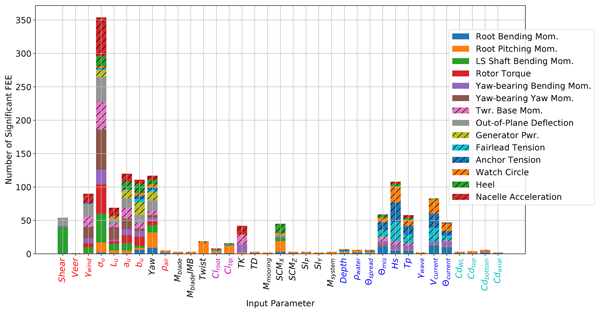
A sensitivity analysis determined the modeling parameters for an operating floating offshore wind turbine with the biggest impact on the ultimate and fatigue loads. The loads were the most sensitive to the standard deviation of the wind speed. Ultimate and fatigue mooring loads were highly sensitive to the current speed; only the fatigue mooring loads were sensitive to wave parameters. The largest platform rotation was the most sensitive to the platform horizontal center of gravity.
Christoffer Hallgren, Heiner Körnich, Stefan Ivanell, Ville Vakkari, and Erik Sahlée
Wind Energ. Sci. Discuss., https://doi.org/10.5194/wes-2023-129, https://doi.org/10.5194/wes-2023-129, 2023
Preprint withdrawn
Short summary
Short summary
Sometimes, the wind changes direction between the bottom and top part of a wind turbine. This affects both the power production and the loads on the turbine. In this study, a climatology of pronounced changes in wind direction across the rotor is created, focusing on Scandinavia. The weather conditions responsible for these changes in wind direction are investigated and the climatology is compared to measurements from two coastal sites, indicating an underestimation by the climatology.
Paula Doubrawa, Kelsey Shaler, and Jason Jonkman
Wind Energ. Sci., 8, 1475–1493, https://doi.org/10.5194/wes-8-1475-2023, https://doi.org/10.5194/wes-8-1475-2023, 2023
Short summary
Short summary
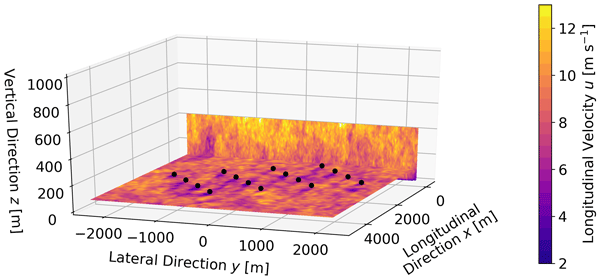
Wind turbines are designed to withstand any wind conditions they might encounter. This includes high-turbulence flow fields found within wind farms due to the presence of the wind turbines themselves. The international standard allows for two ways to account for wind farm turbulence in the design process. We compared both ways and found large differences between them. To avoid overdesign and enable a site-specific design, we suggest moving towards validated, higher-fidelity simulation tools.
Jaime Liew, Tuhfe Göçmen, Alan W. H. Lio, and Gunner Chr. Larsen
Wind Energ. Sci., 8, 1387–1402, https://doi.org/10.5194/wes-8-1387-2023, https://doi.org/10.5194/wes-8-1387-2023, 2023
Short summary
Short summary
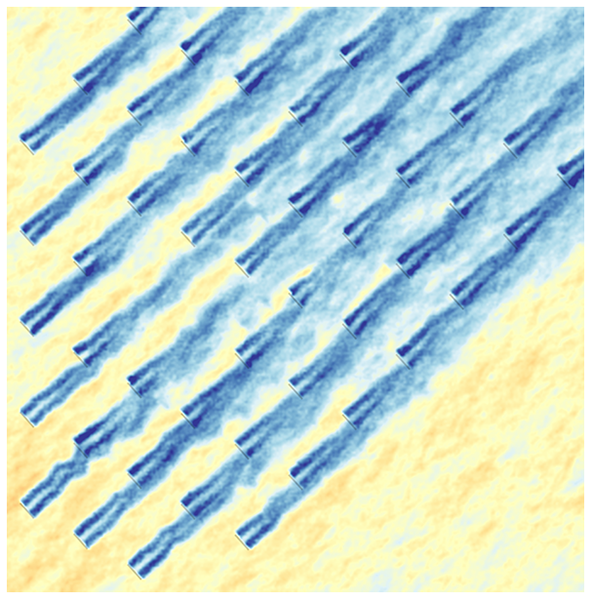
We present recent research on dynamically modelling wind farm wakes and integrating these enhancements into the wind farm simulator, HAWC2Farm. The simulation methodology is showcased by recreating dynamic scenarios observed in the Lillgrund offshore wind farm. We successfully recreate scenarios with turning winds, turbine shutdown events, and wake deflection events. The research provides opportunities to better identify wake interactions in wind farms, allowing for more reliable designs.
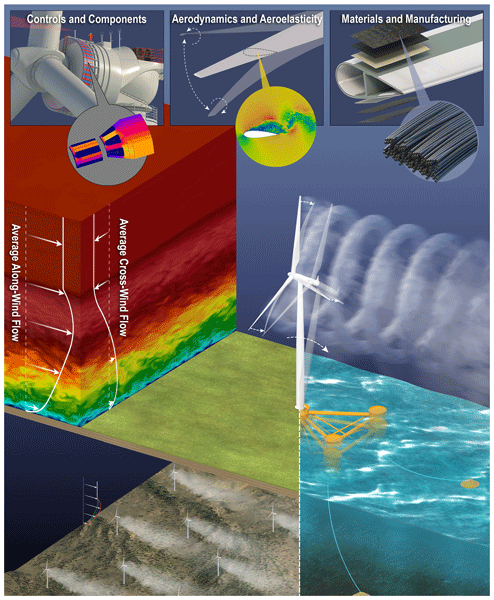
Paul Veers, Carlo L. Bottasso, Lance Manuel, Jonathan Naughton, Lucy Pao, Joshua Paquette, Amy Robertson, Michael Robinson, Shreyas Ananthan, Thanasis Barlas, Alessandro Bianchini, Henrik Bredmose, Sergio González Horcas, Jonathan Keller, Helge Aagaard Madsen, James Manwell, Patrick Moriarty, Stephen Nolet, and Jennifer Rinker
Wind Energ. Sci., 8, 1071–1131, https://doi.org/10.5194/wes-8-1071-2023, https://doi.org/10.5194/wes-8-1071-2023, 2023
Short summary
Short summary
Critical unknowns in the design, manufacturing, and operation of future wind turbine and wind plant systems are articulated, and key research activities are recommended.

Roger Bergua, Amy Robertson, Jason Jonkman, Emmanuel Branlard, Alessandro Fontanella, Marco Belloli, Paolo Schito, Alberto Zasso, Giacomo Persico, Andrea Sanvito, Ervin Amet, Cédric Brun, Guillén Campaña-Alonso, Raquel Martín-San-Román, Ruolin Cai, Jifeng Cai, Quan Qian, Wen Maoshi, Alec Beardsell, Georg Pirrung, Néstor Ramos-García, Wei Shi, Jie Fu, Rémi Corniglion, Anaïs Lovera, Josean Galván, Tor Anders Nygaard, Carlos Renan dos Santos, Philippe Gilbert, Pierre-Antoine Joulin, Frédéric Blondel, Eelco Frickel, Peng Chen, Zhiqiang Hu, Ronan Boisard, Kutay Yilmazlar, Alessandro Croce, Violette Harnois, Lijun Zhang, Ye Li, Ander Aristondo, Iñigo Mendikoa Alonso, Simone Mancini, Koen Boorsma, Feike Savenije, David Marten, Rodrigo Soto-Valle, Christian W. Schulz, Stefan Netzband, Alessandro Bianchini, Francesco Papi, Stefano Cioni, Pau Trubat, Daniel Alarcon, Climent Molins, Marion Cormier, Konstantin Brüker, Thorsten Lutz, Qing Xiao, Zhongsheng Deng, Florence Haudin, and Akhilesh Goveas
Wind Energ. Sci., 8, 465–485, https://doi.org/10.5194/wes-8-465-2023, https://doi.org/10.5194/wes-8-465-2023, 2023
Short summary
Short summary
This work examines if the motion experienced by an offshore floating wind turbine can significantly affect the rotor performance. It was observed that the system motion results in variations in the load, but these variations are not critical, and the current simulation tools capture the physics properly. Interestingly, variations in the rotor speed or the blade pitch angle can have a larger impact than the system motion itself.
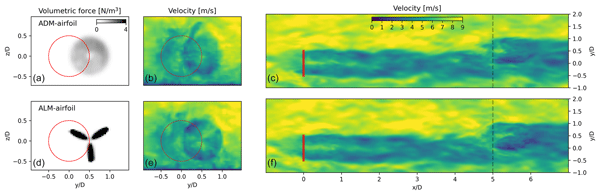
Gonzalo Pablo Navarro Diaz, Alejandro Daniel Otero, Henrik Asmuth, Jens Nørkær Sørensen, and Stefan Ivanell
Wind Energ. Sci., 8, 363–382, https://doi.org/10.5194/wes-8-363-2023, https://doi.org/10.5194/wes-8-363-2023, 2023
Short summary
Short summary
In this paper, the capacity to simulate transient wind turbine wake interaction problems using limited wind turbine data has been extended. The key novelty is the creation of two new variants of the actuator line technique in which the rotor blade forces are computed locally using generic load data. The analysis covers a partial wake interaction case between two wind turbines for a uniform laminar inflow and for a turbulent neutral atmospheric boundary layer inflow.
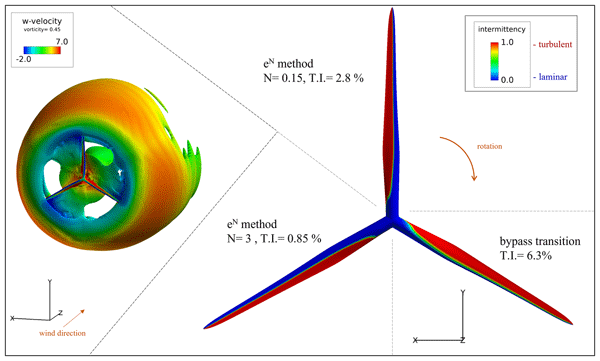
Brandon Arthur Lobo, Özge Sinem Özçakmak, Helge Aagaard Madsen, Alois Peter Schaffarczyk, Michael Breuer, and Niels N. Sørensen
Wind Energ. Sci., 8, 303–326, https://doi.org/10.5194/wes-8-303-2023, https://doi.org/10.5194/wes-8-303-2023, 2023
Short summary
Short summary
Results from the DAN-AERO and aerodynamic glove projects provide significant findings. The effects of inflow turbulence on transition and wind turbine blades are compared to computational fluid dynamic simulations. It is found that the transition scenario changes even over a single revolution. The importance of a suitable choice of amplification factor is evident from the simulations. An agreement between the power spectral density plots from the experiment and large-eddy simulations is seen.
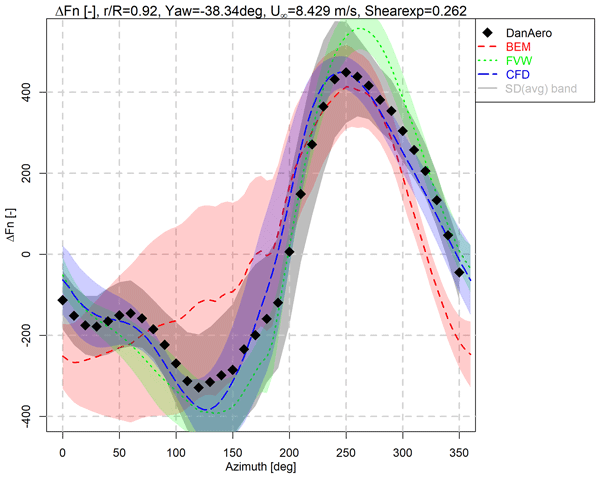
Koen Boorsma, Gerard Schepers, Helge Aagard Madsen, Georg Pirrung, Niels Sørensen, Galih Bangga, Manfred Imiela, Christian Grinderslev, Alexander Meyer Forsting, Wen Zhong Shen, Alessandro Croce, Stefano Cacciola, Alois Peter Schaffarczyk, Brandon Lobo, Frederic Blondel, Philippe Gilbert, Ronan Boisard, Leo Höning, Luca Greco, Claudio Testa, Emmanuel Branlard, Jason Jonkman, and Ganesh Vijayakumar
Wind Energ. Sci., 8, 211–230, https://doi.org/10.5194/wes-8-211-2023, https://doi.org/10.5194/wes-8-211-2023, 2023
Short summary
Short summary
Within the framework of the fourth phase of the International Energy Agency's (IEA) Wind Task 29, a large comparison exercise between measurements and aeroelastic simulations has been carried out. Results were obtained from more than 19 simulation tools of various fidelity, originating from 12 institutes and compared to state-of-the-art field measurements. The result is a unique insight into the current status and accuracy of rotor aerodynamic modeling.
Kelsey Shaler, Amy N. Robertson, and Jason Jonkman
Wind Energ. Sci., 8, 25–40, https://doi.org/10.5194/wes-8-25-2023, https://doi.org/10.5194/wes-8-25-2023, 2023
Short summary
Short summary
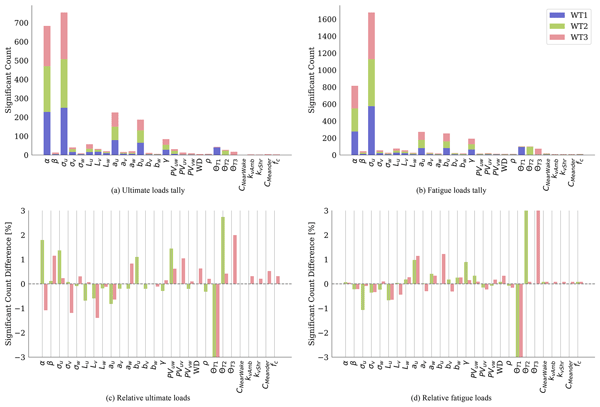
This work evaluates which wind-inflow- and wake-related parameters have the greatest influence on fatigue and ultimate loads for turbines in a small wind farm. Twenty-eight parameters were screened using an elementary effects approach to identify the parameters that lead to the largest variation in these loads of each turbine. The findings show the increased importance of non-streamwise wind components and wake parameters in fatigue and ultimate load sensitivity of downstream turbines.
Ishaan Sood, Elliot Simon, Athanasios Vitsas, Bart Blockmans, Gunner C. Larsen, and Johan Meyers
Wind Energ. Sci., 7, 2469–2489, https://doi.org/10.5194/wes-7-2469-2022, https://doi.org/10.5194/wes-7-2469-2022, 2022
Short summary
Short summary
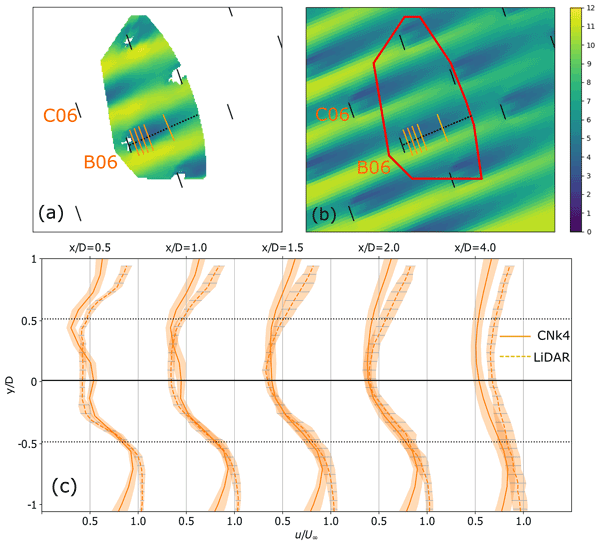
In this work, we conduct a validation study to compare a numerical solver against measurements obtained from the offshore Lillgrund wind farm. By reusing a previously developed inflow turbulent dataset, the atmospheric conditions at the wind farm were recreated, and the general performance trends of the turbines were captured well. The work increases the reliability of numerical wind farm solvers while highlighting the challenges of accurately representing large wind farms using such solvers.
Thanasis Barlas, Georg Raimund Pirrung, Néstor Ramos-García, Sergio González Horcas, Ang Li, and Helge Aagaard Madsen
Wind Energ. Sci., 7, 1957–1973, https://doi.org/10.5194/wes-7-1957-2022, https://doi.org/10.5194/wes-7-1957-2022, 2022
Short summary
Short summary
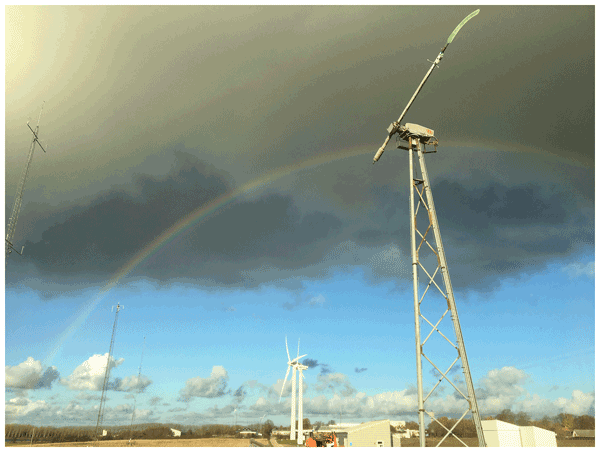
An aeroelastically optimized curved wind turbine blade tip is designed, manufactured, and tested on a novel outdoor rotating rig facility at the Risø campus of the Technical University of Denmark. Detailed aerodynamic measurements for various atmospheric conditions and results are compared to a series of in-house aeroelastic tools with a range of fidelities in aerodynamic modeling. The comparison highlights details in the ability of the codes to predict the performance of such a curved tip.
Christoffer Hallgren, Johan Arnqvist, Erik Nilsson, Stefan Ivanell, Metodija Shapkalijevski, August Thomasson, Heidi Pettersson, and Erik Sahlée
Wind Energ. Sci., 7, 1183–1207, https://doi.org/10.5194/wes-7-1183-2022, https://doi.org/10.5194/wes-7-1183-2022, 2022
Short summary
Short summary
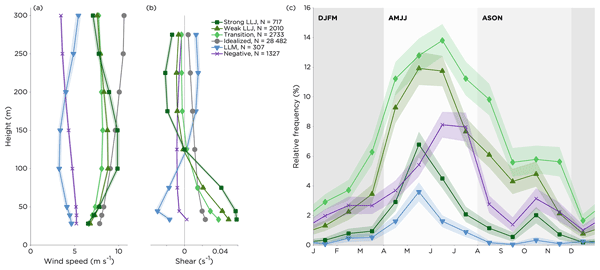
Non-idealized wind profiles with negative shear in part of the profile (e.g., low-level jets) frequently occur in coastal environments and are important to take into consideration for offshore wind power. Using observations from a coastal site in the Baltic Sea, we analyze in which meteorological and sea state conditions these profiles occur and study how they alter the turbulence structure of the boundary layer compared to idealized profiles.
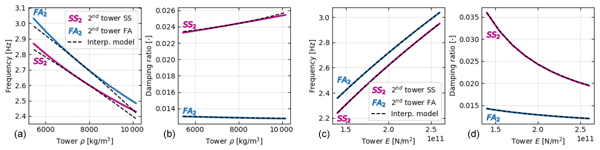
Jason M. Jonkman, Emmanuel S. P. Branlard, and John P. Jasa
Wind Energ. Sci., 7, 559–571, https://doi.org/10.5194/wes-7-559-2022, https://doi.org/10.5194/wes-7-559-2022, 2022
Short summary
Short summary
This paper summarizes efforts done to understand the impact of design parameter variations in the physical system (e.g., mass, stiffness, geometry, aerodynamic, and hydrodynamic coefficients) on the linearized system using OpenFAST in support of the development of the WEIS toolset to enable controls co-design of floating offshore wind turbines.
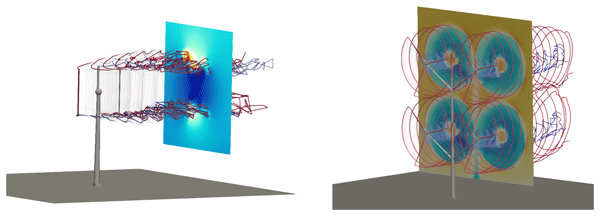
Emmanuel Branlard, Ian Brownstein, Benjamin Strom, Jason Jonkman, Scott Dana, and Edward Ian Baring-Gould
Wind Energ. Sci., 7, 455–467, https://doi.org/10.5194/wes-7-455-2022, https://doi.org/10.5194/wes-7-455-2022, 2022
Short summary
Short summary
In this work, we present an aerodynamic tool that can model an arbitrary collections of wings, blades, rotors, and towers. With these functionalities, the tool can be used to study and design advanced wind energy concepts, such as horizontal-axis wind turbines, vertical-axis wind turbines, kites, or multi-rotors. This article describes the key features of the tool and presents multiple applications. Field measurements of horizontal- and vertical-axis wind turbines are used for comparison.
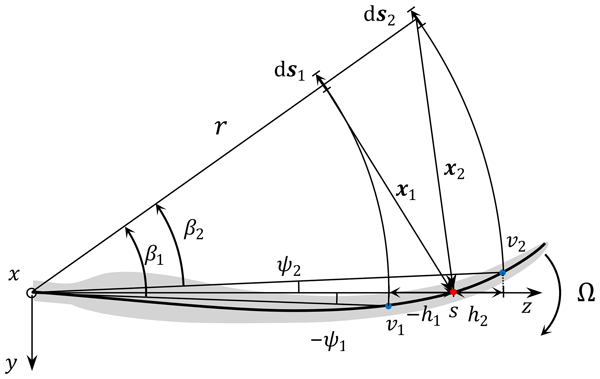
Ang Li, Georg Raimund Pirrung, Mac Gaunaa, Helge Aagaard Madsen, and Sergio González Horcas
Wind Energ. Sci., 7, 129–160, https://doi.org/10.5194/wes-7-129-2022, https://doi.org/10.5194/wes-7-129-2022, 2022
Short summary
Short summary
An engineering aerodynamic model for the swept horizontal-axis wind turbine blades is proposed. It uses a combination of analytical results and engineering approximations. The performance of the model is comparable with heavier high-fidelity models but has similarly low computational cost as currently used low-fidelity models. The model could be used for an efficient and accurate load calculation of swept wind turbine blades and could eventually be integrated in a design optimization framework.
Cited articles
Asmuth, H., Diaz, G. P. N., Madsen, H. A., Branlard, E., Forsting, A. R. M., Nilsson, K., Jonkman, J., and Ivanell, S.: Wind turbine response in waked inflow: A modelling benchmark against full-scale measurements, Renew. Energ., 191, 868–887, https://doi.org/10.1016/j.renene.2022.04.047, 2022. a, b, c
Bartl, J., Mühle, F., Schottler, J., Sætran, L., Peinke, J., Adaramola, M., and Hölling, M.: Wind tunnel experiments on wind turbine wakes in yaw: effects of inflow turbulence and shear, Wind Energ. Sci., 3, 329–343, https://doi.org/10.5194/wes-3-329-2018, 2018. a
Bernard, V., Andersen, S. J., Leon, J. M., Beaudet, L., Verelst, D., and Iliopoulos, A.: Observation and modelling of asymmetric loading on large offshore wind turbines in wake conditions, J. Phys. Conf. Ser., 2767, https://doi.org/10.1088/1742-6596/2767/9/092092, The Science of Making Torque from Wind, Florence, Italy, 29–31 May 2024, 2024. a, b, c
Bossuyt, J., Scott, R., Ali, N., and Cal, R. B.: Quantification of wake shape modulation and deflection for tilt and yaw misaligned wind turbines, J. Fluid Mech., 917, A3, https://doi.org/10.1017/jfm.2021.237, 2021. a
Branlard, E., Martínez-Tossas, L. A., and Jonkman, J.: A time-varying formulation of the curled wake model within the FAST.Farm framework, Wind Energy, 26, 44–63, https://doi.org/10.1002/we.2785, 2023. a, b, c
Branlard, E., Jonkman, J., Platt, A., Thedin, R., Martínez-Tossas, L. A., and Kretschmer, M.: Development and Verification of an Improved Wake-Added Turbulence Model in FAST. Farm, J. Phys. Conf. Ser., 2767, https://doi.org/10.1088/1742-6596/2767/9/092036, The Science of Making Torque from Wind, Florence, Italy, 29–31 May 2024, 2024. a, b, c, d, e
Clayton, B. R. and Filby, P.: Measured effects of oblique flows and change in blade pitch angle on performance and wake development of model wind turbines, in: Proceedings of the fourth BWEA Wind Energy Conference, BHRA Fluid Engineering, Cranfield, Bedford, UK, 214–224, ISBN 0906085713, 1982. a
de Vaal, J. B. and Muskulus, M.: Simplified wake modelling for wind farm load prediction, J. Phys. Conf. Ser., EERA DeepWind'2021, 012012, https://doi.org/10.1088/1742-6596/2018/1/012012, Trondheim, Norway, 13–15 January 2021, 2021. a, b, c, d
Doubrawa, P., Barthelmie, R. J., Wang, H., and Churchfield, M. J.: A stochastic wind turbine wake model based on new metrics for wake characterization, Wind Energy, 20, 449–463, https://doi.org/10.1002/we.2015, 2017. a
Doubrawa, P., Annoni, J. R., and Jonkman, J. M.: Optimization-Based Calibration of FAST.Farm Parameters against SOWFA, 2018 Wind Energy Symposium, Kissimmee, Florida, USA, 8–12 January 2018, https://doi.org/10.2514/6.2018-0512, 2018. a
Doubrawa, P., Shaler, K., and Jonkman, J.: Difference in load predictions obtained with effective turbulence vs. a dynamic wake meandering modeling approach, Wind Energ. Sci., 8, 1475–1493, https://doi.org/10.5194/wes-8-1475-2023, 2023. a
Fleming, P. A., Gebraad, P. M., Lee, S., van Wingerden, J.-W., Johnson, K., Churchfield, M., Michalakes, J., Spalart, P., and Moriarty, P.: Evaluating techniques for redirecting turbine wakes using SOWFA, Renew. Energ., 70, 211–218, https://doi.org/10.1016/j.renene.2014.02.015, 2014. a
Glauert, H.: Airplane Propellers, in: Aerodynamic Theory, 1 edn., Springer, Berlin, Heidelberg, Germany, 169–360, https://doi.org/10.1007/978-3-642-91487-4_3, 1935. a
Hanssen-Bauer, Ø. W., De Vaal, J. B., Tutkun, M., Asmuth, H., Ivanell, S., and Stenbro, R.: Dependence of wind turbine loads on inlet flow field, J. Phys. Conf. Ser., 1618, https://doi.org/10.1088/1742-6596/1618/6/062065, Wind Energy Science Conference, Cork, Ireland, 17–20 June 2019, 2020. a, b
Hanssen-Bauer, Ø. W., Doubrawa, P., Madsen, H. A., Asmuth, H., Jonkman, J., Larsen, G. C., Ivanell, S., and Stenbro, R.: Comparison of three DWM-based wake models at above-rated wind speeds, J. Phys. Conf. Ser., 2505, https://doi.org/10.1088/1742-6596/2505/1/012054, Wake Conference, Visby, Sweden, 20–22 June 2023, 2023. a, b, c, d, e, f, g, h, i, j, k
Jonkman, B., Mudafort, R. M., Platt, A., Branlard, E., Sprague, M., Jonkman, J., Hayman, G., Vijayakumar, G., Buhl, M., Ross, H., Bortolotti, P., Masciola, M., Ananthan, S., Schmidt, M. J., Rood, J., Mendoza, N., Hai, S. L., Hall, M., Sharma, A., Shaler, K., Bendl, K., Schuenemann, P., Sakievich, P., Quon, E. W., Phillips, M. R., Kusouno, N., Gonzalez Salcedo, A., Martinez, T., and Corniglion, R.: OpenFAST v3.1.0, Zenodo [code], https://doi.org/10.5281/zenodo.6324288, 2026. a
Jonkman, B., Mudafort, R. M., Platt, A., Branlard, E., Sprague, M., Jonkman, J., Hayman, G., Vijayakumar, G., Buhl, M., Ross, H., Bortolotti, P., Masciola, M., Ananthan, S., Schmidt, M. J., Rood, J., Mendoza, N., Hai, S. L., Hall, M., Sharma, A., Shaler, K., Bendl, K., Schuenemann, P., Sakievich, P., Quon, E.W., Phillips, M. R., Kusouno, N., Gonzalez Salcedo, A., Martinez, T., and Corniglion, R.: OpenFAST, National Renewable Energy Laboratory, https://www.nrel.gov/wind/nwtc/openfast (last access: 22 August 2025), 2025. a
Jonkman, J., Butterfield, S., Musial, W., and Scott, G.: Definition of a 5-MW reference wind turbine for offshore system development, Tech. Rep., National Renewable Energy Laboratory, Golden, CO, USA, 2009. a
Jonkman, J., Doubrawa, P., Hamilton, N., Annoni, J., and Fleming, P.: Validation of FAST. Farm Against Large-Eddy Simulations, J. Phys. Conf. Ser., 1037, https://doi.org/10.1088/1742-6596/1037/6/062005, The Science of Making Torque from Wind, Milan, Italy, 20–22 June 2018, 2018. a
Jonkman, J. M., Annoni, J., Hayman, G., Jonkman, B., and Purkayastha, A.: Development of FAST.Farm: a new multi-physics engineering tool for wind-farm design and analysis, 35th Wind Energy Symposium, Grapevine, Texas, USA, 9–13 January 2017, https://doi.org/10.2514/6.2017-0454, 2017. a, b, c, d
Keck, R.-E., de Maré, M., Churchfield, M. J., Lee, S., Larsen, G., and Madsen, H. A.: Two improvements to the dynamic wake meandering model: including the effects of atmospheric shear on wake turbulence and incorporating turbulence build-up in a row of wind turbines, Wind Energy, 18, 111–132, https://doi.org/10.1002/we.1686, 2015. a, b, c, d, e
Larsen, G. C. and Lio, A. W.: Low-pass filtering of meandering scales, J. Phys. Conf. Ser., 3016, https://doi.org/10.1088/1742-6596/3016/1/012020, Wake Conference, Visby, Sweden, 10–12 June 2025, 2025. a
Larsen, G. C., Madsen, H. A., Thomsen, K., and Larsen, T. J.: Wake meandering: a pragmatic approach, Wind Energy, 11, 377–395, https://doi.org/10.1002/we.267, 2008. a, b
Larsen, G. C., Ott, S., Liew, J., van der Laan, M. P., Simon, E., Thorsen, G. R., and Jacobs, P.: Yaw induced wake deflection - a full-scale validation study, J. Phys. Conf. Ser., 1618, https://doi.org/10.1088/1742-6596/1618/6/062047, The Science of Making Torque from Wind, Online, 28 September–2 October 2020, 2020. a
Larsen, T. J., Madsen, H. A., Larsen, G. C., and Hansen, K. S.: Validation of the dynamic wake meander model for loads and power production in the Egmond aan Zee wind farm, Wind Energy, 16, 605–624, https://doi.org/10.1002/we.1563, 2013. a, b, c
Larsen, T. J., Larsen, G. C., Pedersen, M. M., Enevoldsen, K., and Madsen, H. A.: Validation of the Dynamic Wake Meander model with focus on tower loads, J. Phys. Conf. Ser., 854, https://doi.org/10.1088/1742-6596/854/1/012027, Wake Conference, Visby, Sweden, 30 May–1 June 2017, 2017. a
Liew, J. and Larsen, G. C.: How does the quantity, resolution, and scaling of turbulence boxes affect aeroelastic simulation convergence?, J. Phys. Conf. Ser., 2265, https://doi.org/10.1088/1742-6596/2265/3/032049, The Science of Making Torque from Wind, Delft, Netherlands, 1–3 June 2022, 2022. a
Liu, L., Franceschini, L., Oliveira, D. F., Galeazzo, F. C., Carmo, B. S., and Stevens, R. J. A. M.: Evaluating the accuracy of the actuator line model against blade element momentum theory in uniform inflow, Wind Energy, 25, 1046–1059, https://doi.org/10.1002/we.2714, 2022. a
Machefaux, E., Larsen, G. C., Troldborg, N., Hansen, K. S., Angelou, N., Mikkelsen, T., and Mann, J.: Investigation of wake interaction using full-scale lidar measurements and large eddy simulation, Wind Energy, 19, 1535–1551, https://doi.org/10.1002/we.1936, 2016. a
Madsen, H. A., Larsen, G. C., Larsen, T. J., Mikkelsen, R., and Troldborg, N.: Wake deficit-and turbulence simulated with two models compared with inflow measurements on a 2 MW turbine in wake conditions, in: European Wind Energy Conference and Exhibition, Brussels, Belgium, 31 March–3 April 2008, 48–53, https://orbit.dtu.dk/files/128949596/Madsen_et_al_2008_DWM_ewec_2008.pdf (last access: 27 June 2025), 2008. a, b, c
Madsen, H. A., Larsen, T. J., Larsen, G. C., and Hansen, K. S.: Wake flow characteristics at high wind speed, in: 34th Wind Energy Symposium, San Diego, California, USA, 4–8 January 2016, 1522, https://doi.org/10.2514/6.2016-1522, 2016. a
Madsen, H. A., Larsen, T. J., Pirrung, G. R., Li, A., and Zahle, F.: Implementation of the blade element momentum model on a polar grid and its aeroelastic load impact, Wind Energ. Sci., 5, 1–27, https://doi.org/10.5194/wes-5-1-2020, 2020. a
Meyer Forsting, A. R., Pirrung, G. R., and Ramos-García, N.: A vortex-based tip/smearing correction for the actuator line, Wind Energ. Sci., 4, 369–383, https://doi.org/10.5194/wes-4-369-2019, 2019. a
Michelsen, J. A.: Basis3D – a platform for development of multiblock PDE solvers, Tech. Rep., Technical University of Denmark, Lyngby, Denmark, 1994a. a
Michelsen, J. A.: Block structured multigrid solution of 2D and 3D elliptic PDE's, Tech. Rep., Technical University of Denmark, Lyngby, Denmark, 1994b. a
Monin, A. S. and Obukhov, A. M.: Basic laws of turbulent mixing in the surface layer of the atmosphere, Nauk SSSR Geophiz. Inst, 24, 163–187, 1954. a
Nygaard, T. A., De Vaal, J., Pierella, F., Oggiano, L., and Stenbro, R.: Development, verification and validation of 3DFloat; aero-servo-hydro-elastic computations of offshore structures, J. Phys. Conf. Ser., 94, 425–433, https://doi.org/10.1016/j.egypro.2016.09.210, EERA DeepWind' 2016, Trondheim, Norway, 20–22 January 2016, 2016. a, b
RCN: Engineering speed modelling of realistic fatigue for all the individual turbines in wind parks by representative pre-calculations – Prosjektbanken, Research Council of Norway, https://prosjektbanken.forskningsradet.no/project/FORISS/281020 (last access: 25 August 2025), 2025. a
Rychlik, I.: A new definition of the rainflow cycle counting method, Int. J. Fatigue, 9, 119–121, https://doi.org/10.1016/0142-1123(87)90054-5, 1987. a
Shaler, K. and Jonkman, J.: FAST.Farm development and validation of structural load prediction against large eddy simulations, Wind Energy, 24, 428–449, https://doi.org/10.1002/we.2581, 2021. a
Sood, I., Simon, E., Vitsas, A., Blockmans, B., Larsen, G. C., and Meyers, J.: Comparison of large eddy simulations against measurements from the Lillgrund offshore wind farm, Wind Energ. Sci., 7, 2469–2489, https://doi.org/10.5194/wes-7-2469-2022, 2022. a
Sørensen, J. N. and Shen, W. Z.: Numerical modeling of wind turbine wakes, J. Fluids Eng., 124, 393–399, https://doi.org/10.1115/1.1471361, 2002. a
Sørensen, N. N.: General purpose flow solver applied to flow over hills, Ph.D. thesis, Risø National Laboratory, Roskilde, Denmark, 1995. a
Trujillo, J.-J., Bingöl, F., Larsen, G. C., Mann, J., and Kühn, M.: Light detection and ranging measurements of wake dynamics. Part II: two-dimensional scanning, Wind Energy, 14, 61–75, https://doi.org/10.1002/we.402, 2011. a
Zong, H. and Porté-Agel, F.: A momentum-conserving wake superposition method for wind farm power prediction, J. Fluid Mech., 889, A8, https://doi.org/10.1017/jfm.2020.77, 2020a. a
Zong, H. and Porté-Agel, F.: A point vortex transportation model for yawed wind turbine wakes, J. Fluid Mech., 890, A8, https://doi.org/10.1017/jfm.2020.123, 2020b. a
Short summary
We studied how different industry-oriented computer models predict the behavior of winds behind turbines in a wind farm. These
wakesreduce energy output and can affect turbines further down the row. By comparing these three models with more detailed simulations, we found they agree well on overall power but differ in how they capture turbulence and wear on machines. Our results show where the models need improvement to make wind farm computer models more accurate and reliable in the future.
We studied how different industry-oriented computer models predict the behavior of winds behind...


Altmetrics
Final-revised paper
Preprint