
Articles | Volume 11, issue 2
https://doi.org/10.5194/wes-11-509-2026
© Author(s) 2026. This work is distributed under
the Creative Commons Attribution 4.0 License.
the Creative Commons Attribution 4.0 License.
https://doi.org/10.5194/wes-11-509-2026
© Author(s) 2026. This work is distributed under
the Creative Commons Attribution 4.0 License.
the Creative Commons Attribution 4.0 License.
Review article
| 
17 Feb 2026
Review article |
| 17 Feb 2026
| 17 Feb 2026
Impact of atmospheric turbulence on performance and loads of wind turbines: knowledge gaps and research challenges

Johns Hopkins University, Ralph O'Connor Sustainable Energy Institute, Baltimore, MD, USA
University at Albany, Atmospheric Sciences Research Center, Albany, NY, USA
Jacob Berg
DHI, Copenhagen, Denmark
Larry K. Berg
Pacific North West National Laboratory, Richland, WA, USA
Sue E. Haupt
NSF National Center for Atmospheric Research, Boulder, CO, USA
Xiaoli G. Larsén
Technical University of Denmark, Roskilde, Denmark
Joachim Peinke
University of Oldenburg, Oldenburg, Germany
Richard J. A. M. Stevens
University of Twente, Entschede, the Netherlands
Paul Veers
National Renewable Energy Laboratory, Golden, CO, USA
Simon Watson
Delft University of Technology, Delft, the Netherlands
Related authors
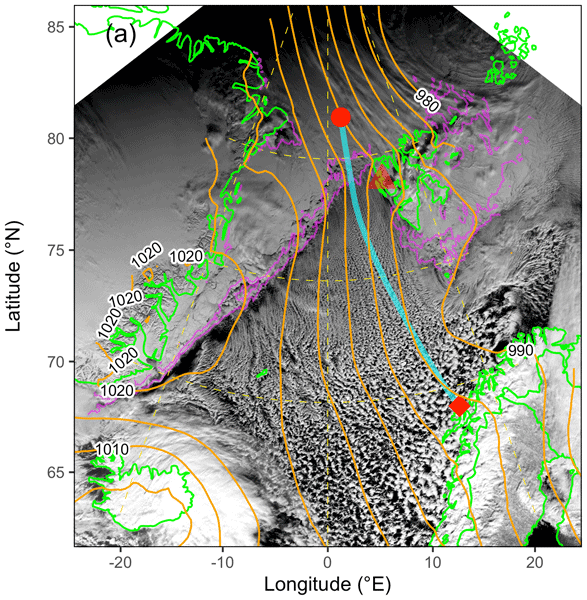
Timothy W. Juliano, Florian Tornow, Ann M. Fridlind, Andrew S. Ackerman, Gregory S. Elsaesser, Bart Geerts, Christian P. Lackner, David Painemal, Israel Silber, Mikhail Ovchinnikov, Gunilla Svensson, Michael Tjernström, Peng Wu, Alejandro Baró Pérez, Peter Bogenschutz, Dmitry Chechin, Kamal Kant Chandrakar, Jan Chylik, Andrey Debolskiy, Rostislav Fadeev, Anu Gupta, Luisa Ickes, Michail Karalis, Martin Köhler, Branko Kosović, Peter Kuma, Weiwei Li, Evgeny Mortikov, Hugh Morrison, Roel A. J. Neggers, Anna Possner, Tomi Raatikainen, Lea Raillard, Sami Romakkaniemi, Niklas Schnierstein, Shin-ichiro Shima, Nikita Silin, Mikhail Tolstykh, Étienne Vignon, Lulin Xue, Meng Zhang, and Xue Zheng
Atmos. Chem. Phys., 26, 13267–13302, https://doi.org/10.5194/acp-26-13267-2026, https://doi.org/10.5194/acp-26-13267-2026, 2026
Short summary
Short summary
Models struggle to capture cloud and precipitation processes and their radiative effects in marine cold-air outbreaks. We use a quasi-Lagrangian framework to compare large-eddy simulation (LES) and single-column model (SCM) output with field and satellite observations. With fixed droplet and ice numbers, LES and SCM agree in liquid-only tests. In mixed-phase conditions, LES plausibly capture cloud thinning and breakup, while SCMs largely remain overcast and thereby miss cloud radiative effects.
Eric A. Hendricks, Timothy W. Juliano, Branko Kosović, Sue Ellen Haupt, Brian J. Gaudet, and Geng Xia
Geosci. Model Dev., 19, 7369–7387, https://doi.org/10.5194/gmd-19-7369-2026, https://doi.org/10.5194/gmd-19-7369-2026, 2026
Short summary
Short summary
A three-dimensional planetary boundary layer (PBL) parameterization, suited for mesoscale model grid spacings of 100–1000 m with improved treatment of unresolved horizontal mixing, is added to a coupled atmosphere/wave modeling system and the first coupled simulations are executed using the parameterization. Simulations of a significant wind-wave event demonstrate that the new parameterization has similar behaviors as one-dimensional PBL parameterizations and compares well with observations.
Timothy W. Juliano, Florian Tornow, Ann M. Fridlind, Andrew S. Ackerman, Gregory S. Elsaesser, Bart Geerts, Christian P. Lackner, David Painemal, Israel Silber, Mikhail Ovchinnikov, Gunilla Svensson, Michael Tjernström, Peng Wu, Alejandro Baró Pérez, Peter Bogenschutz, Dmitry Chechin, Kamal Kant Chandrakar, Jan Chylik, Andrey Debolskiy, Rostislav Fadeev, Anu Gupta, Luisa Ickes, Michail Karalis, Martin Köhler, Branko Kosović, Peter Kuma, Weiwei Li, Evgeny Mortikov, Hugh Morrison, Roel A. J. Neggers, Anna Possner, Tomi Raatikainen, Sami Romakkaniemi, Niklas Schnierstein, Shin-ichiro Shima, Nikita Silin, Mikhail Tolstykh, Lulin Xue, Meng Zhang, and Xue Zheng
EGUsphere, https://doi.org/10.5194/egusphere-2025-6217, https://doi.org/10.5194/egusphere-2025-6217, 2026
Preprint archived
Short summary
Short summary
Models struggle to capture cloud and precipitation processes and their radiative effects in marine cold-air outbreaks. We use a quasi-Lagrangian framework to compare large-eddy simulation (LES) and single-column model (SCM) output with field and satellite observations. With fixed droplet and ice numbers, LES and SCM agree in liquid-only tests. In mixed-phase conditions, LES plausibly capture cloud thinning and breakup, while SCMs largely remain overcast and thereby miss cloud radiative effects.
Patrick Hawbecker, William Lassman, Timothy W. Juliano, Branko Kosović, and Sue Ellen Haupt
Wind Energ. Sci., 11, 51–69, https://doi.org/10.5194/wes-11-51-2026, https://doi.org/10.5194/wes-11-51-2026, 2026
Short summary
Short summary
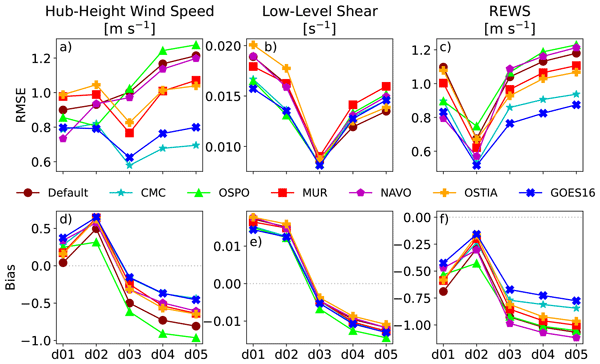
Offshore wind turbines can be directly impacted by the jet maximum winds of low-level jets, which makes them very important to the wind energy community. Here, we simulate an offshore low-level jet event using a weather model from low resolution to very high resolution. We run the simulations several times, varying the sea surface temperature to generate different realizations of the event and comparing against observations. We then ask and answer: "Is model performance consistent across scales?"
Timothy W. Juliano, Fernando Szasdi-Bardales, Neil P. Lareau, Kasra Shamsaei, Branko Kosović, Negar Elhami-Khorasani, Eric P. James, and Hamed Ebrahimian
Nat. Hazards Earth Syst. Sci., 24, 47–52, https://doi.org/10.5194/nhess-24-47-2024, https://doi.org/10.5194/nhess-24-47-2024, 2024
Short summary
Short summary
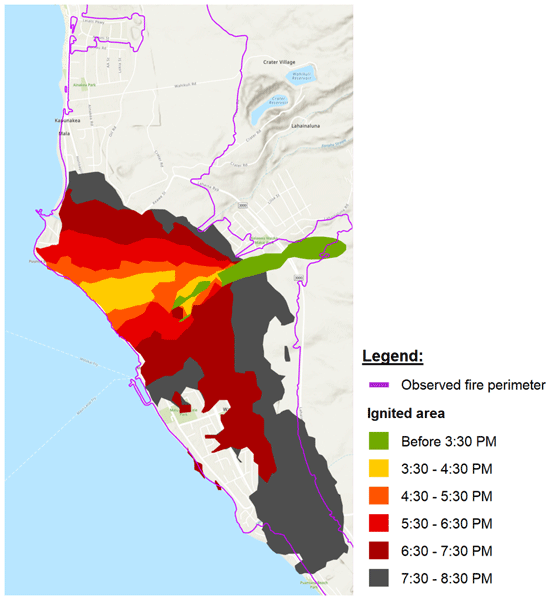
Following the destructive Lahaina Fire in Hawaii, our team has modeled the wind and fire spread processes to understand the drivers of this devastating event. The simulation results show that extreme winds with high variability, a fire ignition close to the community, and construction characteristics led to continued fire spread in multiple directions. Our results suggest that available modeling capabilities can provide vital information to guide decision-making during wildfire events.
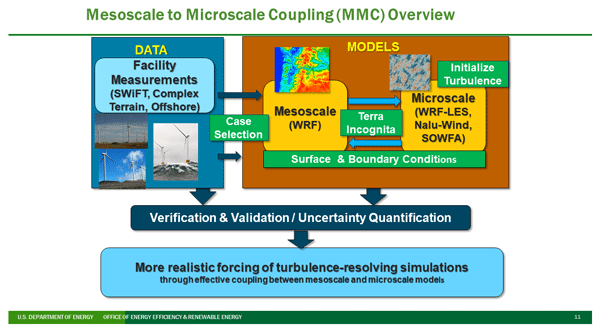
Sue Ellen Haupt, Branko Kosović, Larry K. Berg, Colleen M. Kaul, Matthew Churchfield, Jeffrey Mirocha, Dries Allaerts, Thomas Brummet, Shannon Davis, Amy DeCastro, Susan Dettling, Caroline Draxl, David John Gagne, Patrick Hawbecker, Pankaj Jha, Timothy Juliano, William Lassman, Eliot Quon, Raj K. Rai, Michael Robinson, William Shaw, and Regis Thedin
Wind Energ. Sci., 8, 1251–1275, https://doi.org/10.5194/wes-8-1251-2023, https://doi.org/10.5194/wes-8-1251-2023, 2023
Short summary
Short summary
The Mesoscale to Microscale Coupling team, part of the U.S. Department of Energy Atmosphere to Electrons (A2e) initiative, has studied various important challenges related to coupling mesoscale models to microscale models. Lessons learned and discerned best practices are described in the context of the cases studied for the purpose of enabling further deployment of wind energy. It also points to code, assessment tools, and data for testing the methods.
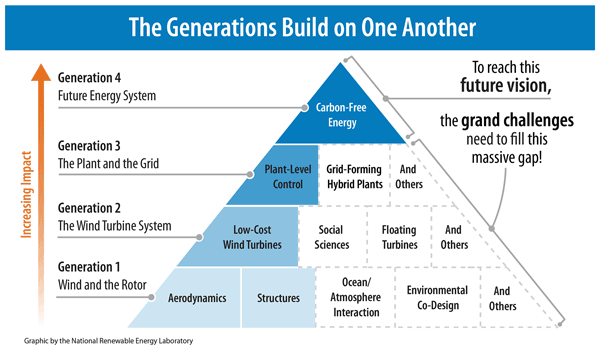
Paul Veers, Katherine Dykes, Sukanta Basu, Alessandro Bianchini, Andrew Clifton, Peter Green, Hannele Holttinen, Lena Kitzing, Branko Kosovic, Julie K. Lundquist, Johan Meyers, Mark O'Malley, William J. Shaw, and Bethany Straw
Wind Energ. Sci., 7, 2491–2496, https://doi.org/10.5194/wes-7-2491-2022, https://doi.org/10.5194/wes-7-2491-2022, 2022
Short summary
Short summary
Wind energy will play a central role in the transition of our energy system to a carbon-free future. However, many underlying scientific issues remain to be resolved before wind can be deployed in the locations and applications needed for such large-scale ambitions. The Grand Challenges are the gaps in the science left behind during the rapid growth of wind energy. This article explains the breadth of the unfinished business and introduces 10 articles that detail the research needs.
Dachuan Feng, Wen Zhang, Minping Wan, and Simon J. Watson
Wind Energ. Sci. Discuss., https://doi.org/10.5194/wes-2026-184, https://doi.org/10.5194/wes-2026-184, 2026
Preprint under review for WES
Short summary
Short summary
Wind turbines operate in air whose behaviour changes through the day: calm, layered air at night gives way to vigorous mixing after sunrise. Using computer simulations driven by measurements from a wind farm in Oklahoma, we tracked how the turbulent wake behind a turbine evolves during this morning transition. The wake changes character within hours, from one regular swaying motion to many irregular ones, altering power output. Power forecasts and controls should reflect these shifts.
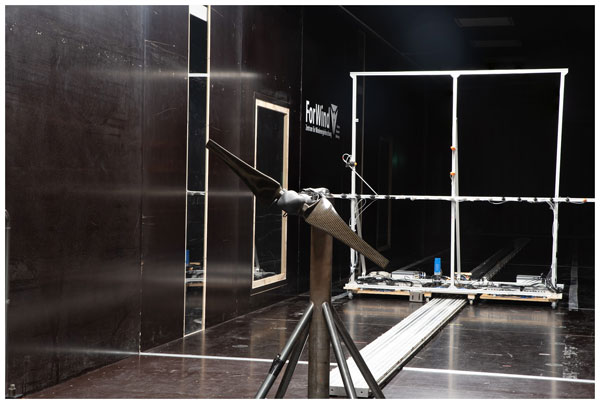
Christian W. Schulz, Michael Hölling, Joachim Peinke, and Thomas Messmer
Wind Energ. Sci., 11, 3775–3783, https://doi.org/10.5194/wes-11-3775-2026, https://doi.org/10.5194/wes-11-3775-2026, 2026
Short summary
Short summary
Floating wind turbines move with waves and wind, surging back and forth. Using wind tunnel experiments, we show that this motion can help the wake (the disturbed air trailing the turbine) recover faster, so downwind turbines receive more wind. This effect is strong when the turbine pulls hard on the wind, known as high thrust. We also discovered a new effect: recovery improves when the surging is just slightly slower than the blades' spin. This could make floating wind farms more efficient.
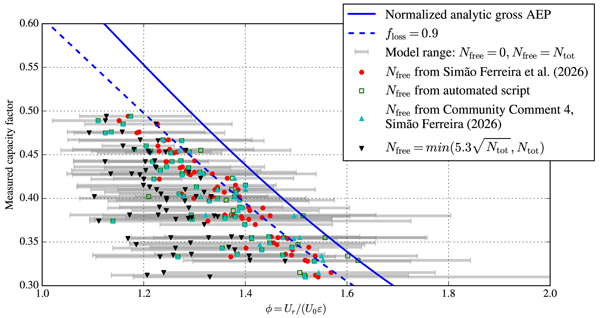
Maarten Paul van der Laan and Simon Watson
Wind Energ. Sci., 11, 3763–3774, https://doi.org/10.5194/wes-11-3763-2026, https://doi.org/10.5194/wes-11-3763-2026, 2026
Short summary
Short summary
A theoretical limit for the energy extraction of offshore wind farms has been suggested by Simão Ferreira et al. (2026) based on a simple model of an infinite wind farm and an ad hoc method to correct the model for application to finite wind farms. In this work, we discuss a number of concerns and we conclude that the limit proposed in Simão Ferreira et al. (2026) is not a theoretical limit but rather a limit supported by the non-reproducible finite wind farm correction.
Timothy W. Juliano, Florian Tornow, Ann M. Fridlind, Andrew S. Ackerman, Gregory S. Elsaesser, Bart Geerts, Christian P. Lackner, David Painemal, Israel Silber, Mikhail Ovchinnikov, Gunilla Svensson, Michael Tjernström, Peng Wu, Alejandro Baró Pérez, Peter Bogenschutz, Dmitry Chechin, Kamal Kant Chandrakar, Jan Chylik, Andrey Debolskiy, Rostislav Fadeev, Anu Gupta, Luisa Ickes, Michail Karalis, Martin Köhler, Branko Kosović, Peter Kuma, Weiwei Li, Evgeny Mortikov, Hugh Morrison, Roel A. J. Neggers, Anna Possner, Tomi Raatikainen, Lea Raillard, Sami Romakkaniemi, Niklas Schnierstein, Shin-ichiro Shima, Nikita Silin, Mikhail Tolstykh, Étienne Vignon, Lulin Xue, Meng Zhang, and Xue Zheng
Atmos. Chem. Phys., 26, 13267–13302, https://doi.org/10.5194/acp-26-13267-2026, https://doi.org/10.5194/acp-26-13267-2026, 2026
Short summary
Short summary
Models struggle to capture cloud and precipitation processes and their radiative effects in marine cold-air outbreaks. We use a quasi-Lagrangian framework to compare large-eddy simulation (LES) and single-column model (SCM) output with field and satellite observations. With fixed droplet and ice numbers, LES and SCM agree in liquid-only tests. In mixed-phase conditions, LES plausibly capture cloud thinning and breakup, while SCMs largely remain overcast and thereby miss cloud radiative effects.
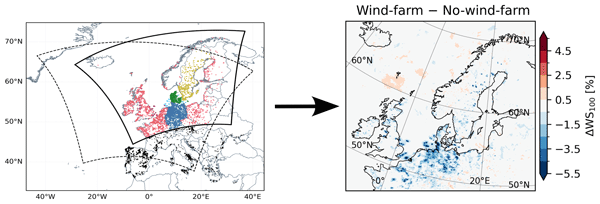
Jana Fischereit, Bjarke T. E. Olsen, Marc Imberger, Henrik Vedel, Kristian H. Møller, Andrea N. Hahmann, and Xiaoli Guo Larsén
Geosci. Model Dev., 19, 8115–8147, https://doi.org/10.5194/gmd-19-8115-2026, https://doi.org/10.5194/gmd-19-8115-2026, 2026
Short summary
Short summary
We evaluated how operating wind farms influence the atmosphere in numerical weather prediction using two wind farm parameterizations in the HARMONIE-AROME model, applied by over 10 European weather services. Accurate yield forecasts require including both onshore and offshore turbines. Wind turbines slightly alter near-surface temperature (<1 K on average). We also present an open-access European wind turbine dataset combining multiple data sources.
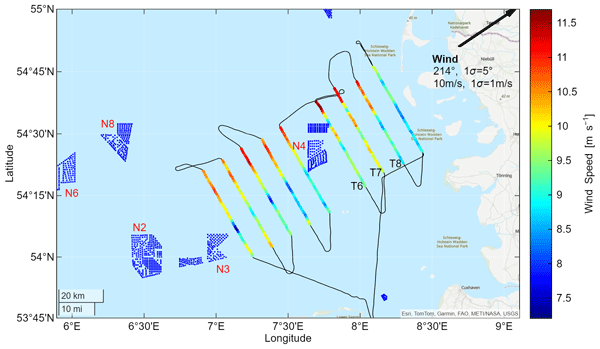
Astrid Lampert, Beatriz Cañadillas, Thomas Rausch, Lea Schmitt, Bughsin' Djath, Johannes Schulz-Stellenfleth, Andreas Platis, Kjell zum Berge, Ines Schäfer, Jens Bange, Lukas Gruchot, Thomas Neumann, Martin Dörenkämper, Bernhard Stoevesandt, Julia Gottschall, Lukas Vollmer, Stefan Emeis, Mares Barekzai, Simon Siedersleben, Martin Kühn, Gerald Steinfeld, Detlev Heinemann, Joachim Peinke, Hendrik Heißelmann, Jörge Schneemann, Gabriele Centurelli, Philipp Waldmann, and Konrad Bärfuss
Wind Energ. Sci., 11, 3057–3075, https://doi.org/10.5194/wes-11-3057-2026, https://doi.org/10.5194/wes-11-3057-2026, 2026
Short summary
Short summary
Two major aircraft measurement campaigns above the North Sea provide insights into modifications of the wind field and sea surface induced by wind farms. The aircraft performed transects at hub height upstream and downstream of wind farm clusters and identified different effects, e.g. how long it takes for the wind speed to recover after the wind farm, how changes across the coastline interact with wind energy, and if wind farms are well represented in numerical simulations.
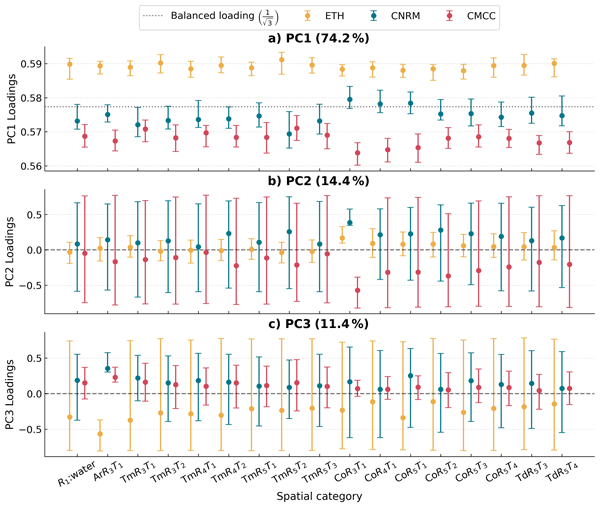
Nathalia Correa-Sánchez, Xiaoli Guo Larsén, Eleonora Dallan, Marco Borga, and Francesco Marra
Wind Energ. Sci., 11, 2961–2985, https://doi.org/10.5194/wes-11-2961-2026, https://doi.org/10.5194/wes-11-2961-2026, 2026
Short summary
Short summary
This research presents the first use of the simplified metastatistical extreme value approach for wind extremes, extending it to wind energy applications. We use a categorical framework that combines climate, roughness, and topography to evaluate convection-permitted models. We find that model formulation drives inter-model uncertainties, rather than surface conditions. Convection-permitted models' uncertainty analysis improves the reliability of extreme wind estimates for design parameters.
Eric A. Hendricks, Timothy W. Juliano, Branko Kosović, Sue Ellen Haupt, Brian J. Gaudet, and Geng Xia
Geosci. Model Dev., 19, 7369–7387, https://doi.org/10.5194/gmd-19-7369-2026, https://doi.org/10.5194/gmd-19-7369-2026, 2026
Short summary
Short summary
A three-dimensional planetary boundary layer (PBL) parameterization, suited for mesoscale model grid spacings of 100–1000 m with improved treatment of unresolved horizontal mixing, is added to a coupled atmosphere/wave modeling system and the first coupled simulations are executed using the parameterization. Simulations of a significant wind-wave event demonstrate that the new parameterization has similar behaviors as one-dimensional PBL parameterizations and compares well with observations.
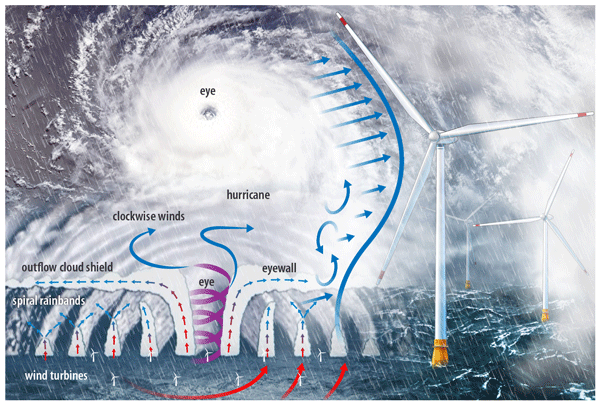
Georgios Deskos, Jiali Wang, Sanjay Arwade, Murray Fisher, Brian Hirth, Xiaoli Guo Larsén, Julie K. Lundquist, Andrew Myers, Weichiang Pang, William J. Pringle, Robert Rogers, Miguel Sanchez-Gomez, Chao Sun, Atsushi Yamaguchi, and Paul Veers
Wind Energ. Sci., 11, 2749–2782, https://doi.org/10.5194/wes-11-2749-2026, https://doi.org/10.5194/wes-11-2749-2026, 2026
Short summary
Short summary
Wind energy is expanding into regions exposed to tropical cyclones, where extreme winds and waves can damage turbines and disrupt energy production. We reviewed observations, simulations, engineering standards, and risk quantification frameworks to identify the most important gaps. Today's design rules, originally built for milder storms, do not capture cyclone hazards. Closing these gaps requires better offshore measurements, improved models, and risk-informed design standards.
William C. Radünz, Jens H. Kasper, Richard J. A. M. Stevens, and Julie K. Lundquist
Wind Energ. Sci., 11, 2723–2747, https://doi.org/10.5194/wes-11-2723-2026, https://doi.org/10.5194/wes-11-2723-2026, 2026
Short summary
Short summary
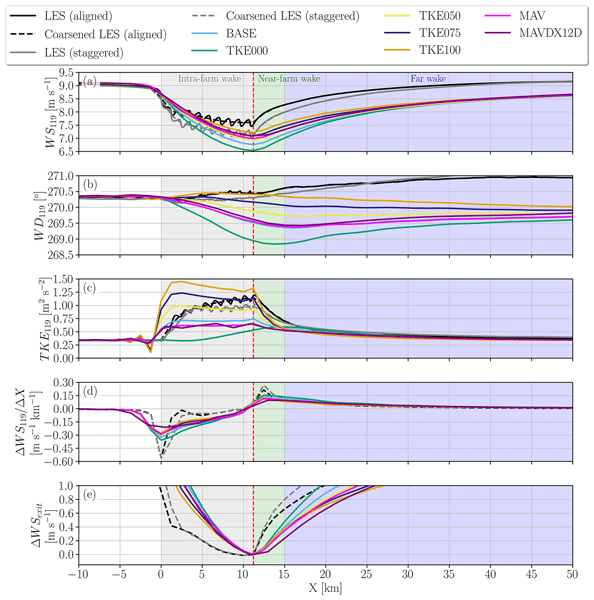
Wind farms extract energy from the wind, creating slower, more turbulent flows that can affect other farms downstream. Using high-fidelity simulations for comparison, we find that mesoscale simulations that parameterize wind farms at coarser resolution may underestimate how quickly the wind recovers downstream. This slow recovery results from missing sharp wind gradients and low turbulence. Improving these aspects can help better predict wind energy production over long distances.
Kayacan Kestel, Xavier Chesterman, Donatella Zappalá, Simon Watson, Mingxin Li, Edward Hart, James Carroll, Yolanda Vidal, Amir R. Nejad, Shawn Sheng, Yi Guo, Matthias Stammler, Florian Wirsing, Ahmed Saleh, Nico Gregarek, Thao Baszenski, Thomas Decker, Martin Knops, Georg Jacobs, Benjamin Lehmann, Florian König, Ines Pereira, Pieter-Jan Daems, Cédric Peeters, and Jan Helsen
Wind Energ. Sci., 11, 2103–2155, https://doi.org/10.5194/wes-11-2103-2026, https://doi.org/10.5194/wes-11-2103-2026, 2026
Short summary
Short summary
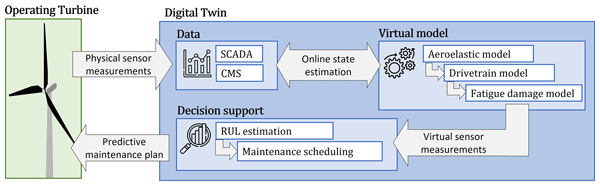
Wind energy use has been rapidly expanding worldwide in recent years. Driven by global decarbonization goals and energy security concerns, this growth is expected to continue. To achieve these targets, production costs must decrease, with operation and maintenance being major contributors. This paper reviews current and emerging technologies for monitoring wind turbine drivetrains, and highlights key academic and industrial challenges that may hinder progress.
Marcel Bock and Joachim Peinke
Wind Energ. Sci. Discuss., https://doi.org/10.5194/wes-2026-71, https://doi.org/10.5194/wes-2026-71, 2026
Revised manuscript under review for WES
Short summary
Short summary
This work describes the wake using higher-order statistics derived from numerical simulations (by using one- and two-point statistics, including velocity increments). This demonstrates the existence of the intermittent ring outside the averaged velocity deficit. Furthermore, a novel method is presented that enables the efficient simulation of turbulent wakes.
Keeta Chapman-Smith, Xiaoli Guo Larsén, and Mark Laier Brodersen
Wind Energ. Sci., 11, 1889–1912, https://doi.org/10.5194/wes-11-1889-2026, https://doi.org/10.5194/wes-11-1889-2026, 2026
Short summary
Short summary
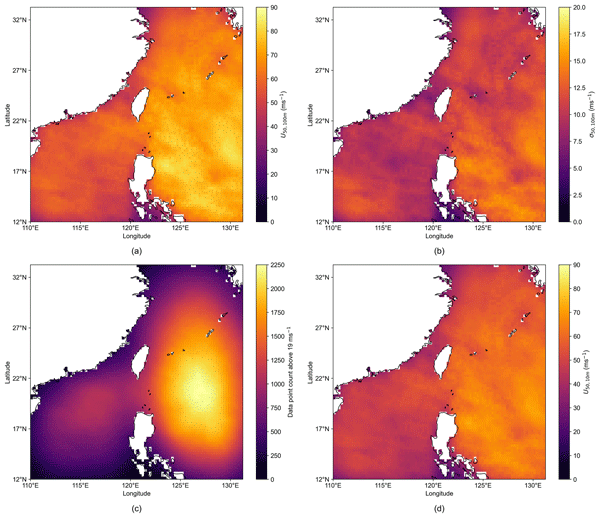
This study presents a method to estimate wind speeds that could occur in a 50-year period. The 50-year wind speed is calculated for three regions: Taiwan, Japan, and the east coast of the US. The method performs well in Taiwan and Japan, which can be attributed to the large dataset size located in a limited spatial area. The east coast of the US performs less well due to the smaller dataset size and wider spatial region that they cover.
Xiaoli Guo Larsén, Marc Imberger, and Rogier Floors
Wind Energ. Sci., 11, 1853–1869, https://doi.org/10.5194/wes-11-1853-2026, https://doi.org/10.5194/wes-11-1853-2026, 2026
Short summary
Short summary
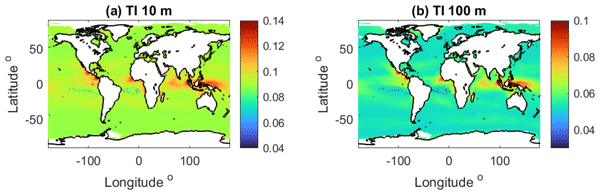
This study delivers a method and datasets for a global offshore atlas for turbulence intensity from a height of 10 m to 200 m. The method innovatively includes both two-dimensional and three-dimensional turbulence, along with stability, wave age and height. Results show satisfactory agreement with measurements and data from the literature.
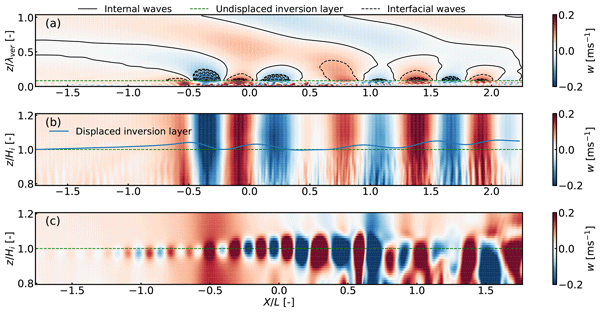
Mehtab Ahmed Khan, Matthew J. Churchfield, and Simon J. Watson
Wind Energ. Sci., 11, 1631–1652, https://doi.org/10.5194/wes-11-1631-2026, https://doi.org/10.5194/wes-11-1631-2026, 2026
Short summary
Short summary
This large-eddy simulation study identifies a realistic set-up for modeling wind-farm–atmosphere interactions, validates a method that minimizes non-physical gravity waves, and examines how real gravity waves and wind farm performance depend on non-dimensional parameters defining atmospheric stability and farm geometry. The results show how realistic and accurate modeling are critical to performance prediction.
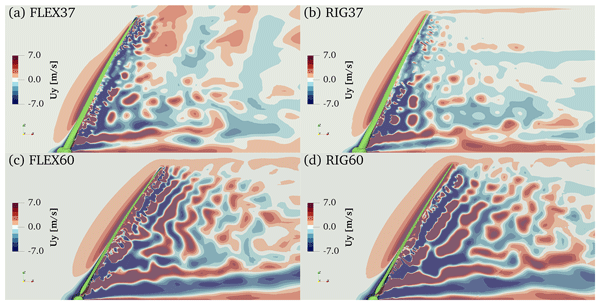
Leo Höning, Iván Herráez, Bernhard Stoevesandt, and Joachim Peinke
Wind Energ. Sci., 11, 1531–1552, https://doi.org/10.5194/wes-11-1531-2026, https://doi.org/10.5194/wes-11-1531-2026, 2026
Short summary
Short summary
High-fidelity fluid–structure-coupled simulations of the IEA 15 MW rotor under storm and yaw misalignment shows that certain misalignments trigger strong edgewise vibrations. Growth surges when effective power turns positive near −35° and fades near −43° yaw. Single-blade analysis finds lock-in at −37° with large tip motion and stability at −60° due to off-resonant Strouhal shedding. It is concluded that aeroelastic response is inflow specific, and operational mitigation strategies are needed.
Ali Eftekhari Milani, Donatella Zappalá, Shawn Sheng, and Simon Watson
Wind Energ. Sci. Discuss., https://doi.org/10.5194/wes-2026-36, https://doi.org/10.5194/wes-2026-36, 2026
Preprint under review for WES
Short summary
Short summary
This paper proposes a probabilistic method for predicting the Remaining Useful Life of wind turbine components. The method effectively addresses the high noise and volatile operating conditions in field SCADA datasets, accurately quantifies forecast uncertainty without distributional assumptions, and guarantees the validity and robustness of the predicted intervals. This method decisively outperforms existing approaches when applied to a real SCADA dataset containing gearbox bearing failures.
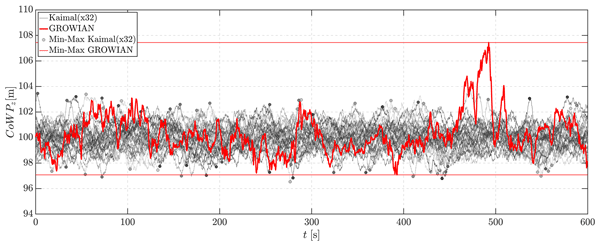
Carsten Schubert, Daniela Moreno, Jörg Schwarte, Jan Friedrich, Matthias Wächter, Gritt Pokriefke, Günter Radons, and Joachim Peinke
Wind Energ. Sci., 11, 1267–1285, https://doi.org/10.5194/wes-11-1267-2026, https://doi.org/10.5194/wes-11-1267-2026, 2026
Short summary
Short summary
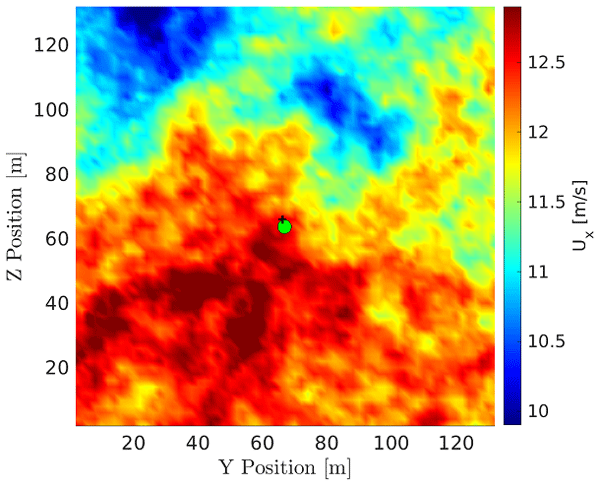
For modern wind turbines, the effects of inflow wind fluctuations on loads are becoming increasingly critical. Based on field measurements and simulations, we identify “bump” events responsible for high damage equivalent loads. In this article, we introduce a new characteristic of a wind field: the virtual center of wind pressure, which highly correlates to the identified load events observed in the operational measured data.
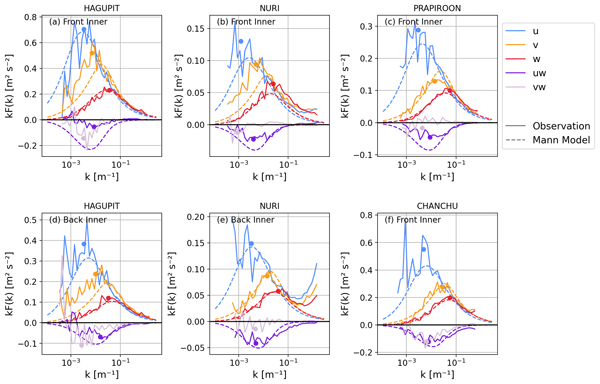
Sara Müller, Xiaoli Guo Larsén, and Fei Hu
Wind Energ. Sci., 11, 961–981, https://doi.org/10.5194/wes-11-961-2026, https://doi.org/10.5194/wes-11-961-2026, 2026
Short summary
Short summary
Wind farms are being developed in areas prone to tropical cyclones. However, it remains unclear whether turbulence models in current design standards, such as the Mann uniform shear model, are suitable for these conditions. For the first time, the Mann model is assessed in depth using high-frequency measurements from four typhoons. Larger-than-predicted spectral energy is found at small wavenumbers in the outer cyclone and, in some cases, in the crosswind component in the inner cyclone.
Jannis Maus, Joachim Peinke, and Michael Hölling
Wind Energ. Sci. Discuss., https://doi.org/10.5194/wes-2026-48, https://doi.org/10.5194/wes-2026-48, 2026
Revised manuscript accepted for WES
Short summary
Short summary
Among wind energy research, wind turbines with more than one rotor have recently gained a lot of attraction. Apart from promised lower maintenance- or construction costs, an increase in power generation per area, a better control over their wake (wind shadow/turbulence from turbines) makes these turbines highly attractive for large scale usage. This study shows experimentally, how the wake in a dual rotor can be steered and why this is highly promising for increasing windfarm efficiencies.
Shadan Mozafari, Jennifer Marie Rinker, Paul Veers, and Katherine Dykes
Wind Energ. Sci., 11, 621–641, https://doi.org/10.5194/wes-11-621-2026, https://doi.org/10.5194/wes-11-621-2026, 2026
Short summary
Short summary
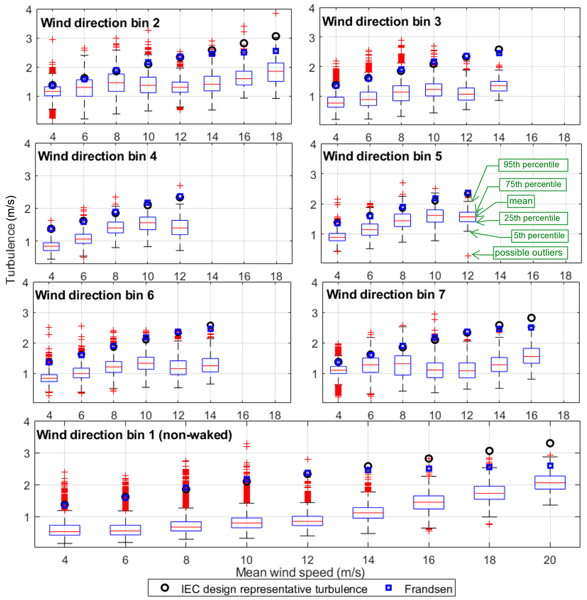
The study showcases the added value of using structural response measurements in lifetime extension assessments within wind farms. In addition, it answers two of the common questions in different methods of assessment. First, it assesses the applicability of the Frandsen model for estimating conservative waked turbulence in the compact layout of wind farms. Second, it showcases probabilistic extrapolation of short- to mid-term data for long-term site-specific fatigue assessments.
Dachuan Feng, Nirav Dangi, and Simon Watson
Wind Energ. Sci., 11, 395–404, https://doi.org/10.5194/wes-11-395-2026, https://doi.org/10.5194/wes-11-395-2026, 2026
Short summary
Short summary
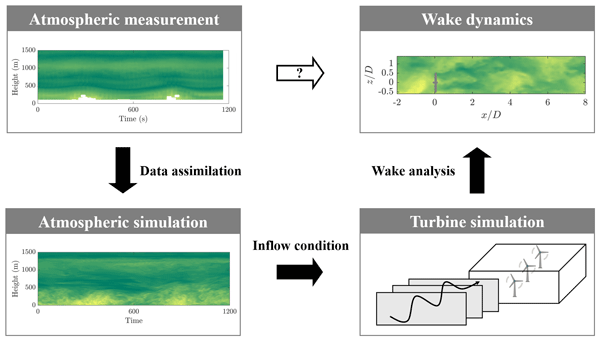
Weather effects drive wind turbine loads and performance to be different from those under mean atmospheric conditions. However, the influence of unsteady atmospheric phenomena on wake behavior remains unclear. This paper explores how atmospheric gravity waves – large-scale wave-like patterns caused by topographical features – affect meandering motions and turbulence generation in the wake region. The outputs of this paper can be used to guide wake modeling in realistic atmospheric flows.
Carlo L. Bottasso, Sandrine Aubrun, Nicolaos A. Cutululis, Julia Gottschall, Athanasios Kolios, Jakob Mann, and Paul Veers
Wind Energ. Sci., 11, 347–348, https://doi.org/10.5194/wes-11-347-2026, https://doi.org/10.5194/wes-11-347-2026, 2026
Short summary
Short summary
This editorial celebrates the 10th anniversary of Wind Energy Science, reflecting on a decade of rapid scientific progress and the journal’s role in advancing fundamental, interdisciplinary research. It highlights key developments in wind energy, the importance of open science and academia–industry collaboration, and emerging challenges such as data sharing and artificial intelligence. Above all, it honors the research community that has shaped the journal and looks ahead to the next decade.
Sima Hamzeloo, Xiaoli Guo Larsén, Alfredo Peña, Jana Fischereit, and Oscar García-Santiago
Wind Energ. Sci. Discuss., https://doi.org/10.5194/wes-2025-267, https://doi.org/10.5194/wes-2025-267, 2026
Revised manuscript accepted for WES
Short summary
Short summary
We studied how winds and ocean waves affect each other during a North Sea storm. Using a multiscale approach that captures processes from kilometers down to meters, we linked wind and wave models and compared the results with real measurements. Our aim was to improve current simulation methods, and the findings show that this detailed approach provides more accurate storm predictions up to 100 m height.
Timothy W. Juliano, Florian Tornow, Ann M. Fridlind, Andrew S. Ackerman, Gregory S. Elsaesser, Bart Geerts, Christian P. Lackner, David Painemal, Israel Silber, Mikhail Ovchinnikov, Gunilla Svensson, Michael Tjernström, Peng Wu, Alejandro Baró Pérez, Peter Bogenschutz, Dmitry Chechin, Kamal Kant Chandrakar, Jan Chylik, Andrey Debolskiy, Rostislav Fadeev, Anu Gupta, Luisa Ickes, Michail Karalis, Martin Köhler, Branko Kosović, Peter Kuma, Weiwei Li, Evgeny Mortikov, Hugh Morrison, Roel A. J. Neggers, Anna Possner, Tomi Raatikainen, Sami Romakkaniemi, Niklas Schnierstein, Shin-ichiro Shima, Nikita Silin, Mikhail Tolstykh, Lulin Xue, Meng Zhang, and Xue Zheng
EGUsphere, https://doi.org/10.5194/egusphere-2025-6217, https://doi.org/10.5194/egusphere-2025-6217, 2026
Preprint archived
Short summary
Short summary
Models struggle to capture cloud and precipitation processes and their radiative effects in marine cold-air outbreaks. We use a quasi-Lagrangian framework to compare large-eddy simulation (LES) and single-column model (SCM) output with field and satellite observations. With fixed droplet and ice numbers, LES and SCM agree in liquid-only tests. In mixed-phase conditions, LES plausibly capture cloud thinning and breakup, while SCMs largely remain overcast and thereby miss cloud radiative effects.
Marcel Bock, Daniela Moreno, and Joachim Peinke
Wind Energ. Sci., 11, 103–126, https://doi.org/10.5194/wes-11-103-2026, https://doi.org/10.5194/wes-11-103-2026, 2026
Short summary
Short summary
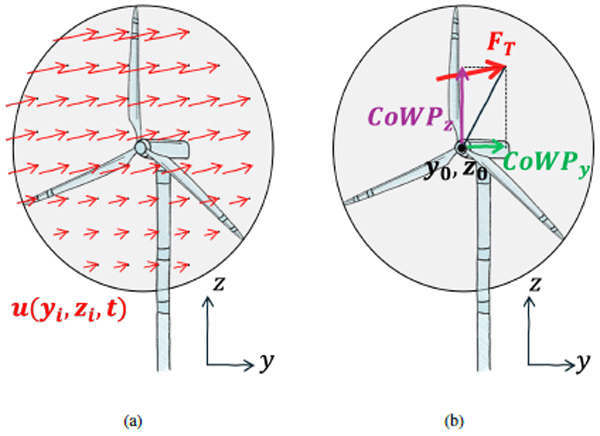
Various simulation tools exist to provide load forecasts in the wind energy field (engineering models and numerical simulations). A newly introduced concept is the center of wind pressure, a quantity extracted from a wind field. In previous works, similar behaviour, then the main shaft bending moments, was shown. However, a clear relationship is missing. In this work, this gap is filled through the introduction of a calibration parameter.
Patrick Hawbecker, William Lassman, Timothy W. Juliano, Branko Kosović, and Sue Ellen Haupt
Wind Energ. Sci., 11, 51–69, https://doi.org/10.5194/wes-11-51-2026, https://doi.org/10.5194/wes-11-51-2026, 2026
Short summary
Short summary
Offshore wind turbines can be directly impacted by the jet maximum winds of low-level jets, which makes them very important to the wind energy community. Here, we simulate an offshore low-level jet event using a weather model from low resolution to very high resolution. We run the simulations several times, varying the sea surface temperature to generate different realizations of the event and comparing against observations. We then ask and answer: "Is model performance consistent across scales?"
Daniela Moreno, Jan Friedrich, Carsten Schubert, Matthias Wächter, Jörg Schwarte, Gritt Pokriefke, Günter Radons, and Joachim Peinke
Wind Energ. Sci., 10, 2729–2754, https://doi.org/10.5194/wes-10-2729-2025, https://doi.org/10.5194/wes-10-2729-2025, 2025
Short summary
Short summary
Increased sizes of modern turbines require extended descriptions of the atmospheric wind and its correlation to loads. Here, a surrogate stochastic method for estimating the bending moments at the main shaft is proposed. Based on the center of wind pressure dynamics, an advantage is the possibility of stochastically reconstructing large amounts of load data. Atmospheric measurements and modeled data demonstrate the validity of this method.
Ali Eftekhari Milani, Donatella Zappalá, Francesco Castellani, and Simon Watson
Wind Energ. Sci., 10, 2563–2576, https://doi.org/10.5194/wes-10-2563-2025, https://doi.org/10.5194/wes-10-2563-2025, 2025
Short summary
Short summary
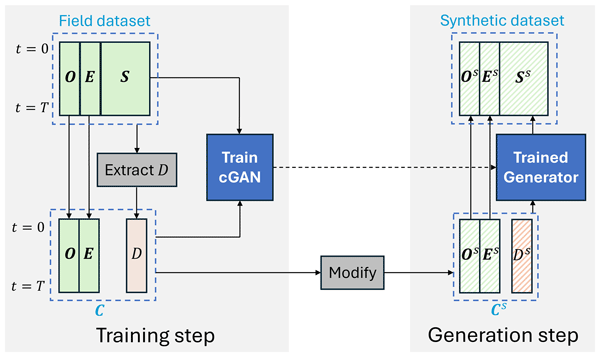
This paper proposes a data-driven approach to simulate wind turbine sensor time series, such as temperature and pressure signals, describing the behaviour of a wind turbine component as it degrades through time up to the failure point. It allows for the simulation of new failure events or the replication of a given failure under different conditions. The results show that the synthetic signals generated using this approach improve the performance of fault detection and prognosis methods.
Nathalia Correa-Sánchez, Xiaoli Guo Larsén, Giorgia Fosser, Eleonora Dallan, Marco Borga, and Francesco Marra
Wind Energ. Sci., 10, 2551–2561, https://doi.org/10.5194/wes-10-2551-2025, https://doi.org/10.5194/wes-10-2551-2025, 2025
Short summary
Short summary
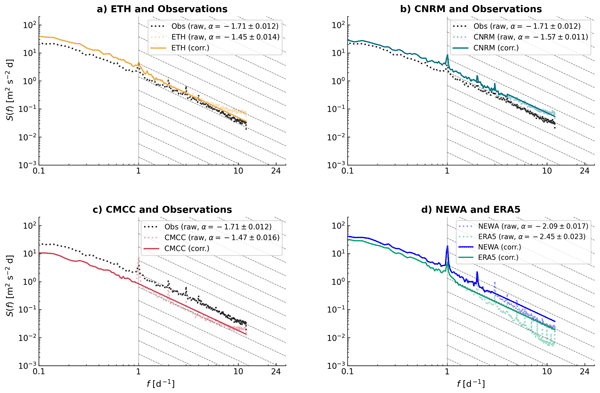
We examined the power spectra of wind speed in three convection-permitting models in central Europe and found that these models have a better representation of wind variability characteristics than standard wind datasets like the New European Wind Atlas, due to different simulation approaches, providing more reliable extreme wind predictions.
Christian Wiedemann, Henrik Bette, Matthias Wächter, Jan A. Freund, Thomas Guhr, and Joachim Peinke
Wind Energ. Sci., 10, 2489–2497, https://doi.org/10.5194/wes-10-2489-2025, https://doi.org/10.5194/wes-10-2489-2025, 2025
Short summary
Short summary
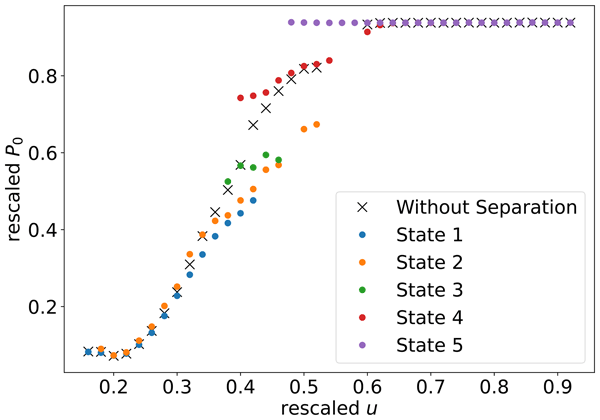
This study utilizes a method to analyze power conversion dynamics across different operational states, addressing non-stationarity with a correlation matrix algorithm. Findings reveal distinct dynamics for each state, emphasizing their impact on system behavior and offering a solution for hysteresis effects in power conversion dynamics.
Matteo Puccioni, Sonia Wharton, Stephan F. J. De Wekker, Robert S. Arthur, Tianyi Li, Ye Liu, Sha Feng, Kyle Pressel, Raj K. Rai, Larry K. Berg, and Jerome D. Fast
Wind Energ. Sci. Discuss., https://doi.org/10.5194/wes-2025-215, https://doi.org/10.5194/wes-2025-215, 2025
Revised manuscript not accepted
Short summary
Short summary
A multi-wind Lidar campaign is conducted in a forest in the United States Southeast, a region featuring low wind resources due to the forest drag. Although the latter reduces the wind for hundreds of meters above ground, we found this effect to be negligible for heights above 8 times the tree height where the wind is dominated by local atmospheric events. This scenario opens to the development of taller turbines harvesting the wind farther away from the ground where the forest drag is minimal.
Oriol Cayon, Simon Watson, and Roland Schmehl
Wind Energ. Sci., 10, 2161–2188, https://doi.org/10.5194/wes-10-2161-2025, https://doi.org/10.5194/wes-10-2161-2025, 2025
Short summary
Short summary
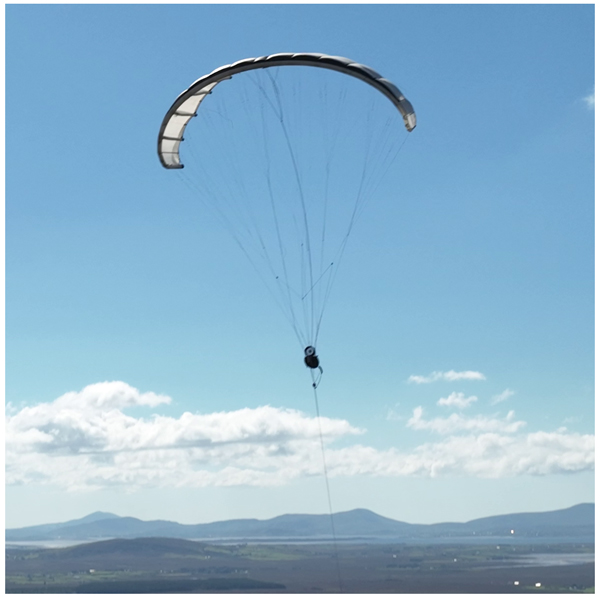
This study demonstrates how kites used to generate wind energy can act as sensors to measure wind conditions and system behaviour. By combining data from existing sensors, such as those measuring position, speed, and forces on the tether, a sensor fusion technique accurately estimates wind conditions and kite performance. This approach can be integrated into control systems to help optimize energy generation and enhance the reliability of these systems under changing wind conditions.
Sheng-Lun Tai, Zhao Yang, Brian Gaudet, Koichi Sakaguchi, Larry Berg, Colleen Kaul, Yun Qian, Ye Liu, and Jerome Fast
Earth Syst. Sci. Data, 17, 4587–4611, https://doi.org/10.5194/essd-17-4587-2025, https://doi.org/10.5194/essd-17-4587-2025, 2025
Short summary
Short summary
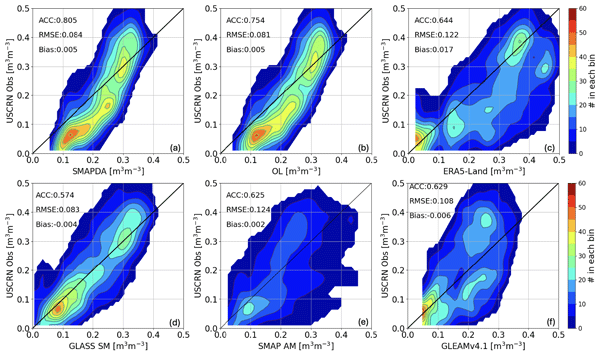
Our study created a high-resolution soil moisture dataset for the eastern US by integrating satellite data with a land surface model and advanced algorithms, achieving 1 km scale analyses. Validated against multiple in situ networks and analysis datasets, it demonstrated superior accuracy. This dataset is vital for understanding soil moisture dynamics, especially during droughts, and highlights the need to mitigate soil-type-dependent biases in the model.
Harish Baki, Sukanta Basu, and George Lavidas
Wind Energ. Sci., 10, 1575–1609, https://doi.org/10.5194/wes-10-1575-2025, https://doi.org/10.5194/wes-10-1575-2025, 2025
Short summary
Short summary
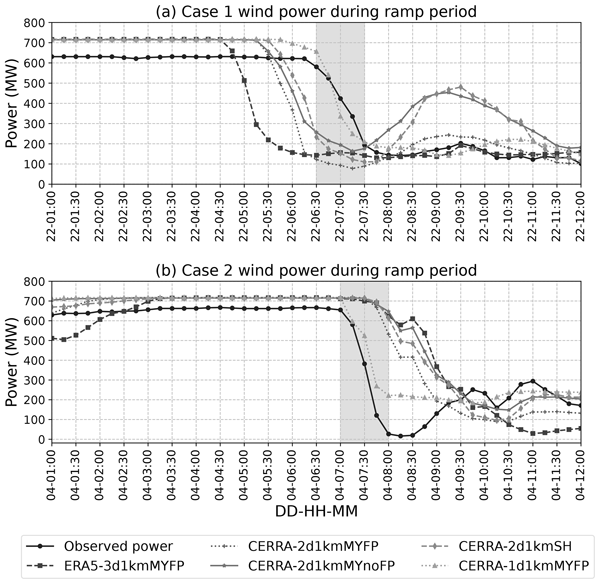
Our study explores how frontal low-level jets (FLLJs) impact wind power production by causing ramp-down events. Using the Weather Research and Forecasting model, we analyzed various modeling configurations and found that initial and boundary conditions, domain configuration, and wind farm parameterization significantly influence simulations. Our findings show such extreme events can be forecasted 1 d in advance, helping manage wind power more efficiently for a stable, reliable energy supply.
Lindsay M. Sheridan, Jiali Wang, Caroline Draxl, Nicola Bodini, Caleb Phillips, Dmitry Duplyakin, Heidi Tinnesand, Raj K. Rai, Julia E. Flaherty, Larry K. Berg, Chunyong Jung, Ethan Young, and Rao Kotamarthi
Wind Energ. Sci., 10, 1551–1574, https://doi.org/10.5194/wes-10-1551-2025, https://doi.org/10.5194/wes-10-1551-2025, 2025
Short summary
Short summary
Three recent wind resource datasets are assessed for their skills in representing annual average wind speeds and seasonal, diurnal, and interannual trends in the wind resource in coastal locations to support customers interested in small and midsize wind energy.
Lindsay M. Sheridan, Dmitry Duplyakin, Caleb Phillips, Heidi Tinnesand, Raj K. Rai, Julia E. Flaherty, and Larry K. Berg
Wind Energ. Sci., 10, 1451–1470, https://doi.org/10.5194/wes-10-1451-2025, https://doi.org/10.5194/wes-10-1451-2025, 2025
Short summary
Short summary
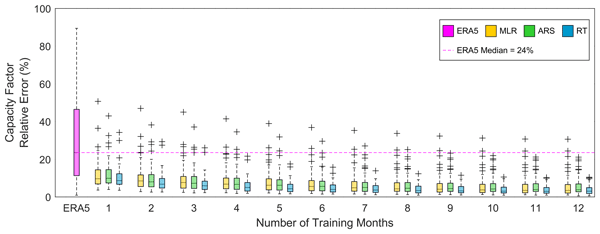
A total of 12 months of onsite wind measurement is standard for correcting model-based long-term wind speed estimates for utility-scale wind farms; however, the time and capital investment involved in gathering onsite measurements must be reconciled with the energy needs and funding opportunities for distributed wind projects. This study aims to answer the question of how short you can go in terms of the observational time period needed to make impactful improvements to long-term wind speed estimates.
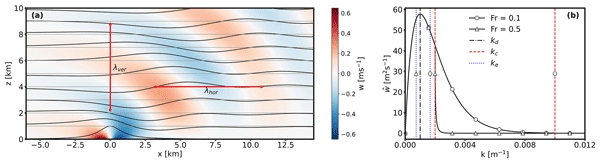
Mehtab Ahmed Khan, Dries Allaerts, Simon J. Watson, and Matthew J. Churchfield
Wind Energ. Sci., 10, 1167–1185, https://doi.org/10.5194/wes-10-1167-2025, https://doi.org/10.5194/wes-10-1167-2025, 2025
Short summary
Short summary
To guide realistic atmospheric gravity wave simulations, we study flow over a two-dimensional hill and through a wind farm canopy, examining optimal domain size and damping layer setup. Wave properties based on non-dimensional numbers determine the optimal domain and damping parameters. Accurate solutions require the domain length to exceed the effective horizontal wavelength, height, and damping thickness to equal the vertical wavelength and non-dimensional damping strength between 1 and 10.
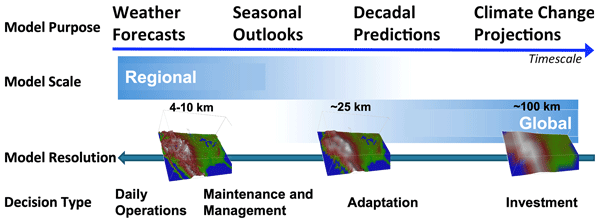
Mari R. Tye, Ming Ge, Jadwiga H. Richter, Ethan D. Gutmann, Allyson Rugg, Cindy L. Bruyère, Sue Ellen Haupt, Flavio Lehner, Rachel McCrary, Andrew J. Newman, and Andy Wood
Hydrol. Earth Syst. Sci., 29, 1117–1133, https://doi.org/10.5194/hess-29-1117-2025, https://doi.org/10.5194/hess-29-1117-2025, 2025
Short summary
Short summary
There is a perceived mismatch between the spatial scales on which global climate models can produce data and those needed for water management decisions. However, poor communication of specific metrics relevant to local decisions is also a problem. We assessed the credibility of a set of water management decision metrics in the Community Earth System Model v2 (CESM2). CESM2 shows potentially greater use of its output in long-range water management decisions.
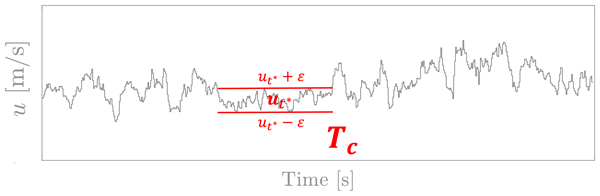
Daniela Moreno, Jan Friedrich, Matthias Wächter, Jörg Schwarte, and Joachim Peinke
Wind Energ. Sci., 10, 347–360, https://doi.org/10.5194/wes-10-347-2025, https://doi.org/10.5194/wes-10-347-2025, 2025
Short summary
Short summary
Unexpected load events measured on operating wind turbines are not accurately predicted by numerical simulations. We introduce the periods of constant wind speed as a possible cause of such events. We measure and characterize their statistics from atmospheric data. Further comparisons to standard modelled data and experimental turbulence data suggest that such events are not intrinsic to small-scale turbulence and are not accurately described by current standard wind models.

Majid Bastankhah, Marcus Becker, Matthew Churchfield, Caroline Draxl, Jay Prakash Goit, Mehtab Khan, Luis A. Martinez Tossas, Johan Meyers, Patrick Moriarty, Wim Munters, Asim Önder, Sara Porchetta, Eliot Quon, Ishaan Sood, Nicole van Lipzig, Jan-Willem van Wingerden, Paul Veers, and Simon Watson
Wind Energ. Sci., 9, 2171–2174, https://doi.org/10.5194/wes-9-2171-2024, https://doi.org/10.5194/wes-9-2171-2024, 2024
Short summary
Short summary
Dries Allaerts was born on 19 May 1989 and passed away at his home in Wezemaal, Belgium, on 10 October 2024 after battling cancer. Dries started his wind energy career in 2012 and had a profound impact afterward on the community, in terms of both his scientific realizations and his many friendships and collaborations in the field. His scientific acumen, open spirit of collaboration, positive attitude towards life, and playful and often cheeky sense of humor will be deeply missed by many.
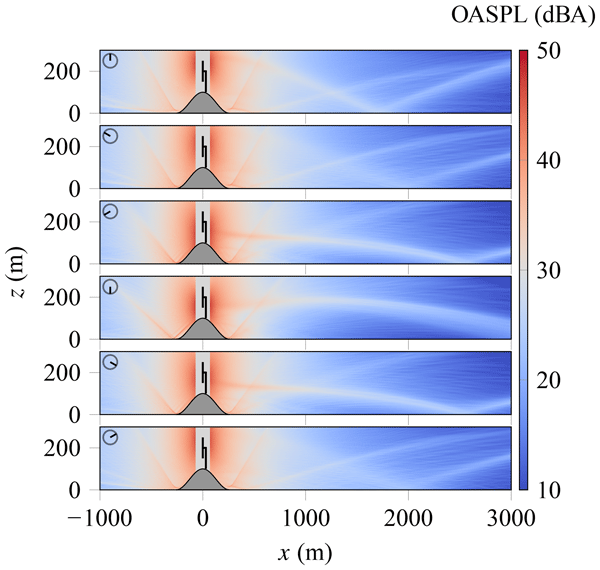
Jules Colas, Ariane Emmanuelli, Didier Dragna, Philippe Blanc-Benon, Benjamin Cotté, and Richard J. A. M. Stevens
Wind Energ. Sci., 9, 1869–1884, https://doi.org/10.5194/wes-9-1869-2024, https://doi.org/10.5194/wes-9-1869-2024, 2024
Short summary
Short summary
We studied wind turbine noise propagation in a hilly terrain through numerical simulation in different scenarios. The sound pressure levels obtained for a wind turbine in front of a 2D hill and a wind turbine on a hilltop are compared to a baseline flat case. The source height and wind speed strongly influence sound propagation downwind. Topography influences the wake shape, inducing changes in the sound propagation that modify the sound pressure level and amplitude modulation downwind.
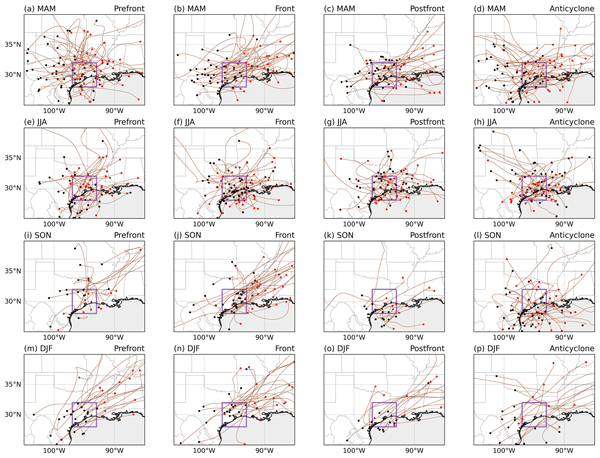
Ye Liu, Yun Qian, Larry K. Berg, Zhe Feng, Jianfeng Li, Jingyi Chen, and Zhao Yang
Atmos. Chem. Phys., 24, 8165–8181, https://doi.org/10.5194/acp-24-8165-2024, https://doi.org/10.5194/acp-24-8165-2024, 2024
Short summary
Short summary
Deep convection under various large-scale meteorological patterns (LSMPs) shows distinct precipitation features. In southeastern Texas, mesoscale convective systems (MCSs) contribute significantly to precipitation year-round, while isolated deep convection (IDC) is prominent in summer and fall. Self-organizing maps (SOMs) reveal convection can occur without large-scale lifting or moisture convergence. MCSs and IDC events have distinct life cycles influenced by specific LSMPs.
Davide Selvatici and Richard J. A. M. Stevens
Wind Energ. Sci. Discuss., https://doi.org/10.5194/wes-2024-60, https://doi.org/10.5194/wes-2024-60, 2024
Manuscript not accepted for further review
Short summary
Short summary
The Actuator Line Method is to date one of the most adopted models for wind turbines in numerical simulations, yet it is known to overestimate the loading at the blade tips. We developed an extremely efficient correction methodology that is able to retrieve the loading distribution of Blade Element Method with tip correction independently on the turbine adopted, or on the chosen inflow velocity, making it possible to be used for simulations of wind farms.
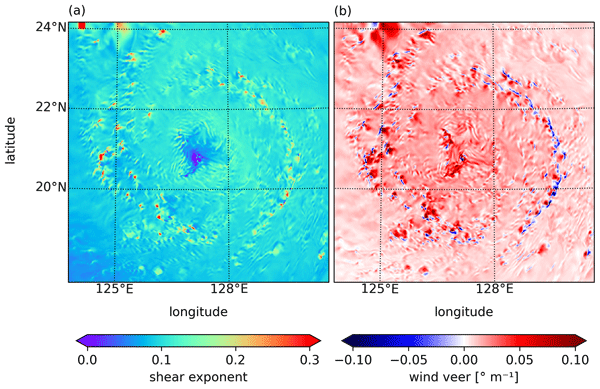
Sara Müller, Xiaoli Guo Larsén, and David Robert Verelst
Wind Energ. Sci., 9, 1153–1171, https://doi.org/10.5194/wes-9-1153-2024, https://doi.org/10.5194/wes-9-1153-2024, 2024
Short summary
Short summary
Tropical cyclone winds are challenging for wind turbines. We analyze a tropical cyclone before landfall in a mesoscale model. The simulated wind speeds and storm structure are sensitive to the boundary parametrization. However, independent of the boundary layer parametrization, the median change in wind speed and wind direction with height is small relative to wind turbine design standards. Strong spatial organization of wind shear and veer along the rainbands may increase wind turbine loads.
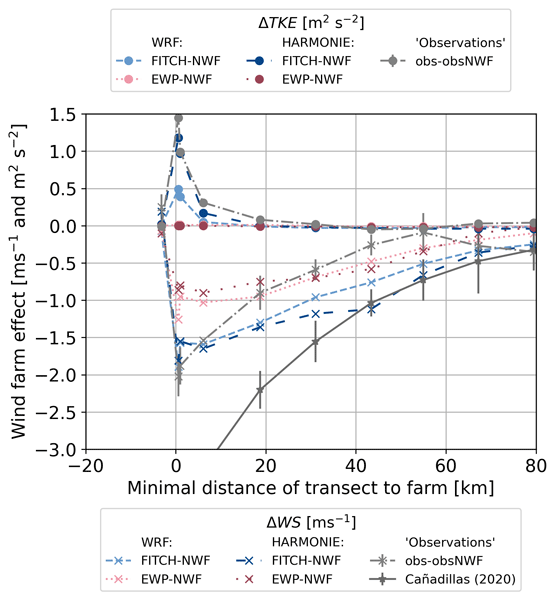
Jana Fischereit, Henrik Vedel, Xiaoli Guo Larsén, Natalie E. Theeuwes, Gregor Giebel, and Eigil Kaas
Geosci. Model Dev., 17, 2855–2875, https://doi.org/10.5194/gmd-17-2855-2024, https://doi.org/10.5194/gmd-17-2855-2024, 2024
Short summary
Short summary
Wind farms impact local wind and turbulence. To incorporate these effects in weather forecasting, the explicit wake parameterization (EWP) is added to the forecasting model HARMONIE–AROME. We evaluate EWP using flight data above and downstream of wind farms, comparing it with an alternative wind farm parameterization and another weather model. Results affirm the correct implementation of EWP, emphasizing the necessity of accounting for wind farm effects in accurate weather forecasting.
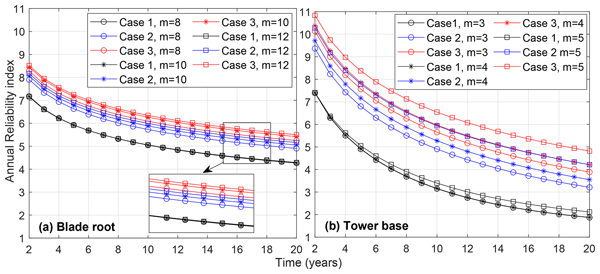
Shadan Mozafari, Paul Veers, Jennifer Rinker, and Katherine Dykes
Wind Energ. Sci., 9, 799–820, https://doi.org/10.5194/wes-9-799-2024, https://doi.org/10.5194/wes-9-799-2024, 2024
Short summary
Short summary
Turbulence is one of the main drivers of fatigue in wind turbines. There is some debate on how to model the turbulence in normal wind conditions in the design phase. To address such debates, we study the fatigue load distribution and reliability following different models of the International Electrotechnical Commission 61400-1 standard. The results show the lesser importance of load uncertainty due to turbulence distribution compared to the uncertainty of material resistance and Miner’s rule.
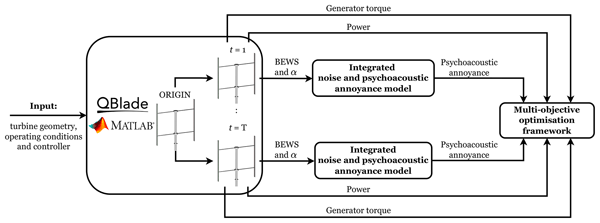
Livia Brandetti, Sebastiaan Paul Mulders, Roberto Merino-Martinez, Simon Watson, and Jan-Willem van Wingerden
Wind Energ. Sci., 9, 471–493, https://doi.org/10.5194/wes-9-471-2024, https://doi.org/10.5194/wes-9-471-2024, 2024
Short summary
Short summary
This research presents a multi-objective optimisation approach to balance vertical-axis wind turbine (VAWT) performance and noise, comparing the combined wind speed estimator and tip-speed ratio (WSE–TSR) tracking controller with a baseline. Psychoacoustic annoyance is used as a novel metric for human perception of wind turbine noise. Results showcase the WSE–TSR tracking controller’s potential in trading off the considered objectives, thereby fostering the deployment of VAWTs in urban areas.
Timothy W. Juliano, Fernando Szasdi-Bardales, Neil P. Lareau, Kasra Shamsaei, Branko Kosović, Negar Elhami-Khorasani, Eric P. James, and Hamed Ebrahimian
Nat. Hazards Earth Syst. Sci., 24, 47–52, https://doi.org/10.5194/nhess-24-47-2024, https://doi.org/10.5194/nhess-24-47-2024, 2024
Short summary
Short summary
Following the destructive Lahaina Fire in Hawaii, our team has modeled the wind and fire spread processes to understand the drivers of this devastating event. The simulation results show that extreme winds with high variability, a fire ignition close to the community, and construction characteristics led to continued fire spread in multiple directions. Our results suggest that available modeling capabilities can provide vital information to guide decision-making during wildfire events.
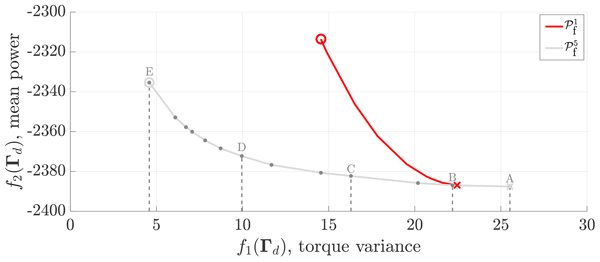
Livia Brandetti, Sebastiaan Paul Mulders, Yichao Liu, Simon Watson, and Jan-Willem van Wingerden
Wind Energ. Sci., 8, 1553–1573, https://doi.org/10.5194/wes-8-1553-2023, https://doi.org/10.5194/wes-8-1553-2023, 2023
Short summary
Short summary
This research presents the additional benefits of applying an advanced combined wind speed estimator and tip-speed ratio tracking (WSE–TSR) controller compared to the baseline Kω2. Using a frequency-domain framework and an optimal calibration procedure, the WSE–TSR tracking control scheme shows a more flexible trade-off between conflicting objectives: power maximisation and load minimisation. Therefore, implementing this controller on large-scale wind turbines will facilitate their operation.
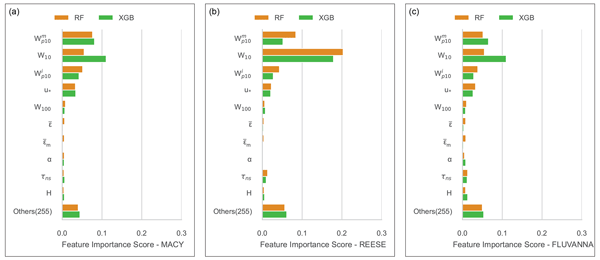
Serkan Kartal, Sukanta Basu, and Simon J. Watson
Wind Energ. Sci., 8, 1533–1551, https://doi.org/10.5194/wes-8-1533-2023, https://doi.org/10.5194/wes-8-1533-2023, 2023
Short summary
Short summary
Peak wind gust is a crucial meteorological variable for wind farm planning and operations. Unfortunately, many wind farms do not have on-site measurements of it. In this paper, we propose a machine-learning approach (called INTRIGUE, decIsioN-TRee-based wInd GUst Estimation) that utilizes numerous inputs from a public-domain reanalysis dataset, generating long-term, site-specific peak wind gust series.
Sue Ellen Haupt, Branko Kosović, Larry K. Berg, Colleen M. Kaul, Matthew Churchfield, Jeffrey Mirocha, Dries Allaerts, Thomas Brummet, Shannon Davis, Amy DeCastro, Susan Dettling, Caroline Draxl, David John Gagne, Patrick Hawbecker, Pankaj Jha, Timothy Juliano, William Lassman, Eliot Quon, Raj K. Rai, Michael Robinson, William Shaw, and Regis Thedin
Wind Energ. Sci., 8, 1251–1275, https://doi.org/10.5194/wes-8-1251-2023, https://doi.org/10.5194/wes-8-1251-2023, 2023
Short summary
Short summary
The Mesoscale to Microscale Coupling team, part of the U.S. Department of Energy Atmosphere to Electrons (A2e) initiative, has studied various important challenges related to coupling mesoscale models to microscale models. Lessons learned and discerned best practices are described in the context of the cases studied for the purpose of enabling further deployment of wind energy. It also points to code, assessment tools, and data for testing the methods.
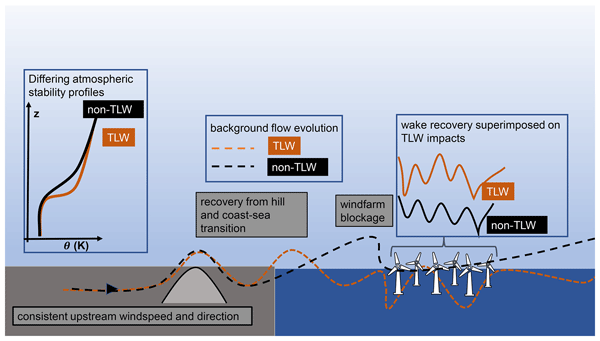
Sarah J. Ollier and Simon J. Watson
Wind Energ. Sci., 8, 1179–1200, https://doi.org/10.5194/wes-8-1179-2023, https://doi.org/10.5194/wes-8-1179-2023, 2023
Short summary
Short summary
This modelling study shows that topographic trapped lee waves (TLWs) modify flow behaviour and power output in offshore wind farms. We demonstrate that TLWs can substantially alter the wind speeds at individual wind turbines and effect the power output of the turbine and whole wind farm. The impact on wind speeds and power is dependent on which part of the TLW wave cycle interacts with the wind turbines and wind farm. Positive and negative impacts of TLWs on power output are observed.
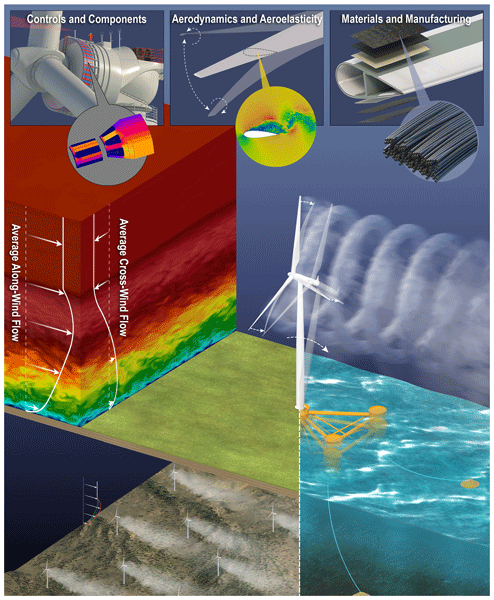
Paul Veers, Carlo L. Bottasso, Lance Manuel, Jonathan Naughton, Lucy Pao, Joshua Paquette, Amy Robertson, Michael Robinson, Shreyas Ananthan, Thanasis Barlas, Alessandro Bianchini, Henrik Bredmose, Sergio González Horcas, Jonathan Keller, Helge Aagaard Madsen, James Manwell, Patrick Moriarty, Stephen Nolet, and Jennifer Rinker
Wind Energ. Sci., 8, 1071–1131, https://doi.org/10.5194/wes-8-1071-2023, https://doi.org/10.5194/wes-8-1071-2023, 2023
Short summary
Short summary
Critical unknowns in the design, manufacturing, and operation of future wind turbine and wind plant systems are articulated, and key research activities are recommended.
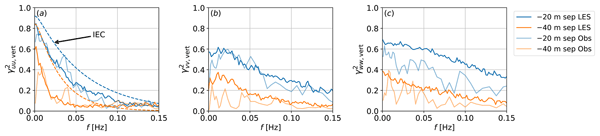
Regis Thedin, Eliot Quon, Matthew Churchfield, and Paul Veers
Wind Energ. Sci., 8, 487–502, https://doi.org/10.5194/wes-8-487-2023, https://doi.org/10.5194/wes-8-487-2023, 2023
Short summary
Short summary
We investigate coherence and correlation and highlight their importance for disciplines like wind energy structural dynamic analysis, in which blade loading and fatigue depend on turbulence structure. We compare coherence estimates to those computed using a model suggested by international standards. We show the differences and highlight additional information that can be gained using large-eddy simulation, further improving analytical coherence models used in synthetic turbulence generators.
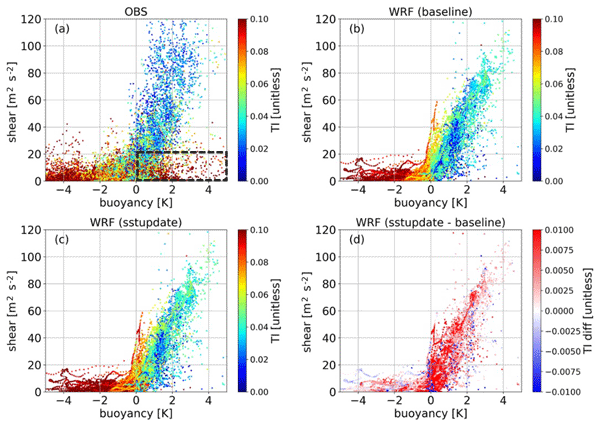
Sheng-Lun Tai, Larry K. Berg, Raghavendra Krishnamurthy, Rob Newsom, and Anthony Kirincich
Wind Energ. Sci., 8, 433–448, https://doi.org/10.5194/wes-8-433-2023, https://doi.org/10.5194/wes-8-433-2023, 2023
Short summary
Short summary
Turbulence intensity is critical for wind turbine design and operation as it affects wind power generation efficiency. Turbulence measurements in the marine environment are limited. We use a model to derive turbulence intensity and test how sea surface temperature data may impact the simulated turbulence intensity and atmospheric stability. The model slightly underestimates turbulence, and improved sea surface temperature data reduce the bias. Error with unrealistic mesoscale flow is identified.
Xiaoli Guo Larsén, Marc Imberger, Ásta Hannesdóttir, and Andrea N. Hahmann
Wind Energ. Sci. Discuss., https://doi.org/10.5194/wes-2022-102, https://doi.org/10.5194/wes-2022-102, 2023
Revised manuscript not accepted
Short summary
Short summary
We study how climate change will impact extreme winds and choice of turbine class. We use data from 18 CMIP6 members from a historic and a future period to access the change in the extreme winds. The analysis shows an overall increase in the extreme winds in the North Sea and the southern Baltic Sea, but a decrease over the Scandinavian Peninsula and most of the Baltic Sea. The analysis is inconclusive to whether higher or lower classes of turbines will be installed in the future.
Paul Veers, Katherine Dykes, Sukanta Basu, Alessandro Bianchini, Andrew Clifton, Peter Green, Hannele Holttinen, Lena Kitzing, Branko Kosovic, Julie K. Lundquist, Johan Meyers, Mark O'Malley, William J. Shaw, and Bethany Straw
Wind Energ. Sci., 7, 2491–2496, https://doi.org/10.5194/wes-7-2491-2022, https://doi.org/10.5194/wes-7-2491-2022, 2022
Short summary
Short summary
Wind energy will play a central role in the transition of our energy system to a carbon-free future. However, many underlying scientific issues remain to be resolved before wind can be deployed in the locations and applications needed for such large-scale ambitions. The Grand Challenges are the gaps in the science left behind during the rapid growth of wind energy. This article explains the breadth of the unfinished business and introduces 10 articles that detail the research needs.
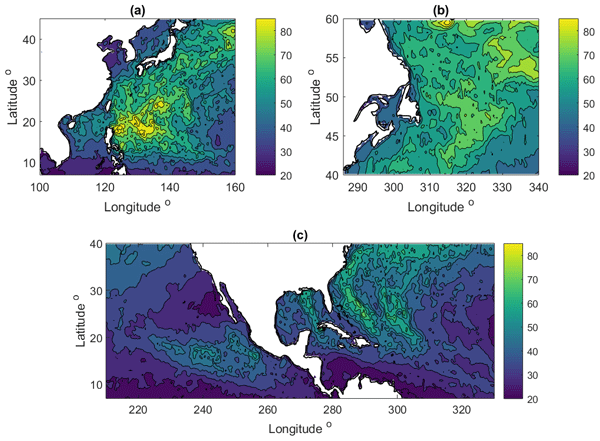
Xiaoli Guo Larsén and Søren Ott
Wind Energ. Sci., 7, 2457–2468, https://doi.org/10.5194/wes-7-2457-2022, https://doi.org/10.5194/wes-7-2457-2022, 2022
Short summary
Short summary
A method is developed for calculating the extreme wind in tropical-cyclone-affected water areas. The method is based on the spectral correction method that fills in the missing wind variability to the modeled time series, guided by best track data. The paper provides a detailed recipe for applying the method and the 50-year winds of equivalent 10 min temporal resolution from 10 to 150 m in several tropical-cyclone-affected regions.
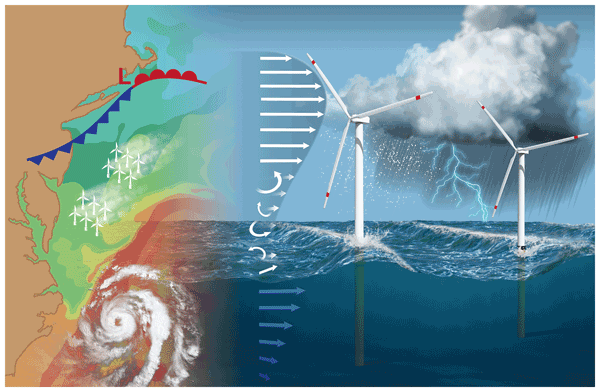
William J. Shaw, Larry K. Berg, Mithu Debnath, Georgios Deskos, Caroline Draxl, Virendra P. Ghate, Charlotte B. Hasager, Rao Kotamarthi, Jeffrey D. Mirocha, Paytsar Muradyan, William J. Pringle, David D. Turner, and James M. Wilczak
Wind Energ. Sci., 7, 2307–2334, https://doi.org/10.5194/wes-7-2307-2022, https://doi.org/10.5194/wes-7-2307-2022, 2022
Short summary
Short summary
This paper provides a review of prominent scientific challenges to characterizing the offshore wind resource using as examples phenomena that occur in the rapidly developing wind energy areas off the United States. The paper also describes the current state of modeling and observations in the marine atmospheric boundary layer and provides specific recommendations for filling key current knowledge gaps.
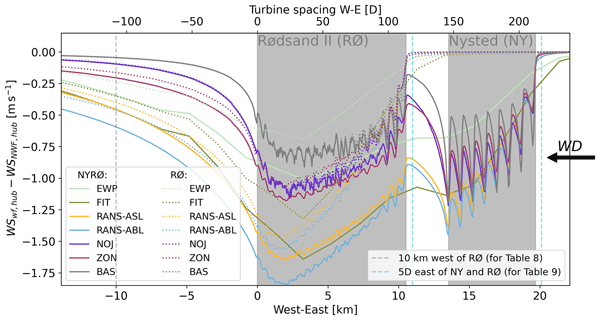
Jana Fischereit, Kurt Schaldemose Hansen, Xiaoli Guo Larsén, Maarten Paul van der Laan, Pierre-Elouan Réthoré, and Juan Pablo Murcia Leon
Wind Energ. Sci., 7, 1069–1091, https://doi.org/10.5194/wes-7-1069-2022, https://doi.org/10.5194/wes-7-1069-2022, 2022
Short summary
Short summary
Wind turbines extract kinetic energy from the flow to create electricity. This induces a wake of reduced wind speed downstream of a turbine and consequently downstream of a wind farm. Different types of numerical models have been developed to calculate this effect. In this study, we compared models of different complexity, together with measurements over two wind farms. We found that higher-fidelity models perform better and the considered rapid models cannot fully capture the wake effect.
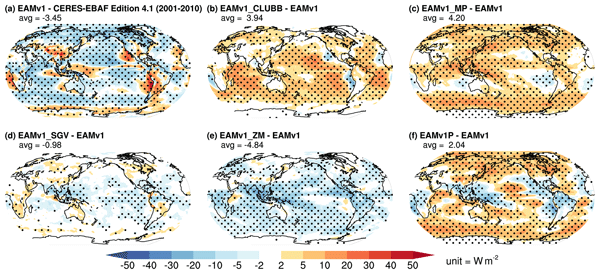
Po-Lun Ma, Bryce E. Harrop, Vincent E. Larson, Richard B. Neale, Andrew Gettelman, Hugh Morrison, Hailong Wang, Kai Zhang, Stephen A. Klein, Mark D. Zelinka, Yuying Zhang, Yun Qian, Jin-Ho Yoon, Christopher R. Jones, Meng Huang, Sheng-Lun Tai, Balwinder Singh, Peter A. Bogenschutz, Xue Zheng, Wuyin Lin, Johannes Quaas, Hélène Chepfer, Michael A. Brunke, Xubin Zeng, Johannes Mülmenstädt, Samson Hagos, Zhibo Zhang, Hua Song, Xiaohong Liu, Michael S. Pritchard, Hui Wan, Jingyu Wang, Qi Tang, Peter M. Caldwell, Jiwen Fan, Larry K. Berg, Jerome D. Fast, Mark A. Taylor, Jean-Christophe Golaz, Shaocheng Xie, Philip J. Rasch, and L. Ruby Leung
Geosci. Model Dev., 15, 2881–2916, https://doi.org/10.5194/gmd-15-2881-2022, https://doi.org/10.5194/gmd-15-2881-2022, 2022
Short summary
Short summary
An alternative set of parameters for E3SM Atmospheric Model version 1 has been developed based on a tuning strategy that focuses on clouds. When clouds in every regime are improved, other aspects of the model are also improved, even though they are not the direct targets for calibration. The recalibrated model shows a lower sensitivity to anthropogenic aerosols and surface warming, suggesting potential improvements to the simulated climate in the past and future.
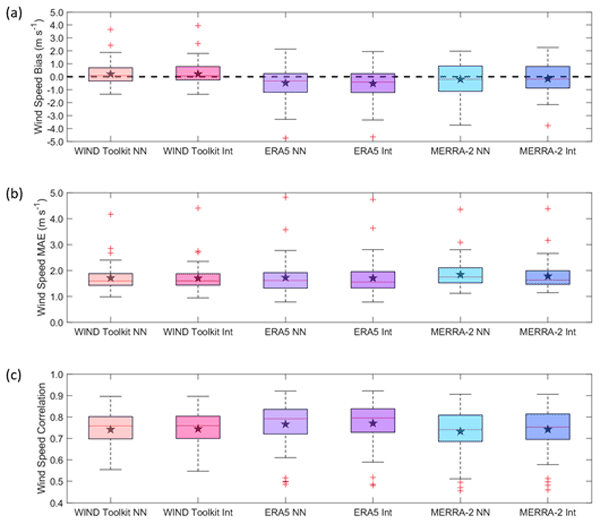
Lindsay M. Sheridan, Caleb Phillips, Alice C. Orrell, Larry K. Berg, Heidi Tinnesand, Raj K. Rai, Sagi Zisman, Dmitry Duplyakin, and Julia E. Flaherty
Wind Energ. Sci., 7, 659–676, https://doi.org/10.5194/wes-7-659-2022, https://doi.org/10.5194/wes-7-659-2022, 2022
Short summary
Short summary
The small wind community relies on simplified wind models and energy production simulation tools to obtain energy generation expectations. We gathered actual wind speed and turbine production data across the US to test the accuracy of models and tools for small wind turbines. This study provides small wind installers and owners with the error metrics and sources of error associated with using models and tools to make performance estimates, empowering them to adjust expectations accordingly.
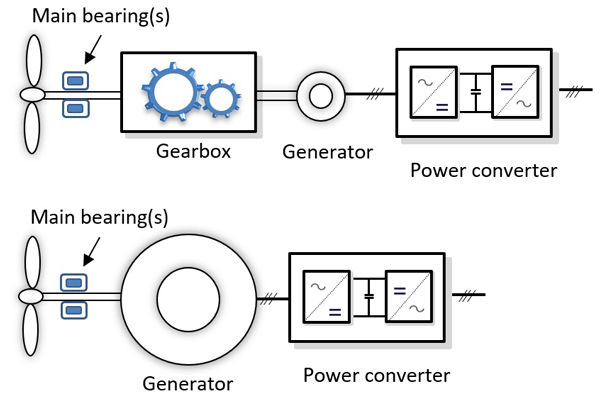
Amir R. Nejad, Jonathan Keller, Yi Guo, Shawn Sheng, Henk Polinder, Simon Watson, Jianning Dong, Zian Qin, Amir Ebrahimi, Ralf Schelenz, Francisco Gutiérrez Guzmán, Daniel Cornel, Reza Golafshan, Georg Jacobs, Bart Blockmans, Jelle Bosmans, Bert Pluymers, James Carroll, Sofia Koukoura, Edward Hart, Alasdair McDonald, Anand Natarajan, Jone Torsvik, Farid K. Moghadam, Pieter-Jan Daems, Timothy Verstraeten, Cédric Peeters, and Jan Helsen
Wind Energ. Sci., 7, 387–411, https://doi.org/10.5194/wes-7-387-2022, https://doi.org/10.5194/wes-7-387-2022, 2022
Short summary
Short summary
This paper presents the state-of-the-art technologies and development trends of wind turbine drivetrains – the energy conversion systems transferring the kinetic energy of the wind to electrical energy – in different stages of their life cycle: design, manufacturing, installation, operation, lifetime extension, decommissioning and recycling. The main aim of this article is to review the drivetrain technology development as well as to identify future challenges and research gaps.

Ingrid Neunaber, Joachim Peinke, and Martin Obligado
Wind Energ. Sci., 7, 201–219, https://doi.org/10.5194/wes-7-201-2022, https://doi.org/10.5194/wes-7-201-2022, 2022
Short summary
Short summary
Wind turbines are often clustered within wind farms. A consequence is that some wind turbines may be exposed to the wakes of other turbines, which reduces their lifetime due to the wake turbulence. Knowledge of the wake is thus important, and we carried out wind tunnel experiments to investigate the wakes. We show how models that describe wakes of bluff bodies can help to improve the understanding of wind turbine wakes and wind turbine wake models, particularly by including a virtual origin.
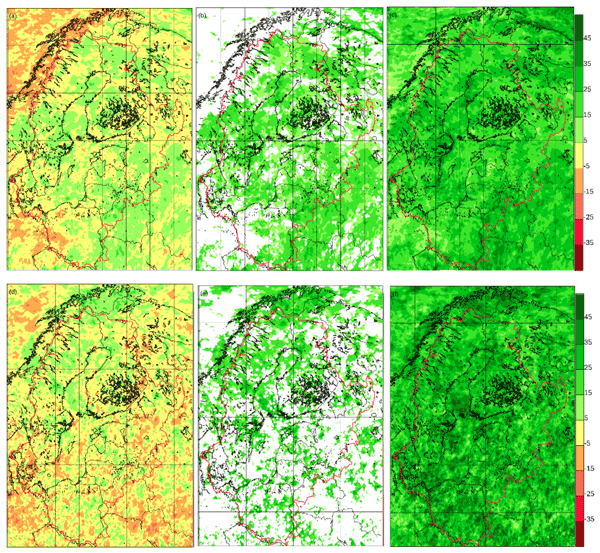
Anna Rutgersson, Erik Kjellström, Jari Haapala, Martin Stendel, Irina Danilovich, Martin Drews, Kirsti Jylhä, Pentti Kujala, Xiaoli Guo Larsén, Kirsten Halsnæs, Ilari Lehtonen, Anna Luomaranta, Erik Nilsson, Taru Olsson, Jani Särkkä, Laura Tuomi, and Norbert Wasmund
Earth Syst. Dynam., 13, 251–301, https://doi.org/10.5194/esd-13-251-2022, https://doi.org/10.5194/esd-13-251-2022, 2022
Short summary
Short summary
A natural hazard is a naturally occurring extreme event with a negative effect on people, society, or the environment; major events in the study area include wind storms, extreme waves, high and low sea level, ice ridging, heavy precipitation, sea-effect snowfall, river floods, heat waves, ice seasons, and drought. In the future, an increase in sea level, extreme precipitation, heat waves, and phytoplankton blooms is expected, and a decrease in cold spells and severe ice winters is anticipated.
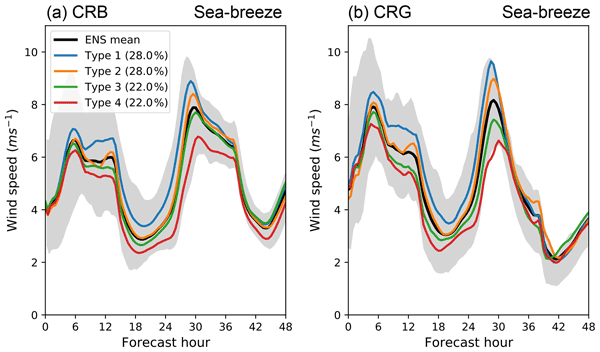
Ye Liu, Yun Qian, and Larry K. Berg
Wind Energ. Sci., 7, 37–51, https://doi.org/10.5194/wes-7-37-2022, https://doi.org/10.5194/wes-7-37-2022, 2022
Short summary
Short summary
Uncertainties in initial conditions (ICs) decrease the accuracy of wind speed forecasts. We find that IC uncertainties can alter wind speed by modulating the weather system. IC uncertainties in local thermal gradient and large-scale circulation jointly contribute to wind speed forecast uncertainties. Wind forecast accuracy in the Columbia River Basin is confined by initial uncertainties in a few specific regions, providing useful information for more intense measurement and modeling studies.
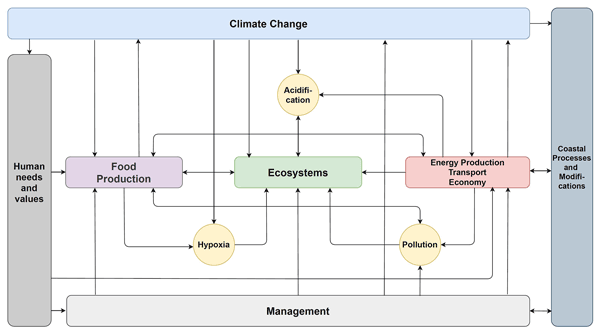
Marcus Reckermann, Anders Omstedt, Tarmo Soomere, Juris Aigars, Naveed Akhtar, Magdalena Bełdowska, Jacek Bełdowski, Tom Cronin, Michał Czub, Margit Eero, Kari Petri Hyytiäinen, Jukka-Pekka Jalkanen, Anders Kiessling, Erik Kjellström, Karol Kuliński, Xiaoli Guo Larsén, Michelle McCrackin, H. E. Markus Meier, Sonja Oberbeckmann, Kevin Parnell, Cristian Pons-Seres de Brauwer, Anneli Poska, Jarkko Saarinen, Beata Szymczycha, Emma Undeman, Anders Wörman, and Eduardo Zorita
Earth Syst. Dynam., 13, 1–80, https://doi.org/10.5194/esd-13-1-2022, https://doi.org/10.5194/esd-13-1-2022, 2022
Short summary
Short summary
As part of the Baltic Earth Assessment Reports (BEAR), we present an inventory and discussion of different human-induced factors and processes affecting the environment of the Baltic Sea region and their interrelations. Some are naturally occurring and modified by human activities, others are completely human-induced, and they are all interrelated to different degrees. The findings from this study can largely be transferred to other comparable marginal and coastal seas in the world.
Marc Imberger, Xiaoli Guo Larsén, and Neil Davis
Adv. Geosci., 56, 77–87, https://doi.org/10.5194/adgeo-56-77-2021, https://doi.org/10.5194/adgeo-56-77-2021, 2021
Short summary
Short summary
Events like mid-latitude storms with their high winds have an impact on wind energy production and forecasting of such events is crucial. This study investigates the capabilities of a global weather prediction model MPAS and looks at how key parameters like storm intensity, arrival time and duration are represented compared to measurements and traditional methods. It is found that storm intensity is represented well while model drifts negatively influence estimation of arrival time and duration.
Cited articles
Abkar, M., Sharifi, A., and Porté-Agel, F.: Wake flow in a wind farm during a diurnal cycle, J. Turbul., 17, 420–441, 2016. a
Adams, B.: Dynamic loads in wind farms 2, Tech. rep., Garrad Hassan and Partners, final report of Joule project JOU2–CT92–0094. GH-report 286/R/1, https://www.osti.gov/etdeweb/biblio/256636 (last access: 13 February 2026), 1996. a
Aird, J. A., Barthelmie, R. J., Shepherd, T. J., and Pryor, S. C.: WRF-simulated low-level jets over Iowa: characterization and sensitivity studies, Wind Energ. Sci., 6, 1015–1030, https://doi.org/10.5194/wes-6-1015-2021, 2021. a
Aird, J. A., Barthelmie, R. J., Shepherd, T. J., and Pryor, S. C.: Occurrence of low-level jets over the eastern US coastal zone at heights relevant to wind energy, Energies, 15, 445, https://doi.org/10.3390/en15020445, 2022. a, b
Aitken, M. L., Kosović, B., Mirocha, J. D., and Lundquist, J. K.: Large eddy simulation of wind turbine wake dynamics in the stable boundary layer using the Weather Research and Forecasting model, J. Renew. Sustain. Ener., 6, 033137, https://doi.org/10.1063/1.4885111, 2014. a
Akhmatov, V., Rasmussen, C., Eriksen, P. B., and Pedersen, J.: Technical aspects of status and expected future trends for wind power in Denmark, Wind Energy, 10, 31–49, 2007. a
Albers, A.: Turbulence and shear normalisation of wind turbine power curve, European Wind Energy Conference and Exhibition 2010, EWEC 2010, 6, 4116–4123, https://api.semanticscholar.org/CorpusID:202742987 (last access: 13 February 2026), 2010. a
Allaerts, D. and Meyers, J.: Gravity waves and wind-farm efficiency in neutral and stable conditions, Bound.-Lay. Meteorol., 166, https://doi.org/10.1007/s10546-017-0307-5, 2018. a
Andren, A.: The structure of stably stratified atmospheric boundary layers: a large-eddy simulation study, Q. J. Roy. Meteor. Soc., 121, 961–984, 1995. a
Ansorge, C. and Mellado, J. P.: Global intermittency and collapsing turbulence in the stratified planetary boundary layer, Bound.-Lay. Meteorol., 153, 89–116, 2014. a
Antoniou, I., Pedersen, S. M., and Enevoldsen, P. B.: Wind shear and uncertainties in power curve measurement and wind resources, Wind Eng., 33, 449–468, 2009. a
Archer, C. L. and Caldeira, K.: Global assessment of high-altitude wind power, Energies, 2, 307–319, 2009. a
Argyle, P. and Watson, S. J.: Assessing the dependence of surface layer atmospheric stability on measurement height at offshore locations, J. Wind Eng. Ind. Aerodyn., 131, 88–99, 2014. a
Arias-Arana, D., Fochesatto, G. J., Jimenez, R., and Ojeda, C.: Locally stationary wavelet analysis of nonstationary turbulent fluxes, Bound.-Lay. Meteorol., 190, 33, https://doi.org/10.1007/s10546-024-00872-y, 2024. a
Arthur, R. S., Mirocha, J. D., Marjanovic, N., Hirth, B. D., Schroeder, J. L., Wharton, S., and Chow, F. K.: Multi-scale simulation of wind farm performance during a frontal passage, Atmosphere-Basel, 11, 245, https://doi.org/10.3390/atmos11030245, 2020. a
Arya, S. P.: Air Pollution Meteorology and Dispersion, Oxford University Press, Oxford, UK, 310 pp., ISBN 9780195073980, 1999. a
Auer, S., Hellmann, F., Krause, M., and Kurths, J.: Stability of synchrony against local intermittent fluctuations in tree-like power grids, Chaos, 27, 127003, https://doi.org/10.1063/1.5001818, 2017. a
Babić, N. and De Wekker, S.: Characteristics of roll and cellular convection in a deep and wide semiarid valley: a large-eddy simulation stud, Atmos. Res., 223, 74–87, 2019. a
Banghoff, J. R., Sorber, J. D., Stensrud, D. J., Young, G. S., and Kumjian, M. R.: A 10-Year warm-season climatology of horizontal convective rolls and cellular convection in central Oklahoma, Mon. Weather Rev., 148, 21–42, 2020. a
Banta, R. M.: Stable-boundary-layer regimes from the perspective of the low-level jet, Acta Geophys., 56, 58, https://doi.org/10.2478/s11600-007-0049-8, 2008. a
Banta, R. M., Pichugina, Y. L., Kelley, N. D., Jonkman, B., and Brewer, W. A.: Doppler lidar measurements of the Great Plains low-level jet: applications to wind energy, in: IOP Conference Series: Earth and Environmental Science, 1, 012020, https://doi.org/10.1088/1755-1315/1/1/012020, 2008. a, b
Bardal, L. M., Sætran, L. R., and Wangsness, E.: Performance test of a 3MW wind turbine – effects of shear and turbulence, Energy Procedia, 80, 83–91, 2015. a
Bärfuss, K., Hankers, R., Bitter, M., Feuerle, T., Schulz, H., Rausch, T., Platis, A., Bange, J., and Lampert, A.: In-situ airborne measurements of atmospheric and sea surface parameters related to offshore wind parks in the German Bight, Flight 20160906_flight01, PANGAEA [data set], https://doi.org/10.1594/PANGAEA.902843, 2019. a, b
Barthelmie, R. J., Crippa, P., Wang, H., Smith, C. M., Krishnamurthy, R., Choukulkar, A., Calhoun, R., Valyou, D., Marzocca, P., Matthiesen, D., Brown, G., and Pryor, S. C.: 3D wind and turbulence characteristics of the atmospheric boundary layer, B. Am. Meteorol. Soc., 95, 743–756, 2014. a
Basu, S., Foufoula-Georgiou, E., Lashermes, B., and Arnéodo, A.: Estimating intermittency exponent in neutrally stratified atmospheric surface layer flows: a robust framework based on magnitude cumulant and surrogate analyses, Phys. Fluids, 19, 1–11, 2007. a
Basu, S., Vinuesa, J.-F., and Swift, A.: Dynamic LES modeling of a diurnal cycle, J. Appl. Meteorol., 47, 1156–1174, 2008. a
Basu, S., Holtslag, A. A. M., Caporaso, L., Riccio, A., and Steeneveld, G.-J.: Observational support for the stability dependence of the bulk Richardson number across the stable boundary layer, Bound.-Lay. Meteorol., 150, 515–523, 2014. a
Berg, J., Patton, E. G., and Sullivan, P. P.: Large-eddy simulation of conditionally neutral boundary layers: a mesh resolution sensitivity study, J. Atmos. Sci., 77, 1969–1991, 2020. a
Berg, L. K., Riihimaki, L. D., Qian, Y., Yan, H., and Huang, M.: The low-level jet over the southern Great Plains determined from observations and reanalyses and its impact on moisture transport, J. Climate, 28, 6682–6706, 2015. a
Berg, L. K., Newsom, R. K., and Turner, D. D.: Year-long vertical velocity statistics derived from Doppler lidar data for the continental convective boundary layer, J. Appl. Meteorol., 56, 2441–2454, 2017. a
Betz, A.: The Maximum of the Theoretically Possible Exploitation of Wind by Means of a Wind Motor, Wind Engineering, 37, 441–446, 2013. a
Bianco, L., Djalalova, I. V., Wilczak, J. M., Olson, J. B., Kenyon, J. S., Choukulkar, A., Berg, L. K., Fernando, H. J. S., Grimit, E. P., Krishnamurthy, R., Lundquist, J. K., Muradyan, P., Pekour, M., Pichugina, Y., Stoelinga, M. T., and Turner, D. D.: Impact of model improvements on 80 m wind speeds during the second Wind Forecast Improvement Project (WFIP2), Geosci. Model Dev., 12, 4803–4821, https://doi.org/10.5194/gmd-12-4803-2019, 2019. a
Blumen, W., Banta, R., Burns, S. P., Fritts, D. C., Newsom, R., Poulos, G. S., and Sun, J.: Turbulence statistics of a Kelvin–Helmholtz billow event observed in the night-time boundary layer during the Cooperative Atmosphere–Surface Exchange Study field program, Dynam. Atmos. Oceans, 34, 189–204, 2001. a
Bodini, N., Zardi, D., and Lundquist, J. K.: Three-dimensional structure of wind turbine wakes as measured by scanning lidar, Atmos. Meas. Tech., 10, 2881–2896, https://doi.org/10.5194/amt-10-2881-2017, 2017. a
Bohr, T., Jensen, M. H., Paladin, G., and Vulpiani, A.: Dynamical Systems Approach to Turbulence, Cambridge University Press, Cambridge, UK, https://doi.org/10.1017/CBO9780511599972, 1998. a
Borraccino, A., Schlipf, D., Haizmann, F., and Wagner, R.: Wind field reconstruction from nacelle-mounted lidar short-range measurements, Wind Energ. Sci., 2, 269–283, https://doi.org/10.5194/wes-2-269-2017, 2017. a
Brümmer, B., Bakan, S., and Hinzpeter, H.: KONTUR: observations of cloud streets and open cellular structures, Dynam. Atmos. Oceans, 9, 281–296, 1985. a
Bryan, G. H. and Rotunno, R.: The maximum intensity of tropical cyclones in axisymmetric numerical model simulations, Mon. Weather Rev., 137, 1770–1789, 2009. a
Burk, S. D. and Thompson, W. T.: The summertime low-level jet and marine boundary layer structure along the California coast, Mon. Weather Rev., 124, 668–686, 1996. a
Burton, T., Sharpe, D., Jenkins, N., and Bossanyi, E.: Wind Energy Handbook, John Wiley and Sons, Ltd, https://doi.org/10.1002/9781119992714, 2001. a
Busch, N. E. and Panofsky, H. A.: Recent spectra of atmospheric turbulence, Q. J. Roy. Meteor. Soc., 98, 132–148, 1968. a
Čavlina Tomašević, I., Cheung, K. K. W., Vučetić, V., Fox-Hughes, P., Horvath, K., Telišman Prtenjak, M., Beggs, P. J., Malečić, B., and Milić, V.: The 2017 Split wildfire in Croatia: evolution and the role of meteorological conditions, Nat. Hazards Earth Syst. Sci., 22, 3143–3165, https://doi.org/10.5194/nhess-22-3143-2022, 2022. a
Chamorro, L. P. and Porté-Agel, F.: Effects of thermal stability and incoming boundary-layer flow characteristics on wind-turbine wakes: a wind-tunnel study, Bound.-Lay. Meteorol., 136, 515–533, 2010. a
Chamorro, L. P., Lee, S. J., Olsen, D., Milliren, C., Marr, J., Arndt, R. E., and Sotiropoulos, F.: Turbulence effects on a full-scale 2.5 MW horizontal-axis wind turbine under neutrally stratified conditions, Wind Energy, 18, 339–349, 2015. a
Chatterjee, T., Li, J., Yellapantula, S., Jayaraman, B., and Quon, E.: Wind farm response to mesoscale-driven coastal low level jets: a multiscale large eddy simulation study, J. Phys. Conf. Ser., 2265, 022004, https://doi.org/10.1088/1742-6596/2265/2/022004, 2022. a
Chen, Y., Yuan, H., and Gao, S.: A high-resolution simulation of roll convection over the Yellow Sea during a cold air outbreak, J. Geophys. Res.-Atmos., 124, 10608–10625, 2019. a
Cheynet, E., Daniotti, N., Bogunović Jakobsen, J., Snæbjörnsson, J., and Wang, J.: Unfrozen skewed turbulence for wind loading on structures, Appl. Sci., 12, https://doi.org/10.3390/app12199537, 2022. a, b
Chougule, A., Mann, J., Kelly, M., and Larsen, G. C.: Modeling atmospheric turbulence via rapid distortion theory: spectral tensor of velocity and buoyancy, J. Atmos. Sci., 74, 949–974, 2017. a
Chow, F. K. and Street, R. L.: Evaluation of turbulence closure models for large-eddy simulation over complex terrain: flow over Askervein Hill, J. Appl. Meteorol., 48, 1050–1065, 2009. a
Chow, F. K., Weigel, A. P., Street, R. L., Rotach, M. W., and Xue, M.: High-resolution large-eddy simulations of flow in a steep Alpine valley. Part I: Methodology, verification, and sensitivity experiments, J. Appl. Meteorol., 45, 63–86, 2006. a
Chow, F. K., Schär, C., Ban, N., Lundquist, K. A., Schlemmer, L., and Shi, X.: Crossing multiple gray zones in the transition from mesoscale to microscale simulation over complex terrain, Atmosphere-Basel, 10, 1–38, 2019. a
Churchfield, M. J., Lee, S., Michalakes, J., and Moriarty, P. J.: A numerical study of the effects of atmospheric and wake turbulence on wind turbine dynamics, J. Turbul., 13, N14, https://doi.org/10.1080/14685248.2012.668191, 2012. a
Clifton, A. and Wagner, R.: Accounting for the effect of turbulence on wind turbine power curves, J. Phys. Conf. Ser., 524, https://doi.org/10.1088/1742-6596/524/1/012109, 2014. a, b
Clifton, A., Barber, S., Stökl, A., Frank, H., and Karlsson, T.: Research challenges and needs for the deployment of wind energy in hilly and mountainous regions, Wind Energ. Sci., 7, 2231–2254, https://doi.org/10.5194/wes-7-2231-2022, 2022. a, b
Cosack, N., Emeis, S., and Kühn, M.: On the influence of low-level jets on energy production and loading of wind turbines, in: Wind Energy: Proceedings of the Euromech Colloquium, 325–328, https://doi.org/10.1007/978-3-540-33866-6_61, 2007. a
Counihan, J. C.: Adiabatic atmospheric boundary layers: a review and analysis of data from the period 1880–1972, Atmos. Environ., 9, 871–905, 1975. a
Dahlberg, J., Poppen, M., and Thor, S.: Load/fatigue effects on a wind turbine generator in a wind farm, J. Wind Eng. Ind. Aerodyn., 39, 199–209, 1992. a
Damiani, R., Dana, S., Annoni, J., Fleming, P., Roadman, J., van Dam, J., and Dykes, K.: Assessment of wind turbine component loads under yaw-offset conditions, Wind Energ. Sci., 3, 173–189, https://doi.org/10.5194/wes-3-173-2018, 2018. a
Dar, A. S. and Porté-Agel, F.: Influence of wind direction on flow over a cliff and its interaction with a wind turbine wake, Phys. Rev. Fluids, 9, 064604, https://doi.org/10.1103/PhysRevFluids.9.064604, 2024. a
Davenport, A. G.: The response of a slender line-like structure to a gusty wind, P. I. Civil Eng.-Civ. En., 23, 389–408, https://doi.org/10.1680/iicep.1962.10876, 1962. a
Davis, N. N., Badger, J., Hahmann, A. N., Hansen, B. O., Mortensen, N. G., Kelly, M., Larsén, X. G., Olsen, B. T., Floors, R., Lizcano, G., Casso, P., Lacave, O., Bosch, A., Bauwens, I., Knight, O. J., van Loon, A. P., Fox, R., Parvanyan, T., Hansen, S. B. K., Heathfield, D., Onninen, M., and Drummond, R.: The global wind atlas – a high-resolution dataset of climatologies and associated web-based application, B. Am. Meteorol. Soc., 104, E1507–E1525, 2023. a
de Jong, E., Quon, E., and Yellapantula, S.: Mechanisms of low-level jet formation in the U.S. mid-Atlantic offshore, J. Atmos. Sci., 81, 31–52, 2024. a
de Maré, M. and Mann, J.: On the space-time structure of sheared turbulence, Bound.-Lay. Meteorol., 160, 453–474, 2016. a
de Vries, O.: Fluid dynamic aspects of wind energy conversion, Tech. rep., NATO Advisory Group for Aerospace Research and Development, National Aerospace Laboratory, the Netherlands, report No. AGARD-AG-243, https://apps.dtic.mil/sti/citations/ADA076315 (last access: 5 February 2026), 1978. a
Deardorff, J. W.: Numerical investigation of neutral and unstable planetary boundary layers, J. Atmos. Sci., 29, 91–115, 1972. a
Debnath, M., Doubrawa, P., Optis, M., Hawbecker, P., and Bodini, N.: Extreme wind shear events in US offshore wind energy areas and the role of induced stratification, Wind Energ. Sci., 6, 1043–1059, https://doi.org/10.5194/wes-6-1043-2021, 2021. a
Debnath, M., Moriarty, P., Krishnamurthy, R., Bodini, N., Newsom, R., Quon, E., Lundquist, J. K., Letizia, S., Iungo, G. V., and Klein, P.: Characterization of wind speed and directional shear at the AWAKEN field campaign site, J. Renew. Sustain. Ener., 15, 033308, https://doi.org/10.1063/5.0139737, 2023. a
DeMarco, A. and Basu, S.: On the tails of the wind ramp distributions, Wind Energy, 21, 892–905, 2018. a
Dettling, S., Haupt, S. E., Brummet, T., Kosovic, B., Gagne, D. J., and Jimenez, P. A.: Downscaling from mesoscale to microscale in complex terrain using a compound Generative Adversarial Network, Artif. Intell. Earth Syst., 4, 1–17, 2025. a
Dimitrov, N., Natarajan, A., and Mann, J.: Effects of normal and extreme turbulence spectral parameters on wind turbine loads, Renew. Energy, 101, 1180–1193, 2017. a
Dimitrov, N., Pedersen, M., and Hannesdóttir, Á.: An open-source Python-based tool for Mann turbulence generation with constraints and non-Gaussian capabilities, J. Phys. Conf. Ser., 2767, 052058, https://doi.org/10.1088/1742-6596/2767/5/052058, 2024. a, b
Doosttalab, A., Siguenza-Alvarado, D., Pulletikurthi, V., Jin, Y., Bocanegra E, H., Chamorro, L. P., and Castillo, L.: Interaction of low-level jets with wind turbines: on the basic mechanisms for enhanced performance, J. Renew. Sustain. Ener., 12, 053301, https://doi.org/10.1063/5.0017230, 2020. a
Doran, J. C., Fast, J. D., and Horel, J.: VTMX 2000 campaign, B. Am. Meteorol. Soc., 83, 537–551, 2002. a
Dörenkämper, M., Tambke, J., Steinfeld, G., Heinemann, D., and Kühn, M.: Atmospheric impacts on power curves of multi-megawatt offshore wind turbines, J. Phys. Conf. Ser., 555, https://doi.org/10.1088/1742-6596/555/1/012029, 2014. a
Draxl, C., Worsnop, R. P., Xia, G., Pichugina, Y., Chand, D., Lundquist, J. K., Sharp, J., Wedam, G., Wilczak, J. M., and Berg, L. K.: Mountain waves can impact wind power generation, Wind Energ. Sci., 6, 45–60, https://doi.org/10.5194/wes-6-45-2021, 2021. a, b
Duarte, H. F., Leclerc, M. Y., and Zhang, G.: Assessing the shear-sheltering theory applied to low-level jets in the nocturnal stable boundary layer, Theor. Appl. Climatol., 110, 359–371, 2012. a
Durran, D. R.: Mountain Waves and Downslope Winds, in: Atmospheric Processes over Complex Terrain. Meteorological Monographs, vol. 23, edited by: Blumen, W., American Meteorological Society, Boston, MA, 59–81, https://doi.org/10.1007/978-1-935704-25-6_4, 1990. a
El Kasim, A. and Masson, C.: Turbulence modeling of atmospheric boundary layer flow over complex terrain: a comparison of models at wind tunnel and full scale, Wind Energy, 13, 689–704, 2010. a
Elderkin, C. E.: Experimental investigation of the turbulence structure in the lower atmosphere, AEC Research and Development Report BNWL-329, Battelle Memorial Institute, Pacific Northwest Laboratory, https://digital.library.unt.edu/ark:/67531/metadc1026155/ (last access: 5 February 2026), 1966. a
Elliot, D. L. and Cadogan, J. B.: Effects of wind shear and turbulence on wind turbine power curves, Tech. rep., Pacific Northwest Lab, Richland, WA, No. PNL-SA-18354; CONF-900989-2, https://www.osti.gov/biblio/6348447 (last access: 5 February 2026), 1990. a
Emeis, S.: Wind speed and shear associated with low-level jets over northern Germany, Meteorol. Z., 23, 295–304, 2014. a
Ertek, G. and Kailas, L.: Analyzing a decade of wind turbine accident news with topic modeling, Sustainability, 13, https://doi.org/10.3390/su132212757, 2021. a
Etling, D. and Brown, R. A.: Roll vortices in the planetary boundary layer: a review, Bound.-Lay. Meteorol., 65, 215–248, 1993. a
Fernando, H. J. S., PardyJak, E. R., di Sabatino, S., Chow, F. K., de Wekker, S. F. J., S. w. Hoch, S. W., Hacker, J., Pace, J. C., Pratt, T., Pu, Z., Steenburgh, W. J., Whiteman, C. D., wang, Y., Zajic, D., Balsley, B., Dimitrova, R., Emmitt, G. D., Higgins, C. W., Hunt, J. C. R., Knievel, J. C., Lawrence, D., Liu, Y., Nadeau, D. F., Kit, E., Blomquist, B. W., P. Conry, P., Coppersmith, R. S., Creegan, E., Felton, M., Grachev, A., Gunawardena, N., Hang, C., Hocut, C. M., Huynh, G., Jeglum, M. E., Jensen, D., Kulandaivelu, V., Lehner, M., Leo, L. S., Liberzon, D., Massey, J. D., Mcenerney, K., Pal, S., Price, T., Sghiatti, M., Silver, Z., Thompson, M., Zhang, H., and Zsedrovits, T.: The MATERHORN: unraveling the intricacies of mountain weather, B. Am. Meteorol. Soc., 96, 1945–1967, 2015. a
Fernando, H. J. S., Mann, J., Palma, J. M. L. M., Lundquist, J. K., Barthelmie, R. J., Belo-Pereira, M., Brown, W. O. J., Chow, F. K., Gerz, T., Hocut, C. M., Klein, P. M., Leo, L. S., Matos, J. C., Oncley, S. P., Pryor, S. C., Bariteau, L., Bell, T. M., Bodini, N., Carney, M. B., Courtney, M. S., Creegan, E. D., Dimitrova, R., Gomes, S., Hagen, M., Hyde, J. O., Kigle, S., Krishnamurthy, R., Lopes, J. C., Mazzaro, L., Neher, J. M. T., Menke, R., Murphy, P., Oswald, L., Otarola-Bustos, S., Pattantyus, A. K., Rodrigues, C. V., Schady, A., Sirin, N., Spuler, S., Svensson, E., Tomaszewski, J., Turner, D. D., van Veen, L., Vasiljević, N., Vassallo, D., Voss, S., Wildmann, N., and Wang, Y.: The Perdigão: peering into microscale details of mountain winds, B. Am. Meteorol. Soc., 100, 799–819, 2019. a
Fovell, R. G. and Cao, Y.: The Santa Ana winds of Southern California: winds, gusts, and the 2007 Witch fire, Wind Struct., 24, 529–564, 2017. a
Frandsen, S.: Turbulence and turbulence-generated fatigue loading in wind turbine clusters, Risoe National Laboratory, Roskilde, 128, ISBN 87-550-3458-6, 2005. a
Frandsen, S. and Thomsen, K.: Change in fatigue and extreme loading when moving wind farms offshore, Wind Engineering, 21, 197–214, 1997. a
Frost, R.: The velocity profile in the lowest 400 feet, Meteorol. Mag., 76, 14–17, 1947. a
Fuchs, A., Kharche, S., Patil, A., Friedrich, J., Wächter, M., and Peinke, J.: An open source package to perform basic and advanced statistical analysis of turbulence data and other complex systems, Phys. Fluids, 34, https://doi.org/10.1063/5.0107974, 2022. a
Fujita, T. T.: The Downburst, Microburst, and Macroburst. Satellite and Mesometeorology Research Project, University of Chicago, Research Paper Number 210, 1985. a
Gadde, S. N. and Stevens, R. J. A. M.: Effect of turbine-height on wind farm performance in the presence of a low-level jet, J. Renew. Sustain. Ener., 13, 013305, https://doi.org/10.1063/5.0026232, 2021a. a
Gadde, S. N. and Stevens, R. J. A. M.: Interaction between low-level jets and wind farms in a stable atmospheric boundary layer, Phys. Rev. Fluids, 6, 014603, https://doi.org/10.1103/PhysRevFluids.6.014603, 2021b. a
Gadde, S., Liu, L., and Stevens, R. J. A. M.: Effect of low-level jet on turbine aerodynamic blade loading using large-eddy simulations, J. Phys. Conf. Ser., 1934, 012001, https://doi.org/10.1088/1742-6596/1934/1/012001, 2021. a
Gambuzza, S. and Ganapathisubramani, B.: The effects of free-stream turbulence on the performance of a model wind turbine, J. Renew. Sustain. Ener., 13, 23304, https://doi.org/10.1063/5.0039168, 2021. a, b
Gimeno, L., Dominguez, F., Nieto, R., Trigo, R., Drumond, A., Reason, C. J. C., Taschetto, A. S., Ramos, A. M., Kumar, R., and Marengo, J.: Major mechanisms of atmospheric moisture transport and their role in extreme precipitation events, Annu. Rev. Environ. Resour., 41, 117–141, 2016. a
Global Wind Report: Global Wind Energy Council: Global Wind Report 2024, https://www.gwec.net/reports/globalwindreport (last access: 4 March 2025), 2024. a
Göçmen, T., Larsén, X. G., and Imberger, M.: The effects of open cellular convection on wind farm operation and wakes, J. Phys. Conf. Ser., 1618, 062014, https://doi.org/10.1088/1742-6596/1618/6/062014, 2020. a
Gorton, A. M. and Shaw, W. J.: Advancing offshore wind resource characterization using buoy-based observations, Mar. Technol. Soc. J., 54, 37–43, 2020. a
Grachev, A. A. and Fairall, C. W.: Dependence of the Monin–Obukhov stability parameter on the bulk Richardson number over the ocean, J. Appl. Meteorol., 36, 406–414, 1997. a
Grinderslev, C., Nørmark Sørensen, N., Raimund Pirrung, G., and González Horcas, S.: Multiple limit cycle amplitudes in high-fidelity predictions of standstill wind turbine blade vibrations, Wind Energ. Sci., 7, 2201–2213, https://doi.org/10.5194/wes-7-2201-2022, 2022. a
Grinderslev, C., Houtin-Mongrolle, F., Nørmark Sørensen, N., Raimund Pirrung, G., Jacobs, P., Ahmed, A., and Duboc, B.: Forced-motion simulations of vortex-induced vibrations of wind turbine blades – a study of sensitivities, Wind Energ. Sci., 8, 1625–1638, https://doi.org/10.5194/wes-8-1625-2023, 2023. a
Grubišić, V., Doyle, J. D., Kuettner, J., Mobbs, S., Smith, R. B., Whiteman, C. D., Dirks, R. A., Czyzyk, S., Cohn, S. A., Vosper, S., Weissmann, M., Haimov, S., De Wekker, S. F., Pan, L., and Chow, F. K.: The terrain-induced rotor experiment: a field campaign overview including observational highlights, B. Am. Meteorol. Soc., 89, 1513–1533, 2008. a
Guo, F., Mann, J., Peña, A., Schlipf, D., and Cheng, P. W.: The space-time structure of turbulence for lidar-assisted wind turbine control, Renew. Energy, 195, 293–310, 2022. a
Gutierrez, W., Araya, G., Kiliyanpilakkil, P., Ruiz-Columbie, A., Tutkun, M., and Castillo, L.: Structural impact assessment of low level jets over wind turbines, J. Renew. Sustain. Ener., 8, 023308, https://doi.org/10.1063/1.4945359, 2016. a, b, c
Gutierrez, W., Ruiz-Columbie, A., Tutkun, M., and Castillo, L.: Impacts of the low-level jet's negative wind shear on the wind turbine, Wind Energ. Sci., 2, 533–545, https://doi.org/10.5194/wes-2-533-2017, 2017. a
Haehne, H., Schottler, J., Waechter, M., Peinke, J., and Kamps, O.: The footprint of atmospheric turbulence in power grid frequency measurements, Europhys. Lett., 121, 30001, https://doi.org/10.1209/0295-5075/121/30001, 2018. a
Haid, M., Gohm, A., Umek, L., Ward, H. C., Muschinski, T., Lehner, L., and Rotach, M. W.: Foehn–cold pool interactions in the Inn Valley during PIANO IOP2. Q. J. Roy. Meteor. Soc., 146, 1232–1263, https://doi.org/10.1002/qj.3735, 2020. a
Hallgren, C., Arnqvist, J., Nilsson, E., Ivanell, S., Shapkalijevski, M., Thomasson, A., Pettersson, H., and Sahlée, E.: Classification and properties of non-idealized coastal wind profiles – an observational study, Wind Energ. Sci., 7, 1183–1207, https://doi.org/10.5194/wes-7-1183-2022, 2022. a
Haupt, S. E., Kosović, B., Shaw, W., Berg, L. K., Churchfield, M. J., Cline, J., Draxl, C., Ennis, B., Koo, E., Kotamarthi, R., Mazzaro, L., Mirocha, J., Moriarty, P., Muñoz-Esparza, D., Quon, E., Rai, R. K., Robinson, M., and Sever, G.: On bridging a modeling scale gap: mesoscale to microscale coupling for wind energy, B. Am. Meteorol. Soc., 100, 2533–2550, 2019. a, b, c
Hawbecker, P., Basu, S., and Manuel, L.: Investigating the impact of atmospheric stability on thunderstorm outflow winds and turbulence, Wind Energ. Sci., 3, 203–219, https://doi.org/10.5194/wes-3-203-2018, 2018. a
He, P. and Basu, S.: Direct numerical simulation of intermittent turbulence under stably stratified conditions, Nonlin. Processes Geophys., 22, 447–471, 2015. a
Held, D. P. and Mann, J.: Detection of wakes in the inflow of turbines using nacelle lidars, Wind Energ. Sci., 4, 407–420, https://doi.org/10.5194/wes-4-407-2019, 2019. a
Herring, J. R.: Statistical theory of quasi-geostrophic turbulence, J. Atmos. Sci., 37, 969–977, 1980. a
Hirth, B. D., Schroeder, J. L., Gunter, W. S., and Guynes, J. G.: Measuring a utility-scale turbine wake using the TTUKa mobile research radars, J. Atmos. Ocean. Tech., 29, 766–771, 2012. a
Hodgson, E. L., Troldborg, N., and Andersen, S. J.: Impact of freestream turbulence integral length scale on wind farm flows and power generation, Renew. Energy, 238, 121804, https://doi.org/10.1016/j.renene.2024.121804, 2025. a
Högström, U. and Smedman-Högström, A.-S.: Turbulence mechanisms at an agricultural site, Bound.-Lay. Meteorol., 105, 373–389, 1974. a
Hölling, M., Peinke, J., and Ivanell, S. (Eds.): Wind Energy – Impact of Turbulence, Research Topics in Wind Energy, Springer, Heidelberg, Germany, https://doi.org/10.1007/978-3-642-54696-9, 2014. a
Holmes, J. D.: Wind loading of structures, CRC Press, London, UK, 2nd edn., 379 pp., https://doi.org/10.1201/b18029, 2007. a, b
Holtslag, M. C., Bierbooms, W. A., and van Bussel, G. J.: Wind turbine fatigue loads as a function of atmospheric conditions offshore, Wind Energy, 19, 1917–1932, 2016. a
Honrubia, A., Vigueras-Rodríguez, A., and Gómez-Lázaro, E.: The influence of turbulence and vertical wind profile in wind turbine power curve, Springer Proc. Phys., 141, 251–254, 2012. a
Horst, T. W., Kleissl, J., Lenschow, D. H., Meneveau, C., Moeng, C.-H., Parlange, M. B., Sullivan, P. P., and Weil, J. C.: HATS: field observations to obtain spatially filtered turbulence fields from crosswind arrays of sonic anemometers in the atmospheric surface layer, J. Atmos. Sci., 61, 1566–1581, 2004. a, b
Howell, J. F. and Mahrt, L.: Multiresolution flux decomposition, Bound.-Lay. Meteorol., 83, 117–137, 1997. a
Hsu, W. and yih Sun, W.: Numerical study of mesoscale cellular convection, Bound.-Lay. Meteorol., 57, 167–186, 1991. a
Hu, W., Letson, F., Barthelmie, R. J., and Pryor, S. C.: Wind gust characterization at wind turbine relevant heights in moderately complex terrain, J. Appl. Meteorol., 57, 1459–1476, 2018. a
Imberger, M., Larsén, X. G., and Davis, N.: Investigation of spatial and temporal wind-speed variability during open cellular convection with the model for prediction across scales in comparison with measurements, Bound.-Lay. Meteorol., 179, 291–312, 2013. a
International Electrotechnical Commission: Wind Turbine Generator System Part 1: Design Requirements, 3rd edn., International Electrotechnical Commission, IEC 61400-1, Geneva, Switzerland, ISBN 2831881617, 2005. a
International Electrotechnical Commission: IEC 61400-3-1:2019 – Wind energy generation systems – Part 3-1: Design requirements for fixed offshore wind turbines, Tech. rep., International Electrotechnical Commission, ISBN 9782832276099, 2019b. a
Irwin, J.: A theoretical variation of the wind profile power-law exponent as a function of surface roughness and stability, Atmos. Environ., 13, 191–194, 1979. a
Ishihara, T., Yamaguchi, A., Takahara, K., Mekaru, T., and Matsuura, S.: An analysis of damaged wind turbines by typhoon Maemi in 2003, in: Proceedings of the sixth asia-pacific conference on wind engineering, https://windeng.t.u-tokyo.ac.jp/ishihara/paper/2005-5.pdf (last access: 5 February 2026), 1413–1428, 2005. a
Johns Hopkins University: Johns Hopkins Turbulence Databases, https://turbulence.pha.jhu.edu/ (last access: 4 March 2025), 2021. a
Jonkman, B. and Jonkman, J.: FAST User's Guide: Version 8, Tech. rep., National Renewable Energy Laboratory, Golden, CO, https://www.nrel.gov/wind/nwtc/fastv8.html (last access: 5 February 2026), 2016. a
Jonkman, J. and Sprague, M.: OpenFAST Documentation, https://openfast.readthedocs.io/en/main/ (last access: 4 March 2025), 2024. a
Joukowsky, N. E.: Windmill of the NEJ type, Transactions of the Central Institute for Aero-Hydrodynamics of Moscow. Also published in Joukowsky N E. Collected Papers Vol. VI, The Joukowsky Institute for Aero-Hydrodynamics, Moscow, Vol. VI, 405–409, 1937, 1920 (in Russian). a
Juliano, T. W., Kosović, B., Jiménez, P. A., Eghdami, M., Haupt, S. E., and Martilli, A.: “Gray Zone” simulations using a three-dimensional planetary boundary layer parameterization in the Weather Research and Forecasting model, Mon. Weather Rev., 150, 1585–1619, 2022. a
Juliano, T. W., Szasdi-Bardales, F., Lareau, N. P., Shamsaei, K., Kosović, B., Elhami-Khorasani, N., James, E. P., and Ebrahimian, H.: Brief communication: The Lahaina Fire disaster – how models can be used to understand and predict wildfires, Nat. Hazards Earth Syst. Sci., 24, 47–52, https://doi.org/10.5194/nhess-24-47-2024, 2024. a
Kaimal, J. C.: Horizontal velocity spectra in an unstable surface layer, J. Atmos. Sci., 35, 14–24, 1978. a
Kaimal, J. C.: Flux and profile measurements from towers in the boundary layer, in: Probing the Atmospheric Boundary Layer, edited by: Lenschow, D. H., American Meteorological Society, Boston, MA, 19–28, https://doi.org/10.1007/978-1-944970-14-7, 1986. a
Kalverla, P. C., Steeneveld, G.-J., Ronda, R. J., and Holtslag, A. A. M.: An observational climatology of anomalous wind events at offshore meteomast IJmuiden (North Sea), J. Wind Eng. Ind. Aerodyn., 165, 86–99, 2017. a
Kalverla, P. C., Duncan Jr., J. B., Steeneveld, G.-J., and Holtslag, A. A. M.: Low-level jets over the North Sea based on ERA5 and observations: together they do better, Wind Energ. Sci., 4, 193–209, https://doi.org/10.5194/wes-4-193-2019, 2019. a
Kapoor, A., Ouakka, S., Arwade, S. R., Lundquist, J. K., Lackner, M. A., Myers, A. T., Worsnop, R. P., and Bryan, G. H.: Hurricane eyewall winds and structural response of wind turbines, Wind Energ. Sci., 5, 89–104, https://doi.org/10.5194/wes-5-89-2020, 2020. a, b
Kawashima, Y. and Uchida, T.: Effects of terrain-induced turbulence on wind turbine blade fatigue loads, Energy and Power Engineering, 15, 843–857, 2018. a
Kelley, N., Shirazi, M., Jager, D., Wilde, S., Patton, E. G., and Sullivan, P.: Lamar low-level jet project interim report, National Renewable Energy Laboratory, 216, https://doi.org/10.2172/15006544, 2004. a
Kelley, N. D.: Turbulence-turbine interaction: The basis for the development of the TurbSim stochastic simulator, Tech. Rep., NREL/TP-5000-52353, National Renewable Energy Laboratory, Golden, CO, https://doi.org/10.2172/1031981, 2011. a, b
Kelley, N. D. and Jonkman, B.: Overview of the TurbSim stochastic inflow turbulence simulator, Tech. Rep. NREL/TP-500-41137, National Renewable Energy Lab (NREL), Golden, CO (US), https://doi.org/10.2172/903073, 2007. a, b
Kelley, N. D., Jonkman, B., and Scott, G.: Great Plains turbulence environment: Its origins, impact, and simulation, Tech. rep., National Renewable Energy Lab (NREL), Golden, CO (US), nREL/CP-500-40176, https://www.nrel.gov/docs/fy07osti/40176.pdf (last access: 5 February 2026), 2006. a
Kim, D. Y., Kim, Y. H., and Kim, B. S.: Changes in wind turbine power characteristics and annual energy production due to atmospheric stability, turbulence intensity, and wind shear, Energy, 214, https://doi.org/10.1016/j.energy.2020.119051, 2021. a
Kitamura, Y. and Matsuda, Y.: Energy cascade processes in rotating stratified turbulence with application to the atmospheric mesoscale, J. Geophys. Res.-Atmos., 115, https://doi.org/10.1029/2009JD012368, 2010. a
Kolmogorov, A. N.: The local structure of turbulence in incompressible viscous fluid for very large Reynolds numbers, Dokl. Akad. Nauk SSSR+, 30, 301–305, 1941. a
Kosović, B. and Curry, J. A.: A large eddy simulation study of a quasi-steady, stably stratified atmospheric boundary layer, J. Atmos. Sci., 57, 1052–1068, 2000. a
Kosović, B., Munoz, P. J., Juliano, T. W., Martilli, A., Eghdami, M., Barros, A. P., and Haupt, S. E.: Three-dimensional planetary boundary layer parameterization for high-resolution mesoscale simulations, J. Phys. Conf. Ser., 1452, 012080, https://doi.org/10.1088/1742-6596/1452/1/012080, 2020. a
Kozmar, H. and Grisogono, B.: Characteristics of downslope windstorms in the view of the typical atmospheric boundary layer, in: The Oxford Handbook of Non-Synoptic Wind Storms, edited by: Hangan, H. and Kareem, A., Chap. 5, Oxford University Press, Oxford, https://doi.org/10.1093/oxfordhb/9780190670252.013.15, 85–114, 2020. a
Kuettner, J. P.: Cloud bands in the earth's atmosphere: observations and theory, Tellus, 23, 404–426, 1971. a
Kusaka, H. and Fudeyasu, H.: Review of downslope windstorms in Japan, Wind Struct., 24, 637–656, 2017. a
Laks, J. H., Pao, L. Y., and Wright, A. D.: Control of wind turbines: past, present, and future, in: Proceedings of the 2009 American Control Conference, St. Louis, MO, USA, 2096–2103, https://doi.org/10.1109/ACC.2009.5160590, 2009. a
Lanchester, F. W.: A contribution to the theory of propulsion and the screw propeller, Journal of the American Society for Naval Engineers, 27, 509–510, 1915. a
Lange, J., Mann, J., Berg, J., Parvu, D., Kilpatrick, R., Costache, A., Chowdhury, J., Siddiqui, K., and Hangan, H.: For wind turbines in complex terrain, the devil is in the detail, Environ. Res. Lett., 12, 094020, https://doi.org/10.1088/1748-9326/aa81db, 2017. a
Lanzilao, L. and Meyers, J.: Set-point optimization in wind farms to mitigate effects of flow blockage induced by atmospheric gravity waves, Wind Energ. Sci., 6, 247–271, https://doi.org/10.5194/wes-6-247-2021, 2021. a
Larsén, X. G. and Fischereit, J.: A case study of wind farm effects using two wake parameterizations in the Weather Research and Forecasting (WRF) model (V3.7.1) in the presence of low-level jets, Geosci. Model Dev., 14, 3141–3158, https://doi.org/10.5194/gmd-14-3141-2021, 2021. a, b
Larsén, X. G., Larsen, S., and Hamann, A. N.: Origin of the waves in `A case-study of mesoscale spectra of wind and temperature, observed and simulated': Lee waves from the Norwegian mountains, Q. J. Roy. Meteor. Soc., 138, 274–279, 2011. a
Larsén, X. G., Petersen, E. L., and Larsen, S. E.: Variation of boundary-layer wind spectra with height, Q. J. Roy. Meteor. Soc., 144, 2054–2066, 2018. a
Laursen, K. K., Jorgensen, D. P., Brasseur, G. P., Ustin, S. L., and Huning, J. R.: HIAPER: the next generation NSF/NCAR research aircraft, B. Am. Meteorol. Soc., 87, 896–910, 2006. a
Lavery, T. F., Bass, A., Strimaitis, D. G., Venkatram, A., Green, B. R., Drivas, P. J., and Egan, B. A.: EPA Complex Terrain Model Development, Tech. Rep. EPA-600/3-82-036, Environmental Science Research Laboratory, U.S. Environmental Protection Agency, Concord, Massachusetts, https://nepis.epa.gov/Exe/ZyPDF.cgi/30000IK2.PDF?Dockey=30000IK2.PDF (last access: 5 February 2026), 1982. a
Lee, J. C. Y., Stuart, P., Clifton, A., Fields, M. J., Perr-Sauer, J., Williams, L., Cameron, L., Geer, T., and Housley, P.: The Power Curve Working Group's assessment of wind turbine power performance prediction methods, Wind Energ. Sci., 5, 199–223, https://doi.org/10.5194/wes-5-199-2020, 2020. a, b
Lee, S., Churchfield, M., Moriarty, P., Jonkman, J., and Michalakes, J.: A numerical study of atmospheric and wake turbulence impacts on wind turbine fatigue loadings, J. Solar Energy Eng., 135, https://doi.org/10.1115/1.4023319, 2013. a
Lee, S., Churchfield, M., Driscoll, F., Sirnivas, S., Jonkman, J., Moriarty, P., Skaare, B., Nielsen, F. G., and Byklum, E.: Load estimation of offshore wind turbines, Energies, 11, 1895, https://doi.org/10.3390/en11071895, 2018. a, b
Lehner, M. and Rotach, M. W.: The performance of a time-varying filter time under stable conditions over mountainous terrain, Bound.-Lay. Meteorol., 188, 523–551, 2023. a
Lehner, M., Whiteman, C. D., Hoch, S. W., Crosman, E. T., Jeglum, M. E., Cherukuru, N. W., Calhoun, R., Adler, B., Kalthoff, N., Rotunno, R., Horst, T. W., Semmer, S., Brown, W. O. J., Oncley, S. P., Vogt, R., Grudzielanek, A. M., Cermak, J., Fonteyne, N. J., Bernhofer, C., Pitacco, A., and Klein, P.: The METCRAX II field experiment: a study of downslope windstorm-type flows in Arizona's meteor crater, B. Am. Meteorol. Soc., 97, 217–235, 2016. a
Leishman, J. G.: Challenges in modelling the unsteady aerodynamics of wind turbines, Wind Energy, 5, 85–132, 2002. a
LeMone, M. A.: The structure and dynamics of horizontal roll vortices in the planetary boundary layer, J. Atmos. Sci., 30, 1077–1091, 1973. a
Lepri, P., Vecenaj, Z., Kozmar, H., and Grisogono, B.: Bora wind characteristics for engineering applications, Wind Struct., 24, 579–611, 2017. a
Letson, F., Barthelmie, R. J., Hu, W., and Pryor, S. C.: Characterizing wind gusts in complex terrain, Atmos. Chem. Phys., 19, 3797–3819, https://doi.org/10.5194/acp-19-3797-2019, 2019. a
Lettau, H. and Davidson, B.: Exploring the Atmosphere's First Mile Proceedings of the Great Plains Turbulence Field Program, 1, Pergamon Press, London, UK, 1st edn., 578, https://archive.org/details/exploringatmosph0002airf/page/n5/mode/2up?utm_source=chatgpt.com (last access: 5 February 2026), 1957. a
Liang, X.: Emerging power quality challenges due to integration of renewable energy sources, IEEE T. Ind. Appl., 53, 855–866, 2017. a
Lilly, D. K.: On the application of the eddy viscosity concept in the inertial sub-range of turbulence, Tech. rep., NCAR Manuscript 281, https://doi.org/10.5065/D67H1GGQ, 1966. a
Lilly, D. K.: The representation of small-scale turbulence in numerical simulation experiments, in: Proceedings of IBM Scientific Computomputing Symposium on Environmental Science, 195–210, https://doi.org/10.5065/D62R3PMM, 1967. a
Lilly, D. K.: Stratified turbulence and the mesoscale variability of the atmosphere, J. Atmos. Sci., 40, 749–761, 1983. a
Lima, D. C. A., Soares, P. M. M., Semedo, A., and Cardoso, R. M.: A global view of coastal low-level wind jets using an ensemble of reanalyses, J. Climate, 31, 1525–1546, 2018. a
Lima, D. C. A., Soares, P. M. M., Semedo, A., Cardoso, R. M., Cabos, W., and Sein, D. V.: A climatological analysis of the Benguela coastal low-level jet, J. Geophys. Res.-Atmos., 124, 3960–3978, 2019. a
Lin, P. P., Wächter, M., Tabar, M. R. R., and Peinke, J.: Discontinuous jump behavior of the energy conversion in wind energy systems, PRX Energy, 2, 033009, https://doi.org/10.1103/PRXEnergy.2.033009, 2023. a
Lind, P. G., Herráez, I., Wächter, M., and Peinke, J.: Fatigue load estimation through a simple stochastic model, Energies, 7, 8279–8293, 2014. a
Lindborg, E.: The energy cascade in a strongly stratified fluid, J. Fluid Mech., 550, 207–242, 2006. a
Lindvall, J. and Svensson, G.: Wind turning in the atmospheric boundary layer over land, Q. J. Roy. Meteor. Soc., 145, 3074–3088, 2019. a
Liu, L. and Stevens, R. J. A. M.: Effects of two-dimensional steep hills on the performance of wind turbines and wind farms, Bound.-Lay. Meteorol., 174, 61–80, 2020. a
Liu, L. and Stevens, R. J. A. M.: Effects of atmospheric stability on the performance of a wind turbine located behind a three-dimensional hill, Renew. Energy, 175, 926–935, 2021. a
Loredo-Souza, A. M., Wittwer, A. R., Castro, H. G., and Vallis, M. B.: Characteristics of Zonda wind in south American Andes, Wind Struct., 24, 657–677, 2017. a
Lovejoy, S. and Schertzer, D.: The Weather and Climate: Emergent Laws and Multifractal Cascades, Cambridge University Press, https://doi.org/10.1017/CBO9781139093811, 2013. a
Lu, N. Y., Hawbecker, P., Basu, S., and Manuel, L.: On wind turbine loads during thunderstorm downbursts in contrasting atmospheric stability regimes, Energies, 12, https://doi.org/10.3390/en12142773, 2019. a, b
Lundquist, J. K., Wilczak, J. M., Ashton, R., Bianco, L., Brewer, W. A., Choukulkar, A., Clifton, A., Debnath, M., Delgado, R., Friedrich, K., Gunter, S., Hamidi, A., Iungo, G. V., Kaushik, A., Kosović, B., Langan, P., Lass, A., Lavin, E., Lee, J. C.-Y., McCaffrey, K. L., Newsom, R. K., Noone, D. C., Oncley, S. P., Quelet, P. T., Sandberg, S. P., Schroeder, J. L., Shaw, W. J., Sparling, L., Martin, C. S., Pe, A. S., Strobach, E., Tay, K., Vanderwende, B. J., Weickmann, A., Wolfe, D., and Worsnop, R.: Assessing state-of-the-art capabilities for probing the atmospheric boundary layer: the XPIA field campaign, B. Am. Meteorol. Soc., 98, 289–314, 2017. a, b
Mahoney, W. P., Parks, K., Wiener, G., Liu, Y., Myers, W. L., Sun, J., Delle Monache, L., Hopson, T., Johnson, D., and Haupt, S. E.: A wind power forecasting system to optimize grid integration, IEEE T. Sustain. Energ., 3, 670–682, 2012. a
Mahrt, L.: Intermittency of atmospheric turbulence, J. Atmos. Sci., 46, 79–95, 1989. a
Mahrt, L.: Stratified atmospheric boundary layers, Bound.-Lay. Meteorol., 90, 375–396, 1999. a
Mann, J.: Wind field simulation, Probabilist. Eng. Mech., 13, 269–282, 1998. a
Mann, J., Cariou, J.-P., Michael Courtney, M., Parmentier, R., Mikkelsen, T., Wagner, R., Lindelöw, P. J. P., Sjöholm, M., and Enevoldsen, K.: Comparison of 3D turbulence measurements using three staring wind lidars and a sonic anemometer, Meteorol. Z., 18, 135–140, 2009. a
Mann, J., Angelou, N., Arnqvist, J., Callies, D., Cantero, E., Arroyo, R. C., Courtney, M., Cuxart, J., Dellwik, E., Gottschall, J., Ivanell, S., Kühn, P., Lea, G., Matos, J. C., Palma, J. M. L. M., Pauscher, L., Peña, A., Rodrigo, J. S., Söderberg, S., Vasiljevic, N., and V., R. C.: Complex terrain experiments in the new European wind atlas, Philos. T. Roy. Soc. A, 375, 23, https://doi.org/10.1098/rsta.2016.0101, 2017. a
Marengo, J. A., Douglas, M. W., and Silva Dias, P. L.: The South American low-level jet east of the Andes during the 1999 LBA-TRMM and LBA-WET AMC campaign, J. Geophys. Res.-Atmos., 107, LBA–47, 2002. a
Marengo, J. A., Soares, W. R., Saulo, C., and Nicolini, M.: Climatology of the low-level jet east of the Andes as derived from the NCEP–NCAR reanalyses: characteristics and temporal variability, J. Climate, 17, 2261–2280, 2004. a
Mason, P. J. and King, J. C.: Measurements and predictions of flow and turbulence over an isolated hill of moderate slope, Q. J. Roy. Meteor. Soc., 111, 617–640, 1985. a
Mata, S. A., Pena Martínez, J. J., Bas Quesada, J., Palou Larrañaga, F., Yadav, N., Chawla, J. S., Sivaram, V., and Howland, M. F.: Modeling the effect of wind speed and direction shear on utility-scale wind turbine power production, Wind Energy, 27, 873–899, 2024. a
McCaffrey, K., Wilczak, J. M., Bianco, L., Grimit, E., Sharp, J., Banta, R., Friedrich, K., Fernando, H., Krishnamurthy, R., Leo, L. S., and Muradyan, P.: Identification and characterization of persistent cold pool events from temperature and wind profilers in the Columbia River Basin, J. Appl. Meteorol., 58, 2533–2551, 2019. a
Meneveau, C.: Big wind power: seven questions for turbulence research, J. Turbul., 20, 2–20, 2019. a
Milan, P., Wächter, M., and Peinke, J.: Turbulent character of wind energy, Phys. Rev. Lett., 110, 138701, https://doi.org/10.1103/PhysRevLett.110.138701, 2013. a, b
Miller, L. M., Gans, F., and Kleidon, A.: Estimating maximum global land surface wind power extractability and associated climatic consequences, Earth Syst. Dynam., 2, 1–12, https://doi.org/10.5194/esd-2-1-2011, 2011. a
Miller, M. A., Duvvuri, S., Brownstein, I., Lee, M., Dabiri, J. O., and Hultmark, M.: Vertical-axis wind turbine experiments at full dynamic similarity, J. Fluid Mech., 844, 707–720, 2018. a
Miller, M. A., Kiefer, J., Westergaard, C., Hansen, M. O. L., and Hultmark, M.: Horizontal axis wind turbine testing at high Reynolds numbers, Phys. Rev. Fluids, 4, 110504, https://doi.org/10.1103/PhysRevFluids.4.110504, 2019. a, b
Mirocha, J. D., Kosović, B., Aitken, M. L., and Lundquist, J. K.: Implementation of a generalized actuator disk wind turbine model into the weather research and forecasting model for large-eddy simulation applications, J. Renew. Sustain. Ener., 6, 013104, https://doi.org/10.1063/1.4861061, 2014. a
Mirocha, J. D., Churchfield, M. J., Muñoz-Esparza, D., Rai, R. K., Feng, Y., Kosović, B., Haupt, S. E., Brown, B., Ennis, B. L., Draxl, C., Sanz Rodrigo, J., Shaw, W. J., Berg, L. K., Moriarty, P. J., Linn, R. R., Kotamarthi, V. R., Balakrishnan, R., Cline, J. W., Robinson, M. C., and Ananthan, S.: Large-eddy simulation sensitivities to variations of configuration and forcing parameters in canonical boundary-layer flows for wind energy applications, Wind Energ. Sci., 3, 589–613, https://doi.org/10.5194/wes-3-589-2018, 2018. a
Moeng, C.-H.: A large-eddy simulation model for the study of planetary boundary-layer turbulence, J. Atmos. Sci., 41, 2052–2062, 1984. a
Molina, A. C., Troyer, T. D., Massai, T., Vergaerde, A., Runacres, M. C., and Bartoli, G.: Effect of turbulence on the performance of VAWTs: an experimental study in two different wind tunnels, J. Wind Eng. Ind. Aerodyn., 193, https://doi.org/10.1016/j.jweia.2019.103969, 2019. a, b, c
Moriarty, P., Bodini, N., Letizia, S., Abraham, A., Ashley, T., Bärfuss, K. B., Barthelmie, R. J., Brewer, A., Brugger, P., Feuerle, T., Frére, A., Goldberger, L., Gottschall, J., Hamilton, N., Herges, T., Hirth, B., Hung, L.-Y. L., Iungo, G. V., Ivanov, H., Kaul, C., Kern, S., Klein, P., Krishnamurthy, R., Lampert, A., Lundquist, J. K., Morris, V. R., Newsom, R., Pekour, M., Pichugina, Y., Porté-Angel, F., Pryor, S. C., Scholbrock, A., Schroeder, J., Shartzer, S., Smiley, E., Vöhringer, L., Wharton, S., and Zalkind, D.: Overview of preparation for the American Wake Experiment (AWAKEN), J. Renew. Sustain. Ener., 16, 053306, https://doi.org/10.1063/5.0141683, 2024. a, b
Mücke, T., Kleinhans, D., and Peinke, J.: Atmospheric turbulence and its influence on the alternating loads on wind turbines, Wind Energy, 14, 301–316, 2011. a
Mücke, T. A., Wächter, M., Milan, P., and Peinke, J.: Langevin power curve analysis for numerical wind energy converter models with new insights on high frequency power performance, Wind Energy, 18, 1953–1971, 2015. a
Müller, S., Larsén, X. G., and Verelst, D.: Enhanced shear and veer in the Taiwan Strait during typhoon passage, J. Phys. Conf. Ser., 2767, 092030, https://doi.org/10.1088/1742-6596/2767/9/092030, 2024a. a
Müller, S., Larsén, X. G., and Verelst, D. R.: Tropical cyclone low-level wind speed, shear, and veer: sensitivity to the boundary layer parametrization in the Weather Research and Forecasting model, Wind Energ. Sci., 9, 1153–1171, https://doi.org/10.5194/wes-9-1153-2024, 2024b. a
Muñoz-Esparza, D., Lundquist, J. K., Sauer, J. A., Kosović, B., and Linn, R. R.: Coupled mesoscale-LES modeling of a diurnal cycle during the CWEX-13 field campaign: from weather to boundary-layer eddies, J. Adv. Model. Earth Sy., 9, 1572–1594, 2017. a
Murthy, K. and Rahi, O.: A comprehensive review of wind resource assessment, Renew. Sustain. Energy Rev., 72, 1320–1342, 2017. a
Nandi, T. N. and Yeo, D.: Estimation of integral length scales across the neutral atmospheric boundary layer depth: a large eddy simulation study, J. Wind Eng. Ind. Aerodyn., 218, 104715, https://doi.org/10.1016/j.jweia.2021.104715, 2021. a, b
Nandi, T. N., Herrig, A., and Brasseur, J. G.: Non-steady wind turbine response to daytime atmospheric turbulence, Philos. T. Roy. Soc. A, 375, https://doi.org/10.1098/rsta.2016.0103, 2017. a
Naqash, T. M. and Alam, M. M.: A state-of-the-art review of wind turbine blades: principles, flow-induced vibrations, failure, maintenance, and vibration suppression techniques, Energies, 18, https://doi.org/10.3390/en18133319, 2025. a
Newsom, R. K., Berg, L. K., Shaw, W. J., and Fischer, M.: Turbine-scale wind field measurements using dual-Doppler lidar, Wind Energy, 18, 219–235, 2013. a
Nguyen, H. H. and Manuel, L.: Extreme and fatigue loads on wind turbines during thunderstorm downbursts: the influence of alternative turbulence models, J. Renew. Sustain. Ener., 7, https://doi.org/10.1063/1.4905700, 2015a. a
Nguyen, H. H. and Manuel, L.: A Monte Carlo simulation study of wind turbine loads in thunderstorm downbursts, Wind Energy, 18, 925–940, 2015b. a
Nguyen, H. H., Manuel, L., and Veers, P. S.: Wind turbine loads during simulated thunderstorm microbursts, J. Renew. Sustain. Ener., 3, https://doi.org/10.1063/1.3646764, 2011. a
Nguyen, H. H., Manuel, L., Jonkman, J., and Veers, P. S.: Simulation of thunderstorm downbursts and associated wind turbine loads, J. Sol. Energy Eng., 135, 021014, https://doi.org/10.1115/1.4023096, 2013. a, b
Nunalee, C. G. and Basu, S.: Mesoscale modeling of coastal low-level jets: implications for offshore wind resource estimation, Wind Energy, 17, 1199–1216, 2014. a
Obukhov, A. M.: Turbulentnost v temperaturnoj – neodnorodnoj atmosfere, Trudy Inst. Theor. Geofiz. AN SSSR, 1, 95–115, 1946. a
Obukhov, A. M.: Turbulence in an atmosphere with a non-uniform temperature, Bound.-Lay. Meteorol., 2, 7–29, 1971. a
Oke, T. R.: Boundary Layer Climates, Routledge, London, UK, 2nd edn., 464 pp., https://doi.org/10.4324/9780203407219, 1987. a, b
Ollier, S. J., Watson, S. J., and Montavon, C.: Atmospheric gravity wave impacts on an offshore wind farm, J. Phys. Conf. Ser., 1037, https://doi.org/10.1088/1742-6596/1037/7/072050, 2018. a
Olsen, B. T. E., Hahmann, A. N., Alonso-de-Linaje, N. G., Žagar, M., and Dörenkämper, M.: Low-level jets in the North and Baltic seas: mesoscale model sensitivity and climatology using WRF V4.2.1, Geosci. Model Dev., 18, 4499–4533, https://doi.org/10.5194/gmd-18-4499-2025, 2025. a
Olson, J. B., Kenyon, J. S., Djalalova, I., Bianco, L., Turner, D. D., Pichugina, Y., Choukulkar, A., Toy, M. D., Brown, J. M., Angevine, W. M., Akish, E., Bao, J.-W., Jimenez, P., Kosović, B., Lundquist, K. A., Draxl, C., Lundquist, J. K., McCaa, J., McCaffrey, K., Lantz, K., Long, C., Wilczak, J., Banta, R., Marquis, M., Redfern, S., Berg, L. K., Shaw, W., and Cline, J.: Improving wind energy forecasting through numerical weather prediction model development, B. Am. Meteorol. Soc., 100, 2201–2220, 2019. a
Orgill, M. M. and Schreck, R. I.: An overview of the ASCOT multi-laboratory field experiments in relation to drainage winds and ambient flow, B. Am. Meteorol. Soc., 66, 1263–1277, 1985. a
Panofsky, H. A. and Mizuno, T.: Horizontal coherence and Pasquill's beta, Bound.-Lay. Meteorol., 9, 247–256, 1975. a
Parish, T. R.: Forcing of the summertime low-level jet along the California coast, J. Appl. Meteorol., 39, 2421–2433, 2000. a
Pauscher, L., Callies, D., Klaas, T., and Foken, T.: Wind observations from a forested hill: relating turbulence statistics to surface characteristics in hilly and patchy terrain, Meteorol. Z., 27, 43–57, 2017. a
Pedlosky, J.: Geophysical Fluid Dynamics, Springer, https://doi.org/10.1007/978-1-4612-4650-3, 1987. a
Pehar, B., Zlomušica, E., and Zalihić, S.: The turbulence intensity of the wind Bora, in: New Technologies, Development and Application, edited by: Karabegović, I., Springer, 369–376, https://doi.org/10.1007/978-3-319-90893-9_44, 2019. a, b, c
Peña, A. and Santos, P.: Lidar observations and numerical simulations of an atmospheric hydraulic jump and mountain waves, J. Geophys. Res.-Atmos., 126, e2020JD033744, https://doi.org/10.1029/2020JD033744, 2021. a
Peña, A., Floors, R., and Gryning, S.-E.: The Høvsøre tall wind-profile experiment: a description of wind profile observations in the atmospheric boundary layer, Bound.-Lay. Meteorol., 150, 69–89, 2014. a
Peña, A., Kosović, B., and Mirocha, J. D.: Evaluation of idealized large-eddy simulations performed with the Weather Research and Forecasting model using turbulence measurements from a 250 m meteorological mast, Wind Energ. Sci., 6, 645–661, https://doi.org/10.5194/wes-6-645-2021, 2021. a
Peng, H. Y., Lam, H. F., and Liu, H. J.: Power performance assessment of H-rotor vertical axis wind turbines with different aspect ratios in turbulent flows via experiments, Energy, 173, 121–132, 2019. a
Petersen, E. L., Mortensen, N. G., Landberg, L., Højstrup, J., and Frank, H. P.: Wind power meteorology. Part I: Climate and turbulence, Wind Energy, 1, 25–45, 1998. a
Pichugina, Y. L., Brewer, W. A., Banta, R. M., Choukulkar, A., Clack, C. T. M., Marquis, M. C., McCarty, B. J., Weickmann, A. M., Sandberg, S. P., Marchbanks, R. D., and Hardesty, R. M.: Properties of the offshore low level jet and rotor layer wind shear as measured by scanning Doppler Lidar, Wind Energy, 20, 987–1002, 2017. a
Pinto, J. O., O'Sullivan, D., Taylor, S., Elston, J., Baker, C. B., Hotz, D., Marshall, C., Jacob, J., Barfuss, K., Piguet, B., Roberts, G., Omanovic, N., Fengler, M., Jensen, A. A., Steiner, M., and Houston, A. L.: The status and future of small uncrewed aircraft systems (UAS) in operational meteorology, B. Am. Meteorol. Soc., 102, E2121–E2136, 2021. a
Platzman, G. W.: The Rossby wave, Q. J. Roy. Meteor. Soc., 94, 225–248, 1968. a
Poulos, G. S., Blumen, W., Fritts, D. C., Lundquist, J. K., Sun, J., Burns, S. P., Nappo, C., Banta, R., Newsom, R., Cuxart, J., Terradellas, E., Balsley, B., and Jensen, M.: CASES-99: a comprehensive investigation of the stable nocturnal boundary layer, B. Am. Meteorol. Soc., 83, 555–582, 2002. a
Price, J. D., Vosper, S., Brown, A., Ross, A., Clark, P., Davies, F., Horlacher, V., Claxton, B., McGregor, J. R., Hoare, J. S., Jemmett-Smith, B., and Sheridan, P.: COLPEX: field and numerical studies over a region of small hills, B. Am. Meteorol. Soc., 92, 1636–1650, 2011. a
Puccioni, M., Moss, C. F., Solari, M. S., Roy, S., Iungo, G. V., Wharton, S., and Moriarty, P.: Quantification and assessment of the atmospheric boundary layer height measured during the AWAKEN experiment by a scanning LiDAR, J. Renew. Sustain. Ener., 16, 053304, https://doi.org/10.1063/5.0211259, 2024. a
Quint, D., Lundquist, J. K., and Rosencrans, D.: Simulations suggest offshore wind farms modify low-level jets, Wind Energ. Sci., 10, 117–142, https://doi.org/10.5194/wes-10-117-2025, 2025. a
Ranjha, R., Svensson, G., Tjernström, M., and Semedo, A.: Global distribution and seasonal variability of coastal low-level jets derived from ERA-Interim reanalysis, Tellus A, 65, 20412, https://doi.org/10.3402/tellusa.v65i0.20412, 2013. a
Ranjha, R., Tjernström, M., Svensson, G., and Semedo, A.: Modelling coastal low-level wind-jets: does horizontal resolution matter?, Meteorol. Atmos. Phys., 128, 263–278, 2016. a
Research Alliance Wind Energy: Krummendeich Research Wind Farm, WiValdi, https://windenergy-researchfarm.com/ (last access: 4 March 2025), 2024. a
Rife, D. L., Pinto, J. O., Monaghan, A. J., Davis, C. A., and Hannan, J. R.: Global distribution and characteristics of diurnally varying low-level jets, J. Climate, 23, 5041–5064, 2010. a
Rijo, N., Semedo, A., Miranda, P. M. A., Lima, D., Cardoso, R. M., and Soares, P. M. M.: Spatial and temporal variability of the Iberian Peninsula coastal low-level jet, Int. J. Climatol., 38, 1605–1622, 2018. a
Rinker, J. M., Gavin, H. P., Clifton, A., Veers, P. S., and Kilcher, L. F.: Temporal coherence: a model for non-stationarity in natural and simulated wind records, Bound.-Lay. Meteorol., 159, 373–389, 2016. a
Riziotis, V. A. and Voutsinas, S. G.: Fatigue loads on wind turbines of different control strategies operating in complex terrain, J. Wind Eng. Ind. Aerodyn., 85, 211–240, 2000. a
Rossby, C. G. and Collaborators: Relation between variations in the intensity of the zonal circulation of the atmosphere and the displacements of the semi-permanent centers of action, J. Mar. Res., 2, 380–355, 1985. a
Rotach, M. W. and Zardi, D.: On the boundary-layer structure over highly complex terrain: key findings from MAP, Q. J. Roy. Meteor. Soc., 133, 937–948, 2007. a
Sakagami, Y., Santos, P., Haas, R., Passos, J. C., and Taves, F.: Effects of turbulence, wind shear, wind veer, and atmospheric stability on power performance: a case study in Brazil, in: Proc. EWEA Annual Event 2015, ISBN 978-1-5108-1993-1, 2015. a
Sakagami, Y., Radünz, W. C., Santos, P., Haas, R., Passos, J. C., and Taves, F. F.: Power curve performance of coastal turbines subject to low turbulence intensity offshore winds, J. Braz. Soc. Mech. Sci., 45, https://doi.org/10.1007/s40430-022-03942-9, 2023. a
Salesky, S. T., Katul, G. G., and Chamecki, M.: Buoyancy effects on the integral lengthscales and mean velocity profile in atmospheric surface layer flows, Phys. Fluids, 25, 105101, https://doi.org/10.1063/1.4823747, 2013. a
Salesky, S., Chamecki, M., and Bou-Zeid, E.: On the nature of the transition between roll and cellular organization in the convective boundary layer, Bound.-Lay. Meteorol., 163, 41–68, 2017. a
Sanchez Gomez, M., Lundquist, J. K., Deskos, G., Arwade, S. R., Myers, A. T., and Hajjar, J. F.: Wind fields in category 1–3 tropical cyclones are not fully represented in wind turbine design standards, J. Geophys. Res.-Atmos., 128, e2023JD039233, e2023JD039233 2023JD039233, 2023. a
Sanchez-Gomez, M., Muñoz-Esparza, D., and Sauer, J. A.: Implementation and validation of a generalized actuator disk parameterization for wind turbine simulations within the FastEddy model, Wind Energy, 27, 1353–1368, 2024. a
Santos, P., Mann, J., Vasiljević, N., Cantero, E., Sanz Rodrigo, J., Borbón, F., Martínez-Villagrasa, D., Martí, B., and Cuxart, J.: The Alaiz experiment: untangling multi-scale stratified flows over complex terrain, Wind Energ. Sci., 5, 1793–1810, https://doi.org/10.5194/wes-5-1793-2020, 2020. a
Sathe, A., Mann, J., Barlas, T., Bierbooms, W. A., and Van Bussel, G. J.: Influence of atmospheric stability on wind turbine loads, Wind Energy, 16, 1013–1032, 2013. a
Sathe, A., Banta, R., Pauscher, L., Vogstad, K., Schlipf, D., and Wylie, S.: Estimating turbulence statistics and parameters from ground-and nacelle-based lidar measurements, Tech. rep., DTU Wind Energy, iEA Wind expert report, ISBN 9788793278356, 2015. a
Schäfer, B., Beck, C., Aihara, K., Witthaut, D., and Timme, M.: Non-Gaussian power grid frequency fluctuations characterized by Lévy-stable laws and superstatistics, Nature Energy, 3, 119–126, 2018. a
Schlipf, D., Cheng, P. W., and Mann, J.: Model of the correlation between lidar systems and wind turbines for lidar-assisted control, J. Atmos. Ocean. Tech., 30, 2233–2240, 2013. a
Schmid, B., Tomlinson, J. M., Hubbe, J. M., Comstock, J. M., Mei, F., Chand, D., Pekour, M. S., Kluzek, C. D., Andrews, E., Biraud, S. C., and McFarquhar, G. M.: The DOE ARM aerial facility, B. Am. Meteorol. Soc., 95, 723–742, 2014. a
Schmietendorf, K., Peinke, J., and Kamps, O.: The impact of turbulent renewable energy production on power grid stability and quality, Eur. Phys. J. B, 90, 222, 2017. a
Schwartz, M. and Elliott, D.: Wind shear characteristics at Central Plains tall towers, Tech. Rep. NREL/CP-500-40019, National Renewable Energy Laboratory, Golden, CO, https://docs.nlr.gov/docs/fy06osti/40019.pdf (last access: 5 February 2026), 2006. a
Segalini, A. and Arnqvist, J.: A spectral model for stably stratified turbulence, J. Fluid Mech., 781, 330–352, 2015. a
Shaw, W. J. and Businger, J. A.: Intermittency and the organization of turbulence in the near-neutral marine atmospheric boundary layer, J. Atmos. Sci., 42, 2563–2584, 1985. a
Shaw, W. J., Berg, L. K., Cline, J., Draxl, C., Djalalova, I., Grimit, E. P., Lundquist, J. K., Marquis, M., McCaa, J., Olson, J. B., Sivaraman, C., Sharp, J., and Wilczak, J. M.: The second Wind Forecast Improvement Project (WFIP2): general overview, B. Am. Meteorol. Soc., 100, 1687–1699, 2019. a
Shaw, W. J., Berg, L. K., Debnath, M., Deskos, G., Draxl, C., Ghate, V. P., Hasager, C. B., Kotamarthi, R., Mirocha, J. D., Muradyan, P., Pringle, W. J., Turner, D. D., and Wilczak, J. M.: Scientific challenges to characterizing the wind resource in the marine atmospheric boundary layer, Wind Energ. Sci., 7, 2307–2334, https://doi.org/10.5194/wes-7-2307-2022, 2022. a, b
Sherry, M. and Rival, D.: Meteorological phenomena associated with wind-power ramps downwind of mountainous terrain, J. Renew. Sustain. Ener., 7, 033101, https://doi.org/10.1063/1.4919021, 2015. a
Sim, S.-K., Peinke, J., and Maass, P.: Signatures of geostrophic turbulence in power spectra and third-order structure function of offshore wind speed fluctuations, Sci. Rep.-UK, 13, 13411, https://doi.org/10.1038/s41598-023-40450-9, 2023. a, b
Sisterson, D. L. and Frenzen, P.: Nocturnal boundary-layer wind maxima and the problem of wind power assessment, Environ. Sci. Technol., 12, 218–221, 1978. a
Skyllingstad, E. D. and Edson, J. B.: Large-eddy simulation of moist convection during a cold air outbreak over the Gulf stream, J. Atmos. Sci., 66, 1274–1293, 2009. a
Smedman, A.-S., Högström, U., and Hunt, J. C. R.: Effects of shear sheltering in a stable atmospheric boundary layer with strong shear, Q. J. Roy. Meteor. Soc., 130, 31–50, 2004. a
Soares, P. M. M., Cardoso, R. M., Semedo, A., Chinita, M. J., and Ranjha, R.: Climatology of the Iberia coastal low-level wind jet: weather research forecasting model high-resolution results, Tellus A, 66, 22377, https://doi.org/10.3402/tellusa.v66.22377, 2014. a
Soares, P. M. M., Lima, D. C. A., Semedo, A., Cardoso, R. M., Cabos, W., and Sein, D.: The North African coastal low level wind jet: a high resolution view, Clim. Dynam., 53, 1211–1230, 2019. a
Solari, G.: Wind Science and Engineering – Origins, Developments, Fundamentals and Advancements, Springer, https://doi.org/10.1007/978-3-030-18815-3, 2019. a
Sørensen, J. N. and Myken, A.: Unsteady actuator disc model for horizontal axis wind turbines, J. Wind Eng. Ind. Aerodyn., 39, 139–149, 1992. a
Sørensen, J. N. and Shen, W. Z.: Computation of Wind Turbine Wakes using Combined Navier-Stokes/Actuator-line Methodology, in: 1999 European Wind Energy Conference: Wind Energy for the Next Millennium, ISBN 9781902916002, 1996. a
Sørensen, P., Cutululis, N., Vigueras-Rodríguez, A., H, H. M., Pinson, P., Jensen, L., Hjerrild, J., and Donovan, M.: Modelling of power fluctuations from large offshore wind farms, Wind Energy, 11, 29–43, 2008. a
Sørensen, P., Pinson, P., Cutululis, N., H, H. M., Jensen, L., Hjerrild, J., Donovan, M., Kristoffersen, J. R., and Vigueras-Rodríguez, A.: Power fluctuations from large offshore wind farms, in Proceedings of the Nordic Wind Power Conference (cd-rom), 2006. a
Sprague, M. A., Ananthan, S., Vijayakumar, G., and Robinson, M.: ExaWind: a multifidelity modeling and simulation environment for wind energy, J. Phys. Conf. Ser., 1452, 012071, https://doi.org/10.1088/1742-6596/1452/1/012071, 2020. a
St. Martin, C. M., Lundquist, J. K., Clifton, A., Poulos, G. S., and Schreck, S. J.: Wind turbine power production and annual energy production depend on atmospheric stability and turbulence, Wind Energ. Sci., 1, 221–236, https://doi.org/10.5194/wes-1-221-2016, 2016. a
Stanislawski, B. J., Thedin, R., Sharma, A., Branlard, E., Vijayakumar, G., and Sprague, M. A.: Effect of the integral length scales of turbulent inflows on wind turbine loads, Renew. Energy, 217, 119218, https://doi.org/10.1016/j.renene.2023.119218, 2023. a
Stefanos, N. C., Voutsinas, S. G., Rados, K. G., and Zervos, A.: A combined experimental and numerical investigation of wake effects in complex terrain, in: Proceedings of the 5th European Wind Energy Association Conference and Exhibition, 1994. a
Stefanos, N. C., Morfiadakis, E. E., and Glinou, G. L.: Wake measurements in complex terrain, in: Proceedings of the 1996 European Union Wind Energy Conference and Exhibition, 1996. a
Stengel, K., Glaws, A., Hettinger, D., and King, R. N.: Adversarial super-resolution of climatological wind and solar data, PNAS, 375, 16805–16815, 2020. a
Storm, B., Dudhia, J., Basu, S., Swift, A., and Giammanco, I.: Evaluation of the Weather Research and Forecasting model on forecasting low-level jets: implications for wind energy, Wind Energy, 12, 81–90, 2009. a
Stull, R. B.: An Introduction to Bound.-Lay. Meteorol., Kluwer Academic Publishers, Dordrecht, the Netherlands, 670 pp., https://doi.org/10.1007/978-94-009-3027-8, 1988. a, b, c
Sumner, J. and Masson, C.: Influence of atmospheric stability on wind turbine power performance curves, J. Sol. Energy Eng., 128, 531–538, 2006. a
Sun, J., Lenschow, D. H., Burns, S. P., Banta, R. M., Coulter, R., Frasier, S., Ince, T., Nappo, C., Mahrt, L., Miller, D., and Skelly, B.: Atmospheric disturbances that generate intermittent turbulence in nocturnal boundary layers, Bound.-Lay. Meteorol., 110, 255–279, 2004. a
Sun, J., Mahrt, L., Nappo, C., and Lenschow, D. H.: Wind and temperature oscillations generated by wave-turbulence interactions in the stably stratified boundary layer, J. Atmos. Sci., 72, 1484–1503, 2015. a
Svensson, N., Sahlée, E., Bergström, H., Nilsson, E., Badger, M., and Rutgersson, A.: A case study of offshore advection of boundary layer rolls over a stably stratified sea surface, Adv. Meteorol., 9015891, https://doi.org/10.1155/2017/9015891, 2017. a
Syed, A. H. and Mann, J.: Simulating low-frequency wind fluctuations, Wind Energ. Sci., 9, 1381–1391, https://doi.org/10.5194/wes-9-1381-2024, 2024. a, b
Syed, A. H., Mann, J., Platis, A., and Bange, J.: Turbulence structures and entrainment length scales in large offshore wind farms, Wind Energ. Sci., 8, 125–139, https://doi.org/10.5194/wes-8-125-2023, 2023. a
Tabas, D., Fang, J., and Porté-Agel, F.: Wind energy prediction in highly complex terrain by computational fluid dynamics, Energies, 12, 1311, https://doi.org/10.3390/en12071311, 2021. a
Taylor, G. J. and Smith, D.: Wake measurements over complex terrain, in: Proceedings of the 13th British Wind Energy Association (BWEA) Conference, Wind Energy Conversion, ISBN 0852987781, 335–342, 1991. a
Taylor, P. A. and Teunisse, H. W.: The Askervein Hill project: overview and background data, Bound.-Lay. Meteorol., 39, 15–39, 1987. a
Thedin, R., Quon, E., Churchfield, M., and Veers, P.: Investigations of correlation and coherence in turbulence from a large-eddy simulation, Wind Energ. Sci., 8, 487–502, https://doi.org/10.5194/wes-8-487-2023, 2023. a
Tobin, N., Zhu, H., and Chamorro, L. P.: Spectral behaviour of the turbulence-driven power fluctuations of wind turbines, J. Turbul., 16, 832–846, 2015. a
Treviño, G. and Andreas, E.: On wavelet analysis of nonstationary turbulence, Bound.-Lay. Meteorol., 81, 27–288, 1996. a
Troldborg, N., Sørensen, J. N., and Mikkelsen, R.: Actuator line simulation of wake of wind turbine operating in turbulent inflow, J. Phys. Conf. Ser., 75, 012063, https://doi.org/10.1088/1742-6596/75/1/012063, 2007. a
Trujillo, J. J., Seifert, J. K., Würth, I., Schlipf, D., and Kühn, M.: Full-field assessment of wind turbine near-wake deviation in relation to yaw misalignment, Wind Energ. Sci., 1, 41–53, https://doi.org/10.5194/wes-1-41-2016, 2016. a, b
Tulloch, R. and Smith, K. S.: A theory of the atmospheric energy spectrum: depth-limited temperature anomalies at the tropopause, PNAS, 103, 14690–14694, 2006. a
Uchida, T.: Numerical investigation of terrain-induced turbulence in complex terrain by large-eddy simulation (LES) technique, Energies, 11, 2638, https://doi.org/10.3390/en11102638, 2018. a
Uchida, T.: Numerical investigation of terrain-induced turbulence in complex terrain using high-resolution elevation data and surface roughness data constructed with a drone, Energies, 12, 3766, https://doi.org/10.3390/en12193766, 2019. a
Urbancic, G. H., Suomi, I., and Vihma, T.: A general theory for the characterization of submeso-scale motions and turbulence in the atmospheric surface layer, Q. J. Roy. Meteor. Soc., 147, 660–678, 2021. a
van de Wiel, B. J. H., Moene, A. F., de Ronde, W. H., and Jonker, H. J. J.: Local similarity in the stable boundary layer and mixing-length approaches: consistency of concepts, Bound.-Lay. Meteorol., 128, 103–116, 2008. a
Van der Hoven, I.: Power spectrum of horizontal wind speed in the frequency range from 0.0007 to 900 cycles per hour, J. Meteorol., 14, 160–164, 1957. a
van Ulden, A. P. and Holtslag, A. A. M.: Estimation of atmospheric boundary layer parameters for diffusion applications, J. Appl. Meteorol., 24, 1196–1207, 1985. a
Vanderwel, C., Placidi, M., and Ganapathisubramani, B.: Wind resource assessment in heterogeneous terrain, Philos. T. Roy. Soc. A, 375, https://doi.org/10.1098/rsta.2016.0109, 2017. a
Veers, P. S.: Modeling stochastic wind loads on vertical axis wind turbines, Collection of Technical Papers – AIAA/ASME/ASCE/AHS/ASC Structures, Structural Dynamics and Materials Conference, 200–210, https://doi.org/10.2514/6.1984-910, 1984. a
Veers, P., Bottasso, C. L., Manuel, L., Naughton, J., Pao, L., Paquette, J., Robertson, A., Robinson, M., Ananthan, S., Barlas, T., Bianchini, A., Bredmose, H., Horcas, S. G., Keller, J., Madsen, H. A., Manwell, J., Moriarty, P., Nolet, S., and Rinker, J.: Grand challenges in the design, manufacture, and operation of future wind turbine systems, Wind Energ. Sci., 8, 1071–1131, https://doi.org/10.5194/wes-8-1071-2023, 2023. a, b
Vincent, C. L. and Trombe, P.-J.: Renewable energy forecasting, Chap. 8 Forecasting intrahourly variability of wind generation, Series in Energy, Woodhead Publishing, 219–233, https://doi.org/10.1016/B978-0-08-100504-0.00008-1, 2017. a
Vratsinis, K., Marini, R., Daems, P.-J., Pauscher, L., van Beeck, J., and Helsen, J.: Impact of inflow conditions and turbine placement on the performance of offshore wind turbines exceeding 7 MW, Wind Energ. Sci. Discuss. [preprint], https://doi.org/10.5194/wes-2025-32, in review, 2025. a
Wagner, D., Steinfeld, G., Witha, B., Wurps, H., and Reuder, J.: Low level jets over the southern North Sea, Meteorol. Z., 28, 389–415, 2019. a
Wagner, R., Antoniou, I., Pedersen, S. M., Courtney, M. S., and Jørgensen, H. E.: The influence of the wind speed profile on wind turbine performance measurements, Wind Energy, 12, 348–362, 2009. a
Wakimoto, R. M.: Forecasting Dry Microburst Activity over the High Plains, Mon. Weather Rev., 113, 1131–1143, https://doi.org/10.1175/1520-0493(1985)113<1131:FDMAOT>2.0.CO;2, 1985. a
Wang, J., Deskos, G., Pringle, W. J., Haupt, S. E., Feng, S., Berg, L. K., Churchfield, M., Biswas, M., Musial, W., Muradyan, P., Hendricks, E., Kotamarthi, R., Xue, P., Rozoff, C. M., and Bryan, G.: Impact of tropical and extratropical cyclones on future U.S. offshore wind energy, B. Am. Meteorol. Soc., 105, E1506–E1513, 2024a. a
Wang, J., Hendricks, E., Rozoff, C. M., Churchfield, M., Zhu, L., Feng, S., Pringle, W. J., Biswas, M., Haupt, S. E., Deskos, G., Jung, C., Xue, P., Berg, L. K., Bryan, G., Kosović, B., and Kotamarthi, R.: Modeling and observations of North Atlantic cyclones: implications for U.S. offshore wind energy, J. Renew. Sustain. Ener., 16, 052702, https://doi.org/10.1063/5.0214806, 2024b. a
Weide Luiz, E. and Fiedler, S.: Spatiotemporal observations of nocturnal low-level jets and impacts on wind power production, Wind Energ. Sci., 7, 1575–1591, https://doi.org/10.5194/wes-7-1575-2022, 2022. a, b
Wharton, S. and Lundquist, J. K.: Atmospheric stability affects wind turbine power collection, Environ. Res. Lett., 7, https://doi.org/10.1088/1748-9326/7/1/014005, 2012. a
Whiteman, D.: Mountain Meteorology, Oxford University Press, https://doi.org/10.1093/oso/9780195132717.001.0001, 2000. a
Whiteman, C. D., Muschinski, A., Zhong, S., Fritts, D., Hoch, S. W., Hahnenberger, M., Yao, W., Hohreiter, V., Behn, M., Cheon, Y., Clements, C. B., Horst, T. W., Brown, W. O. J., and Oncley, S. P.: Metcrax 2006: meteorological experiments in Arizona's meteor crater, B. Am. Meteorol. Soc., 89, 1665–1680, 2008. a
Wilczak, J. M., Finley, C., Freedman, J., Cline, J., Bianco, L., Olson, J., Djalalova, I., Sheridan, L., Ahlstrom, M., Manobianco, J., Zack, J., Carley, J. R., Benjamin, S., Coulter, R., Berg, L. K., Mirocha, J., Clawson, K., Natenberg, E., and Marquis, M.: The Wind Forecast Improvement Project (WFIP): a public–private partnership addressing wind energy forecast needs, B. Am. Meteorol. Soc., 96, 1699–1718, 2015. a
Wilczak, J. M., Olson, J. B., Djalalova, I., Bianco, L., Berg, L. K., Shaw, W. J., Coulter, R. L., Eckman, R. M., Freedman, J., Finley, C., and Cline, J.: Data assimilation impact of in situ and remote sensing meteorological observations on wind power forecasts during the first Wind Forecast Improvement Project (WFIP), Wind Energy, 22, 932–944, 2019. a, b
Wildmann, N., Bodini, N., Lundquist, J. K., Bariteau, L., and Wagner, J.: Estimation of turbulence dissipation rate from Doppler wind lidars and in situ instrumentation for the Perdigão 2017 campaign, Atmos. Meas. Tech., 12, 6401–6423, https://doi.org/10.5194/amt-12-6401-2019, 2019. a
Wildmann, N., Gerz1, T., and Lundquis, J. K.: Long-range Doppler lidar measurements of wind turbine wakes and their interaction with turbulent atmospheric boundary-layer flow at Perdigão 2017, J. Phys. Conf. Ser., 1618, 032034, https://doi.org/10.1088/1742-6596/1618/3/032034, 2020. a
Wimhurst, J. J. and Greene, J. S.: Oklahoma's future wind energy resources and their relationship with the Central Plains low-level jet, Renew. Sustain. Energy Rev., 115, 109374, https://doi.org/10.1016/j.rser.2019.109374, 2019. a
Winant, C. D., Dorman, C. E., Friehe, C. A., and Beardsley, R. C.: The marine layer off northern California: an example of supercritical channel flow, J. Atmos. Sci., 45, 3588–3605, 1988. a
WindForS: WINSENT, Wind Science and Engineering Facility in Complex Terrain, https://www.windfors.de/en/projects/test-site/winsent-diary (last access: 4 March 2025), 2024. a
Worsnop, R. P., Lundquist, J. K., Bryan, G. H., Damiani, R., and Musial, W.: Gusts and shear within hurricane eyewalls can exceed offshore wind turbine design standards, Geophys. Res. Lett., 44, 6413—6420, 2017b. a
Wu, K. L. and Porté-Agel, F.: Flow adjustment inside and around large finite-size wind farms, Energies, 10, 2164, https://doi.org/10.3390/en10122164, 2017. a, b
Wyngaard, J. C.: Turbulence in the atmosphere, Cambridge University Press, https://doi.org/10.1017/CBO9780511840524, 2010. a, b
Yang, Q., Li, H., Li, T., and Zhou, X.: Wind farm layout optimization for levelized cost of energy minimization with combined analytical wake model and hybrid optimization strategy, Energ. Convers. Manage., 248, 114778, https://doi.org/10.1016/j.enconman.2021.114778, 2021a. a
Yang, X., Pakula, M., and Sotiropoulos, F.: Large-eddy simulation of a utility-scale wind farm in complex terrain, Appl. Energy, 229, 767–777, 2021b. a
Zhang, X., Yang, C., and Li, S.: Influence of low-level jet intensity on aerodynamic loads of horizontal axis wind turbine rotor, Eng. Appl. Comput. Fluid Mech., 13, 300–308, 2019. a
Zhong, S., Fast, J. D., and Bian, X.: A case study of the Great Plains low-level jet using wind profiler network data and a high-resolution mesoscale model, Mon. Weather Rev., 124, 785–806, 1996. a
Zhou, B. and Chow, F. K.: Large-eddy simulation of the stable boundary layer with explicit filtering and reconstruction turbulence modeling, J. Atmos. Sci., 68, 2142–2155, 2011. a
Zhu, P.: Simulation and parameterization of the turbulent transport in the hurricane boundary layer by large eddies, J. Geophys. Res.-Atmos., 113, https://doi.org/10.1029/2007JD009643, 2008. a
Short summary
Most human activity happens in the layer of the atmosphere which extends a few hundred meters to a couple of kilometers above the surface of the Earth. The flow in this layer is turbulent. Turbulence impacts wind power production and turbine lifespan. Optimizing wind turbine performance requires understanding how turbulence affects both wind turbine efficiency and reliability. This paper points to gaps in our knowledge that need to be addressed to effectively utilize wind resources.
Most human activity happens in the layer of the atmosphere which extends a few hundred meters to...


Altmetrics
Final-revised paper
Preprint