Articles | Volume 6, issue 1
https://doi.org/10.5194/wes-6-203-2021
© Author(s) 2021. This work is distributed under
the Creative Commons Attribution 4.0 License.
https://doi.org/10.5194/wes-6-203-2021
© Author(s) 2021. This work is distributed under
the Creative Commons Attribution 4.0 License.
Redesign of an upwind rotor for a downwind configuration: design changes and cost evaluation
Blade Science Center, Suzlon, Vejle, Denmark
Leonardo Bergami
Blade Science Center, Suzlon, Vejle, Denmark
Frederik Zahle
DTU Wind Energy, Technical University of Denmark, Roskilde, Denmark
David Robert Verelst
DTU Wind Energy, Technical University of Denmark, Roskilde, Denmark
Related authors
No articles found.
Ana Margarida Antunes, Andreas Zwölfer, David Robert Verelst, Riccardo Riva, Philipp Ulrich Haselbach, and Taeseong Kim
Wind Energ. Sci. Discuss., https://doi.org/10.5194/wes-2025-235, https://doi.org/10.5194/wes-2025-235, 2025
Preprint under review for WES
Short summary
Short summary
This study addresses the challenges of applying aerodynamic loads to a multibody reduced-order model based on solid finite elements. This model differs from the beam models typically used in wind turbine aeroelastic simulations, by relying on a higher-fidelity finite element model. The results show that the proposed load application methodology produces accurate structural responses, while also identifying best practices for this process.
Sara Müller, Xiaoli Guo Larsén, and David Robert Verelst
Wind Energ. Sci., 9, 1153–1171, https://doi.org/10.5194/wes-9-1153-2024, https://doi.org/10.5194/wes-9-1153-2024, 2024
Short summary
Short summary
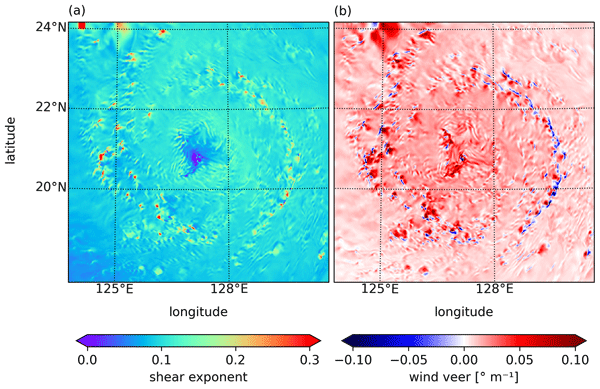
Tropical cyclone winds are challenging for wind turbines. We analyze a tropical cyclone before landfall in a mesoscale model. The simulated wind speeds and storm structure are sensitive to the boundary parametrization. However, independent of the boundary layer parametrization, the median change in wind speed and wind direction with height is small relative to wind turbine design standards. Strong spatial organization of wind shear and veer along the rainbands may increase wind turbine loads.
David Robert Verelst, Rasmus Sode Lund, and Jean-Philippe Roques
Wind Energ. Sci. Discuss., https://doi.org/10.5194/wes-2024-24, https://doi.org/10.5194/wes-2024-24, 2024
Publication in WES not foreseen
Short summary
Short summary
This study discusses key issues when performing simulations of a dynamic power cable that is connected to a floating wind turbine. Such simulations are an important tool to asses if the floater and cable motions cause the power cable to survive or fail specific conditions, and generally assure they can fulfil their intended design life. This work describes how to model such power cables and combine that with a fully coupled model of an operating floating wind turbine.
Ásta Hannesdóttir, David R. Verelst, and Albert M. Urbán
Wind Energ. Sci., 8, 231–245, https://doi.org/10.5194/wes-8-231-2023, https://doi.org/10.5194/wes-8-231-2023, 2023
Short summary
Short summary
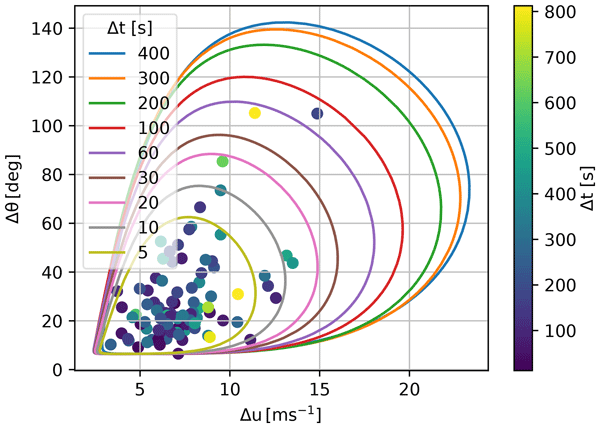
In this work we use observations of large coherent fluctuations to define a probabilistic gust model. The gust model provides the joint description of the gust rise time, amplitude, and direction change. We perform load simulations with a coherent gust according to the wind turbine safety standard and with the probabilistic gust model. A comparison of the simulated loads shows that the loads from the probabilistic gust model can be significantly higher due to variability in the gust parameters.
Mads H. Aa. Madsen, Frederik Zahle, Sergio González Horcas, Thanasis K. Barlas, and Niels N. Sørensen
Wind Energ. Sci., 7, 1471–1501, https://doi.org/10.5194/wes-7-1471-2022, https://doi.org/10.5194/wes-7-1471-2022, 2022
Short summary
Short summary
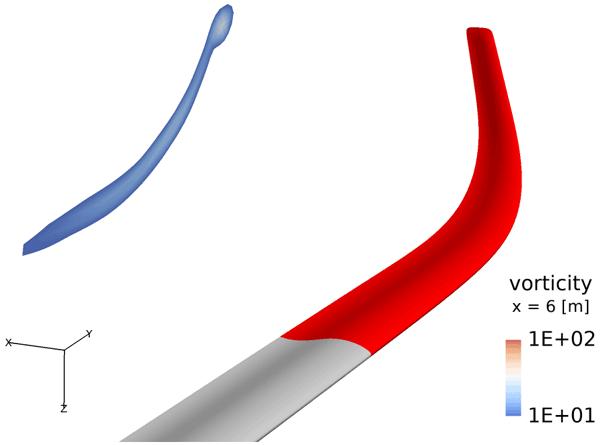
This work presents a shape optimization framework based on computational fluid dynamics. The design framework is used to optimize wind turbine blade tips for maximum power increase while avoiding that extra loading is incurred. The final results are shown to align well with related literature. The resulting tip shape could be mounted on already installed wind turbines as a sleeve-like solution or be conceived as part of a modular blade with tips designed for site-specific conditions.
Thales Fava, Mikaela Lokatt, Niels Sørensen, Frederik Zahle, Ardeshir Hanifi, and Dan Henningson
Wind Energ. Sci., 6, 715–736, https://doi.org/10.5194/wes-6-715-2021, https://doi.org/10.5194/wes-6-715-2021, 2021
Short summary
Short summary
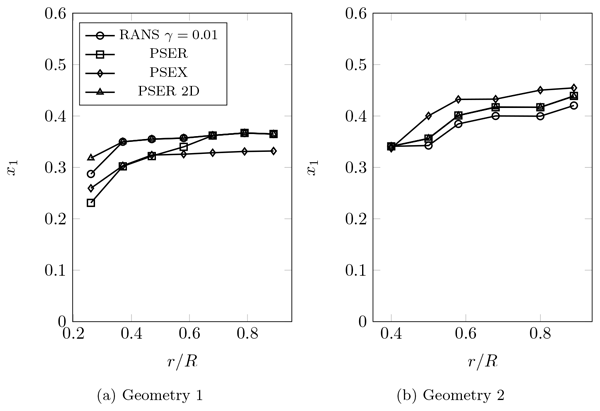
This work develops a simplified framework to predict transition to turbulence on wind-turbine blades. The model is based on the boundary-layer and parabolized stability equations, including rotation and three-dimensionality effects. We show that these effects may promote transition through highly oblique Tollmien–Schlichting (TS) or crossflow modes at low radii, and they should be considered for a correct transition prediction. At high radii, transition tends to occur through 2D TS modes.
Christian Grinderslev, Niels Nørmark Sørensen, Sergio González Horcas, Niels Troldborg, and Frederik Zahle
Wind Energ. Sci., 6, 627–643, https://doi.org/10.5194/wes-6-627-2021, https://doi.org/10.5194/wes-6-627-2021, 2021
Short summary
Short summary
This study investigates aero-elasticity of wind turbines present in the turbulent and chaotic wind flow of the lower atmosphere, using fluid–structure interaction simulations. This method combines structural response computations with high-fidelity modeling of the turbulent wind flow, using a novel turbulence model which combines the capabilities of large-eddy simulations for atmospheric flows with improved delayed detached eddy simulations for the separated flow near the rotor.
Cited articles
Andersen, M.: Conceptual aerodynamic and structural design optimization of wind
turbine blades, Master's thesis, Technical University of Denmark (DTU),
Roskilde, Denmark,
available at:
https://findit.dtu.dk/en/catalog/2438083980 (last access: 5 November 2019), 2018. a
Blasques, J.: Optimal Design of Laminated Composite Beams, PhD thesis,
Technical University of Denmark, Risø, Roskilde, Denmark, DCAMM Special Repport, No. S134,
2011. a
Blasques, J. P. and Stolpe, M.: Multi-material topology optimization of
laminated composite beam cross sections, Compos. Struct., 94,
3278–3289, https://doi.org/10.1016/j.compstruct.2012.05.002,
2012. a, b
Bortolotti, P., Kapila, A., and Bottasso, C. L.: Comparison between upwind and downwind designs of a 10 MW wind turbine rotor, Wind Energ. Sci., 4, 115–125, https://doi.org/10.5194/wes-4-115-2019, 2019. a, b
Bottasso, C. L., Croce, A., and Sartori, L.: Free-form design of low induction
rotors, Wind Energy Symposium, 33, 1–8, https://doi.org/10.2514/6.2015-0488, 2015. a
Bottasso, C. L., Bortolotti, P., Croce, A., and Gualdoni, F.: Integrated
aero-structural optimization of wind turbines, Multibody Syst. Dyn., 38,
317–344, https://doi.org/10.1007/s11044-015-9488-1, 2016. a, b
Carstensen, C.: Large scale structural topology optimization of wind turbine
blades with eigenfrequency constraints, Master's thesis, Technical University
of Denmark (DTU), Roskilde, Denmark,
available at: https://findit.dtu.dk/en/catalog/2355769010 (last access: 2 November 2019), 2017. a
Glasgow, J., Miller, D., and Corrigan, R.: Comparison of upwind and downwind
rotor operations of the DOE/NASA l00-kW MOD-0 wind turbine, NASA Report,
TM-8744, National Aeronautics and Space Administration, Lewis Research Center, Cleveland, Ohio, USA, 225–234, 1981. a
Greene, G. C.: Measured and Calculated Characteristics of Wind Turbine Noise,
NASA Report, CP-2185, National Aeronautics and Space Administration, Langley Research Center, Hampton, Virginia, USA, 1981. a
Hansen, M.: Aeroelastic Stability Analysis of Wind Turbines Using an Eigenvalue
Approach, Wind Energy, 7, 113–143, https://doi.org/10.1002/we.116, 2004. a
Hansen, M.: Aerodynamics of Wind Turbines, Earthscan, Edn. 2, 44–62, Earthscan, London, UK, 2008. a
Hansen, M., Thomsen, K., Natarajan, A., and Barlas, A.: Design Load Basis for
onshore turbines Revision 00, DTU Report, E-0074, DTU wind energy, Risø, Roskilde, Denmark, 2015. a
Ichter, B., Steele, A., Loth, E., Moriarty, P., and Selig, M.: A morphing
downwind-aligned rotor concept based on a 13-MW wind turbine, Wind Energy,
19, 625–637, https://doi.org/10.1002/we.1855, 2016. a
IEC: IEC 61400-1 ed.3 Wind turbines – Part1: Design requirements, Tech. rep.,
International Electronical Commission, Geneva, Switzerland, 2014. a
Kolda, T. G., Lewis, M., and Torczon, V.: A generating set direct search augmented Lagrangian algorithm for optimization with a combination of general and linear constraints, Sandia Report, Sandia National Laboratories, Livermore, USA, 2006. a
Loenbaek, K., Bak, C., Madsen, J. I., and Dam, B.: Optimal relationship
between power and design-driving loads for wind turbine rotors using 1-D
models, Wind Energ. Sci., 5, 155–170, https://doi.org/10.5194/wes-5-155-2020,
2020. a, b
Loth, E., Steele, A., Qin, C., Ichter, B., Selig, M. S., and Moriarty, P.:
Downwind pre-aligned rotors for extreme-scale wind turbines, Wind Energy, 20,
1241–1259, https://doi.org/10.1002/we.2092, 2017. a
Madsen, H. A., Larsen, T. J., Pirrung, G. R., Li, A., and Zahle, F.: Implementation of the blade element momentum model on a polar grid and its aeroelastic load impact, Wind Energ. Sci., 5, 1–27, https://doi.org/10.5194/wes-5-1-2020, 2020. a
Metzger, F. and Klatte, R.: Status report on downwind horizontal axis wind
turbine noise prediction, NASA Report, N82-23684 14-44, 425–430, Hamilton Standard Devision of United Technologies Corporation, Hamilton, US, 1981. a
Ning, A. and Petch, D.: Integrated design of downwind land-based wind turbines
using analytic gradients, Wind Energy, 19, 2137–2152, https://doi.org/10.1002/we.1972,
2016. a, b, c
Ning, S. A.: A simple solution method for the blade element momentum equations
with guaranteed convergence, Wind Energy, 17, 1327–1345,
https://doi.org/10.1002/we.1636, 2014. a
Reiso, M. and Muskulus, M.: The simultaneous effect of a fairing tower and
increased blade flexibility on a downwind mounted rotor, J. Renew.
Sustain. Ener., 5, 033106-1–1033106-11,
https://doi.org/10.1063/1.4803749, 2013. a
Tibalidi, C., Hansen, M. H., and Henriksen, L. C.: Optimal tuning for a
classical wind turbine controller, J. Phys. Conf. Ser., 555,
1–11, https://doi.org/10.1088/1742-6596/555/1/012099, 2014. a
Wächter, A. and Biegler, L. T.: On the implementation of an interior-point
filter line-search algorithm for large-scale nonlinear programming,
Math. Program., 106, 25–57, https://doi.org/10.1007/s10107-004-0559-y, 2006. a
Wanke, G., Bergami, L., Larsen, T. J., and Hansen, M. H.: Changes in design
driving load cases: Opterating an upwind turbine with a downwind rotor
configuration, Wind Energy, 22, 1500–1511, https://doi.org/10.1002/we.2384,
2019a. a, b
Wanke, G., Hansen, M. H., and Larsen, T. J.: Qualitative yaw stability analysis of free-yawing downwind turbines, Wind Energ. Sci., 4, 233–250, https://doi.org/10.5194/wes-4-233-2019, 2019b. a
Wanke, G., Bergami, L., and Verelst, D. R.: Differences in damping of edgewise whirl modes operating an upwind turbine in a downwind configuration, Wind Energ. Sci., 5, 929–944, https://doi.org/10.5194/wes-5-929-2020, 2020.
a
Zahle, F., Tibaldi, C., Verelst, D., Bak, C., Bitsche, R., and Blasques, J.:
Aero-Elastic Optimization of a 10 MW Wind Turbine, vol. 1,
American Institute of Aeronautics and Astronautics, Kissimmee, Florida, USA, 201–223, 2015. a
Zahle, F., Tibalidi, C., Pavese, C., McWilliam, M. K., Blasques, J. P. A. A.,
and Hansen, M. H.: Design of an Aeroelastically tailored 10 MW Wind Turbine
Rotor, J. Phys. Conf. Ser., 753, 1–11,
https://doi.org/10.1088/1742-6596/753/6/062008, 2016. a, b, c
Zalkind, D. S., Ananda, G. K., Chetan, M., Martin, D. P., Bay, C. J., Johnson, K. E., Loth, E., Griffith, D. T., Selig, M. S., and Pao, L. Y.: System-level design studies for large rotors, Wind Energ. Sci., 4, 595–618, https://doi.org/10.5194/wes-4-595-2019, 2019. a, b, c

Short summary
This article regards a rotor redesign for a wind turbine in upwind and in downwind rotor configurations. A simple optimization tool is used to estimate the aerodynamic planform, as well as the structural mass distribution of the rotor blade. The designs are evaluated in full load base calculations according to the IEC standard with the aeroelastic tool HAWC2. A scaling model is used to scale turbine and energy costs from the design loads and compare the costs for the turbine configurations.
This article regards a rotor redesign for a wind turbine in upwind and in downwind rotor...
Altmetrics
Final-revised paper
Preprint