Articles | Volume 10, issue 4
https://doi.org/10.5194/wes-10-679-2025
© Author(s) 2025. This work is distributed under
the Creative Commons Attribution 4.0 License.
https://doi.org/10.5194/wes-10-679-2025
© Author(s) 2025. This work is distributed under
the Creative Commons Attribution 4.0 License.
On the influence of cross-sectional deformations on the aerodynamic performance of wind turbine rotor blades
Julia Gebauer
CORRESPONDING AUTHOR
Institute for Wind Energy Systems, Leibniz University Hannover, Appelstr. 9 A, 30167 Hanover, Germany
Felix Prigge
Institute for Wind Energy Systems, Leibniz University Hannover, Appelstr. 9 A, 30167 Hanover, Germany
Dominik Ahrens
Institute of Turbomachinery and Fluid Dynamics, Leibniz University Hannover, An der Universität 1, 30823 Garbsen, Germany
Lars Wein
Institute of Turbomachinery and Fluid Dynamics, Leibniz University Hannover, An der Universität 1, 30823 Garbsen, Germany
Claudio Balzani
Institute for Wind Energy Systems, Leibniz University Hannover, Appelstr. 9 A, 30167 Hanover, Germany
Related authors
No articles found.
Hye Rim Kim and Lars Wein
Wind Energ. Sci. Discuss., https://doi.org/10.5194/wes-2026-155, https://doi.org/10.5194/wes-2026-155, 2026
Preprint under review for WES
Short summary
Short summary
Offshore wind turbines (10–15 MW) experience diverse flow conditions, beyond what smaller turbines face. This challenges the accuracy of low-order aerodynamic tools. As experimental validation is difficult, high-order methods such as Delayed Detached Eddy Simulation (DDES) are used. Here, DDES is validated for offshore conditions, enabling accurate prediction of unsteady, nonlinear flows for operational safety and power optimization.
Claudio Balzani and Pablo Noever Castelos
Wind Energ. Sci., 10, 1249–1267, https://doi.org/10.5194/wes-10-1249-2025, https://doi.org/10.5194/wes-10-1249-2025, 2025
Short summary
Short summary
Wind turbine rotor blades consist of subcomponents that are glued together. Such connections are subject to fatigue loads. This paper analyzes the fatigue load characteristics of three different wind turbine rotor blades in trailing edge adhesive joints. It is shown that the fatigue loads have measurable degrees of non-proportionality and that the choice of the procedure to calculate the fatigue damage is crucial for designing reliable blades.
Hye Rim Kim, Jasson A. Printezis, Jan Dominik Ahrens, Joerg R. Seume, and Lars Wein
Wind Energ. Sci., 10, 161–175, https://doi.org/10.5194/wes-10-161-2025, https://doi.org/10.5194/wes-10-161-2025, 2025
Short summary
Short summary
The need for renewable energy, thus more efficient wind turbines, is ever increasing. Accurate prediction of the performance in the design stage is necessary. In particular, predicting the dynamic performance of a wind turbine in the region where it undergoes highly unsteady flow is very challenging. We investigated the dynamic performance of an airfoil, which is typical for megastructure wind farms, in support of the development of more efficient design tools in the future.
Hendrik Verdonck, Oliver Hach, Jelmer D. Polman, Otto Schramm, Claudio Balzani, Sarah Müller, and Johannes Rieke
Wind Energ. Sci., 9, 1747–1763, https://doi.org/10.5194/wes-9-1747-2024, https://doi.org/10.5194/wes-9-1747-2024, 2024
Short summary
Short summary
Aeroelastic stability simulations are needed to guarantee the safety and overall robust design of wind turbines. To increase our confidence in these simulations in the future, the sensitivity of the stability analysis with respect to variability in the structural properties of the wind turbine blades is investigated. Multiple state-of-the-art tools are compared and the study shows that even though the tools predict similar stability behavior, the sensitivity might be significantly different.
Edgar Werthen, Daniel Hardt, Claudio Balzani, and Christian Hühne
Wind Energ. Sci., 9, 1465–1481, https://doi.org/10.5194/wes-9-1465-2024, https://doi.org/10.5194/wes-9-1465-2024, 2024
Short summary
Short summary
We provide a comprehensive overview showing available cross-sectional approaches and their properties in relation to derived requirements for the design of composite rotor blades. The Jung analytical approach shows the best results for accuracy of stiffness terms (coupling and transverse shear) and stress distributions. Improved performance compared to 2D finite element codes could be achieved, making the approach applicable for optimization problems with a high number of design variables.
Jan Dominik Ahrens, Jasson A. Printezis, Ahmed G. Yosry, Joerg R. Seume, and Lars Wein
Wind Energ. Sci. Discuss., https://doi.org/10.5194/wes-2023-159, https://doi.org/10.5194/wes-2023-159, 2023
Manuscript not accepted for further review
Short summary
Short summary
Dynamic stall introduces transient loads that excite blade vibrations, which contribute to mechanical fatigue and can lead to blade failure. In order to design wind turbine airfoils that are less prone to dynamic stall, the onset of dynamic stall has to be predicted. This work contributes to the development of reduced-order models that predict dynamic stall in a cost-efficient way. The models can be used in the design process of new airfoil geometries of future wind turbines.
Pablo Noever-Castelos, David Melcher, and Claudio Balzani
Wind Energ. Sci., 7, 623–645, https://doi.org/10.5194/wes-7-623-2022, https://doi.org/10.5194/wes-7-623-2022, 2022
Short summary
Short summary
In the wind energy industry, a digital twin is fast becoming a key instrument for the monitoring of a wind turbine blade's life cycle. Here, our introduced model updating with invertible neural networks provides an efficient and powerful technique to represent the real blade as built. This method is applied to a full finite element Timoshenko beam model of a blade to successfully update material and layup parameters. The advantage over state-of-the-art methods is the established inverse model.
Pablo Noever-Castelos, Bernd Haller, and Claudio Balzani
Wind Energ. Sci., 7, 105–127, https://doi.org/10.5194/wes-7-105-2022, https://doi.org/10.5194/wes-7-105-2022, 2022
Short summary
Short summary
Modern rotor blade designs depend on detailed numerical models and simulations. Thus, a validated modeling methodology is fundamental for reliable designs. This paper briefly presents a modeling algorithm for rotor blades, its validation against real-life full-scale blade tests, and the respective test data. The hybrid 3D shell/solid finite-element model is successfully validated against the conducted classical bending tests in flapwise and lead–lag direction as well as novel torsion tests.
Cited articles
Ahrens, J. D., Ziesse, M., Wein, L., and Seume, J. R.: A Novel And Costeffective Approach To Simulating Dynamic Stall On Rotating Wind Turbine Blades With A Changing Angle Of Attack, GPPS Chania, https://doi.org/10.33737/gpps22-tc-13, 2022. a, b
Bak, C.: Aerodynamic design of wind turbine rotors, in: Advances in wind turbine blade design and materials, edited by: Brøndsted, P., Nijssen, R., and Goutianos, S., Woodhead Publishing, 79–128, https://doi.org/10.1016/B978-0-08-103007-3.00001-X, 2023. a
Balzani, C. and Gebauer, J.: Impact of shell structure stiffness on aero-structural coupling in wind turbine rotor blades, IOP Conf. Ser.-Mat. Sci., 1293, 012025, https://doi.org/10.1088/1757-899X/1293/1/012025, 2023. a, b
Burton, T., Jenkins, N., Bossanyi, E., Sharpe, D., and Graham, M.: Wind energy handbook, 3rd edn., Wiley, ISBN 9781119451150, 2021. a
Cecchini, L. S. and Weaver, P. M.: Brazier effect in multibay airfoil sections, AIAA J., 43, 2252–2258, 2005. a
Drela, M.: XFOIL: An Analysis and Design System for Low Reynolds Number Airfoils, in: Low Reynolds Number Aerodynamics: Proceedings of the Conference Note Dame, Indiana, USA, 5–7 June 1989, edited by: Mueller, T. J., Springer Verlag, 1–12, https://doi.org/10.1007/978-3-642-84010-4, 1989. a
Eder, M. A. and Bitsche, R.: A qualitative analytical investigation of geometrically nonlinear effects in wind turbine blade cross sections, Thin Wall. Struct., 93, 1–9, 2015a. a
Eder, M. A. and Bitsche, R. D.: Fracture analysis of adhesive joints in wind turbine blades, Wind Energy, 18, 1007–1022, https://doi.org/10.1002/we.1744, 2015b. a
Etemaddar, M., Hansen, M. O. L., and Moan, T.: Wind turbine aerodynamic response under atmospheric icing conditions, Wind Energy, 17, 241–265, 2014. a
Gaertner, E., Rinker, J., Sethuraman, L., Zahle, F., Anderson, B., Barter, G., Abbas, N., Meng, F., Bortolotti, P., Skrzypinski, W., Scott, G., Feil, R., Bredmose, H., Dykes, K., Shields, M., Allen, C., and Viselli, A.: Definition of the IEA 15-Megawatt Offshore Reference Wind, Tech. Rep. NREL/TP-5000-75698, National Renewable Energy Laboratory, Golden, CO, 2020. a, b
Gaudern, N.: A practical study of the aerodynamic impact of wind turbine blade leading edge erosion, J. Phys. Conf. Ser., 524, 012031, https://doi.org/10.1088/1742-6596/524/1/012031, 2014. a, b
Hansen, M. O. L.: Aerodynamics of wind turbines, 3rd edn., Earthscan from Routledge, ISBN 9781315769981, 2015. a
Haselbach, P. U., Eder, M. A., and Belloni, F.: A comprehensive investigation of trailing edge damage in a wind turbine rotor blade, Wind Energy, 19, 1871–1888, https://doi.org/10.1002/we.1956, 2016. a
Hodges, D. H.: Nonlinear composite beam theory, American Institute of Aeronautics and Astronautics, https://doi.org/10.2514/4.866821, 2006. a
Issa, R. I.: Solution of the implicitly discretised fluid flow equations by operator-splitting, J. Comput. Phys., 62, 40–65, 1986. a
Jensen, F., Weaver, P., Cecchini, L., Stang, H., and Nielsen, R.: The Brazier effect in wind turbine blades and its influence on design, Wind Energy, 15, 319–333, 2012. a
Kiefer, J., Brunner, C. E., Hansen, M. O., and Hultmark, M.: Dynamic stall at high Reynolds numbers induced by ramp-type pitching motions, J. Fluid Mech., 938, A10, https://doi.org/10.1017/jfm.2022.70, 2022. a
Kim, H. R., Printezis, J. A., Ahrens, J. D., Seume, J. R., and Wein, L.: Characterization of dynamic stall of a wind turbine airfoil with a high Reynolds number, Wind Energ. Sci., 10, 161–175, https://doi.org/10.5194/wes-10-161-2025, 2025. a
Kim, T., Hansen, A. M., and Branner, K.: Development of an anisotropic beam finite element for composite wind turbine blades in multibody system, Renew. Energ., 59, 172–183, 2013. a
Larsen, T. J. and Hansen, A. M.: How 2 HAWC2, the user’s manual, ver. 13.1, ISBN 978 87 550 3583 6, 2023. a
Lennie, M., Pechlivanoglou, G., Marten, D., Nayeri, C. N., and Paschereit, O.: A review of wind turbine polar data and its effect on fatigue loads simulation accuracy, Turbo Expo: Power for Land, Sea, and Air, 15–19 June 2015, Montreal, Quebec, Canada, 56802, V009T46A018, https://doi.org/10.1115/GT2015-43249, 2015. a
Liu, X., Lu, C., Liang, S., Godbole, A., and Chen, Y.: Vibration-induced aerodynamic loads on large horizontal axis wind turbine blades, Appl. Energ., 185, 1109–1119, 2017. a
Madsen, H. A., Larsen, T. J., Pirrung, G. R., Li, A., and Zahle, F.: Implementation of the blade element momentum model on a polar grid and its aeroelastic load impact, Wind Energ. Sci., 5, 1–27, https://doi.org/10.5194/wes-5-1-2020, 2020. a
Menter, F. R.: Two-equation eddy-viscosity turbulence models for engineering applications, AIAA J., 32, 1598–1605, https://doi.org/10.2514/3.12149, 1994. a
National Renewable Energy Laboratory: BeamDyn User Guide and Theory Manual, https://openfast.readthedocs.io/en/main/source/user/elastodyn/index.html, last access: 21 October 2024a. a
Noever-Castelos, P., Haller, B., and Balzani, C.: Validation of a modeling methodology for wind turbine rotor blades based on a full-scale blade test, Wind Energ. Sci., 7, 105–127, https://doi.org/10.5194/wes-7-105-2022, 2022. a, b
Rosemeier, M. and Saathoff, M.: Impact of manufacture-induced blade shape distortion on turbine loads and energy yield, J. Phys. Conf. Ser., 1618, 052011, https://doi.org/10.1088/1742-6596/1618/5/052011, 2020. a
Schürmann, H.: Konstruieren mit Faser-Kunststoff-Verbunden, vol. 2, Springer, https://doi.org/10.1007/978-3-540-72190-1, 2007. a
Söker, H.: Loads on wind turbine blades, in: Advances in Wind Turbine Blade Design and Materials, edited by: Brøndsted, P. and Nijssen, R. P. L., Woodhead Publishing, 55–78, https://doi.org/10.1016/B978-0-08-103007-3.00002-1, 2013. a
Vassilopoulos, A. P.: Fatigue life prediction of wind turbine blade composite materials, in: Advances in wind turbine blade design and materials, edited by: Brøndsted, P. and Nijssen, R. P. L., Woodhead Publishing, 251–297, https://doi.org/10.1533/9780857097286.2.251, 2013. a
Vitulano, M. C., De Tavernier, D., De Stefano, G., and von Terzi, D.: Numerical analysis of transonic flow over the FFA-W3-211 wind turbine tip airfoil, Wind Energ. Sci., 10, 103–116, https://doi.org/10.5194/wes-10-103-2025, 2025. a, b
Warming, R. F. and Beam, R. M.: Upwind Second-Order Difference Schemes and Applications in Aerodynamic Flows, AIAA J., 14, 1241–1249, https://doi.org/10.2514/3.61457, 1976. a
Yalcin, O., Cengiz, K., Wein, L., Özyörük, Y., and Seume, J. R.: Transitional DDES Study over a Circular Cylinder and an Airfoil Profile, The 13th International ERCOFTAC symposium on engineering, turbulence, modelling and measurements, 15–17 September 2021, Rhodes, Greece, 2021. a

Short summary
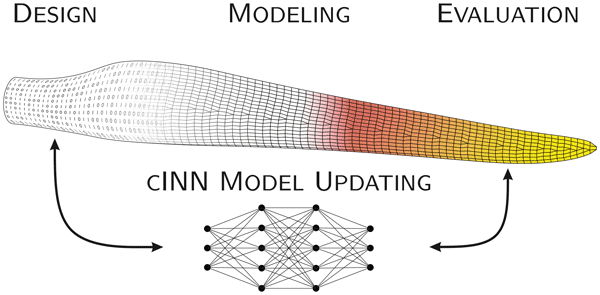
The amount of energy that can be extracted from wind depends primarily on the blade geometry, which can be affected by elastic deformations. This paper presents a first study analysing the influence of cross-sectional deformations of a 15 MW wind turbine blade on aero-elastic simulations. The results show that cross-sectional deformations have a minor influence on the internal loads of rotor blades in normal operation.
The amount of energy that can be extracted from wind depends primarily on the blade geometry,...
Altmetrics
Final-revised paper
Preprint