Articles | Volume 6, issue 4
https://doi.org/10.5194/wes-6-983-2021
© Author(s) 2021. This work is distributed under
the Creative Commons Attribution 4.0 License.
Special issue:
https://doi.org/10.5194/wes-6-983-2021
© Author(s) 2021. This work is distributed under
the Creative Commons Attribution 4.0 License.
Aeroelastic loads on a 10 MW turbine exposed to extreme events selected from a year-long large-eddy simulation over the North Sea
Gerard Schepers
CORRESPONDING AUTHOR
TNO Energy Transition, Wind Energy, Petten, 1755 LE, the Netherlands
Pim van Dorp
Whiffle, Delft, 2629 JD, the Netherlands
Remco Verzijlbergh
Whiffle, Delft, 2629 JD, the Netherlands
Peter Baas
Whiffle, Delft, 2629 JD, the Netherlands
Harmen Jonker
Whiffle, Delft, 2629 JD, the Netherlands
Related authors
Niels Adema, Josep Gil-Vernet Pagonabarraga, Wouter Swart Ranshuysen, Arjen de Ruijter, and Gerard Schepers
Wind Energ. Sci. Discuss., https://doi.org/10.5194/wes-2025-244, https://doi.org/10.5194/wes-2025-244, 2025
Preprint under review for WES
Short summary
Short summary
Small wind turbines could help to generate renewable energy but are often inefficient and expensive. This study tested a counter-rotating dual rotor design with both rotors connected through one generator, eliminating gearboxes. Wind tunnel tests achieved a 1 kilowatt output with 33 % efficiency. A computational model showed the turbine could theoretically reach 51 % efficiency with optimized blade angles and speeds. This compact design reduces mechanical complexity and suits urban applications.
Koen Boorsma, Gerard Schepers, Helge Aagard Madsen, Georg Pirrung, Niels Sørensen, Galih Bangga, Manfred Imiela, Christian Grinderslev, Alexander Meyer Forsting, Wen Zhong Shen, Alessandro Croce, Stefano Cacciola, Alois Peter Schaffarczyk, Brandon Lobo, Frederic Blondel, Philippe Gilbert, Ronan Boisard, Leo Höning, Luca Greco, Claudio Testa, Emmanuel Branlard, Jason Jonkman, and Ganesh Vijayakumar
Wind Energ. Sci., 8, 211–230, https://doi.org/10.5194/wes-8-211-2023, https://doi.org/10.5194/wes-8-211-2023, 2023
Short summary
Short summary
Within the framework of the fourth phase of the International Energy Agency's (IEA) Wind Task 29, a large comparison exercise between measurements and aeroelastic simulations has been carried out. Results were obtained from more than 19 simulation tools of various fidelity, originating from 12 institutes and compared to state-of-the-art field measurements. The result is a unique insight into the current status and accuracy of rotor aerodynamic modeling.
Simone Mancini, Koen Boorsma, Gerard Schepers, and Feike Savenije
Wind Energ. Sci., 8, 193–210, https://doi.org/10.5194/wes-8-193-2023, https://doi.org/10.5194/wes-8-193-2023, 2023
Short summary
Short summary
Modern wind turbines are subject to complex wind conditions that are far from the hypothesis of steady uniform inflow at the core of blade element momentum methods (the current industry standard for wind turbine design). Various corrections have been proposed to model this complexity. The present work focuses on modelling the unsteady evolution of wind turbine wakes (dynamic inflow), comparing the different corrections available and highlighting their effects on design load predictions.
Kisorthman Vimalakanthan, Harald van der Mijle Meijer, Iana Bakhmet, and Gerard Schepers
Wind Energ. Sci., 8, 41–69, https://doi.org/10.5194/wes-8-41-2023, https://doi.org/10.5194/wes-8-41-2023, 2023
Short summary
Short summary
Leading edge erosion (LEE) is one of the most critical degradation mechanisms that occur with wind turbine blades. A detailed understanding of the LEE process and the impact on aerodynamic performance due to the damaged leading edge is required to optimize blade maintenance. Providing accurate modeling tools is therefore essential. This novel study assesses CFD approaches for modeling high-resolution scanned LE surfaces from an actual blade with LEE damages.
Alessandro Bianchini, Galih Bangga, Ian Baring-Gould, Alessandro Croce, José Ignacio Cruz, Rick Damiani, Gareth Erfort, Carlos Simao Ferreira, David Infield, Christian Navid Nayeri, George Pechlivanoglou, Mark Runacres, Gerard Schepers, Brent Summerville, David Wood, and Alice Orrell
Wind Energ. Sci., 7, 2003–2037, https://doi.org/10.5194/wes-7-2003-2022, https://doi.org/10.5194/wes-7-2003-2022, 2022
Short summary
Short summary
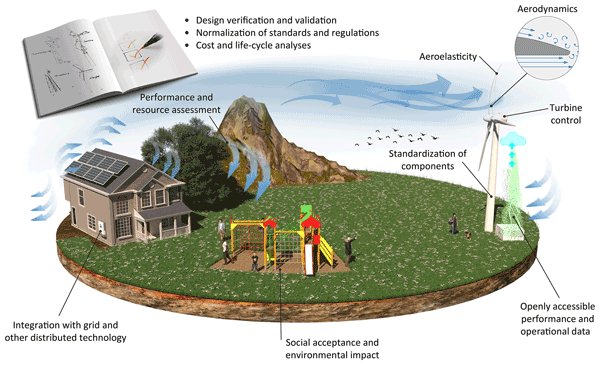
The paper is part of the Grand Challenges Papers for Wind Energy. It provides a status of small wind turbine technology in terms of technical maturity, diffusion, and cost. Then, five grand challenges that are thought to be key to fostering the development of the technology are proposed. To tackle these challenges, a series of unknowns and gaps are first identified and discussed. Improvement areas are highlighted, within which 10 key enabling actions are finally proposed to the wind community.
Frederik Berger, Lars Neuhaus, David Onnen, Michael Hölling, Gerard Schepers, and Martin Kühn
Wind Energ. Sci., 7, 1827–1846, https://doi.org/10.5194/wes-7-1827-2022, https://doi.org/10.5194/wes-7-1827-2022, 2022
Short summary
Short summary
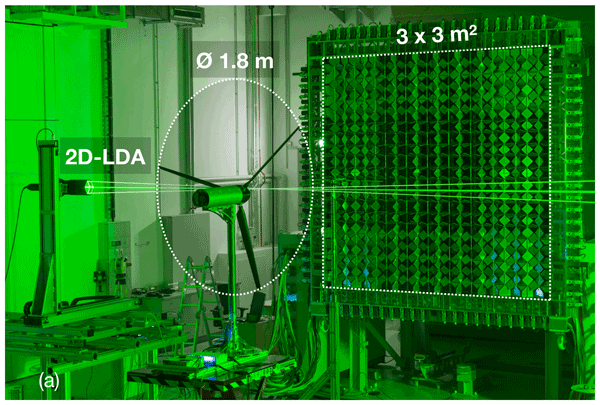
We proof the dynamic inflow effect due to gusts in wind tunnel experiments with MoWiTO 1.8 in the large wind tunnel of ForWind – University of Oldenburg, where we created coherent gusts with an active grid. The effect is isolated in loads and rotor flow by comparison of a quasi-steady and a dynamic case. The observed effect is not caught by common dynamic inflow engineering models. An improvement to the Øye dynamic inflow model is proposed, matching experiment and corresponding FVWM simulations.
Benjamin Sanderse, Vinit V. Dighe, Koen Boorsma, and Gerard Schepers
Wind Energ. Sci., 7, 759–781, https://doi.org/10.5194/wes-7-759-2022, https://doi.org/10.5194/wes-7-759-2022, 2022
Short summary
Short summary
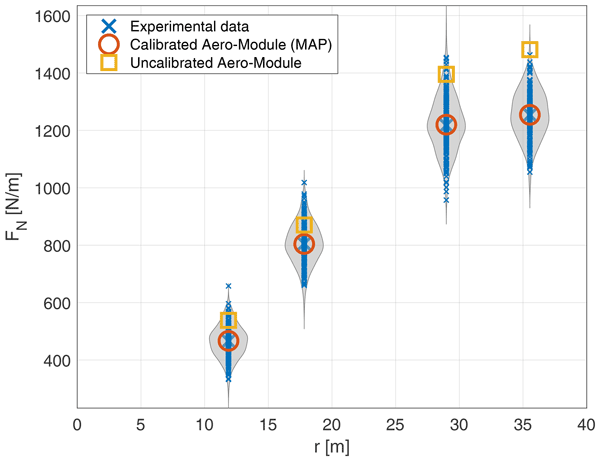
An accurate prediction of loads and power of an offshore wind turbine is needed for an optimal design. However, such predictions are typically performed with engineering models that contain many inaccuracies and uncertainties. In this paper we have proposed a systematic approach to quantify and calibrate these uncertainties based on two experimental datasets. The calibrated models are much closer to the experimental data and are equipped with an estimate of the uncertainty in the predictions.
Frederik Berger, David Onnen, Gerard Schepers, and Martin Kühn
Wind Energ. Sci., 6, 1341–1361, https://doi.org/10.5194/wes-6-1341-2021, https://doi.org/10.5194/wes-6-1341-2021, 2021
Short summary
Short summary
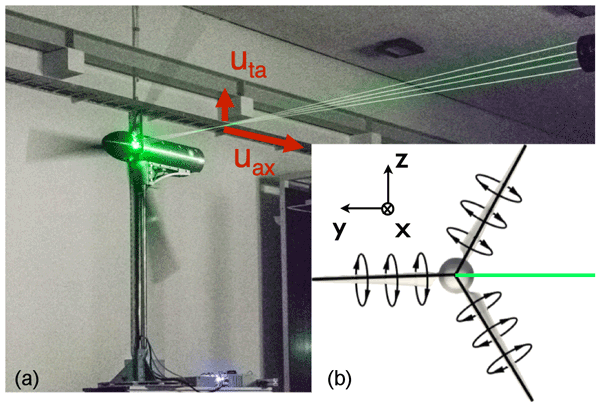
Dynamic inflow denotes the unsteady aerodynamic response to fast changes in rotor loading and leads to load overshoots. We performed a pitch step experiment with MoWiTO 1.8 in the large wind tunnel of ForWind – University of Oldenburg. We measured axial and tangential inductions with a recent method with a 2D-LDA system and performed load and wake measurements. These radius-resolved measurements allow for new insights into the dynamic inflow phenomenon.
Niels Adema, Josep Gil-Vernet Pagonabarraga, Wouter Swart Ranshuysen, Arjen de Ruijter, and Gerard Schepers
Wind Energ. Sci. Discuss., https://doi.org/10.5194/wes-2025-244, https://doi.org/10.5194/wes-2025-244, 2025
Preprint under review for WES
Short summary
Short summary
Small wind turbines could help to generate renewable energy but are often inefficient and expensive. This study tested a counter-rotating dual rotor design with both rotors connected through one generator, eliminating gearboxes. Wind tunnel tests achieved a 1 kilowatt output with 33 % efficiency. A computational model showed the turbine could theoretically reach 51 % efficiency with optimized blade angles and speeds. This compact design reduces mechanical complexity and suits urban applications.
Bernard Postema, Remco A. Verzijlbergh, Pim van Dorp, Peter Baas, and Harm J. J. Jonker
Wind Energ. Sci., 10, 1471–1484, https://doi.org/10.5194/wes-10-1471-2025, https://doi.org/10.5194/wes-10-1471-2025, 2025
Short summary
Short summary
Atmospheric large-eddy simulation is a technique that simulates weather conditions in high detail and is used to plan new wind farms. This research presents ways to estimate the long-term (10-year) power production of a wind farm without having to simulate 10 years of weather and instead simulating much less (1 year or less). The results show that the methods reduce the uncertainty in power production estimates by an order of magnitude and that wind observations can be included as well to add more insight.
Peter Baas, Remco Verzijlbergh, Pim van Dorp, and Harm Jonker
Wind Energ. Sci., 8, 787–805, https://doi.org/10.5194/wes-8-787-2023, https://doi.org/10.5194/wes-8-787-2023, 2023
Short summary
Short summary
This work studies the energy production and wake losses of large offshore wind farms with a large-eddy simulation model. Therefore, 1 year of actual weather has been simulated for a suite of hypothetical 4 GW wind farm scenarios. The results suggest that production numbers increase significantly when the rated power of the individual turbines is larger while keeping the total installed capacity the same. Also, a clear impact of atmospheric stability on the energy production is found.
Koen Boorsma, Gerard Schepers, Helge Aagard Madsen, Georg Pirrung, Niels Sørensen, Galih Bangga, Manfred Imiela, Christian Grinderslev, Alexander Meyer Forsting, Wen Zhong Shen, Alessandro Croce, Stefano Cacciola, Alois Peter Schaffarczyk, Brandon Lobo, Frederic Blondel, Philippe Gilbert, Ronan Boisard, Leo Höning, Luca Greco, Claudio Testa, Emmanuel Branlard, Jason Jonkman, and Ganesh Vijayakumar
Wind Energ. Sci., 8, 211–230, https://doi.org/10.5194/wes-8-211-2023, https://doi.org/10.5194/wes-8-211-2023, 2023
Short summary
Short summary
Within the framework of the fourth phase of the International Energy Agency's (IEA) Wind Task 29, a large comparison exercise between measurements and aeroelastic simulations has been carried out. Results were obtained from more than 19 simulation tools of various fidelity, originating from 12 institutes and compared to state-of-the-art field measurements. The result is a unique insight into the current status and accuracy of rotor aerodynamic modeling.
Simone Mancini, Koen Boorsma, Gerard Schepers, and Feike Savenije
Wind Energ. Sci., 8, 193–210, https://doi.org/10.5194/wes-8-193-2023, https://doi.org/10.5194/wes-8-193-2023, 2023
Short summary
Short summary
Modern wind turbines are subject to complex wind conditions that are far from the hypothesis of steady uniform inflow at the core of blade element momentum methods (the current industry standard for wind turbine design). Various corrections have been proposed to model this complexity. The present work focuses on modelling the unsteady evolution of wind turbine wakes (dynamic inflow), comparing the different corrections available and highlighting their effects on design load predictions.
Kisorthman Vimalakanthan, Harald van der Mijle Meijer, Iana Bakhmet, and Gerard Schepers
Wind Energ. Sci., 8, 41–69, https://doi.org/10.5194/wes-8-41-2023, https://doi.org/10.5194/wes-8-41-2023, 2023
Short summary
Short summary
Leading edge erosion (LEE) is one of the most critical degradation mechanisms that occur with wind turbine blades. A detailed understanding of the LEE process and the impact on aerodynamic performance due to the damaged leading edge is required to optimize blade maintenance. Providing accurate modeling tools is therefore essential. This novel study assesses CFD approaches for modeling high-resolution scanned LE surfaces from an actual blade with LEE damages.
Alessandro Bianchini, Galih Bangga, Ian Baring-Gould, Alessandro Croce, José Ignacio Cruz, Rick Damiani, Gareth Erfort, Carlos Simao Ferreira, David Infield, Christian Navid Nayeri, George Pechlivanoglou, Mark Runacres, Gerard Schepers, Brent Summerville, David Wood, and Alice Orrell
Wind Energ. Sci., 7, 2003–2037, https://doi.org/10.5194/wes-7-2003-2022, https://doi.org/10.5194/wes-7-2003-2022, 2022
Short summary
Short summary
The paper is part of the Grand Challenges Papers for Wind Energy. It provides a status of small wind turbine technology in terms of technical maturity, diffusion, and cost. Then, five grand challenges that are thought to be key to fostering the development of the technology are proposed. To tackle these challenges, a series of unknowns and gaps are first identified and discussed. Improvement areas are highlighted, within which 10 key enabling actions are finally proposed to the wind community.
Frederik Berger, Lars Neuhaus, David Onnen, Michael Hölling, Gerard Schepers, and Martin Kühn
Wind Energ. Sci., 7, 1827–1846, https://doi.org/10.5194/wes-7-1827-2022, https://doi.org/10.5194/wes-7-1827-2022, 2022
Short summary
Short summary
We proof the dynamic inflow effect due to gusts in wind tunnel experiments with MoWiTO 1.8 in the large wind tunnel of ForWind – University of Oldenburg, where we created coherent gusts with an active grid. The effect is isolated in loads and rotor flow by comparison of a quasi-steady and a dynamic case. The observed effect is not caught by common dynamic inflow engineering models. An improvement to the Øye dynamic inflow model is proposed, matching experiment and corresponding FVWM simulations.
Benjamin Sanderse, Vinit V. Dighe, Koen Boorsma, and Gerard Schepers
Wind Energ. Sci., 7, 759–781, https://doi.org/10.5194/wes-7-759-2022, https://doi.org/10.5194/wes-7-759-2022, 2022
Short summary
Short summary
An accurate prediction of loads and power of an offshore wind turbine is needed for an optimal design. However, such predictions are typically performed with engineering models that contain many inaccuracies and uncertainties. In this paper we have proposed a systematic approach to quantify and calibrate these uncertainties based on two experimental datasets. The calibrated models are much closer to the experimental data and are equipped with an estimate of the uncertainty in the predictions.
Frederik Berger, David Onnen, Gerard Schepers, and Martin Kühn
Wind Energ. Sci., 6, 1341–1361, https://doi.org/10.5194/wes-6-1341-2021, https://doi.org/10.5194/wes-6-1341-2021, 2021
Short summary
Short summary
Dynamic inflow denotes the unsteady aerodynamic response to fast changes in rotor loading and leads to load overshoots. We performed a pitch step experiment with MoWiTO 1.8 in the large wind tunnel of ForWind – University of Oldenburg. We measured axial and tangential inductions with a recent method with a 2D-LDA system and performed load and wake measurements. These radius-resolved measurements allow for new insights into the dynamic inflow phenomenon.
Cited articles
Baas, P., Bosveld, F. C., Klein Baltink, H., and Holtslag, A. A. M.: A climatology of nocturnal low-level jets at Cabauw, J. Appl. Meteorol. Clim., 48, 1627–1642, 2009.
Bak, C., Zahle, F., Bitsche, R., Kim, T., Yde, A., Henriksen, L. C., Hansen, M. H., Blasques, J. P. A. A., Gaunaa, M., and Natarajan, A.: The DTU 10 MW Reference Wind Turbine, Danish Technical University, Lyngby, Denmark, 2013.
Boorsma, K., Chasapogianis, P., Manolas, D., Stettner, M., and Reijerkerk,
M.: Comparison of models with respect to fatigue load analysis of the INNWIND.EU and the AVATAR RWT, Deliverable D4.6 of the EU project AVATAR, TNO Energy Transition, Petten, the Netherlands, 2016.
Boorsma, K., Wenz, F., Aman, M., Lindenburg, C., and Kloosterman, M.: TKI WOZ VortexLoads final report, TNO 2019 R11388, TNO Energy Transition, Petten, the Netherlands, 2019.
Duncan, J.: Observational Analyses of the North Sea low-level jet, TNO R11428, TNO Energy Transition, Petten, the Netherlands, 2018.
Gilbert, C., Messner, J. W., Pinson, P., Trombe, P. J., Verzijlbergh, R.,
van Dorp, P., and Jonker, H.: Statistical post-processing of turbulence-resolving weather forecasts for offshore wind power forecasting,
Wind Energy, 23, 884–897, https://doi.org/10.1002/we.2456, 2020.
Hersbach, H., Bell, B., Berrisford, P., Hirahara, S., Horányi, A., Muñoz-Sabater, J., Nicolas, J., Peubey, C., Radu, R., Schepers, D., Simmons, A., Soci, C., Abdalla, S., Abellan, X., Balsamo, G., Bechtold, P., Biavati, G., Bidlot, J., Bonavita, M., De Chiara, G., Dahlgren, P., Dee, D., Diamantakis, M., Dragani, R., Flemming, J., Forbes, R., Fuentes, M., Geer, A., Haimberger, L., Healy, S., Hogan, R. J., Hólm, E., Janisková, M, Keeley, S., Laloyaux, P., Lopez, P., Lupu, C., Radnoti, G., de Rosnay, P., Rozum, I., Vamborg, F., Villaume, S., and Thépaut, J. N.: The ERA5 global reanalysis, Q. J. Roy. Meteorol. Soc., 146, 1999–2049, https://doi.org/10.1002/qj.3803, 2020.
Jonkman, B.: TurbSim User Guide, NREL/TP-500-46198, NREL, Boulder, USA, 2009.
Lindenburg, C.: PHATAS Program for Horizontal Axis Turbine Analysis and Simulation, ECN-I-05-005, ECN – Energy Research Center of the Netherlands,
Petten, the Netherlands, 2005.
Mann, J.: Wind field simulation, Probab. Eng. Mech., 13, 269–282, 1998.
Mehta, D., van Zuijlen, A. H., Koren, B., Holierhoek, J. G., and Bijl, H.:
Large Eddy Simulation of wind farm aerodynamics: A review, J. Wind Eng. Indust. Aerodynam., 133, 1–17, https://doi.org/10.1016/j.jweia.2014.07.002, 2014.
Sathe, A., Gotschall, J., and Courtney, M.: Can Wind Lidars measure turbulence, J. Atmos. Ocean. Tech., 28, 853–868, https://doi.org/10.1175/JTECH-D-10-05004.1 , 2011.
Savenije, F., Gonzalez Salcedo, A., Martin San Roman, R.,
Lampropoulos, N., Barlas, A., Sieros, G., Prospathopoulos, J., Manolas, D.,
Sartori, L., Jost, E., and Maeder, T.: Evaluation of the new design, The advanced Reference Wind Turbine, Deliverable 1.7 of the EU project AVATAR, TNO Energy Transition, Petten, the Netherlands, 2017.
Schalkwijk, J., Jonker, H. J. J., Siebesma, A. P., and Bosveld, F. C.: A Year-Long Large-Eddy Simulation of the Weather over Cabauw: an Overview, Mon. Weather Rev., 143, 828–844, https://doi.org/10.1175/MWR-D-14-00293.1, 2015.
Schepers, J. G.: Engineering models in Wind Energy Aerodynamics, PhD thesis, TU Delft, Delft, November 2012.
Schepers, J. G.: Final Report of the EU project AVATAR, available at:
http://www.eera-avatar.eu/fileadmin/avatar/user/AVATAR_final_report_v26_2_2018.pdf (last access: 17 December 2019), 2018.
Sieros, G., Lekou, D., Chortis, D., Chaviaropoulos, P., Munduate, X., Irissarri, A., Madsen, H. A., Yde, K., Thomsen, K., Stettner, M., Reijerkerk, M., Grasso, F., Savenije, R., Schepers, G., and Andersen, C. F.: Design of the AVATAR RWT rotor, Deliverable D1.2 of the EU project AVATAR, TNO Energy Transition, Petten the Netherlands, 2015.
Stettner, M., Reijerkerk, H. J., Kooijman, A., Irisarri Ruiz, H. A., Madsen, D. R., Verelst, A., Croce, L., Sartori, M. S., Lunghini, M.: Evaluation and cross-comparison of te AVATAR and INNWIND.EU RWT's, Deliverable D1.3 of EU project AVATAR, TNO Energy Transition, Petten the Netherlands, 2015.
Stevens, R. J. A. M. and Meneveau, C.: Flow structure and turbulence in wind farms, Annu. Rev. Fluid Mech., 49, 311–339, 2017.
Storey, R. C., Norris, S. E., Stol, K. A., and Cater, J. E.: Large eddy simulation of dynamically controlled wind turbines in an offshore environment, Wind Energy, 16, 845–864, https://doi.org/10.1002/we.1525, 2013.
Veers, P., Dykes, K., Lantz, E., Barth, S., Bottasso, C. L., Carlson, O., Clifton, A., Green, J., Green, P., Holttinen, H., Laird, D., Lehtomaki, V., Lundquist, J. K., Manwell, J., Marquis, M., Meneveau, C., Moriarty, P., Munduate, X., Muskulus, M., Naughton, J., Pao, L., Paquette, J., Peinke, J., Robertson, A., Sanz Rodrigo, J., Sempreviva, A. M., Smith, J. C., Tuohy, A., and Wiser, R.: Grand challenges in the science of wind energy, Science, 366, eaau2027, https://doi.org/10.1126/science.aau2027, 2019.
Werkhoven, E. and Verhoef, J.: Offshore Meteorological Mast IJmuiden, ECN-Wind-Memo 12-010, Energy Research Center of the Netherlands,
Petten, the Netherlands, 2012.
Wiegant, E. and Verzijlbergh, R.: GRASP model description & validation report, available at:
https://www.dutchoffshorewindatlas.nl/binaries/dowa/documents/reports/2019/12/05/whiffle-report---grasp-model-description-and-validation-report/grasp_description_validation.pdf
(last access: 1 July 2021), 2019.
Winkelaar, D.: SWIFT, Program for Three Dimensional Wind Simulation, Pt1, Model description and Program Verification, Netherlands, Energy Research Foundation, ECN, 1992.
Short summary
In this article the aeroelastic loads on a 10 MW turbine in response to unconventional wind conditions selected from a year-long large-eddy simulation on a site at the North Sea are evaluated. Thereto an assessment is made of the practical importance of these wind conditions within an aeroelastic context based on high-fidelity wind modelling. Moreover the accuracy of BEM-based methods for modelling such wind conditions is assessed.
In this article the aeroelastic loads on a 10 MW turbine in response to unconventional wind...
Special issue
Altmetrics
Final-revised paper
Preprint